Sunday, June 29, 2014

British Prime Minister David Cameron's Ramadhan greeting with a sting


British Prime Minister David Cameron should not have joined his Ramadhan greetings with the WW1 centenary role of Muslim soldiers fighting for British and allies to in effect dismantling their own Khalifat (Caliphate), however weak and tottering.
David lauds the war sacrifices of the Indians with Muslim majority in their ranks, and thanks them for saving Allied 'freedom'. Having lost their own freedom in India, these hapless Muslim soldiers had hardly any clue, how clever and perfidious the British(that includes British Jewry) were who implanted Israel in their Khilafat lands and triggered the series of conspiracies that are still disrupting the peace and freedom of Muslim Middle East.

Will Muslims be so stupid to accept this Jewish Prime Minister's political backslapping, on the occasion of the month of Ramadhan, which is as David himself agrees, is the time for contemplation.
Ghulam Muhammed, Mumbai
<ghulammuhammed3@gmail.com>

----- ----- ------ ----- -----


Ghulam Muhammed has shared a video with you on YouTube


Ramadan 2014: message from David Cameron

"I want to send my very best wishes to everyone observing the holy month of Ramadan.

This is an incredibly special time of year for Muslims at home and abroad a time for charity, for contemplation and community.

First, charity. This is one of the things that Islam is all about. Here in Britain, Muslims are our biggest donors -- they give more to charity than any other faith group. We see this spirit of giving all year round from the mosques running sports clubs for local children to the Muslim groups selling poppies for Remembrance Day, to those people from around the country who put their wellies on, rolled their sleeves up, and went to help the families hit hardest by this winter's storms.

Ramadan is a time when that spirit comes to the fore and I am so proud when I hear, every year, about the millions of pounds raised for good causes for those less fortunate than us here in Britain, and those who are suffering in wars and in famines overseas.

Second, Ramadan is a time for contemplation to fast, and to pray, and to think deeply about others.

This Ramadan, I hope that we can reflect upon a key aspect of our shared history, the bravery of those who fought and died for our freedoms nearly 100 years ago. Just days after Eid, we will be marking 100 years since the First World War. More than a million men and boys from India fought with our troops during that conflict and many thousands of them were Muslims. They travelled across the world to fight to defend our freedom, guided and sustained by their bravery, comradeship, and, above all, by their faith. Their selflessness and their courage helped to secure the liberties we all enjoy today, so this Ramadan -- and this centenary -- we will remember them and reflect upon their sacrifice.

Third, Ramadan is a time for community. And there is nothing that exemplifies this more than those nightly afters, when the fast is broken, the dates are opened, and all that great food is served.

Last year I was delighted to see how many community iftars were taking place across the country, in mosques and in community centres, in parks and even in tents. Again this year Government is supporting the Big Iftar programme, with hundreds more communities, from Leeds to Luton, Woking to Manchester, throwing open their doors, so that people of all faiths and none can break bread and get to know their neighbours.

So wherever you are this holy month, let me wish you, once again, Ramadan Mubarak."


©2014 YouTube, LLC 901 Cherry Ave, San Bruno, CA 94066


Ramadhan Mubarak to one and all


Ramadhan Mubarak
to
one and all

Ghulam Muhammed Siddiqui
Mumbai

Saturday, June 28, 2014

LiveMint/WSJ create war hysreria in India?


 LiveMint/WSJ create war hysreria in India?


Dear Ms.Sidin Vadukut (Live Mint/WSJ)

Though the subject of war in relation to India as an independent nation has been receiving comparatively less space in mainstream media,the impact of Mint's  so many full pages coverage of an old war in which an enslaved nation was dragged, will not go unnoticed,as once again West is on the rampage and this time around,it has once again targeting India as a source of armed involvement in bloody wars in India's neighborhood.

All the media propaganda about bloody events in Iraq and Afghanistan is deliberately focused on dragging India into western conspiracies while pulling out their own bloodied and bruised armies under the dubious pretext that it's India's own security that is at stake while West is merely acting as protector of world peace and security.

I am sure as an Indian while based in UK and exposed to current media focus on the war in the middle east, you may find it rather difficult to switch to the focus that I drawing your attention to.
I feel India as a young nation recently liberated from 150 year colonial rule,and very strategically keeping itself aloof from big power politics, should deliberate thousands of times before being lured or forced to send its troops abroad. India as a warring nation does not have such security or material stakes around the world at the moment, nor has enemies that can threaten its survival, as per norms that move the WEST to all corner of the world, falsely propagating existential threats to its existence. Liberalization has opened INDIA to the global market place. However, a robust commitment to peace, like Japan, should be our diplomatic endeavor, strictly refused to be drawn in world conflicts.

I thought, as a writer, you may be requested to ponder over this side of the development and not force India to celebrate if not mourn the loss of Indian lives in both world wars, when India was hardly in a position to take an independent and informed judgement on joining the murderous wars between countries, with whom we hardly had any close contacts, alliance, etc.

West, especially US, under the aggressive tutelage of Israeli conspirators is making very long term changes in its relationship with Indian establishment. The new Modi government, starved of power for decades, has gone on a limb to submit to US and Israeli manipulations. Its so-called experts fumble openly when called upon to opine on sudden demands West makes on India.

It is silly to believe Arnab Goswamy, TIMES NOW anchor, who goes ballistic on threat to India, by terrorists taking over Iraq piece by piece.

I deeply resent and protest MINT/WSJ promoting war hysteria in India, to back up their government's war efforts by unleashing ingenious media blitz to create war psychosis in Indian rank and file. MINT's cover story is certainly readable and interesting. But the poison that it is spreading by manipulating events in the Middle East and Muslim world, to demand India to get involved. Indian society is very fragile and its peace and integrity is bound to be adversely affected, if India is victimized by US, UK and Israel.
Ghulam Muhammed, Mumbai
<ghulammuhammed3@gmail.com>

Saturday, June 21, 2014

The Crisis in Iraq and India - By Mani Shankar Aiyar - NDTV

A letter to the editor

Mani Shankar Aiyar writes about his own personal biographical account of how his terms as Indian diplomatic staff gives him an inside grounding, as to Iraq, its history, its modern misfortunes and the religious divide that is now becoming more debilitating than any shooting war inflicted by US planes and drones on the hapless people of this doomed country sitting on a oil fortune that has the potential to change the destiny of its people.


Aiyar has not come out with any advice to the current establishment, as how to deal with the new situation in Iraq. The case of kidnapped Indian workers, exposed India's hopeless connections with those with any influence in Iraq, on any side of the divides. The fault lies with India's natural Islamophobic distancing with Muslim world in general and Arab world in particular.

India's Brahmin rulers are loath to cozy up with any foreign nation that directly or indirectly could compromise their hard stand on Indian Muslims.

The off the cuff remark by Brahmin Romesh Bhandari, dreaming to make Iraq a district of Bombay Presidency, shows how colonial terms of influence still cloud the minds of our Brahmin Foreign Office staffers. It is impossible to imagine that they could be realist  and sincere with Muslim World, especially now that Hindutva idol Modi is in power. Since independence, India has been isolated from the Muslim world, even though geographically it is practically surrounded by countries with huge Muslim  populations. The illogical fear about Islam or Muslims once again making inroads and taking over India as in old times, is so deeply embedded and has so chewed up the normal thinking of a confident people. that India is denying itself a well deserved confident potentially highly developed future through petty minded small thinking.

India should respect the people of Iraq. It should befriend it as brotherly nation and without getting entangled in Israel inspired intrigues and conspiracies, should act maturely on world stage and should not overreact when tested with such challenges that will test its leadership.

Ghulam Muhammed, Mumbai
<ghulammuhammed3@gmail.com>
----- ----- ----- ----- -----


http://www.ndtv.com/article/opinion/the-crisis-in-iraq-and-india-544814?pfrom=home-topstories

Latest News

Opinion

The Crisis in Iraq and India

Opinion | Mani Shankar Aiyar | Updated: June 20, 2014 11:35 IST
More by Mani Shankar Aiyar

(Mani Shankar Aiyar is a Congress MP in the Rajya Sabha)


The only time I met Hillary Clinton - or am likely to meet her - was at a small luncheon hosted by Natwar Singh, then our External Affairs minister. I had been specially invited because Natwar knew I had spent two years in our Embassy in Baghdad (1976-78) and was currently Petroleum Minister, a portfolio with a crucial connect to West Asia and Iran who supplied (and continue to supply) the bulk of our massive crude oil imports.

I was startled to find that Ms. Clinton did not seem to have heard of either the Battle of Qadisseyah, where in 637 AD the Arabs drove the Persian Sassanids out of Mesopotamia, nor of Ismail I who from 1501 AD started the progressive transformation of Persia into a Shi'ite state, thus imparting to traditional Arab-Persian ethno-linguistic rivalry the sectarian complexion of a Sunni-Shia confrontation whose historical roots go back to the succession to the Prophet (Peace Be Upon Him).

The emotional consequences of the assassination of the Prophet's son-in-law, Ali, in 661 AD in the Grand Mosque of al-Kufa, and the military defeat of his sons, Hussein and Hassan, at the hands of the Ummayad Caliph, Yazd's army, at the Battle of Karbala, 680 AD, reverberate down to the 21st century, never more strongly than the present when US intervention in Iraq has brought Shia Iran cheek-by-jowl with Sunni-Wahabi Saudi Arabia and the Sunni Emirates of the western coast of the Gulf that they share with Shia Iran on the other side of the same narrow waterway.

Till almost exactly a hundred years ago, Iran's Shi'ism was principally pitted against the Sunni Turkish Empire of the Ottomans and the Sunni Kingdoms of Central Asia. The dismantling of the Ottoman Empire as a result of their defeat in the First World War led to the emergence of a number of Arab nations generally under the Mandate of Britain or France. Britain got Iraq and the modern history of Iraq begins in 1932 with King Feisal I being placed on the throne of Harun al-Rashid but as a vassal of the British Empire. (As an aside I cannot resist recalling that under the Mandate, Iraq was administered as a district of the Bombay Presidency. So, when on arrival in Baghdad, I asked my Ambassador, the gracious Romesh Bhandari, what were our "larger goals'" in Iraq, he punctured my pompous question by remarking, with a wicked gleam in his eye, that our larger goal was to re-establish that position!)

But to return to our narrative, the Iraqi monarchy was overthrown in 1958 and a decade later the Ba'ath Party under Saddam Hussein established its murderous rule. Murderous it might have been but it was also modernizing and secular. Shia and Sunni both were to be found in high office in the Baghdad where I served, both at the ministerial and civil servant level. The presence of numerous women in universities as unveiled teachers and students, as also in high public sector positions, was truly impressive. Any number of minorities, including the Christian number two to Saddam, Tariq Aziz, even the wretched Armenians, were given respect and security (provided, of course, they hailed the Leader). The Iraqis were especially proud of preserving and pointing out to Indian visitors the precincts where Guru Nanak is said to have meditated on returning from Mecca to India via Baghdad. For Saddam, India was so much the secular exemplar to follow, even as India to him was Indira (which is why he held a mass rally in Baghdad in support of her Emergency!) that when she was defeated in the elections of 1977, I saw several Iraqi officials wearing a black band of mourning on their upper arms in the expectation that in India, as in Iraq, the leader would be hanged when their government fell!

My closest encounter with the secular Iraqi state came from being required from time to time to visit Najf and Karbala on the Euphrates to distribute largesse from a fund set up by the Nawab of Rampur in the thirties to support Indian Shias resident in these holy places. After Independence, the administration of the fund had devolved on the Indian government and through it to the Embassy. That too was when I discovered the extent of Sunni-Shia rivalry for the temperature would be hovering near 50 degrees centigrade but Azmi, our English-Hindi-Arabic interpreter, would drink no water. I asked him discreetly whether he was not thirsty and he solemnly warned that since his name gave him away as a Sunni, he feared the Shias would spit in his glass before they served it to him!

All this changed with the ascendance of Ayatollah Khomeini (who, in fact, had spent 14 years of his exile in Najf under the benevolent secular protection of Saddam Hussein, the Sunni). By mid-1978, as my posting was drawing to a close, it became clear that the Shah of Iran's days were numbered. At this, Saddam startled the world by inviting the Shah's sister, the notorious Princess Ashrafi, to make a state visit to Baghdad. All stops were pulled out to make the visit a really grand affair (including all private house-owners with villas on the banks of the Tigris being ordered to vacate their homes to make these available to Princess Ashrafi's large suite) in order the better to signal the Ayatollah that the triumph of a clerico-political Shia order in Iran would be fiercely resisted by the Ba'athist regime in neighbouring Iraq. This reflected the millennial paranoia of the Iraqi Sunni that were the Sh'ia Iranians from in front and the Shias of the Euphrates (Farhat) from behind to clamp their jaws together, the Sunnis on the Tigris (Dijla), to whom Saddam and a large part of his cohort belonged, would simply be snapped up as so much carrion. 

When the Ayatollah took over, and the US hostage crisis began, the Americans (specifically Donald Rumsfeld) saw in Saddam their surrogate who would win for them their war against the Ayatollah. That is when secular Iraq crumbled. Invoking the Battle of Qadisseyah, Saddam, with massive and unremitting US backing, went in to invade Iran. Meretriciously, he called this the Second Battle of Qadisseyah. While the war with Iran ended in a draw (and the worst blood-letting since the Second World War), the Nineties brought on the first Gulf War, followed a decade later by the second, under respectively the two Bush's, father and son. Iraq as a shared home of Sunni and Shia, and a secular buffer state between Shia Iran and Sunni Saudi Arabia, was destroyed. The latest ISIS capture of almost all of Iraq north of Baghdad definitively smashes the buffer and brings Shia and Sunni into eyeball-to-eyeball confrontation over Baghdad. Worse, with US power exposed as hollow and non-sustainable, the field has been cleared for a resumption of the seventh-century Battle of Qadissiyeh, backed respectively by the Sunni Wahabis of Saudi Arabia and the Shia clergy of Iran.

This has been the disastrous long-term outcome of the vacuous American intervention that began with their encouraging Iraq to invade Iran in the Eighties - and all that has since followed. While we might rely on the excellence of our Foreign Service officers to rescue the Indians caught in someone else's war, as they did so magnificently in the two previous Gulf wars and more recently in Libya, what of our political leadership?

From Nehru to Rajiv Gandhi, the careful cultivation of Arab friendships made us the most influential outsider in the Arab world. We began siding with Israel and cozying up to the Americans in Narasimha Rao's time (who, I often think, was perhaps our first BJP Prime Minister). By neglecting our relationship with the Arabs for the better part of the last twenty years, we are now virtually without a voice in a region from where we import 70% of our oil and is host to some 7 million expatriate Indians whose remittances fill our coffers.

What little influence we had left is now reduced to nil by an inaugural President's Address that studiously and insultingly ignores West Asia and a Prime Minister who does not know the difference between Bhutan and Nepal or Ladakh and Thimpu. How then can we expect him to tell between the Farhat and the Dijla? In this gathering darkness, all we have to rely on is the ever-reliable Indian Foreign Service to which I once had the proud honour of belonging. Allah preserve us from the saffronisation of the Indian Foreign Service.

Disclaimer: The opinions expressed within this article are the personal opinions of the author. NDTV is not responsible for the accuracy, completeness, suitability, or validity of any information on this article. All information is provided on an as-is basis. The information, facts or opinions appearing in the article do not reflect the views of NDTV and NDTV does not assume any responsibility or liability for the same.
 

For NDTV Updates,


Follow NDTV on Pinterest

Story First Published: June 20, 2014 11:14 IST

Sunday, June 15, 2014

India's Islamic Traditions - Book Review by M. V. Kamath - THE FREE PRESS JOURNAL, Mumbai, INDIA


Mr. M. V. Kamath, a Karnatak Brahmin (hence his focus on Tipu Sultan), in his late eighties, had never had a good word about Islam and Muslims, especially Indian  Muslims. Even his best advice to Muslims smacked of sarcasm and dubious intentions. His review of the book by OXFORD Press, ends with a very generous opinion by him, when he writes: Muslims in India today seem rudderless, but under the new political dispensation they may yet get into the mainstream and become a force to reckon with. The new dispensation is of course RSS/BJP rule, which had sustained MV Kamath for long years, both intellectually and financially. For a mainstream Muslim to hope that they will become a force to reckon under Modi, is like rubbing salt on the wounds. Still a flurry of books, on Indian Muslims and Gujarat riots and sexual atrocities on women during those riots, are now out mainly by Jewish 'scholars' manifestly trying to fish in troubled waters. Though Muslims much ignored in media traditionally, would appreciate West now through professionally Jewish scribes is presenting itself as concerned with India and its Muslims, this could be a forerunner of West's conspiratorial  plans for India, using Muslims as a lever to pry open India's fault-lines. The entire cabal of scholars, writers and reviewer now concentrating on India's Muslims should be of some concern to Muslims themselves.
Ghulam Muhammed, Mumbai
<ghulammuhammed3@gmail.com>----- ----- ----- ----- -----

http://freepressjournal.in/indias-islamic-traditions/

Free Press Journal

India’s Islamic Traditions

— By M.V. KAMATHJune 15, 2014 12:10 am
Protest in Srinagar 
 
The essays in this book cover a wide range of topics and provide a comprehensive summary of the rich diversity and cultural syncretism which are the hallmarks of the Islamic traditions in India.

India’s Islamic Traditions: 711-1750 Ed. By Richard M. Eaton Oxford University Press Pages: 439 Price: Rs 425
India’s Islamic Traditions: 711-1750
Ed. By Richard M. Eaton
Oxford University Press
Pages: 439
Price: Rs 425

Hindus and Muslims have lived together for centuries and among many questions that have remained unanswered or partly answered is one which asks: How did South Asia become home to more Muslims than those living in the entire Middle East?

Also raised are questions like: How were religions and state power related to pre-colonial times and how did Muslims in political authority interact with non-Muslims? And over the course of more than twelve centuries had Muslims and Islamic Traditions become indigenised as natural elements of India’s cultural landscape? These and many other questions have been raised in this wide study and efforts have been made to answer them howsoever unconvincingly.
All kinds of answers, often contradictory to each other are given and analysed. Was there forced conversions? If so, who got converted? Was Brahmanism and the caste factor good reasons for Hindus of lower castes opting for Islam to escape from upper caste tyranny? These and allied subjects are answered by as many as seventeen scholars, each contributing one chapter that makes this volume all-inclusive.

The invading Muslim leaders like Babar had contempt for Hindus. Babar wrote to say that Hindustan is a country that “has few pleasures to recommend it”. According to him the people in the country “have no genius, no comprehension of mind, no politeness of manners, no kindness or fellow-feeling… no skill or knowledge!” And there hasn’t been a more damning indictment of Hindus.

Was that another reason for many Hindus getting converted? According to the historians of the Delhi Sultanate Hinduism was “an absolutely worthless and contemptible religion” and a demand was made that the Sultan must not be content with taking “jizya” from the Hindu who are “worshippers of idols and of cow dung” but must “strive with all his courage to overthrow infidelity and to slaughter its leaders who in India are the Brahmans”.

Then there is the attitude of the celebrated Naqshbandi Sufi Shaikh Ahmad Sirhindi (1564-1624) who had adopted an attitude diametrically opposed to Dara Shikoh. Accord¬ing to Sirhindi, absolutely no religious value could be ascribed to the Hindu tradition which to him was “the embodiment of infidelity”.

As he put it: “Islam and infidelity are two irreconcilable opposites which could only thrive at the expense of each other” and the honour of Islma required the humiliation of infidels. The Hindus must therefore be oppressed, treated…and mercilessly subjected to “Jizya”. The supremacy of Islam must fearlessly be demonstrated and “a very effective way to do it is by cow sacrifice which is one of the most glorious commandments of Islam in India”.

Did fear lead to accepting Islam by a segment of Hindus? According to Yohann Friedmann, a contributor, “the development of Sirhindi’s modern image is a clear reflection of the fact that the uncompromising attitude towards Hindus gained the upper hand, both politically and culturally”.

Many Hindus (incidentally, it is granted that the term Hindu was a Muslim invention) who got employment and learnt certain arts from Muslim migrants from Central Asia took to Islam. Then again it is said that land-holding families of upper India declared themselves Muslims in order to escape imprisonment for non-payment of revenue or to keep ancestral lands in the family. Some landlords took to Islam out of gratitude for favours granted to them by Muslim rulers.

Over and over again contributors draw reference to the ‘suffering’ endured by low caste people suggesting that Islam was a way to escape the yoke of “Brahmanic oppression”. Others took to   Islam to gain “social equality”.

One of the contributors T.W. Arnold explains the growth of Islam in India mainly in terms of “preaching by Muslim missionaries” like Sufi saints who made deep inroads among rural people in Kashmir. Another contributor, Cynthia Talbot makes the point that strong reaction to Islam is because of as many as 60,000 Hindu temples are said to have been torn down by Muslim rulers and mosques built on temple foundations of some 3,000 of them. But here again the argument is made that the temple-destruction was not religion-based but politically motivated. Hindu temples represented power of the Hindu rulers.

Five chapters deal with how Islam conquered the hearts and minds of people in Kashmir, East Bengal, West Punjab, Kerala and Andbra Pradesh, largely away from Islamic clusters, as in Lucknow where, between 1775 and 1800, population surged from 200,000 to 3,00,000 with over 1,000 mosques  available to serve Muslims.

In the case of Kashmir, especially, credit for change of religion is attributed to the work of devout Sufis but more especially to the bold protest of Lal Ded, a Saiva mystic of the 14th century against the supremacy of the Brahman priests and the social inequalities of her age.

The point is made by one Mohammad Isaq Khan that “Islam did not make its way into Kashmir by ‘forcible  conquest’ but by ‘gradual conversion for which the influx of foreign adventurers both from the South and from Central Asia had prepared the ground”.

Though much has been said of the approaches of Akbar the Great, Dara Shikoh, Aurangazeb and several others towards Hindus, there is hardly any word about Tipu Sultan’s aversion to Hindus and the destruction of temples he indulged in.

The disturbing part of this collection of essays is that the stress is laid out on the diverse standards of behaviour in which Islamic rulers functioned and no one theory gets credit for totality and incontrovertibility. Even in South India it would seem that Islam and Hinduism in 18th century rather than being in conflict survived in close accommodation with each other.

The religious environment was syncretic in nature. But the fact remains that Muslims remain a force to reckon with today whatever the plusses and minuses of their cultural heritage. What this book provides is a background to the past in all its convolutions. Muslims in India today seem rudderless, but under the new political dispensation they may yet get into the mainstream and become a force to reckon with.

M.V. KAMATH

  • Share this Post:

Saturday, June 14, 2014

Class act - By Shamik Bag - Live Mint and The Wall Street Journal

My comments posted on LIVE MINT website over Shamik Bag's article Class Act:


Madrasas got a bad name world-wide when Americans in Afghanistan suffered military defeat at the hands of Taliban, who came out of refugee camps on the other side of Afghanistan
border in Pakistan. A million Afghans crossed over and had to remain in Pakistan based refugee camps for ten years, where their children joined Madarsas for basic Islamic learning. Arbitrarily accusing these Madarsas to be breeding grounds of terrorism, US and allies started a world-wide campaign against Madarsas. India too picked up its terrorism lexicon from the US, and started viewing Madarsas as enemy territory. Little did they had time and inclination to go back to its own past to observe what great services Madrasa have provided to this diversified nation and the composite culture.


The writer of article had done some amount of justice to bring back
the flavour of the Madrasa movement that thrived in India for over centuries.
 

Now that the new rulers, once again reviving their campaign against Madarsas are adopting flank action, by offering bogus and ill-intentioned facilities, mainly with the objective of dividing Madarsa movement and getting their own lackeys to start of at a tangent, to a made to order Madarsa education, that they think will lose their sting as far as their fundamental basics stand firm against any encroachment on their constitutional rights to freedom of religion. As the Madrasa movements have known to turn into effective resistance movement against oppression, there is an apparent danger that if the new Brahmin rulers try to create trouble, they may have to deal with wider disenchantment, than the merely the matter of roti, kapda and makan.

Ghulam Muhammed, Mumbai
<ghulammuhammed3@gmail.com>

----- ----- ----- -----

http://www.livemint.com/Leisure/3IBDqNkSr4Py8O3uJW2VuI/Education--Class-act.html


Education | Class act

We visited a rural West Bengal madrasa and its Hindu topper to find out whether the state can be a model for reform in madrasa education
Shamik Bag

Education | Class act

Girls cycle to the Bogdahara Sidikiya High Madrasah in Bankura district, West Bengal. Photographs by Indranil Bhowmik

“None of the Hindu children should feel insecure, that’s a strict message we give out to any new class,” says Abu Layes Siddique, teacher of Arabic at the Bogdahara Sidikiya High Madrasah in West Bengal’s Bankura district. It’s a complete contrast to the long-prevailing discourse on Muslim insecurity in the country.

“If our Hindu students suffer from the anxiety of being a minority here, we wouldn’t be able to produce students like Mou Haldar,” contends the bearded Siddique, who wears a white skull cap. Fifteen-year-old Haldar, a Hindu girl from the remote, forest-surrounded Jiabandi village in Bankura, stood sixth in the class X results of the West Bengal Board of Madrasah Education (WBBME) last month. She was the topper in her madrasa and is one of 74 Hindu students among the 1,681 students at the Bogdahara Sidikiya High Madrasah—the rest are Muslims.
photo

Mou Haldar with her family at their home in Jiabandi village, Bankura

This high madrasa isn’t an aberration—nearly 10% of Bengal’s 500,000-strong high madrasa student community is Hindu and there are at least five madrasas where Hindus outnumber Muslim students, according to the WBBME. Nor is Haldar’s stellar performance an exception: Usually every year, at least one Hindu student features among the top 20 in the class X madrasa examination, which includes general subjects like mathematics, history, geography, English, Bengali, physical and life sciences, as well as Arabic and Islam Parichay. “Learning Arabic is enjoyable,” says Haldar. “It’s like learning any other language in school. Globally, Arabic is widely spoken too,” she says. Haldar scored 75% and 90% in Arabic and Islam Parichay, respectively—the two subjects that distinguish the madrasa syllabus from the general secondary education syllabus in West Bengal. We are at her maternal grandparents’ home in Jiabandi, where she stays. Her uncles too studied at the same madrasa for a few years; there is still no other secondary school. Her parents live in a village 30km away where Haldar’s father, Debendranath, is a small-time farmer whose earnings rarely cross Rs.4,000 a month—hardly enough, says elder uncle Lalu Kar, to support a family that includes two other children. Her father studied till class X; Haldar wants to be a doctor. Kar is a small-time electrical contractor while the younger maternal uncle, Sudarshan, was an agent with two chit fund companies, both of which collapsed following last year’s Saradha scam in West Bengal. Haldar, who won a national scholarship earlier for being a meritorious student, scored 719 out of 800, marks that are good enough to assure her a science education at the higher secondary level. “My madrasa teachers want me to continue studying in the science stream there. But I’m wondering if I should apply to a college elsewhere,” she says. When the West Bengal Board of Madrasah Education Act, 1994, came into force, giving statutory powers to the Board of Madrasah Education, the state became the “first in India to formalize the secularization of madrasah education”, with the syllabus mirroring that of the West Bengal Board of Secondary Education. With high madrasa education being treated on a par with general education, non-Muslim students began joining in greater numbers. According to WBBME secretary Syed Nurus Salam, almost 10% of West Bengal’s 512 high madrasas have Hindu headmasters, about 18% of all teachers are Hindu, while Hindu students like Haldar and her schoolmate Ruby Sarkar have been front-rankers over the years. “Given that even our textbooks are common with general secondary education, sometimes we are criticized for having given up the traditional madrasa identity,” says the secretary. “But we are lucky because people here aren’t particularly dogmatic and there is a legacy of modern education. Besides, those wanting to pursue Muslim theological studies can enrol in the senior madrasas and appear for Alim and Fazil examinations, at class X and class XII, respectively.” High madrasas offer a more general education, while senior madrasas focus more on religion and theology. Modernizing madrasas Three months ago, the response to a right to information (RTI) application filed by a Moradabad-based RTI activist revealed that certificates issued to madrasa students by five states—Madhya Pradesh, Bihar, Chhattisgarh, Uttar Pradesh and West Bengal—are considered equivalent to those issued by the Central Board of Secondary Education (CBSE). “I was informed that the process started in November 2013,” says Saleem Baig, the RTI activist, on phone. Baig is sceptical: He thinks the recognition to madrasa students is merely “a pre-election lollypop given to states with high Muslim population”, and plans to file a second RTI application soon to find out more. Nevertheless, it’s worth noting that at least some states have formalized madrasa education boards which have merited recognition. These boards are funded by the state government, which has a say in their syllabus, teacher selection and pay. Countless smaller madrasas, however, continue to operate independently. Like most states, West Bengal too has seen the growth of thousands of khariji madrasas—unrecognized, unaffiliated and informal centres of Muslim religious education funded through charitable donations (zakat). And West Bengal too has come in for criticism for its inability to ensure the all-round development of the community. The point was made in the 2006 report of the Sachar Committee, which was set up to assess the socio-economic and educational status of the Muslim community. Last month, another report revealed that only 0.4% of the surveyed Muslim community in Bengal “has access to socially preferred professions like medical, legal or engineering”. This was based on a survey conducted jointly by several social organizations, including Nobel laureate Amartya Sen’s Pratichi Trust, which works on creating greater equity and efficiency in the education and health sectors. On 9 June, President Pranab Mukherjee’s address to Parliament mentioned that the government would initiate a National Madrasa Modernization Programme.

 photo
Students watering plants on the school premises

India has a long way to go before it “modernizes” madrasa education, says Ajaz Ahmad of the Uttar Pradesh-based Islamic Madarsa Modernization Teachers Association. The UPA government’s 2009 idea of developing a Central Madrasa Board to, among other things, introduce uniformity in standards for the non-theological aspects of madrasa education remained a non-starter.

Ahmad led deputations to former prime minister Manmohan Singh and UPA chairperson Sonia Gandhi seeking better implementation of Union government proposals like the Scheme for Providing Quality Education in Madrasas (SPQEM). This envisages teaching subjects like science, mathematics, language and social studies, among others, with teachers getting an honorarium, and science and computer labs being provided at the secondary and higher secondary stage in madrasas, according to the Union ministry of human resource development website.

“While such schemes are good on paper, they become ineffective if teachers don’t get paid properly. Madrasas don’t have enough to fund both religious and modern education. We are for modern general and technical education in madrasas but systems should be in place,” complains Ahmad. He is critical of Bengal’s “partial modernization” of madrasas but praises Kerala which, even without a formal board, has seen individual madrasas forging associations with colleges and universities and stressing on technical education.

In Mumbai, the bustling cosmopolitan capital of Maharashtra, Rama Shyam, a former assistant professor at the Tata Institute of Social Sciences, is “struggling” to introduce non-religious studies at a madrasa in Jogeshwari. As the co-founder of Saher (Society for Awareness, Harmony and Equal Rights), a cross-community, peace-building organization that came up after riots in Mumbai in 1997, she knows she is up against the odds.
“Though the minority community’s sense of insecurity is not unfounded, we try impressing the clergy on the need for livelihood skills and a child’s right to knowledge outside of solely religious education. We also understand that revamping the curriculum by introducing general subjects might not work with the clergy for whom madrasas are seats of power,” says Shyam.

The Maharashtra government’s “half-hearted attempt” to include general subjects in the madrasa curriculum a few years back has been stonewalled, she says. “Unlike in Bengal, which has pioneered model madrasas where non-religious studies also take place, it is difficult to replicate the same in states like Maharashtra where there is a history of religious polarization. Madrasas have seen complete segregation and you will rarely find Hindu students enrolling other than in Bengal,” Shyam says.


Seeking knowledge

Visitors to the Bogdahara Sidikiya High Madrasah in Bengal’s Bankura district are greeted by panels of quotations painted on the campus’ outer boundary walls.

One highlights the Prophet Muhammad’s saying (“Seek knowledge even if you have to go to distant China”); the other quotes Hindu ascetic Swami Vivekananda (“Education is the manifestation of perfection already in Man”). Another quote, of Napoleon Bonaparte, leads one to the austere office of the headmaster, Mirajul Islam, where the only visible Islamic iconography is on a calendar half-covered by a polythene bag hanging there. Another calendar features mugshots of Bengal’s greatest: Sri Aurobindo, Kazi Nazrul Islam, Rabindranath Tagore, Raja Rammohun Roy, Ramakrishna Paramahamsa and Swami Vivekananda.

A sheet on the headmaster’s table lists the holidays in 2014— an 18-day break during Ramzan, eight days off for Durga Puja and three for Kali Puja, among other festivals.

photo
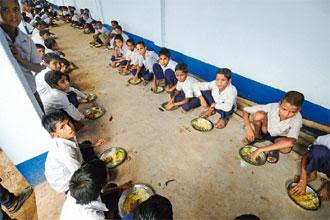
A midday meal at the Bogdhara Sidikiya High Madrasah, Bankura

As classes break noisily for the midday meal, the headmaster talks of how the madrasa does not discriminate, the availability of Hindu texts like the Bhagavad Gita and Mahabharat in the school library, and the original tenet and definition of madrasas as centres of learning that welcomed all.

In her book, Reading With Allah: Madrasas In West Bengal (Routledge, 2010), Nilanjana Gupta, author and professor of English at Jadavpur University, dwells on the evolution of the madrasa in India. Beginning from the pre-modern and early modern periods, madrasas, like Hindu pathshalas, imparted education to suit religious structures or feed administrative and judicial systems in traditional Indian society. “However, these religious boundaries were not rigid. Hindu students would also join the madrasas, especially if they were keen on becoming administrators or judicial officers. The notion of madrasas as centres of religion-centred education had not yet evolved,” she writes.

 
After the British introduced the Western form of education that supported the then upcoming administrative structures of the expanding regime, the madrasas began to be sidelined. While Hindus took to Western-style schools, for “political and religious reasons”, most Muslims stayed away, leading to their marginalization from government jobs. In 1886-87, Muslims in Bengal held only 8.5% of the executive and judicial positions though they formed 31.2% of the population, Gupta’s book says.

However, the British did leave a legacy behind in Bengal’s madrasa system. When the first British governor general,Warren Hastings, established the Madrasah-i-Aliah or Calcutta Madrasah in 1780, it was the first such formal educational institution in South Asia, predating the Calcutta, Bombay and Madras Universities by 77 years. It was the first time, in fact, that general subjects were being taught at a madrasa. “The madrasa board and secular education in India came together. Even back then, the Calcutta Madrasah had a course in medicine,” says Salam.

The central Kolkata area of Rafi Ahmed Kidwai Road and Haji Mohd Mohsin Square, where the WBBME has its office, is home to the city’s Muslim intellectual past and present. It has the West Bengal Urdu Academy, Maulana Azad College and Muslim Institute situated in close proximity to the 234-year-old, Doric- and Ionic-columned magnificent heritage structure of the Hastings-founded Calcutta Madrasah. The Madrasah would go on to become the Calcutta Madrasah College and in 2007, by an Act passed in the West Bengal legislative assembly, Aliah University.

The shift to modern university education wasn’t without controversy. “Some saw the move as an attack on specifically Muslim culture, though the authorities insist it is an attempt to build upon Islamic traditions of scholarship in preparing young Muslim men and women to cope with the evolution of technology and knowledge-systems,” noted authors Jeremy Seabrook and Imran Ahmed Siddiqui in People Without History: India’s Muslim Ghettos (Navayana, 2011).

Today, Aliah University, with colleges spread across the city, is a much sought after academic destination for madrasa students, offering utilitarian master’s degree courses in mathematics and computing, physics, chemistry, English, computer science, journalism and mass communication, and business administration, other than Arabic and Islamic theology.

Yet, as a measure of the many contradictions facing Muslim society in West Bengal, Muslim squatter families line the boundary railings of the university’s head office at Haji Mohd Mohsin Square.
A cross-stitch of cultures

Back at the Bogdahara Sidikiya High Madrasah, we discuss the Bengali syllabus with the subject’s teacher and assistant headmaster, Jinnat Ali Khan. Earlier, at the teachers’ room fragrant with the light waft of attar, history teacher Asaf Ali Mallick had suggested the syllabus be tweaked to include the Maurya and Gupta periods.

Littérateurs have no caste or religion, says Khan during our discussion. The works of Bengali writers like Mahasweta Devi, Manik Bandopadhyay or the Bangladeshi author Abul Fazal have been chosen as texts to advocate secular values and counter dogma. While talking about Fazal’s essay, Manabtantra, and the symbolism of the tulsi (holy basil) plant left behind by a Hindu family fleeing from East Bengal following Partition, Khan brings up a personal anecdote.

photoA class in progress


At his maternal home near Bogdahara in Birbhum, a carved Hindu idol was discovered while a pond was being dug. “We were Hindus forced to convert to Islam for a variety of reasons, especially the discrimination faced from upper-caste Hindus. My interpretation of the Bengali syllabus would be as a cross-stitch of cultures and interlinked faith.”

Having returned from the madrasa, Haldar offers prayers in front of an image of Thakur Anukulchandra, the late 19th century Hindu guru. The Kars are disciples. They are strict vegetarians; Haldar renounces the occasional egg offered as part of the madrasa’s midday meal.

She then leaves for mathematics tuition. Sudarshan will ferry her on his bike across the elephant-visiting forest tracts to the tuition centre and wait till the class ends.

Outside the Kar home, Haldar’s Hindu classmate at the madrasa, Piu Rani Saha, is waiting to guide us to her grandfather, Aditya Saha. His was the only Hindu name I noticed earlier on the Bogdahara Madrasah’s roster of high officials—he has been both secretary and president.

Now the 76-year-old runs a rice mill. Saha, who was a Communist Party of India—Marxist, or CPM, worker, arranged for the land and looked after the logistics when the madrasa came up in the Muslim-majority village of Bogdahara in 1978.

Two years back, Saha was instrumental in establishing a junior high school in his Jiabandi village. The school accepts general students till class VIII; the madrasa has lost some students to it. “I have managed to get teachers from Kolkata for the new school,” says the septuagenarian, his voice frail but firm in tone. “It’s about the education of children.”

First Published: Sat, Jun 14 2014. 01 01 AM IST

Madrasa West Bengal Education Schools Minority education


Thursday, June 12, 2014

ALL INDIA MUSLIM ELECTION COUNCIL

 Posting on NRINDIAN GOOGLE GROUP FORUM:
ALL INDIA MUSLIM ELECTION COUNCIL


This is in response to Mr. Mohammed Adeeb's message posted by Mr. Pasha Patel on NRIndian google group.

Wednesday, May 28, 2014

Friends, ASAK

Mr. Muhammad Adeeb's very timely and emotional account of despair should come out with some positive steps if we focus on unity and a non-self-appointed leadership.
I propose a democratic organizing of the 25 crore Indian Muslims, or at least the registered Muslim voters, as per records with the Election Commission.
An 'ALL-INDIA MUSLIM ELECTION COUNCIL’ be formed, preferably by  young Muslim IT professionals, granting all Muslims an open membership of the Council --- on one person one vote basis.
Let all Muslim registered voters be listed on an open publicly available data-bank.
The choice of  IT based organisation is to save cost, opt for transparency and usher in young blood into the mainstream of political mobilization.
The Council shall have conveners at all block level constituencies, who will first monitor the membership registration drive. A FREE membership, like AAP membership, is promoted, though by definition all Indian Muslims will be considered general members of the Council.
With the help of our internet resources, we can have nationwide referendum, to elect National Executive members. That exercise should cut across all existing leadership conglomerates and open a real democratic opening to a new leadership based on local grass-root mobilization.
All convening team members of the Council, would pledge to be neutral and not be partial to any stakeholders for leadership team.
Widest numbers of National Executive membership aspirants would be encouraged to place their names for being voted by the membership.
That National Executive elections are not held till at least a sizable percentage of members is registered on the Council Website and are fully identifiable and verifiable.
The IT team should be highly motivated and committed to the idea of forming a democratic leadership of 25 Crore Indian Muslims that may eventually take up the mobilization of a political cadre as well as aspirants of elected posts.
Those who are interested, my as a start contact me at the following address and contact numbers with preferably their contact details.
It may be clear from the outset, that we will not form a Muslim Political Party. Instead we will encourage forming a Muslim led secular party that will be most inclusive.
Sincerely,

Ghulam Muhammed Siddiqui

IDRAAK / MASHWARA

Temporary internet contact: <ghulammuhammed3@gmail.com>

601, Seacroft, Shirly Rajan Road,

Bandra West

Mumbai - 400050 . INDIA

Phone: 918286930388