Sunday, June 5, 2016

mid-day special: Former terror accused reveal unforgiving life post acquittal - Mid-day

http://www.mid-day.com/articles/mid-day-special-former-terror-accused-reveal-unforgiving-life-post-acquittal/17304193

Inline image 1

mid-day special: Former terror accused reveal unforgiving life post acquittal


By Sailee Dhayalkar, Amit Kumar and Chaitraly Deshmukh |Posted 05-Jun-2016


 8 5 2 1 0
Last month, eight men acquitted in the 2006 Malegaon blasts case put a price on their misery: R1 crore each as compensation for being falsely implicated by the Anti-Terrorism Squad. It's a fitting sum, say most former terror accused, for a life to be spent among unforgiving would-be employers, brides and landlords
When 37-year-old Abdul Wahid Din Mohammed Shaikh resumed work at Grant Road's Jan Mohammed Kasam High School last year, it was the candid questions of the class 7 and 8 students that caught him off guard.
Abdul Wahid Din Mohammed Shaikh, 37, was accused of harbouring Pakistanis (who along with 13 Indian conspirators allegedly assembled bombs that went off in the 7/11 blasts) at his Mumbra home. He was acquitted in 2015 after 9 years. Although he works at a Grant Road school, the government refuses to release his salary. "It does not believe in my acquittal," he says. Pic/Rana Chakraborty
"I was resuming work after nine years and none of the kids had seen me around," says Wahid, who on September 29, 2006, was arrested for alleged involvement in the July 11, 2006, Mumbai train blasts that left 188 commuters dead. "One day, a student asked if I was new to the profession. Before I could respond, another whispered to him, 'Don't you know? Sir has come from jail.' I was taken aback." Wahid, who was released from Arthur Road Jail (where he was lodged for nine years), after being acquitted in the case by a Sessions Court in September 2015, surmises that the students must have heard of his case on television or read of it in the papers.
He says that when they realised that he was comfortable answering questions pertaining to his time in prison, they let their curiosity unfold. Questions ranged from if he had to stand in queue for food to if he was roughed up. Facing a class of 12- and 13-year-olds could never be easy. Much less so, if there's a curiosity about your past. And, Wahid knows that although he has been rid of the terror tag, he will always be a 'former terror accused'.
Every one who has been to prison on a terror charge will speak of post traumatic stress disorder (PTSD). Mohammed Amir Khan, who was in 2012 acquitted on charges of masterminding a series of 17 low-intensity blasts in the Capital between 1996 and 1997, speaks of how the 14 years he spent behind bars left him with a chronic fear of the khaki.
"I still have nightmares of police vans chasing me," says the 36-year-old, who lives in the Sadar Bazaar area of Old Delhi. But, the demons that haunt you once you are pronounced not guilty, are not just personal. Whether while looking for livelihood, a home to rent or creating new social bonds, mention of such a case — even if the court has ruled that you were falsely implicated — proves an obstacle. Which is probably why last month, eight men who had been acquitted in the 2006 Malegaon blasts demanded a compensation of R1 crore each from the Maharashtra government in lieu of being falsely implicated in the case by the then Anti-Terrorism Squad (ATS), also demanding prosecution of the then ATS chief, KP Raghuwanshi and his team.
Compensation to those arrested on terror charges, and later acquitted, does have precedence. In 2010, India-born Dr Mohamed Haneef, detained in Australia on terror-related charges in 2007, reportedly received a compensation of $1 million, in addition to a formal apology from the government. In India, the Andhra Pradesh government in a 'confidence building measure', ordered a compensation of R3 lakh each to 16 Muslim youth arrested, and later acquitted, in connection with the 2007 Mecca Masjid blasts in Hyderabad.

Abdul Wahid Din Mohammed Shaikh, accused of harbouring Pakistani nationals (who along with 13 Indian conspirators allegedly assembled the bombs that went off in the 7/11 blasts) at his Mumbra home, says the time spent in prison kept him away from his children — son Umar (then 1.5 years) and daughter Umrah (in pic, then six months). "I missed out on taking them out on vacations, picking them up from school. I have lost the most precious days of my life," he says. Pic/Rana Chakraborty
Not suitable enough

Wahid grew up in Vikhroli and attended a local municipal school. After clearing the HSC exam, he acquired a Diploma in Education and started teaching math, Hindi and English at the Anjuman-e-Islam-run school. He says though acquitted by one court, the police are still persecuting him and restricting his income.
"I have been working since eight months but the government has not released my salary. It does not believe in my acquittal. It says it will appeal in the High Court." In the meanwhile, Wahid has taken a monthly loan of R15,000 from the school. The money will be deducted from his salary, once it is released.
It's not just the salaried, but also those with their own businesses and clinics who find it difficult to re-establish themselves. Dr Fargoh Makhdoomi from Malegaon is a 43-year-old with a Bachelors degree in Unani Medicine and Surgery, a qualified dentist from the Government Dental College, with a diploma in optometry.
K P Raghuwanshi
K P Raghuwanshi

He also has a law degree. Makhdoomi, who was arrested in the Malegaon blasts case, completed a bachelors and later, a masters degree in art while in prison between 2006 and 2011. At the time of arrest, he was a practising doctor. Even wafter being released on bail, the practice suffered.
"Initially, I did not know what to do. I approached friends and others for work at their clinics, but no one trusted me. Even if they felt that I was innocent, they feared that my being attached to their clinic, would make them a target of the police. For three months, I sat at home and lost confidence in my ability to work. It was with my wife and parents' help that I could start my own clinic which is now running well."
Factoring in trust

Thise acquitted of terror charges often find it challenging to rebuild social trust, as Raees Ahmed (45), accused of planting the 2006 Malegaon bombs, has learnt. A tailor, Raees started a battery business after moving to Malegaon in 1990. The family had to sell off the business and the shop after his arrest. When he was released on bail in 2011, he tried looking for a job as a daily wage labourer but realised the no one wanted to employ him. His current business involves selling artificial jewellery, cosmetics and cutlery at a shop in Anjum Chowk, Malegaon.
"This was my wife's idea. When she visited me at the Special MCOCA court and Arthur Road Jail between 2007 and 2010, she'd pick up artificial jewellery sets from around and sell them back home," says Raees, who also recalls how tough it was to find matrimonial matches for his two daughters. Life now, he says, is only a shade better. "The owner of my store keeps harassing me as if the cops will arrest me again."
Need for rehab

Arrested at the age of 18, Aamir, who once dreamt of being a pilot, says all he wants now is a 'dignified job'. Acquitted in 2012, the 14 years in jail robbed him of more than just time. "In 1998, things were very different. When I was released, technology had progressed by leaps and bounds. People were using advanced phones, social media, ATMs and the metro."
He was stuck in 1998, older, without a degree — "I tried to continue my study through the Indira Gandhi National Open University (IGNOU) in jail, but the authorities spoiled my attempt midway" — and not qualified for most jobs.
"Several NGOs offered me a chance to be associated with them. I joined ANHAD, a Delhi-based outfit run by activist Shabnam Hashmi, and worked there for four years. Now, I am working as a researcher with Aman Biradri with activists like Harsh Mander. I am part of a National Human Rights Commission project on jail reforms," he says. What he wants — more than monetary compensation — is rehabilitation. "The state has a policy for rehabilitating surrendered terrorists. Why don't they have a similar policy for those wrongly sent to jail?" he wonders.
Gulzar Azmi
Gulzar Azmi
Gulzar Azmi, secretary of the legal cell of Jamiat Ulema, an Islamic organisation, says that despite acquittals in terror cases, rehabilitation of victims remains a challenge. "They do not get jobs. Even if they get private jobs, they are never offered handsome salaries. They find it hard to get married." He says about 200 people have been acquitted in different terror related cases since 2006, and about 700 are in different jails in India in terror-related cases.
Undoing the damage
Those acquitted in the Malegaon blasts case have also demanded a character certificate from the government. While there is no precedence for this, Malegaon-based advocate Irfana Hamdani, says, "Their names are listed in various immigration centres in India. If they plan to go abroad, their passports are blocked, which is why a character certificate is important. Even if they are no longer considered terrorists by law, public memory associates them with the attacks."
From doc to shepherd
Dr Salman Farsi (44), a medical emergency practitioner, who was recently acquitted in the 2006 Malegaon blasts, believes it is impossible to 'repay' for the five years spent in jail, or remove the stigma.
 Dr Salman Farsi now works with a government ambulance service in a village on the outskirts of Malegaon. Pic/Mubasshir Mushtaq
 Dr Salman Farsi now works with a government ambulance service in a village on the outskirts of Malegaon. Pic/Mubasshir Mushtaq
In the five years since his release on bail in November 2011, Farsi — arrested for having participated in the conspiracy and orchestrating the blasts — has struggled to feed his family. From unsuccessfully reopening a clinic in a Malegaon slum to taking a clerical job with the Welfare Party of India (WPI) in New Delhi to being a cattle herder in Yeola town in Nashik district, Farsi has been doing odd jobs to make ends meet.
When demanding compensation, he thinks R1 crore isn't enough. Quoting the case of Dr Haneef, who was paid $1 million, he asks, "Why can't the Indian government compensate us similarly?" "In 2016, our compensation comes to Rs 1.5 crore per day."
Farsi's medical practice along with his wife's — also a Unani doctor — came to a standstill following his arrest. He believes the government should give his family a "world tour visa" and bear all the expenses to compensate for the "mental agony" of the false terror case.
Moreover, he wants that the government conduct a narco analysis test on the ATS officers who "deliberately framed" him. "The narco tests would expose the actual relationship of ATS officers with the real terrorists," he adds.
I have seen how their families suffered — wives left to cope and fend for themselves, stunned and bewildered parents pleading their sons' innocence and all those interrupted childhoods, 'fatherless' kids unable to make sense, seeing their Abbu behind bars, meeting him once every year or two in jail.
Rakesh Sharma, Goa-based documentary filmmaker, currently making a film on Malegaon
Not only must these men be compensated, but the guilty police officers must be awarded exemplary punishment by the courts to send a stern message to their counterparts in other states. The sheer number of such cases resulting in acquittals after years of incarceration (especially from Gujarat, Maharashtra, Karnataka and Delhi) suggests that the communalisation of police forces and partisan investigations are a deep-rooted and widespread malaise.
The various attacks

1997:
 Between 1996 and 1997, 17 low-intensity bomb blasts occurred in Delhi and neighbour-ing states, killing 5 people
After his acquittal in the 1996-97 Delhi blasts case, Mohammad Aamir Khan (accused of masterminding the attacks) married Alia Khan, a teacher at a private school. A delegation of well-wishers, including lawyers and activists, had to convince Alia’s father of his character and accept the proposal. The couple has chosen a non-Islamic name for their two-year-old daughter. Pic/Ajay Gautam
2006: On July 11, a series of seven blasts on the Mumbai local trains, killed 209 people and left over 700 injured. On September 8, a series of blasts took place in Malegaon, in which 37 people died and 125 were injured
Raees Ahmed (45), who had been accused of planting the Malegaon bombs, says his wife had to sell their shop at a nominal amount to raise money. His children’s education suffered. Today, he runs an artificial jewellery store in Malegoan. PIC/ Mubasshir Mushtaq
2007: On May 18, blasts took place inside the Mecca Masjid located in the old city area of Hyderabad. 16 people were killed (of which five were killed in a police firing to quell the mob), while over 50 were injured
Fargoh Makhdoomi (43), acquitted this April in the Malegaon blasts case, now runs the Makhdoomi Polyclinic on Kusumba Road in Malegaon. Arrested for being a conspirator in the blasts, he says his family also became a target of the police, with cops barging in often without intimation. Pic/Mubasshir Mushtaq
'Will have to check'
Ram Shinde

Prof Ram Shinde, minister of state for home, said he has not come across any such letter (demanding compensation for Malegaon blasts acquitted). But he said that whenever the application is brought to his notice, the government will check for legal provisions that allow appropriate measures to be taken in this regard.
The various attacks
Senior Advocate Dr Yug Mohit Chaudhry breaks it down
> The court awards compensation in writ jurisdiction when it holds the government vicariously liable for the tortuous action of its employees (police officers in this case).
Dr Yug Mohit Chaudhry
> In the Malegaon 2006 case, according to what I have read in newspapers, the State is filing an appeal against the discharge order of the trial court. In case the State files this appeal, the appeal will have to be decided upon first. The compensation can be claimed only in case of false implication and not merely acquittal.
> In the Malegaon case, the final investigating agency (National Investigation Agency) has said that the earlier investigating officer, ACP Kisan Shengal, fabricated evidence and statements, to the extent of even planting RDX on innocent persons. Had this not been detected, they would have got the death penalty. Fabrication of evidence happens all too often, but the police officers never get caught. This time, they have been caught doing it and must be punished. It is absolutely crucial that the state not only compensates these innocent victims of police corruption but also prosecutes the concerned police officer to deter others from doing it again.
> The government will have to prosecute the officers and if turns a blind eye to what has happened, then a private complaint can be filed. But, before the case can even begin, the government will have to agree to grant a sanction for a private prosecution. If the government does not prosecute itself, it is not likely to grant sanction for a private prosecution because it wants to protect the police officers. The complainant must put pressure on the government to prosecute the guilty officers. The accused may be acquitted but the stigma remains, which very difficult to overcome.

Muslim women smash false propaganda against Muslim Personal Law - By Abdul Bari Masood - MuslimMirror.Com

http://muslimmirror.com/eng/muslim-women-smash-false-propaganda-against-muslim-personal-law-say-so-called-liberal-groups-used-as-tool-by-anti-islamic-forces/


MuslimMirror


Muslim women smash false propaganda against Muslim Personal Law


June 4, 2016 in Home Slider, Indian Muslim, Issues, Women | 4 Comments
9
Muslim women smash false propaganda against Muslim Personal Law; say so-called liberal groups used as tool by anti-Islamic forces.
6954412
Abdul Bari Masoud
New Delhi:  Strongly condemning the false propaganda and tirade   against Islamic law unleashed by some letter-head organizations and women andolans with a section of media, highly-qualified Muslim women today announced that they will not accept any change in the Muslim Personal Law and alleged the “so called” Muslims liberal groups and andolans are being used as tools by anti Muslim Personal Law forces in the country.
Muslim personal board woman members said they vehemently opposed any amendment in the Sharia Law arguing that it guaranteed them equal rights and protect their dignity and self respect. They asked the media and so-called sympathizers of womenfolk that why Muslims are only targeted and blamed for the poor status of Women in India. Dowry death, child marriages, female foeticide and crimes against women are rampant in India Society.
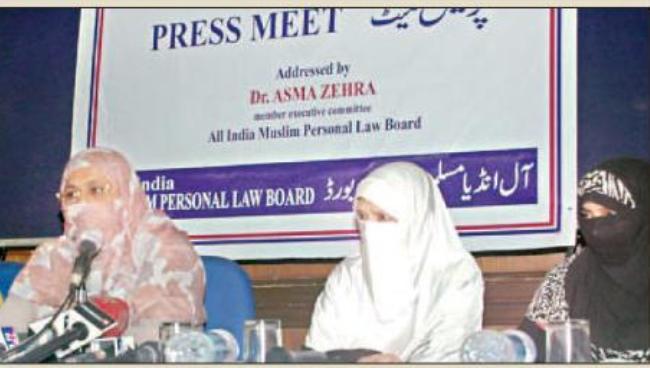
In the wake of continued attack on Sharia law,   woman executive committee members of All India Muslim Personal Law Board addressed media persons at the Press Club of India here to smash the web of falsehoods created by some dubious character ‘Muslim women with the help of a ‘biased’ media.
Dr. Asma Zehra (Executive Member AIMPLB) asserted that divorce rate is least in the Muslim Community. Quoting an article published in the Hindustan Times to support her point, Dr Asma stated that in India the Divorce rate in metro cities of Mumbai, Kolkata, Delhi, Chennai and Bangalore has increased to 350% in last 5 years. Bangalore had 3 family courts which were increased to six last year. Majority of couples seeking Divorce belong to IT sector and there are many cases seeking Divorce within months of Marriage.
“Then why are Muslims targeted for Divorce, and why is Muslim Personal Law being attacked that it is prone to misuse”, she asked.
Woman members said the so-called and self-styled organizations    have presented a false concocted data in their survey report, in which it was shown that 92% of Muslim women were in favour of Ban on Triple Talaq & amendments in the Muslim Personal Law. It was also presented that 50 thousand men & women have signed a petition to the NCW (National commission for Women) to abolish the Muslim code for divorce.
They said they strongly denounced such survey & self made petitions saying a section of Media is only highlighting the issue of Triple Talaq to show that huge numbers of Muslims Women are suffering because of this provision. However, it never pays any attention to towards pathetic condition of Muslim women.
In Islam Talaq “Divorce” is an unpleasant discouraged act. If both the partners fail to reconcile, then divorce is a Safe – exit for unsuccessful marriages.
The methodology & procedure of Divorce is clearly explained in Qur’an & Hadith. Triple Talaq or Divorce in one sitting is a Bidath (Discouraged) form of Divorce. The Media is portraying this matter with hype & out of proportion.
They said that such fringe groups & andolans have no credibility amongst Muslim masses and they have no right to advocate for any changes, amendments in Muslim Personal Law on behalf the Muslim community.
They said that Muslim women of this country have full faith with Muslim Personal Law and all those persons who want change and unprincipled life style are free to follow the civil code of the country. They can get married under the Special Marriages Act.
Secondly the allegation of Gender bias is repeatedly raised to attack Islam & Muslims. It is portrayed that Islamic Law is “Anti women” & “Cruel”
Islam guarantees equal rights to both Men & Women. Men are given the role of care taker of family and ordered to treat women kindly. India ranks 136 in gender equality. Some corners are raising demands for divorce through courts. The present Lower & High Courts are already burdened with large number of cases. Average time for disposal is 4 to 8 years. If any party files for higher court then the disposal time period will be more that 8 to 12 yrs.
In contrast Muslim personal Law has simple easier more successful way of solving family disputes though Darul Qaza or Shariah courts. Shariah courts support & lesson the burden of Judiciary.
Saira Banu and Afreen have filed a petition the Supreme Court. These cases may take years. No court in the world can ban Divorce & force any person to continue married life.
“We will not tolerate any interference in the Muslim Personal Law. All the Muslims Group, organizations, Jamaats, Masalak, unintedly oppose any effort to make amendments in “Divorce” Laws. We shall try to protect our basic constitutional right by peaceful democratic way”.
Besides Dr. Asma Zehra, the press conference was also addressed by Mrs. Mamduha Majid, Member AIMPLB, and Mrs. Zinat Mehtab Convener Islah-e-Moashra for Delhi Women, Prof. Samina Tabish Joint Convener Islah-e-Moashra for Delhi Women and Mrs. Umme Aimen Member Islah-e-Moashra for Delhi Women. They were flanked by AIMPLB executive member Kamal Farooqui who also spoke on the occasion.
---

Thursday, June 2, 2016

24 Convicted in Massacre of Muslims During Gujarat Riots in India By ELLEN BARRY- The New York Times

http://www.nytimes.com/2016/06/03/world/asia/gujarat-riots-massacre-india-verdict.html?emc=edit_tnt_20160602&nlid=28904237&tntemail0=y&_r=0

The New York Times

24 Convicted in Massacre of Muslims During Gujarat Riots in India


By ELLEN BARRYJUNE 2, 2016


Vehicles on fire in Ahmedabad, India, on Feb. 28, 2002, the day 69 Muslims, mostly women and children, died in a compound set ablaze by thousands of Hindu men armed with stones, iron rods and bombs.CreditManish Swarup/Associated Press

NEW DELHI — Twenty-four people were found guilty on Thursday of massacring Muslims during the 2002 religious riots that tore through Gujarat, a state then led by Narendra Modi, who is now India’s prime minister.
A judge in Ahmedabad, Gujarat’s largest city, acquitted 36 people for lack of evidence, including a police inspector and a midranking official in the Bharatiya Janata Party, led by Mr. Modi.
The verdict, the latest in more than a dozen prosecutions arising from the riots, did not implicate officials who were working under Mr. Modi’s authority at the time, or indeed any prominent leaders. But it was a reminder of a bloody episode that the prime minister has taken great pains to put behind him. On trips abroad, including one to the United States next week, Mr. Modi will probably face more questions about communal violence and the far-right agenda advanced by some in his party.
Two more cases stemming from the Gujarat riots, in which about 1,000 people were killed over the course of two months, are still pending. One of those cases, brought by the widow of Ehsan Jafri, a former member of Parliament killed in the attacks, seeks to establish that the riots were the result of a high-level conspiracy involving Mr. Modi.
The case Thursday involved the attack in which Mr. Jafri was killed, on Feb. 28, 2002, one of the worst episodes of the Gujarat riots. A crowd of Muslims, mostly women and children, had taken shelter in a compound in Ahmedabad from a mob of thousands of Hindu men armed with stones, iron rods and bombs.
Witnesses said that for hours, Mr. Jafri, who lived in the compound, made frantic calls to city officials asking for police protection. But the compound was already on fire when the police arrived in force, and the people inside died of burns and smoke inhalation. Sixty-nine people died.

KEY FACTS

  • 24 people were found guilty of massacring Muslims ​in one of the worst episodes of the riots in Gujarat in 2002. 36 people were acquitted for lack of evidence.
  • 69 people died in the episode. About 1,000 people were killed overall in the riots.
  • Gujarat’s chief minister at the time was Narendra Modi, India’s current prime minister.
  • Teesta Setalvad, an activist who has spearheaded a campaign to prosecute Gujarat officials, called the verdict “hugely disappointing.”
  • Sentences will be announced on Monday.
  • Two more cases stemming from the riots are still pending.
Of the 24 people convicted Thursday, 11 were found guilty of murder, which brings a minimum punishment of life in prison and a possible death sentence, according to lawyers who emerged from the courthouse on Thursday. Others were convicted of lesser charges, including arson and looting. Sentences will be announced on Monday.
A spokesman for Mr. Modi’s party expressed satisfaction with the verdict because it did not point to official involvement.
“There was so much of a witch hunt against the current prime minister, and in that sense I am happy,” said the spokeswoman, Shaina Nana Chudasama. “If we move on as a society united, rather than distinguishing who is from B.J.P. or another party, we would be doing ourselves and the victims a great service.”
Teesta Setalvad, an activist who has spearheaded a campaign to prosecute Gujarat officials, called Thursday’s verdict “hugely disappointing” because the judge did not cast the riot as a conspiracy.
“When you have a mob of 66 accused, then common intent is already established,” she said. “That means at a local level, there was a conspiracy.” Several of the original defendants in the case have died since the proceedings began.
The Gujarat riots began on a February morning, when a train carrying Hindu pilgrims was surrounded by a crowd and caught fire at a train platform in Godhra, which has a large Muslim population. The remains of 59 people burned to death on the train were displayed in Ahmedabad, stoking anti-Muslim fury.

Today’s Headlines: Asia Edition

Get news and analysis from Asia and around the world delivered to your inbox every day in the Asian morning.
Riots occurred sporadically for two months after that, with little interference from the state police.
At the time, Mr. Modi was accused by some of failing to deploy security forces to stop the killing. In 2005, the United States took the unusual step of imposing a visa ban on him for his role in the riots, and high-ranking officials from the United States and some European countries would not meet with him for almost a decade.
Since then, though, the memory of those events has receded. In 2013, an Indian court rejected a petition to prosecute Mr. Modi over the riots, on the grounds that there was not sufficient evidence to proceed. Mr. Modi’s party swept into power nationally after a campaign that focused heavily on economic development, and he has styled himself as a progressive, internationalist leader.
That effort may be damaged by Thursday’s verdict. “It suddenly brings back Mr. Modi of 2002, the person with dirty hands,” said Nilanjan Mukhopadhyay, the author of a biography of the leader. “It weakens Mr. Modi’s claim to be the leader of a pluralistic India.”
Rupa Mody, a survivor of the episode, said she had hoped for more convictions. In a telephone interview, she described holding hands with her daughter and 13-year-old son, huddled together inside the compound, while people in the crowd outside threw gasoline in.
“Lots of people were fainting,” she said. “I also fell. Then somebody egged me on to get up and run.”
While running, she said, “I fell, and my daughter stooped to help, and in the process, she lost hold of my son’s hand. In the chaos that ensued, I lost him.” Though the police later displayed a number of children’s bodies, she said, they were so badly burned that she could not recognize him.
Follow Ellen Barry on Twitter @EllenBarryNYT.
Suhasini Raj contributed reporting.

Wednesday, June 1, 2016

Islamic banking to make India debut in PM Modi’s home state Gujarat - By Zia Haq, Hindustan Times

http://www.hindustantimes.com/india/islamic-banking-to-make-india-debut-in-modi-s-home-state-gujarat/story-qp9TjJ5v9Hwmp3WM3iSPKI.html

Islamic banking to make India debut in PM Modi’s home state Gujarat

  • Zia Haq, New Delhi
  •  |  
  • Updated: Jun 01, 2016 07:43 IST
Islamic banking is a finance system based on the principle of not charging interest, prohibited under Islam. Instead of charging interest, the lender shares a part of the profit – or loss – with the borrower. (Representative image)

The Jeddah-based Islamic Development Bank (IDB) is in the final stages of setting up shop in Prime Minister Narendra Modi’s home state, a move that will usher Islamic finance for homegrown startups and fund Indian exports to many African and central Asian Muslim nations.
The developments follow an agreement between India’s state-owned Exim Bank and the Islamic Corporation for the Development of the Private Sector (ICD), a private-sector arm of the IDB group, as part of deals signed during Modi’s trip to Saudi Arabia in April.
The IDB, a multilateral lender with an authorised capital of $100 billion, counts 56 Muslim nations as its members. Most of these countries belong to the Organisation of Islamic Cooperation.

WHAT IS ISLAMIC BANKING

  • It is a finance system based on the principle of not charging interest, prohibited under Islam. Now, it goes by a more formal moniker – participatory banking.
  • Instead of charging interest, the lender shares a part of the profit – or loss – with the borrower
  • It is open to non-Muslims as well
  • By 2020, the global Islamic banking industry profit pool is expected to reach $30.3 billion.
  • Its India operations will be led by Zafar Sareshwala, a prominent Muslim businessman from Gujarat whom the Modi government appointed chancellor of the Maulana Azad National Urdu University soon after assuming office.
    Asked if the launch had Modi’s blessings, given the opposition from a section of the ruling BJP, Sareshwala told HT: “Modi is a very pragmatic man. He is keen on investment, infrastructure, trade and economic growth.”
    The agreement in Jeddah was signed by Exim Bank regional head Tarun Sharma and ICD CEO Khaled Al Aboodi in the presence of Ahmad Javed, India’s ambassador to Saudi Arabia.
    To be based in Ahmedabad, the bank will offer interest-free capital to business startups, including small and medium enterprises within India, marking the entry of the so-called Islamic banking – also known as participatory banking – into the country.
    According to an Exim Bank statement, the IDB’s bigger role will be in the $100 million (about Rs 670 crore) credit line it has pledged “with the aim of facilitating the export of goods and services from India to ICD’s member countries”.
    “The ICD will be open for business to all Indians, regardless of religious background. In Malaysia, the KFC chain runs on ICD finance although it is owned by a Chinese firm. Some people have this unnecessary issue with Islamic banking, which is actually known as participatory banking across the globe now,” said Sareshwala, who has been named as a director for the bank’s India operations.
    The IDB has also promised $55m (about Rs 380 crore) for a state-of-the-art rural mobile medical network – the first leg of which will be launched in Gujarat.
    The IDB, which complies with global Islamic finance norms, does not charge interest on loans because the religion prohibits it. Instead, it charges a part of the profit and also shares any losses with the borrower.
    According to the EY’s World Islamic Banking Competitiveness Report 2016, Global Islamic banking assets would have reached US$1 trillion by 2015-end.

    Monday, May 30, 2016

    Mamluks and maliks : Why Arab monarchies have survived uprisings better than republics --- The Economist --- May 14th 2016 | From the print edition

    http://www.economist.com/news/special-report/21698437-why-arab-monarchies-have-survived-uprisings-better-republics-mamluks-and-maliks

    Inline image 1

    The nature of the state

    Mamluks and maliks

    Why Arab monarchies have survived uprisings better than republics

    May 14th 2016 | From the print edition


    Inline image 2

    Best of friends


    IN HIS CAIRO office overlooking the Nile, a businessman keeps his mobile phone in a glass jar on his desk. Elsewhere in the city a writer keeps hers in the fridge. If smartphones were once the tools of young revolutionaries across the Arab world, the fear is that they have become the means for the mukhabarat, the secret police, to eavesdrop on dissenters by hacking into their telephones and turning them into bugging devices. These days a journalist working across the Arab world needs a phone packed with the latest encrypted communications apps. Egyptians like Signal; Saudis prefer Telegram; the Lebanese are content with the more common WhatsApp.
    The deep state in Egypt was dislocated only slightly by the uprising that swept away Hosni Mubarak in 2011. Now it is back with a vengeance, the army having toppled the elected Islamist president, Muhammad Morsi. Under Abdel-Fattah al-Sisi, the general who claims to be a son of the revolution, Egypt is more repressive than it had been under Mr Mubarak, and the economy is doing considerably worse. Protests are growing, particularly over Mr Sisi’s deal with King Salman of Saudi Arabia (both pictured) to hand over two islands in the Red Sea.
    Special report
    Related topics
    Many draw parallels with the repression during Gamal Abdel Nasser’s military rule, minus his heady rhetoric of Arab nationalism. Nasser, too, tried to crush the Muslim Brotherhood. And as with Nasser, there is a danger that Mr Sisi will turn political Islamists into violent jihadists. Islamic State (IS) has declared the Sinai peninsula, once a winter-holiday playground, one of its “provinces”. In October 2015 it brought down a Russian airliner that had taken off from Sharm-el-Sheikh.
    Strikingly, all the Arab leaders who were overthrown in 2011 were heading republics, not monarchies. Arab presidents, it seems, are hard but brittle. Nasser’s Egypt was typical of what Jean-Pierre Filiu, a former French diplomat, calls the “Mamluk state”, after the self-perpetuating caste of slave-soldiers who ruled Egypt from the 13th to the 16th century. Mr Filiu applies the label to several other republics—among them Algeria, Syria and Yemen—with a long and mournful history of military domination of the state.
    These “Mamluk” republics, mostly socialist-leaning with a penchant for central control of the economy, at first modelled themselves on the authoritarian nationalism of Turkey under Ataturk, though they did not fully share his militant secularism. Their internal-security systems, though, were more akin to those of the Soviet Union, with which they often aligned.
    Radical nationalism also served to hide the sometimes narrow sectarian support base of the regimes: the minority Sunnis in Iraq and the Alawites in Syria. It is perhaps no surprise, then, that their regimes were among the most vile. Iraq was called the “Republic of Fear” by a dissident writer, Kanan Makiya; Syria was labelled “The State of Barbarity” by the late Michel Seurat, a French Arabist. Under Saddam Hussein, Iraq gassed the rebellious Kurds at Halabja in 1988; under Hafez al-Assad, Syria flattened the city of Hama in 1982 to crush an uprising by the Muslim Brotherhood. Algeria waged a dirty and bloody war against jihadists that started in 1992 and lasted a decade.
    Fear and loathing
    Under Mr Mubarak, Egypt was ruled with a lighter touch, perhaps because he was keen to maintain the support of his Western allies. Mr Sisi has had fewer scruples about shedding blood. Thousands have been killed in his suppression of the Muslim Brotherhood, and tens of thousands have been jailed.
    According to one conspiracy theory, the Egyptian uprising of 2011 was manipulated throughout by the generals. They used the protesters to get rid of Hosni Mubarak, then the Muslim Brotherhood to sideline liberals, and finally exploited liberal protesters to get rid of the Brothers and introduce direct military rule. In reality their response seems to have been much more improvised, but the theory shows how the deep state is perceived.
    And indeed the repression is both arbitrary and vicious. The courts are a law unto themselves. Mr Sisi’s quest for international respectability has not been helped by the torture and murder in February of an Italian PhD student conducting research on Egyptian trade unions, thought to have been committed by members of the secret police.
    “ I do not think there is a state in Egypt today,” says Yezid Sayigh of the Carnegie Middle East Centre, a think-tank in Beirut. “There is a coalition of interest groups and institutions, each of which is above the state. They are working at cross-purposes and often undermining Sisi.”
    The legitimacy of many republics has rested on two objectives: Arab unity and the liberation of Palestine. Neither has been achieved. And for all their republicanism, their rulers often succumbed to the temptation of establishing their own dynasties. In Syria, Hafez al-Assad was succeeded by his son, Bashar. Egypt’s Hosni Mubarak wanted to install his son, Gamal. In Yemen, Ali Abdullah Saleh was thought to be grooming his son, Ahmad. In Tunisia, the ousted president, Zine el-Abidine Ben Ali, was reckoned to be rooting for his son-in-law, Sakher El Materi.
    Some mock these states as jumlikiyat, an Arabic neologism combining jumhuriyat(republics) and malakiyat (monarchies). “It reached the absurd point that the state became like a car or apartment that they could give to their kids,” says Ghassan Salamé, professor emeritus at Sciences Po, a university in Paris. “This was a big trigger for the uprisings.”
    The genuine Arab dynasties have fared much better, at least so far. In the days of nationalist tumult they seemed an endangered species: five Arab monarchs were toppled, from King Farouk of Egypt in 1952 to King Idris of Libya in 1969, and the rest felt threatened for decades. But now there seems to be something in the nature of Arab monarchy—maliks, emirs and sultans—that is more resilient than presidential autocracy.
    Mr Salamé sees three main sources of legitimacy for Arab rulers: representation (none is freely elected), achievements (most republics have few to boast about) and provenance (currently the best qualification). “I rule you because I created you,” as Mr Salamé puts it. That is certainly true of the Saudi royal family, which, uniquely, has given its name to its country and can trace its rule in the central Nejd region back to the 18th century.
    For the six oil-producing states of the Gulf Co-operation Council (GCC)—Saudi Arabia, Kuwait, Bahrain, Qatar, the United Arab Emirates and Oman—the key to survival has been money. Throughout the turbulence of the Arab spring the monarchies were splurging out, raising salaries and launching new projects to maintain popular support.
    Moreover, all GCC states enjoy unspoken diplomatic and military support from outside as allies of the West (Qatar has a large American air base and Bahrain a naval one). After widespread protests in Bahrain, where a minority Sunni family rules a mostly Shia population, other Gulf states sent forces to the island to help shore up the monarchy.
    Morocco and Jordan do not produce oil, but their kings, Mohammed VI and Abdullah II, derive some authority from religion, pointing to their descent from the Prophet Muhammad. They also claim political legitimacy: Morocco’s former sultan, Mohammed V, was exiled to Madagascar by the French, and the demand for his return became the rallying cry for Moroccan nationalists. The Hashemites, for their part, raised the flag of revolt against Turkish rule (with British help) in 1916.
    Perhaps more important than heritage, though, has been the ability of both monarchies to adapt to changing times. Unlike the ruling families of the Gulf, where royals hold posts throughout the government bureaucracy, those of Morocco and Jordan tend to stand more aloof from day-to-day government. They have also shown a knack for co-opting some critics, or at least maintaining dialogue with them. During the Arab spring both made a show of responding to demands for greater freedom. Both countries introduced limited constitutional reforms and held parliamentary elections. Jordan is more tense. The Muslim Brotherhood boycotted the ballot, and the government is trying to split the movement. In Morocco, the Brotherhood-inspired Justice and Development for the first time won the largest number of votes of any party. Its leader, Abdelilah Benkirane, became prime minister at the head of a four-party coalition.
    Arab history since the emergence of Islam in the 7th century is dominated by three empires: Umayyad, Abbasid and Ottoman. “The idea of dynasties is in the mindset of the people. If you held a referendum in Jordan, a vast majority would vote for the monarchy,” says Oraib Rantawi, director of the Al-Quds Centre for Political Studies, a think-tank in Jordan. Political parties in Jordan and Morocco have mostly agreed to abide by the rules, above all acceptance of the monarchy. Elsewhere, says Mr Rantawi, “bloody regimes create bloody oppositions.”

    ---