Thursday, September 7, 2017

European Court Orders EU Countries to Take Migrants

European Court Orders EU Countries to Take Migrants


European Court Orders EU
Countries to Take Migrants


"Politics has raped
European law and values."

by 


§  The September 6 ruling, which has been hailed as a
victory for European federalism, highlights the degree to which the European
Union has usurped decision-making powers from its 28 member states. The ruling
also showcases how the EU's organs of jurisprudence have become politicized.

§  Many so-called asylum seekers have refused to relocate
to Central and Eastern Europe because the financial benefits there are not as
generous as in France, Germany or Scandinavia.

§  "Let us not forget that those arriving have been
raised in another religion, and represent a radically different culture. Most
of them are not Christians, but Muslims. This is an important question, because
Europe and European identity is rooted in Christianity. Is it not worrying in
itself that European Christianity is now barely able to keep Europe Christian?
If we lose sight of this, the idea of Europe could become a minority interest
in its own continent." — Hungarian Prime Minister Viktor Orbán.


The European Union's highest court has rejected a complaint by
Hungary and Slovakia over the legality of the bloc's mandatory refugee quota
program, which requires EU member states to admit tens of thousands of migrants
from Africa, Asia and the Middle East.
The European Court of Justice (ECJ) ruled that the European Commission, the
powerful executive arm of the European Union, has the legal right to order EU
member states to take in so-called asylum seekers, and, conversely, that EU
member states have no legal right to resist those orders.

The September 6 ruling, which has been hailed as a victory for
European federalism, highlights the degree to which the European Union has
usurped decision-making powers from its 28 member states. The ruling also
showcases how the European Union's organs of jurisprudence have become
politicized.

Opponents of the relocation scheme say that decisions about the
granting of residence permits should be kept at the national level, and that by
unilaterally imposing migrant quotas on EU member states, unelected bureaucrats
in Brussels are seeking to force the democratically elected leaders of Europe
to submit to their diktat.

The dispute dates back to September 2015, when, at the height of
Europe's migration crisis, EU member states narrowly voted to relocate
120,000 "refugees" from Italy and Greece to other parts of the bloc.
This number was in addition to a July 2015 plan to redistribute 40,000
migrants from Italy and Greece.

Of the 160,000 migrants to be "shared," nine countries
in Central and Eastern Europe were ordered to take in around 15,000 migrants.
Although the Czech Republic, Hungary, Romania and Slovakia voted against the
agreement, they were still required to comply.

Since then, several states have refused to accept their assigned
quotas of migrants. Poland, for example, has a quota of 6,182 migrants, not one
of whom has been admitted. The Czech Republic has a quota of 2,691 migrants, of
whom only 12 have been taken. Hungary has a quota of 1,294, none of whom has
been admitted.

In the EU as a whole, so far only around 25,000 migrants have been
relocated (7,873 from Italy and 16,803 from Greece), according to the
EU's latest relocation and resettlement report, published on July 26, 2017. Of
the 28 EU member states, only Latvia and Malta have taken in their full quotas
— a combined total of 469 migrants.

Many so-called asylum seekers have refused to relocate
to Central and Eastern Europe because the financial benefits there are not as
generous as in France, Germany or Scandinavia. Hundreds of migrants who have
been relocated to Estonia, Latvia and Lithuania, which rank among the poorest
countries in the EU, have since fled to Germany and
other wealthier countries in the bloc.

Hungary and Slovakia, backed by Poland, argued that the European
Union broke its own rules and exceeded its powers when it approved the quota
system with a "qualified majority"
— around two thirds of the bloc's members. They also argued that the relocation
scheme is a direct violation of the European Union's Dublin Regulation, a law
that requires people seeking refuge within the EU to do so in the first
European country they reach.

The European Court of Justice ruled that a qualified majority vote
was sufficient because the EU "was not required to act unanimously when it
adopted the contested decision." The ruling, which did not mention the
Dublin Regulation, concluded: "The mechanism actually contributes to
enabling Greece and Italy to deal with the impact of the 2015 migration crisis
and is proportionate."

Hungarian Foreign Minister Peter Szijjarto called the court
ruling "outrageous and irresponsible" and "contrary to the
interests of the European nations, including Hungary." He added: "The
decision puts at risk the security of all of Europe and the future of all of
Europe as well."

Szijjarto vowed that Hungary
would continue to challenge any attempts by the EU resettle migrants in Hungary
without its approval. "The real battle is only just beginning," he
said, adding that the decision was political: "Politics has raped European
law and values."
Slovakian Prime Minister Robert Fico said that while he
"respected" the court's decision, his government's opposition to the
relocation plan "has not changed at all." He added: "We will
continue to work on having solidarity expressed in different ways other than
forcing on us migrants from other countries that do not want to be here
anyway."

Polish Prime Minister Beata Szydło also was defiant: "I was convinced that the court
would make such a decision, but this absolutely does not change the stance of
the Polish government with respect to migration policy."
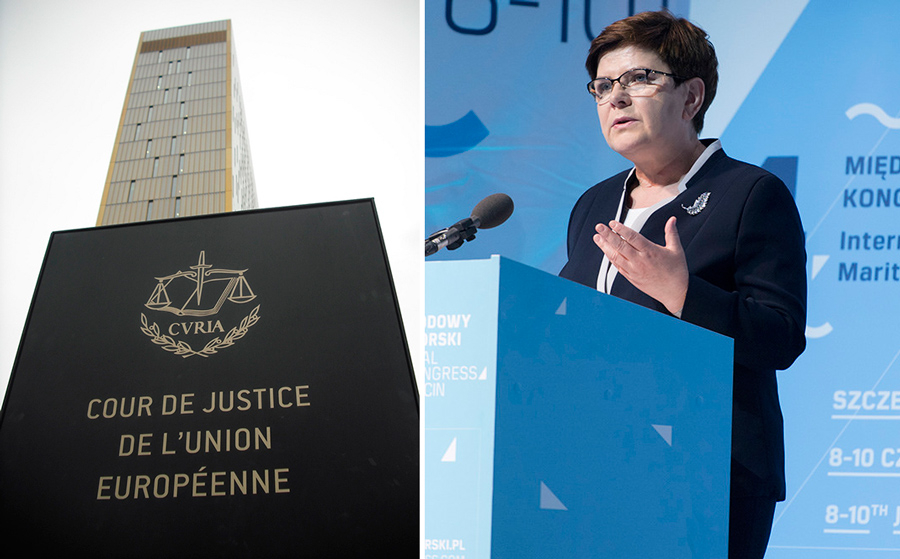


After the ruling of the European Court
of Justice that the EU has the legal right to order member states to take in
so-called asylum seekers, and that member states have no right to resist
those orders, Polish PM Beata Szydło was defiant, saying, "this
absolutely does not change the stance of the Polish government with respect
to migration policy." (ECJ photo by Transparency International/Flickr;
Szydło photo by Polish PM Chancellery)

German Foreign Minister Sigmar Gabriel said that the
ruling means Eastern European member states must abide by the refugee sharing
scheme: "I always said to our Eastern European partners that it is right
to clarify questions legally if there is doubt. But now we can expect all
European partners to stick to the ruling and implement the agreements without
delay."
EU Migration Commissioner Dimitris Avramopoulos welcomed the ECJ
ruling: "ECJ confirms relocation scheme valid. Time to work in unity and
implement solidarity in full." He warned holdouts of legal action if they
do not comply with the refugee obligations "in coming weeks."
The European Commission has already initiated legal
action against the Czech Republic, Hungary and Poland for failing to take in
their quotas of migrants. The so-called infringement procedure,
which authorizes the Commission to sue member states that are considered to be
in breach of their obligations under EU law, could lead to massive financial
penalties.
The ECJ ruling and the continued threats from Brussels are likely
to help Hungarian Prime Minister Victor Orbán in his campaign for re-election
in 2018. In a recent opinion survey, Orbán's Fidesz party polled at 53%,
followed by the nationalist Jobbik party, at 21%. He has said that his
campaign platform would focus on boosting the economy, improving security and
preserving national identity.
Orbán, who has emerged as the standard-bearer of European
opposition to German Chancellor Angela Merkel's "open-door" migration
policy, has repeatedly warned that Muslim
migrants are threatening Europe's Christian identity:
"Let us not forget that those arriving have been raised in
another religion, and represent a radically different culture. Most of them are
not Christians, but Muslims. This is an important question, because Europe and
European identity is rooted in Christianity. Is it not worrying in itself that European
Christianity is now barely able to keep Europe Christian? If we lose sight of
this, the idea of Europe could become a minority interest in its own
continent."
At a September 3 campaign rally in the town of Kötcse, Orbán cited expert
predictions that more than 60 million people are expected to make their way
from Africa into Europe during the next 20 years — thereby pushing Europe's
Muslim population to above 20% by 2030. "The Islamization of Europe is
real," Orbán warned.
Soeren Kern is a Senior Fellow at
the New York-based
 Gatestone Institute.

©
2017 Gatestone Institute. All rights reserved.
 The
articles printed here do not necessarily reflect the views of the Editors or of
Gatestone Institute. No part of the Gatestone website or any of its contents
may be reproduced, copied or modified, without the prior written consent of
Gatestone Institute.


Thursday, August 31, 2017

Has France Been Bought by a State Sponsor of Islamic Terrorism? by Drieu Godefrid iAugust 31, 2017

Has France Been Bought by a State Sponsor of Islamic Terrorism?


Has France Been Bought by a
State Sponsor of Islamic Terrorism?


§  It
is through these tax breaks that the Qataris are buying the "jewels"
of France. The U.S. is not selling its defense companies to Qatar.
§  Thanks
to its huge gas and oil reserves, Qatar has the highest per capita income in
the world and huge reserves of cash to invest everywhere, whereas France,
thanks to 40 years of socialism, is in dire need of cash.


The state of Qatar has been officially labelled as a "state
sponsor of terrorism", and an active supporter of Islamic terrorist
organizations such as the Muslim Brotherhood, al-Qaeda and the Islamic State --
not by Western governments, but by Saudi Arabia, the
cradle of Islamic faith, and the other Islamic regimes of the region.

Knowing the facts of Qatar -- 11000km2, one-third the
size of Belgium, population 2.5 million -- the question may seem far-fetched:
How could France, the great France, possibly be bought by a tiny state such as
Qatar?

For the single reason that, thanks to its huge gas and oil
reserves, Qatar has the highest per capita income in the world and huge
reserves of cash to invest everywhere, whereas France, thanks to 40 years of
socialism, is in dire need of cash and has a tradition of corruptible officials,
to say nothing of a propensity for "collaboration".

On August 4, the English press -- not the French press -- revealed that
French prosecutors are actively investigating two events: the awarding the 2022
World Cup of football (soccer) to Qatar, and the purchase by "Qatari
Diar", a state-owned investment company, of a stake in the French utility
firm Veolia.

At the center of the investigation is former French President
Nicolas Sarkozy. To be sure, Sarkozy has not been formally indicted (and he may
never be), but the evidence is overwhelming.

First, the World Cup. That the State of Qatar, known for decades
for its active support of Islamic terror organizations, and with a temperature
among the highest in the world -- in addition to zero tradition in the world of
football -- was awarded the 2022 World Cup is, of course, a source of wonder
ever since the award was announced by FIFA, the international governing body of
football.

French investigators are now looking into a meeting that took
place between then-President Sarkozy, Michel Platini -- the French former
president of the Union of European Football Associations (UEFA), who sat on the
FIFA committee that chose Qatar -- and Qatari officials on November 23, 2010
(10 days before the vote). It is alleged that Platini was dead-set against
Qatar and that Sarkozy urged him to
change his mind: "They're good people."

The "deal" is said to have been sealed when Qatar agreed
to buy the biggest French soccer team, the Paris-Saint-Germain (PSG). It is
alleged that huge bribes were paid by Qatar to high-ranking French officials,
to secure these two deals: the World Cup and the Veolia investment. Although no
evidence has 

yet been presented, the case would not have been opened by French
prosecutors without it. In addition, no one has ever denied the meeting of
November 23, 2010.

In April 2010, the "Qatari Diar" fund bought a 5% stake
in Veolia. Investigators are tracking 182 million euros suspected of having
been used to bribe French officials. Investigators are also looking into a
possible link between these two operations: Qatar investing in Veolia as a
favor to France, possibly in exchange for France's support for Qatar to host
the 2022 World Cup.


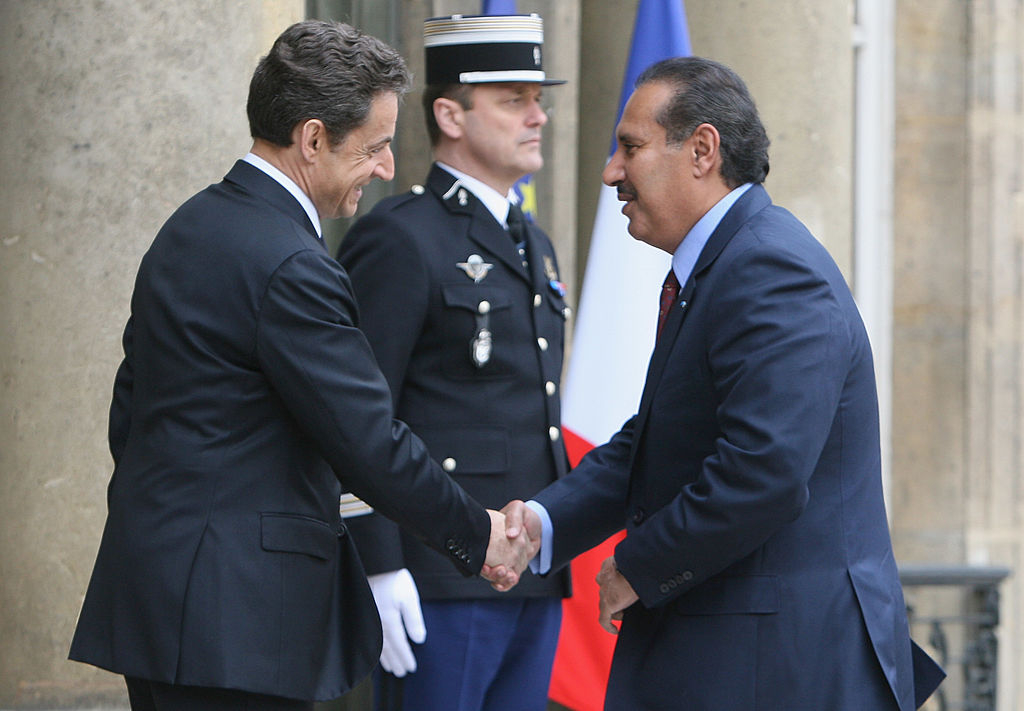
France's then-President Nicolas Sarkozy
(left) greets Qatar's then-Prime Minister Sheikh Hamad bin Jassim bin Jabor
al-Thani (right) on March 19, 2011 in Paris, France. (Photo by Franck
Prevel/Getty Images)


It is doubtful if the French investigators will ever get to the
bottom of these two cases. The judiciary in France has a long tradition of
submitting to the government. Since 1789, the French judiciary has not even
been an independent power -- as are the Legislative and the Executive
-- but a mere authority with a more limited scope.

It is revealing that these two investigations were exposed, not by
the French press, but by the English press.

What we already know for sure is the following:

1.   
A state sponsor of terrorism, Qatar, was allowed to buy France's
leading soccer team, Paris-Saint-Germain, with the help of then-president
Nicolas Sarkozy. The former owner of the PSG was a private fund controlled
in Europe by one of Sarkozy's close friends. There would have been no deal
without the direct consent of Sarkozy -- that is the way France functions.

2.   
A state sponsor of terrorism, Qatar, was not only allowed, but
actively courted, by French
officials to invest in some of France's largest companies, including defense
companies, such as Veolia, as well as the Airbus parent company, European
Aeronautic Defence and Space Company (EADS); the energy group EDF; the
construction firm, Vinci; and the media and defense group Lagardère.

3.   
A state sponsor of terrorism, Qatar, was actively supported in its
2022 bid for the World Cup by the government of France and Nicolas Sarkozy,
who declared after the
FIFA vote in 2010: "Sport does not belong to a few countries. It belongs
to the world... I don't understand those who say that events should always be
held in the same countries and the same continents."

4.   
There is a significant part of the French political class that
seems to consider the Embassy of Qatar in Paris some sort of automatic teller
machine (ATM), as has been showed by renowned journalists Christian Chesnot and
Georges Malbrunot in their book, Nos très chers émirs (Our
Very Dear Emirs
) and deplored by the new
ambassador of Qatar in France, Meshaal al-Thani.

5.   
Since 2008, a state sponsor of terrorism, Qatar, has benefited
from a huge tax break in France: the exemption of
profits on property sales. In France, profits on property sales are not only
taxed at 19%, they are subject to a further CSG/CRDS and social tax (15.5%),
resulting in a combined total minimum tax rate of 34.5%. The
rule is the same for everyone, whether a person or a corporation. Everyone,
that is, but the State of Qatar, when the administration of Nicolas Sarkozy
decided to exempt it from the tax. As a result, Qatar's royal family and
sovereign fund have since built up a huge portfolio of assets in France, one
that dwarfs the portfolio of a state such as Saudi Arabia. Qatar's portfolio
ranges from a Champs-Élysées mall to the Lido Cabaret. "Our deficit has
destroyed our freedom," said Nathalie Goulet, a
centrist senator from Lower Normandy, in 2013.


 "The Qataris are here to
buy, while we are selling our family jewels." Which they did. [1]
Qatar and other Gulf states try to benefit from tax exemptions
everywhere in the world, but this convergence of facts -- the selling of
assets, sports clubs, defense companies and governmental representatives -- is
unique to France. It is through these tax breaks -- this is only one of them --
that the Qataris are buying the "jewels" of France. Of course, the
U.S. is also selling arms to the Qataris --
the U.S. has a military base in Al Udeid -- but the U.S. is not selling its
defense companies to Qatar.

We therefore probably do not even have to wait for the results of
the latest investigations to note that France, particularly but not exclusively
under the auspices of Nicolas Sarkozy, has literally been bought by a state
sponsor of terrorism, Qatar.

At the same time, Islam in France has been spreading. France has
been deeply infiltrated by the Muslim Brotherhood terror
organization, which is not categorized in France -- unlike the UK -- as a
sponsor of terror. This organization, since it was overthrown by Egypt's
current president, Abdel Fattah al-Sisi, is now the darling of Qatar. Without
Qatar, the Muslim Brotherhood would be without a home-base. Given its huge
financial, corporate and political dependence on Qatar, it is clear that France
-- in the name of "stability" -- would not do anything to displease
its darling.

Although France is a member of NATO and a nuclear power, nowhere
else in the West is Islamism so deeply embedded in the fabric of the
institutions, mind and zeitgeist of a country as it is there.
Even in the UK, you still find very powerful counter-powers (see the
governmental report on the Muslim Brotherhood). Not in France.

Consider the case of the Palestinian official Jabril Rajoub -- sentenced to life in
prison in 1970 for throwing a grenade at an Israeli army vehicle, but released,
along with others, in exchange for three Israeli soldiers taken hostage by the
Popular Front for the Liberation of Palestine (PFLP). Rajoub is now chairman of
the Palestinian Football Association -- another illustration of the deep
infiltration of FIFA by Islamists and Jew-haters sponsored by Gulf States,
beginning with Qatar. Would that position even be thinkable without France's
sponsorship of Qatar in FIFA? Probably not.

It is true that Qatar is buying assets from
around the world, including politicians, not only in France. And it is true
that the U.S. is also selling arms to the Qataris, as are many other countries.
It is one thing, however, to sell arms, but another to sell your defense
companies. It is one thing to be open to foreign investment, but another to
give huge tax breaks to a state sponsor of terror so it can acquire the
"jewels" of your country.

It is also not an accident that the main face of Islamism in
Europe, the Muslim Brother Tariq Ramadan (from his base in Oxford, England) now
sees France as the future of Islam in Europe,
and not the UK (still number 2 on the list).

The U.S. and other countries may be selling things, but France is
selling herself.

Drieu Godefridi, a classical-liberal Belgian author, is the
founder of the l'Institut Hayek in Brussels. He has a PhD in Philosophy from
the Sorbonne in Paris and also heads investments in European companies.


[1] The
6th of December 2014, Nicolas Sarkozy was invited and paid by
the "Qatar National Bank" to give a lecture in Doha. Subject?
Investment opportunities in France.

© 2017
Gatestone Institute. All rights reserved.
 The articles
printed here do not necessarily reflect the views of the Editors or of
Gatestone Institute. No part of the Gatestone website or any of its contents
may be reproduced, copied or modified, without the prior written consent of
Gatestone Institute.


Wednesday, August 30, 2017

The Fake News Media of Sweden By Nima Gholam Ali Pour

The Fake News Media of Sweden

.


The
Fake News Media of Sweden


by 


August 30,
2017 at 4:00 am


§  In
most democratic countries, the media should be critical of those who hold
power. In Sweden, however, the media criticize those who criticize the
authorities. Criticism is not aimed at the people who hold power, but against
private citizens who, according to the journalists, have the "wrong"
ideas.
§  TV4
and all other media refused to report that it was Muslims who interrupted the
prime minister because they wanted to force Islamic values on Swedish
workplaces. When the Swedish media reported on the event, the public were not
told that these "hijab activists" had links with Islamist
organizations. Rather, it was reported as if they were completely unknown
Muslim girls who only wanted to wear their veils.
§  The
Swedish media are politicized to the extent that they act as a propaganda
machine. Through their lies, they have created possibilities for
"post-truth politics". Instead of being neutral, the mainstream
Swedish media have lied to uphold certain "politically correct" values.
One wonders what lifestyle and political stability Sweden will have when no one
can know the truth about what is really going on.


In February 2017, after U.S. President Donald Trump's statements about
events in Sweden, the journalist Tim Pool travelled to Sweden to report on
their accuracy. What Tim Pool concluded is now available for everyone to watch
on YouTube, but what is really interesting is how
the Swedish public broadcasting media described him.
On Radio Sweden's website, one of the station's employees, Ann Törnkvist, wrote an op-ed in which Pool
and the style of journalism he represents are described as "a threat to
democracy".
Why is Pool "a threat to democracy" in Sweden? He reported negatively
about an urban area in Stockholm, Rinkeby, where more than 90% of the
population has a foreign background. When Pool visited Rinkeby, he had to
be escorted out by
police. Journalists are often threatened in Rinkeby. Before this incident, in
an interview with Radio Sweden, Pool had described Rosengård,
an area in the Swedish city of Malmö heavily populated by immigrants, as
"nice, beautiful, safe". After Pool's negative but accurate report
about Rinkeby, however, he began to be described as an unserious journalist by
many in the Swedish media, and finally was labeled the "threat to
democracy."
One might think that this was a one-time event in a country whose
journalists were defensive. But the fact is that Swedish journalists are deeply
politicized.
In most democratic countries, media are, or should be, critical of
those who hold power. In Sweden, the media criticize those who criticizes those
who hold power.
In March 2017, the public broadcasting company Sveriges
Television
 revealed the name
of a person who runs the Facebook page Rädda vården ("Save
Healthcare"). The person turned out to be an assistant nurse, and was
posting anonymously only because he had been critical of the hospital where he
worked. Swedish hospitals are run by the local county councils, and thus when
someone criticizes the healthcare system in Sweden, it is primarily politicians
who are criticized. Sveriges Television explained on its
website why it revealed the identity of the private individuals behind
Facebook:
"These hidden powers of influence abandon and break the open
public debate and free conversation. Who are they? What do they want and why?
As their impact increases, the need to examine them also grows."
It is strange that Sveriges Television believes
that an assistant nurse who wants to tell how politicians neglect public
hospitals, is breaking "the open public debate and free
conversation". This was not the only time that the mainstream Swedish
media exposed private citizens who were criticizing those who hold power. In
December 2013, one of Sweden's largest and most established newspapers, Expressenannounced that it
intended to disclose the names of people who commented on various Swedish
blogs:
"Expressen has partnered with Researchgruppen.
The group has found a way, according to their own description, without any kind
of unlawful intrusion, to associate the usernames that the anonymous commentators
on the hate websites are using to the email addresses from which comments were
sent. After that, the email addresses have been cross-checked with registries
and authorities to identify the persons behind them."
The term "hate websites" (hatsajterna) is what
that the mainstream media uses to describe some of the blogs that are critical
of Islam or migration.
It is one thing to be critical of bloggers who you may consider
have racist opinions. But exposing the people who have written in comments
sections of various blogs in one of Sweden's biggest newspapers is strange and
terrifying.
Researchgruppen has clear links to Antifascistisk
Aktion
 (Antifascist Action), a group which, according to the
Swedish government, consists of violent left-wing extremists. For their efforts
to expose private individuals in the comments section, Researchgruppen received
the Guldspaden, a
prestigious journalistic award in Sweden.
Jim Olsson was one individual exposed in Expressen simply
because he wrote something in a blog's comments section. A 67-year-old docent
in physical chemistry, Olsson received a home-visit from Expressen with
a camera and microphone present. A private citizen with no connection to any
political party or organization, he exposed by Sweden's media because he
had written the
following in the comments section:
"The Swedish asylum system rewards swindlers with a permanent
residence permit. There are, of course, swindlers flooding Sweden."


The Swedish newspaper Expressen accessed
databases of website commenters, targeted critics of immigration, and
confronted them at home. The above screenshot is taken from a video on
the Expressen website, published under the headline
"Jim Olsson writes on hate sites."


Another private individual, Patrik Gillsvik, with no political
links, was exposed and fired from his job because, in a blog's comments
section, he wrote:
"I would like to join the structural prejudices of the
majority in society and state that gypsies are inventive and witty
entrepreneurs who can enrich our culture -- yes, and then they steal like
ravens, of course!"
Although the statement can be criticized for being unacceptably
racist, what is unique is that the mainstream media in a Western democracy can
expose private individuals because they wrote something in a blog's comments
section. Criticism is not aimed at the people who hold power, but against
private citizens who according to the journalists have the "wrong"
ideas.
Moreover, each of these private citizens, who have had their lives
ruined because they wrote something distasteful in a comments section, serves
as a warning, so that others will not dare to make the mistake of posting
something politically incorrect on a blog.
It is shocking that in a democracy, the media acts this way, but
that is how Swedish -- and, increasingly, other Western media -- operate these
days.
In addition to punishing private individuals who, according to the
them, communicate "wrong" ideas, the media celebrate and support
people who have the "right" ideas. On May 1, 2017, Sweden's Prime
Minister Stefan Löfven was interrupted by a number of hijab-wearing activists
who were protesting a verdict of the Court of Justice of the European Union
that employers are entitled to prohibit staff from wearing a hijab. Given that
Sweden's prime minister cannot directly influence the Court, and that one
should not interrupt the country's prime minister when he speaks, one would
think that these "hijab activists" might be criticized in the media.
TV4, a national TV-channel and one of the first media outlets
to report this incident,
refused to say that those who interrupted the prime minister were wearing the
Islamic veil. The title of TV4's clip was "Demonstrators Interrupted
Löfven speech". The sub-headline read as follows: "Female protesters
screamed out their anger against the prime minister and wondered where the
feminist government was."
From the text, it is not clear that these activists demonstrated
against the verdict of the Court of Justice of the European Union; that all
activists wore a hijab, or that they screamed, "Stand up for Muslim
women's rights!" However, information that
these activists were wearing hijabs and protesting the verdict of the Court of
Justice of the European Union was on their Facebook page and YouTube.
Nevertheless, TV4 and all other media refused to report that those who
interrupted the prime minister were Muslims who were interrupting the prime
minister because they seemingly wanted to force Islamic values on the Swedish
workplace.
The day after their protest, in an interview with
Radio Sweden, these activists had the opportunity to explain why they protested
-- but were not asked any critical questions. The next day, an Expressen columnist,
Maria Rydhagen, compared one of the hijab-activists glowingly with one of the
founders of the Swedish Social Democratic Party, Axel Danielsson. Rydhagen
wrote the following about
Jasmin Nur Ismail:
"Then, on Monday, the protest of the girls was perceived as
only an incident. But imagine if it was the start of something big? Perhaps
history was being written, there and then? Imagine if Jasmin Nur is the Axel
Danielsson of 2017. Hero and rebel. In that case: Was it not a pity to remove
her with the help of the police?"
As the media refused to write anything negative about the protest
against the prime minister, this author began to investigate the matter. It
took half an hour to find out several important thingswhich were never
mentioned by the Swedish mainstream media. Jasmin Nur Ismail had written about
the incident on her Facebook page shortly after the protest. Who was behind the
protest was not a secret.
The demonstration had been organized by the Hayat Women's Movement
and a network called, "The Right to Our Bodies". The Hayat Women's
Movement was founded by Aftab Soltani, who in March 2017 was one of the speakers at a much-criticized annual
Islamic event in Sweden, Muslimska Familjedagarna (Muslim
Family Days). The event was blamed by both the left and the right for inviting hate preachers,
anti-Semites and Muslim radicals as speakers. Another speaker at this Islamic
event in March 2017 was Jasmin Nur Ismail, a heroine of the Swedish
media. Muslimska Familjedagarna was organized by the Islamist Ibn Rushd Educational Association,
the Islamic Association of Sweden (Islamiska Förbundet i Sverige) and
Sweden's Young Muslims (Sveriges Unga Muslimer).
Jasmin Nur Ismail, hailed as a heroine in Expressen, is
a public figure. Southern Sweden's largest newspaper, Sydsvenskandescribed her in an
October 2016 article as an "activist, anti-racist and writer".
According to Sydsvenskan, Jasmin Nur Ismail's political role-model
is Malcolm X. During the Swedish Forum for Human Rights in 2016, Jasmin Nur
Ismail was, in a panel discussion, the
representative for Malmö's Young Muslims -- in turn, a subdivision of an Islamist organization, Sweden's
Young Muslims.
Swedish newspapers did not write a single word that the person and
organizations behind the protest against Sweden's prime minister had links with
Islamist organizations. When the Swedish media reported about the event, the
public were told that these hijab-activists were completely unknown Muslim
girls who only wanted to wear their veils.
Mainstream Swedish media outlets simply do not report some things.
When the largest mosque in Scandinavia was
opened in Sweden's third largest city, Malmö, the news about this was first
published in the Qatar News Agency and The Peninsula on
May 3, 2017. The reason that Qatar's media wrote about it was because Qatar
financed a large part of the mosque. On May 5, an article about this mosque was
published in Breitbart. On May 6, one
day after Breitbart reported the news and three days after the Qatari media
reported the news, the Swedish terrorist expert Magnus Ranstorp sent a tweet about this
mosque, but he linked it to the Qatari media. At this time, there are still no
Swedish media outlets that have reported anything about the largest mosque in
Scandinavia.
On May 8, the Swedish blog Jihad i Malmö wrote about the
mosque and its Qatari financing. On May 9, the Swedish blog Pettersson
gör skillnad
 wrote about the
mosque. At the same time, the Norwegian author and activist Hege Storhaug, who
is critical of Islam, wrote about the
mosque and noted that the Swedish media had not yet written about it:
"I had expected that the Swedish media at the very least
would mention the opening of Scandinavia's largest mosque with positive words.
But no, not a word in Swedish mainstream media, as far as I have noticed. You
have to go to the English version of Arabic media to get some limited
information, like Qatar News Agency."
By the time I tweeted about it on May 10, the
mainstream Swedish media still had not widely reported it. On May 15, I wrote
an article on it for
the news website Situation Malmö, run by the Sweden Democrats party
branch in Malmö. With one hour's research, I managed, through what the mosque
had published on Facebook, to discover that one of the leading Social Democrat
politicians in Malmö, Frida Trollmyr, a municipal commissioner with
responsibility for culture, recreation and health, had been at the mosque's
opening. Representatives of the Qatari government also attended, but the
mainstream Swedish media still had not reported anything about it.
On May 17, two weeks after the Qatari media had written about the
opening of Scandinavia's largest mosque in Malmö, 12 days after Breitbart had written
about the event, and two days after my article, the Sydsvenskan newspaper wrote about the
mosque opening. You could not read the article, however, if you had not paid
for "premium membership" to this newspaper.
One can see this omission as an unfortunate coincidence, but it is
strange when Breitbart succeeds in communicating more information about Malmö
than southern Sweden's largest newspaper, which is headquartered in Malmö. Why
would the Swedish media not write about the mosque? It was certainly not a
secret. There was no explanation from the Swedish media or anyone else. Yet,
these same media outlets did not hesitate to expose the names of private citizens
who wrote inappropriate opinions on a public comments page.
There are journalists in Sweden who change their views as soon as
the government changes its opinion. Göran Greider, a journalist and editor,
active in the public debate in Sweden for more than 30 years, wrote the following in August
2015, about migration policy:
"The European governments who say no to increasing the number
of refugees received not only show a shameful lack of solidarity. They are also
silent when they decline to rejuvenate their populations."
In November 2015, only three months later, when the Swedish
government was forced to change its migration policy because of the migration
crisis, Göran Greider wrote:
"But even the left, including many Social Democrats and
members of the Green Party, have sometimes been characterized by an
unwillingness to discuss the great challenges that receiving refugees, in the
quantity we have seen lately, implies for a society. No one wants to be a
nationalist. No one wants to be accused of running the errands of Sweden
Democrats, or racism. But in this way, people on the left, who are so broadly
for bringing in refugees, have often locked themselves out of a realistic
discussion."
There is nothing wrong in reconsidering one's opinion. But it has
become common for Swedish journalists frequently to have opinions that favor
certain political parties -- often the Social Democrats, the Left Party and the
Green Party. The issue is not even about values. People who work for the
mainstream Swedish media are ready to reconsider their values so long as it
helps certain parties to stay in power. This is far from what is presumably the
media's main task in a democracy.
How is it that no newspaper is rebelling against this order? It
would be a good business proposition; such a media outlet could gain financial
benefits. Sweden's political establishment is, after all, not popular. Well, we
can look at the example of someone who tried. In February 2017, a financier,
Mats Qviberg, bought a free daily newspaper, Metro, usually
distributed in subways and buses in Sweden. In May, he gave an interview to the
newspaper Nyheter Idag, considered by the Swedish establishment to
be "right-wing" or "populist". In his interview, Qviberg
gave a slight playful hint that Metro might in some way
cooperate with Nyheter Idag.
The consequence of the
playful statement was that the Green Party in Stockholm County Council
threatened that Stockholm County would stop handing out Metro in
Stockholm's subways. A columnist stopped writing for the paper. Other media
outlets started to wonder out loud if Metrowere becoming a racist
platform. Before the month of May was over, Qviberg had sold his shares
in Metro. That politicians would punish a newspaper owner who had
"wrong" views did not surprise anyone in Sweden; the situation was
not worth mentioning. In Sweden, even owners of newspapers are supposed to
follow the political order.
In June 2017, the leader of the Sweden Democrats (SD), Jimmie
Åkesson, spoke in Järva, a district in Stockholm dominated by immigrants. The
Sweden Democrats is a social-conservative party in the Swedish parliament; it
supports, among other matters, a restrictive migration policy. While Åkesson
was speaking, there were protests against him; and among the protesters were
various placards. A photograph of Radio Sweden's van showed an anti-SD placard
inside it. On it, one could read "Jimmie = Racist". The explanation from
Radio Sweden was:
"Someone put a sign on Ekot's (a Radio Sweden news program)
car in Järva on Sunday evening. It was taken down and put into the car and then
thrown away on the way from there."
You can have a discussion about why Radio Sweden spends its time
discarding placards that left-wing protesters use. Is that what journalist are
supposed to do when they are covering a story? In the end, however, it does not
matter. The people's confidence in the mainstream media in Sweden is being
eroded as we write.
A new study from Institutet för Mediestudier shows that 54%
agree, or partly agree, that the Swedish media are not telling the whole truth
about problems in society linked to migration. Instead of the media accepting
that they are biased and starting to change their ways, the media continue to
attack citizens who appear critical.
In June 2017, the editorial writer of the daily Aftonbladet,
Anders Lindberg, wrote an editorialtitled,
"Hitler Did Not Trust the Media Either," in which he equated the
critics of the Swedish media with Nazis. Anders Lindberg, after working 10
years for the Social Democrats, resigned as the
Communications Ombudsman for the Social Democrats in 2010, to start working as
an editorial writer for Aftonbladet. He is so well-known for what
his critics view as unusual versions of the truth that he has the privilege of
writing for Sweden's largest newspaper. In 2015, he described the issue
of organized begging, a visible problem in northern Europe, as "legends
and folklore". Today there is no party that denies that organized begging
is a real problem.
I often have difficulty explaining to many of my American friends
and colleagues how the Swedish media work. Often, there may be clear examples
of anti-Semitism and other unsavory behavior. The first question I always get
is: Why is the media not writing about this? The answer is simple. The Swedish
media are politicized to the extent that they act as a propaganda machine. It
is not a propaganda machine in the traditional sense of the word, with an
official Ministry of Propaganda. But in Sweden, many journalists and editors
are either old established political party employees, as Anders Lindberg, or
simply ideologically indoctrinated and therefore extremely biased. The Swedish
propaganda machine punishes those who have the "wrong" opinions and
celebrates those who have the "right" opinions.
What happened to Tim Pool was a part of how media works in Sweden.
As long as he said the "right" things, the Swedish media gave a
positive picture of him. When he started to have the "wrong" opinion,
the propaganda machine started doing its work and Pool became "a threat to
democracy".
There are, of course, more examples that show how sick the Swedish
debate- and media-climate has become. In such a negative environment, there are
many casualties. The first casualty is, obviously, the truth. When people start
to understand that the mainstream media are lying, they turn to alternative
media. Alternative media outlets, however, also usually have political agendas.
A democracy cannot survive well only on biased media. A democracy desperately
needs mainstream media outlets that inform its citizens and criticize people
who hold power. That is something Sweden does not have today.
A large portion of the Swedish population are apparently aware of
this and do not trust the media. Through its lies, the Swedish media have
created possibilities for "post-truth politics" in Sweden. Instead of
being a neutral party, the mainstream Swedish media have lied to uphold certain
"politically correct" values. The result is an atmosphere where many
people believe that everything that the media says has a political agenda. When
the mainstream media in Sweden lie shamelessly, where can one go to find the
truth? One wonders what lifestyle and political stability Sweden will have when
no one can know the truth about what is really going on.
Nima Gholam Ali Pour is a member of the board of education in the
Swedish city of Malmö and is engaged in several Swedish think tanks concerned
with the Middle East. He is also editor for the social conservative website
Situation Malmö, and is the author of the Swedish book "
Därför är mångkultur förtryck"("Why
Multiculturalism is Oppression").

© 2017 Gatestone Institute. All rights reserved. The
articles printed here do not necessarily reflect the views of the Editors or of
Gatestone Institute. No part of the Gatestone website or any of its contents
may be reproduced, copied or modified, without the prior written consent of
Gatestone Institute.