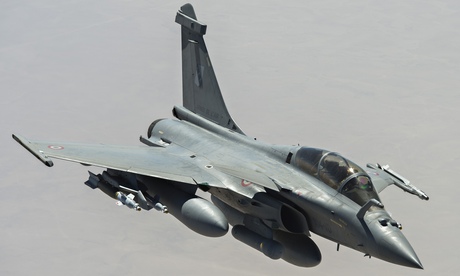
'Now we have a
new target, and a new reason to dispense mercy from the sky, with
similar prospects of success.' Photograph: ASAP/ECPAD/Corbis
Let’s bomb the Muslim world – all of it – to save the lives of its
people. Surely this is the only consistent moral course? Why stop at
Islamic State (Isis), when the Syrian government has murdered and
tortured so many? This, after all, was last year’s moral imperative.
What’s changed?
What humanitarian principle instructs you to stop there? In Gaza this
year, 2,100 Palestinians were massacred: including people taking
shelter in schools and hospitals. Surely these atrocities demand an air
war against Israel? And what’s the moral basis for refusing to liquidate
Iran? Mohsen Amir-Aslani was hanged there last week for making “innovations in the religion”
(suggesting that the story of Jonah in the Qur’an was symbolic rather
than literal).
Surely that should inspire humanitarian action from
above?
Pakistan is crying out for friendly bombs: an elderly British
man, Mohammed Asghar, who suffers from paranoid schizophrenia, is, like
other blasphemers, awaiting execution there after claiming to be a holy prophet. One of his prison guards has already shot him in the back.
Is there not an urgent duty to blow up Saudi Arabia? It has beheaded
59 people so far this year, for offences that include adultery, sorcery
and witchcraft. It has long presented a far greater threat to the west
than Isis now poses. In 2009 Hillary Clinton warned in a secret memo that
“Saudi Arabia remains a critical financial support base for al-Qaida,
the Taliban … and other terrorist groups”. In July, the former head of
MI6, Sir Richard Dearlove, revealed that Prince Bandar bin Sultan, until
recently the head of Saudi intelligence, told him:
“The time is not far off in the Middle East, Richard, when it will be
literally ‘God help the Shia’. More than a billion Sunnis have simply
had enough of them.” Saudi support for extreme Sunni militias in Syria
during Bandar’s tenure is widely blamed for the rapid rise of Isis. Why
take out the subsidiary and spare the headquarters?
The humanitarian arguments aired in parliament last week,
if consistently applied, could be used to flatten the entire Middle
East and west Asia. By this means you could end all human suffering,
liberating the people of these regions from the vale of tears in which
they live.
Perhaps this is the plan: Barack Obama has now bombed seven largely
Muslim countries, in each case citing a moral imperative.
The result, as
you can see in Libya, Iraq, Pakistan, Afghanistan,Yemen, Somalia and
Syria, has been the eradication of jihadi groups, of conflict, chaos,
murder, oppression and torture. Evil has been driven from the face of
the Earth by the destroying angels of the west.
Now we have a new target, and a new reason to dispense mercy from
the sky, with similar prospects of success. Yes, the agenda and
practices of Isis are disgusting. It murders and tortures, terrorises
and threatens. As Obama says,
it is a “network of death”. But it’s one of many networks of death.
Worse still, a western crusade appears to be exactly what Isis wants.
Already Obama’s bombings have brought Isis and Jabhat al-Nusra,
a rival militia affiliated to al-Qaida, together. More than 6,000
fighters have joined Isis since the bombardment began. They dangled the
heads of their victims in front of the cameras as bait for war planes.
And our governments were stupid enough to take it.
And if the bombing succeeds? If – and it’s a big if – it manages to
tilt the balance against Isis, what then? Then we’ll start hearing once
more about Shia death squads and the moral imperative to destroy them
too – and any civilians who happen to get in the way.
The targets
change; the policy doesn’t. Never mind the question, the answer is
bombs. In the name of peace and the preservation of life, our
governments wage perpetual war.
Just as crucial evidence was about to be
released, Tony Blair intervened to stop the investigation. The biggest
alleged beneficiary was Prince Bandar. The SFO was investigating a claim
that, with the approval of the British government, he received £1bn
in secret payments from BAE.
And still it is said to go on. Last week’s Private Eye, drawing on a
dossier of recordings and emails, alleges that a British company has
paid £300m in bribes to facilitate weapons sales to the Saudi national
guard. When a whistleblower in the company reported these payments to
the British Ministry of Defence, instead of taking action it alerted his
bosses. He had to flee the country to avoid being thrown into a Saudi
jail.
There are no good solutions that military intervention by the UK or
the US can engineer. There are political solutions in which our
governments could play a minor role: supporting the development of
effective states that don’t rely on murder and militias, building civic
institutions that don’t depend on terror, helping to create safe passage
and aid for people at risk. Oh, and ceasing to protect, sponsor and arm
selected networks of death. Whenever our armed forces have bombed or
invaded Muslim nations, they have made life worse for those who live
there. The regions in which our governments have intervened most are
those that suffer most from terrorism and war. That is neither
coincidental nor surprising. Yet our politicians affect to learn nothing. Insisting that more
killing will magically resolve deep-rooted conflicts, they scatter bombs
like fairy dust.
A fully referenced version of this article can be found at monbiot.com
Religious leaders appeal for defeating the politics of ‘divide & rule’
01 Oct 2014 05:10 PM, IST
Scholars from different religions at Jamaat-e-Islami Hind program in Jaipur on 28 Sep 2014.
By IndiaTomorrow.net,
Jaipur,
01 Oct 2014: Leaders and intellectuals from across religious
communities have given a call for communal harmony and mutual love.
Drawn from different parts of the country for an event here this past
Sunday, they urged people to stand up against ‘divide & rule’
tactics of politicians to ensure peace and justice in the society.
They
were speaking at a seminar on How to build a society on the basis of justice and morality? on 28th Sep in Jaipur.
Gyani
Dhavinder Singh, Member of Delhi Gurudwara Prabandhak Committee said:
“It is religion that teaches morality to man. We all are the servants of
one Almighty. Then why are there differences? People are diving people
for political benefits.”
Speaking
at the seminar, eminent human rights activist and writer from Mumbai,
Prof. Ram Puniyani said: “Innocents are being killed in the name of
religions which teach brotherhood and love. Today Muslims and Christians
are being targeted. History of the country is being distorted to spread
hatred.” He also said that calling India a Hindu Rashtra is contempt of
the Constitution of the country.
“We
need to fight the battle of justice by taking people of all weaker
sections and religions along. There is a need to spread the message of
communal harmony among common people,” said Puniyani.
Gandhian
Adv. Prem Kishan Sharma from Delhi said one should not expect justice
from those who have come to power through doing injustice. “If those
whose hands are sullied with blood come to power how can we expect
justice from them?”
Yugal
Kishore Shastri, Hindu priest and peace activist in Ayodhya, stressed
peace and mutual love and equal representation in government. “Until all
communities get equal representation in all departments of government,
it will be difficult to resolve the problems,” he said.
He
also said: There is a need to spread the atmosphere of love so much so
that the borders of our neighbouring countries get submerged in love.
Earlier
opening the seminar, Mohammad Salim Engineer, Secretary,
Jamaat-e-Islami Hind, said Prophet Muhammad had come to establish
justice and peace in the society and he did it in his lifetime and set
an example for all time to come.
Criticizing
acts and policies of the Bharatiya Janata Party government at the
centre, he said faith is being preferred to justice. On one hand, they
give a slogan of Sab ka Saath Sab ka Vikas, on the other they are spewing hatred and communal fire, he said.
Jamaat secretary urged leaders of all religions to come out and work together to keep the country from going astray.
“We
should create an atmosphere of mutual brotherhood, love and harmony. It
is the duty of leaders of all religions to keep the country from going
on the wrong path. We should strengthen the foundations on which the
nation was built,” he said.
He
emphasised the fear of Almighty for one to keep from committing crime.
“Only laws cannot prevent people from doing evils. The fear of God is
must,” he said.
The seminar was part of the three-day all-Rajasthan conference organized by the state unit of Jamaat-e-Islami Hind.
In
his speech, Mr. Amarnath, a social activist from Jaipur, said no
religion teaches enmity. “I wonder from where hatred has crept among
Hindus. All religions teach love and harmony.”
Hitting
hard at the hate campaign of some leaders of BJP, he said: “Who has
given licence to BJP to represent entire Hindu religion?”
“Our
politicians are still working on the British policy of divide and rule.
The day our countrymen wake up, everything will be changed.”
Presiding
over the program, Maulana Syed Jalaluddin Omari, national president of
Jamaat-e-Islami Hind, quoted Quran to explain how Islam builds a society
on the basis of justice and morality.
He
quoted Quran to highlight respect of human life. “If anyone slays a
person, it would be as if he slew the whole people; and if any one saved
a life, it would be as if he saved the life of the whole people,” says
Quran.
Jamaat
chief said: “If an entire nation stands up for justice, I swear by God
that injustice cannot be done with anyone there.” He said Islam does not
allow injustice even with enemies.
The Pashtun Question: The Unresolved Key to the Future of Pakistan and Afghanistan by Abubakar Siddique
Hurst, 271 pp, £30.00, May, ISBN 978 1 84904 292 5
The Taliban Revival: Violence and Extremism on the Pakistan-Afghanistan Frontier by Hassan Abbas
Yale, 280 pp, £18.99, May, ISBN 978 0 300 17884 5
The conflict in
the Afghanistan-Pakistan borderlands has similarities with other
contemporary struggles. From Timbuktu to Kandahar, jihadis, national
governments, ethnic groups and, in some cases, tribes are fighting for
supremacy. In each place there are complicating local factors: badly
drawn international borders; the relative strength or weakness of
non-violent Islamist movements; the presence or absence of foreign
forces, whether Western or jihadi; and different historical experiences
of colonialism. From the point of view of Western policymakers some of
these conflicts seem to be more important than others. For the French,
the potential fall of Mali to radical Islamist forces was unacceptable,
so they intervened. In Somalia, by contrast, the problem has largely
been ignored by the West and is mostly being dealt with by the African
Union. It was said that al-Qaida must not be allowed to hold territory
in Syria, but both an al-Qaida affiliate and Isis have been doing just
that, and it wasn’t until earlier this month that Obama announced he’d
strike Isis from the air.
It’s far from clear that these varied responses to jihadi activity
are the result of rational decision-making. In Yemen, for example,
al-Qaida supporters move about freely and plot attacks against the West.
Yet although the US has used air power in Yemen it has for the most
part left the fighting to the far from capable Yemeni armed forces. But
the Pashtun areas of the Afghanistan-Pakistan borderlands are an
exception to the mixed messages. There the West has used every tactic at
its disposal to confront jihadis: boots on the ground, air strikes,
drone attacks, bribes, social welfare programmes and infrastructure
projects – the effort to control the Pashtuns hasn’t lacked commitment.
There are, of course, important differences between Yemen and the
Pashtun areas.
Attacks organised in Pashtun areas – including 9/11 and
7/7 – have succeeded; even the most sophisticated plot to emerge from
Yemen, in which bombs were disguised as printer cartridges, was foiled.
And it isn’t just that the US was impelled to avenge 9/11. The outside
world is interested in the Pashtuns’ poppy crop and their hosting of
much of Pakistan’s nuclear arsenal. Over the last century and a half the
intricacies of Pashtun politics have been discussed by politicians and
their advisers in the capitals of all the Great Powers: it’s Washington
that’s worrying today, but it used to be Moscow, and before that London.
In
1893 the British created the Durand Line to divide Afghanistan from the
north-west corner of the Raj (now Pakistan). These days Pakistan
accepts the border and Afghanistan doesn’t. The line cuts the Pashtun
people in two: roughly a third of them are in Afghanistan and two-thirds
in Pakistan. The Durand Line had a specific purpose, and governed
British policy towards the Pashtuns.
This was not an imperial heartland
but a buffer zone and British administrative arrangements reflected
this. Some British-controlled Pashtun areas were declared ‘settled’;
others, close to the line, were designated ‘tribal’. The tribal elders
were given subsidies and status: in return, they were expected to keep
the peace and, crucially, to ensure the roads stayed open. And so the
military objective of protecting the edge of the empire was achieved
with minimum resources. Just in case the bribes were insufficient, the
elders were further persuaded to co-operate by the Frontier Crimes
Regulation, imposed in 1901. It had two crucial elements: first, people
could be held indefinitely without charge; second, it allowed collective
punishment, meaning that whole communities could be sanctioned for the
crimes of one member.
As
some British administrators realised at the time, the system entrenched
tribal structures. It might have been thought that the birth of
Pakistan in 1947 would transform the situation, with the new state
making efforts to drag the tribal areas towards more regular
constitutional arrangements. In fact little changed. Collective
punishments against the families and communities of suspected miscreants
are still handed down. The Pakistani officials who implement the system
are still called political agents, just like their British forebears.
Their powers remain sweeping and arbitrary. ‘Around here,’ a Khyber
political agent once told me, ‘I am Allah’s deputy.’ On the Afghan side
of the border, too, the central government has never been strong enough
to break down tribal affiliations. On both sides of the Durand Line the
result has been economically and socially disastrous – on the Pakistani
side female illiteracy stands at more than 70 per cent.
The
unusual methods of governance in the Pashtun areas became especially
significant after 9/11. When the Taliban and al-Qaida fled Afghanistan
in 2001 and 2002, many ended up in Pashtun areas on the Pakistani side
of the line. They took advantage of the fact that jihadis and tribesmen
are free to move across it but the military forces of Washington, Kabul
and Islamabad are not. As the war in Afghanistan ground on, and the
Afghan Taliban regrouped, the US had a choice. It could work with
Pakistan’s political agents to bribe and bully tribal elders to hand
over Taliban fighters seeking refuge in Pakistan; or it could use force.
Unwilling to delegate a frontline in the war on terror to a bunch of
tribal administrators, the US deployed soldiers in Afghanistan and
drones and special forces on both sides of the Durand Line. The tribal
elders found themselves squeezed by the forces surrounding them. Should
they offer sanctuary to the jihadis? Or should they capture them and
take US money for handing them over? As they considered their options,
the elders took into account the challenges posed by local political
competition, including both religious and nationalist leaders.
In
recent years the religious elements have been in the ascendant, but the
nationalists also have deep roots in the Pashtun areas. The faqir of
Ipi, a Pashtun leader who fought the British in the 1930s, represented
both aspects of Pashtun society. An obscure rural cleric from North
Waziristan, he became a symbol of opposition to the British Empire. The
case that thrust him to prominence has a modern parallel. The story goes
that Mullah Omar established his leadership credentials in the Afghan
Taliban by challenging a warlord near Kandahar who had buggered a local
boy. The faqir of Ipi began his career by complaining about a British
Indian court’s ruling against the marriage of a 15-year-old girl to a
Muslim man. The court found that the girl, originally a Hindu, had been
converted when she was a minor and so removed her from her husband. The
faqir used the case to unite tribal forces and was soon able to raise a
private army of thousands, drawn from Afghanistan as well as areas under
British control. At this stage, his pitch was religious: he spoke about
the impending doomsday, when only those Muslims who answered his call
to action would gain entry to paradise. His followers believed he could
heal the sick and turn air ordnance into paper. The British practice of
airdropping propaganda leaflets confirmed the faqir’s powers.
When
it came to the creation of Pakistan, the faqir, knowing that it would
be difficult to object on religious grounds to a country created in the
name of Islam, opposed it for nationalist reasons. He argued that for
the Pashtuns to be ruled by Pakistanis was hardly better than being
ruled by the British. After 1947 he allied himself with the Pashtun
nationalist leader Abdul Ghaffar Khan, whose followers were known as Red
Shirts (their uniforms were stained with brick dust). As the British
prepared to leave the subcontinent, Ghaffar Khan’s anti-imperialist
rhetoric resonated throughout the Pashtun areas. To accommodate the
nationalist movement, the British decided to hold a referendum in the
North-West Frontier Province. Ghaffar Khan demanded that as well as
offering a choice between India and Pakistan, the British should allow
the Pashtuns to vote for an independent state, Pashtunkhwa. The
government in Kabul argued for a fourth option: union with Afghanistan.
Lord Mountbatten, however, permitted just two choices: union with India
or Pakistan. Ghaffar Khan, desiring neither outcome, boycotted the vote.
Of those who voted, 99 per cent opted for Pakistan.
*
The nationalist
movement didn’t go away. Ten years ago I watched a rally in north-west
Pakistan that was attended by thousands of people wearing red shirts.
The event was organised by the Awami National Party (ANP), the direct
political descendant of Abdul Ghaffar Khan’s movement: it is currently
led by his grandson Asfandyar Wali Khan. Wali Khan has always been
careful to ask only for greater autonomy (Pakistani law forbids open
demands for secession), but few doubt that if Pashtun independence were
on offer he would grasp it. The ANP can be seen as just an obscure
regional party with – now – only one member in the National Assembly.
But you could argue that it is one of the most important parties in
Pakistan: unlike most of the others, it articulates liberal values and
directly opposes the Taliban. While everyone else has compromised with
the jihadis, the ANP has taken a stand, and paid a terrible price.
Recognising that the ANP is its main ideological challenger, the
Pakistani Taliban has relentlessly targeted the party’s leaders. As the
death toll mounted, the electorate came to see the ANP as weak and, in
the unforgiving world of patronage politics, voters lost confidence that
the party would be able to secure benefits from the government in
Islamabad and so rejected it at the polls. The ANP’s lonely stand
against the religious extremists was further undermined by the central
government’s fears that the party threatens Pakistan’s territorial
integrity.
If it was looking for existential threats, Islamabad
would have been better advised to worry about the jihadis. The Pashtun
nationalists have always faced insurmountable obstacles. They are
divided between two states – Pakistan and Afghanistan – that have no
intention of giving up territory. Just as the Line of Control has
fatally undermined the attempts of Kashmiri nationalists to break free
of India and Pakistan, so the Durand Line has obstructed the Pashtun
nationalist cause. And by giving senior military and bureaucratic jobs
to a few Pashtuns from prominent families, Islamabad and Kabul have been
able to co-opt potential separatist leaders. Pakistani Pashtuns are now
so well represented in the army and the civil service, and so
commercially active in Karachi, that independence would come at a cost
higher than most would be willing to pay.
For all their appeal to
many Pashtuns, the nationalists seem doomed to remain bystanders to
another struggle: between the tribal and religious leaderships. At the
time of Pakistan’s creation, the tribal elders had the upper hand. The
mullahs were seen as uneducated, socially inferior functionaries whose
main role was to supervise marriages and funerals. Over the last decade
there have been moments when tribal elders on both sides of the Durand
Line (often encouraged by US bribes) have protected their interests by
forming lashkars – private armies – to fight Taliban forces. All the
governments involved in fighting the Taliban have tried to leverage
tribal loyalties, although this policy has the arguably
counterproductive effect of entrenching the tribal structures that have
held back social and economic development: in the long run this only
helps the jihadis find more recruits. In some ways the origins of the
Afghan and Pakistan Taliban movements lie in a revolutionary politics
demanding the overthrow of the tribal structures. There is no doubt
about the intensity of this contest. It is reckoned that over the last
decade the Pakistani Taliban have killed nearly a thousand tribal
elders.
The ethnic, religious and tribal affiliations in the
Pashtun areas are not always easy to disentangle. Take Jalalludin
Haqqani, the man who has overseen the growth of the Haqqani network, a
formidable military force that over four decades has worked with a wide
range of international jihadi organisations, al-Qaida, Pakistan, the UAE
and both the Afghan and Pakistan Taliban movements. It has also
sometimes acted as a mediator between them. It has fought against both
the Soviet Union and the United States with considerable success.
Haqqani supports his military activities with a diverse international
business that ranges from scrap metal to hostage-taking. At one point he
even had a private airport. Four of his children have been killed: two
by drones; one by US ground forces in eastern Afghanistan; one in
mysterious circumstances last year in Islamabad. The Haqqanis first
stood out from the other tribal leaders when they encouraged Arab
volunteers to join the anti-Soviet struggle in Afghanistan. One of
Jalalludin’s early recruits was Osama bin Laden and it could be said
that the Haqqanis pioneered global jihad before bin Laden had even
thought of it. The network has hosted jihadis from China, Chechnya,
Central Asia and Europe. Because of its might and its international
approach to business and conflict, the Haqqani network has been a close
ally of the Afghan Taliban but has never been subsumed by it. As
well as its bases in eastern Afghanistan, the Haqqani network has
religious and military training facilities on the Pakistani side of the
Durand Line, and so has needed to stay on good terms with the Pakistani
state. It has achieved this by providing services: in the 1990s it
trained militants to fight as Pakistani state proxies in Kashmir; more
recently it has bombed Indian and US targets in Afghanistan – in some
cases with the connivance of the ISI. One of these attacks, in 2011,
involved a truckload of explosives sent by the Haqqanis from Pakistan to
a Nato base in Afghanistan. The Americans had intelligence about the
truck and asked Pakistan to stop it. Despite assurances from Pakistan’s
chief of army staff, General Kayani, the truck continued into
Afghanistan. The Americans were monitoring its progress using spy drones
but the Haqqanis outwitted them by switching vehicles in a tunnel. The
truck bomb wounded 77 US personnel.
The US became so frustrated by
the Pakistani state’s links to the Haqqani network that in 2011,
despite America’s longstanding effort to keep up appearances in its
relationship with Pakistan, the chairman of the joint chiefs of staff,
Admiral Mike Mullen, could contain himself no longer. ‘The Haqqani
network,’ he complained to the US Senate Armed Services Committee, ‘acts
as a veritable arm of Pakistan’s Inter-Services Intelligence agency.’
In 2012, Washington put the Haqqani network on its list of designated
terrorist organisations. The Pakistani state, however, continued to
allow it freedom of action, even overlooking its close relations with
the Pakistani Taliban. Having cleared the Pakistani Taliban from six of
the seven tribal areas – in a series of campaigns that led to the deaths
of five thousand Pakistani soldiers – the high command in Rawalpindi
failed for years to mount a final offensive in the one place that
remained in militants’ hands: North Waziristan. It wanted to allow the
Haqqani network’s operations there to continue without disruption. When
the offensive finally took place earlier this year, the Haqqanis were
given sufficient warning to enable them to slip to the relative safety
of Afghanistan.
*
InThe Pashtun Question,
Abubakar Siddique, a correspondent for Radio Free Europe, argues that
if the Pashtuns had been able to govern themselves from 1947 they might
have drawn on moderate indigenous traditions represented by figures such
as Pir Roshan, a 16th-century cleric whose opposition to the Mughals
unified the tribes. Roshan gave the Pashtun language a script,
introduced external intellectual influences and accepted Sufi
interpretations of sharia. That Pashtun society moved in a less tolerant
direction was a result of the new Pakistani state’s sense of
insecurity. Karachi (the first capital) and later Islamabad had an
interest in encouraging less benign strains of thinking. The Pakistan
military backed successive jihads against Kabul, partly as a way of
resisting Afghan attempts to undermine the Durand Line, and having
become a tool of Pakistani policy, the jihadis were empowered for
decades by the huge levels of funding – an estimated $20 billion – that
flowed in from the US and Saudi Arabia during the anti-Soviet struggle.
By sponsoring religious parties and establishing a network of madrasas
to train up zealous cannon fodder, Islamabad created the conditions in
which not only the Taliban but also al-Qaida could flourish.
On
this account, the creation of Pakistan, rather than emancipating the
Pashtuns, simply replaced one set of outside rulers with another. For
Siddique, the entrenchment of regressive power structures by a
succession of outsiders is a better explanation for what is going on
than the alternative argument that the roots of jihadism in the
borderlands lie in the predisposition of the tribesmen to violence.
Westerners misunderstand Pashtun society, Siddique argues, in part
because they are often fixated on romantic ideas about Pashtunwali – the
tribal code that is said to prize honour, revenge and hospitality above
all other virtues. Understandably irritated that British imperialists
and today’s foreign correspondents have reduced his culture to an
Orientalist fantasy, Siddique points out that, far from relishing the
chance to murder one another, most Pashtuns, just like everyone else,
would be very happy to live in peace. As for Pashtunwali, as well as
allowing for the violent resolution of disputes, its traditions include
taking decisions after broad consultation and discussion aimed at
finding consensus.
Hassan Abbas, a former police officer in
north-west Pakistan, also objects to those who see the Pashtuns as
ferocious tribesmen with traditions and attitudes at odds with the
modern world. In The Taliban Revival, he offers rational
explanations for their having fought against the British, the Soviets
and the Americans: the Pashtuns have a culture of resisting invaders, he
writes, because they have always lived on the edge of other people’s
empires and so have been invaded with remarkable frequency.
The
Afghan Taliban, Abbas argues, was able to re-emerge after its defeat in
2001 for a number of reasons, including the presence of US forces in
Afghanistan and the profits being made by criminals associated with the
organisation. As for the Pakistani Taliban, it drew strength from the
lack of state control in the tribal areas and, for some years, from
Musharraf’s ambiguous policy of supporting those elements of the Taliban
movements which he thought could further Pakistani interests. Both
Talibans were helped by Saudi funding and by the Pakistani concern that
trumped all other considerations: the fear of growing Indian influence
in Afghanistan and Balochistan. But while Pakistan was busy bolstering
the Afghan Taliban to counter the Indians, it found that the Pakistani
Taliban was an increasing problem. Islamabad was comfortable with the
Afghan Taliban’s objective of getting back into power in Kabul, but had
trouble containing the Pakistani Taliban’s growing independence. Some
ISI officers shared Mullah Omar’s frustration with the Pakistani Taliban
fighters who refused to rally to his Afghan cause. As Abbas points out,
recruits for the Pakistani Taliban have been drawn not just from the
Pashtun belt but from all over Pakistan. Sectarian militants from Punjab
and alumni from Karachi’s radical madrasas joined up not to fight
alongside Pashtuns and against the US, but to topple the Pakistani
government and establish religious rule in Islamabad and beyond. The
strategic and ideological differences between the two Talibans manifest
themselves in many ways. The more ideological and internationalist
Pakistani Taliban, for example, has opposed polio vaccinations; the more
pragmatic Afghan Taliban has been much more willing to allow UN health
teams to do their work.
When foreigners consider Siddique’s
‘Pashtun question’ they tend to do so in the hope that resolving
conflict in the Pashtun belt will make the West safer. Pashtuns want the
question answered for different reasons. They want to escape the
poverty and insecurity that has plagued and brutalised several
generations. It isn’t just that a great many Pashtuns have been killed
over the last century: even more have been dispersed. There are now more
Pashtuns living in Karachi than in Peshawar or Kandahar. Wherever they
live, many would agree with Siddique that the answer lies in economic
development.
But Pashtun nationalists face a contradiction.
Siddique argues that more should be done to incorporate the Pashtuns
into regular state structures: for one thing, laws that apply in the
rest of Pakistan should replace the repressive Frontier Crimes
Regulation. But any process of political modernisation and reform will
necessarily include the acceptance of the Durand Line as the
international border. Modern states exist only because they have borders
that they police. But this would entrench the division of the Pashtun
people. Siddique tries to get round the problem by proposing the
recognition of the line as a border but allowing free movement across
it. It’s a solution that can’t work: as long as militants are able to
cross the border more freely than the two states’ security personnel,
the Taliban movements will maintain a crucial advantage. Mullah Omar is
based in Pakistan and the Pakistani Taliban’s leader, Mullah Fazlullah,
operates from Afghanistan. Distrust between the governments in Kabul and
Islamabad is so acute that the intelligence agencies of both sides are
happy to host each other’s enemies.
Governments in the Middle East
and North Africa are using different methods to try to control
religious movements with political ambitions. In Syria, the Assads have
massacred them. In Egypt, Sisi has imprisoned them. In Tunisia,
Gannouchi is trying to use politics to outwit them. But in Pakistan and
Afghanistan, despite everything that’s been thrown at them, the two
Talibans are still standing. The Pashtuns have suffered decades of
conflict and few expect that the US withdrawal from Afghanistan will
bring an end to internal strife. Iran, India and China are already being
drawn in to fill the vacuum left by the US. If history is any guide
they will each back different warlords in an attempt to maintain
influence or at least to prevent others from getting influence over the
government in Kabul. And once again the Pashtuns will be caught in the
crossfire.
New Delhi | Posted: September 27, 2014 1:28 am| Updated: September 27, 2014 3:32 am
With six MPs, the Lok Janshakti Party may not count for much
in the 330-plus ruling NDA. But ABDUL KHALIQ, secretary general of LJP,
is the first ally to speak out against ‘the unfettered hate being
spewed’ against Muslims by ‘a long list of hate mongers’ The by-election results in Bihar and UP are being viewed as a
vindication of the deep-rooted and strong secular credentials of the
nation. As heartening to the secular devotees is the Prime Minister’s
statement that Indian Muslims would live and die for the country.
However, the fact that the PM has thought it necessary to underline the
patriotism of Muslims is in itself deeply disturbing. Implicit in the
statement is the frightening reality of how the Muslim is viewed in
today’s India.
I am an Indian but the fact that I am a Muslim has endangered my
claim to equal citizenship. I say this not because of our laws which are
unexceptionable but because of the mind-numbing environment of
hostility and prejudice, the inexorable growth of sheer distrust and
hatred for the Muslim and all that he represents.
Although the Muslims are near the bottom of the socio-economic ladder
and at par with the Dalits in almost every human development index, the
public discourse today is not about the economic and educational
backwardness of this beleaguered community but about the huge affliction
they are in the nation’s social fabric.
The plight of the ordinary Muslim is getting progressively worse.
Living on the margins of society, he has always been up against it in
the field of education, in the job market, even when looking for
accommodation. He is also burdened with the stigma of being in tacit
collusion with terrorists. But hitherto, the discrimination and the
distrust of the Muslim were covert. Now the gloves are off and the
hatred is in-your-face.
Like never before, the Muslim is viewed not just as “the other” but
as the root cause of the nation’s problems. The most pernicious myths
are being given the widest publicity — about forced conversion of Hindu
girls as a “love jihad” conspiracy to distort the population ratio,
about every conversion to Islam creating one more enemy for Hindus,
about 90 per cent of all rapes being committed by Muslims, about Muslims
provoking riots, about there being no place for non-Muslims in areas
where there are more than 35 per cent Muslims. The miasma of distrust,
of hate, of prejudice hangs like a black cloud over the community.
Today Praveen Togadia is passé. What was the narrative of the shakhas
and the fulminations of right wing fundamentalists are now mainstream
discourse. The most inflammatory and divisive rhetoric has become
commonplace. Leading a long list of hate mongers, Member of Parliament,
Sakshi Maharaj, uses the public platform to allege that the madrasas
across the country are imparting the ‘education of terror’ and ‘love
jihad’.
Maneka Gandhi, Minister and inveterate animal lover, has no qualms in
making the outrageously mendacious statement that profits from trade of
slaughtered animals go into financing terrorism. Senior police officers
express the most poisonous views against Muslims and Islam in their
internet discussion forum on Yahoo.
At a time when there are legitimate fears of Hindu majoritarianism, a
Supreme Court judge has publicly announced that if he had been the
dictator of India, he would have introduced Gita and Mahabharata in
schools. Tragically, these deviant thoughts, which violate the basic
canons of secular humanism, are not an aberration but an everyday,
recurring theme in our fractured society.
In this iniquitous environment where even allegedly secular parties
tango to the politics of community and caste, rational but lonesome
voices like Fali Nariman, Rajmohan Gandhi and Meghnad Desai have warned
against the anti-minority bigotry and rabid hate being freely aired in
the public space and the studied silence of the governing class.
Significantly, Nariman in his keynote address at a National
Minorities Commission forum had exhorted the commission to fulfill its
constitutional mandate of protecting the interests of minorities by
filing criminal complaints and taking other strong measures to counter
the hate tirades against minorities. In limp response, the commission
has appealed to the Home Minister to take suitable action, thereby
reinforcing the view of minorities that they cannot depend on state
institutions for redress of their problems.
It is unfortunate that the observations of such enlightened
individuals do not constitute “breaking news” and are hence consigned to
peripheral by lines whereas the hate-soaked ranting of a Yogi
Adityanath captures banner headlines and ‘eyeballs’. With the media’s
lopsided focus on the sensational, everybody knows what the Yogi has
said. But the rational voice is muted. It is high time that the media
seriously introspected on how it projects such nation-threatening
issues.
Significantly, those who are working to create a permanent rift
between communities and isolate the Muslims are actually executing the
pernicious plot of the separatists and other enemies of the state who
thrive on social discord. It is foolhardy to believe that the nation can
progress by banishing 150 million Indians into ghettoes and isolation.
Our Prime Minister has, in that most compelling slogan “Sabke saath
sabka vikas”, nailed the panacea for the nation’s problems. This slogan
needs to become a reality or else we face the deluge.
(The writer, a former civil servant, is secretary general of the Lok Janshakti Party. The views are personal)
AP
Attorney Gurpatwant Pannun from lawyers for rights group the American
Justice Centre, during a press conference in New York on Friday.
'Summons could simply be served by ascertaining the presence of Mr.
Modi in relatively close proximity, for example depositing the summons
at his feet'
The organisation behind a lawsuit filed against Prime Minister Narendra
Modi has offered a bounty of $10,000 to anyone who could serve him with
the summons issued by a federal district court
and capture the service on video, sparking concerns that there could be
a security incident during Mr. Modi’s historic five-day visit to the
U.S.
In a statement, the American Justice Centre (AJC) said that the award
for serving Mr. Modi was announced “due to the fact that the PM's visit
will only last 5 days and will include a packed schedule of meetings and
speeches. Servers are expected to produce a video of the serving to be
eligible for the award.”
On Thursday human rights group AJC filed a 28-page complaint against Mr. Modi on
behalf of multiple plaintiffs who hailed from Gujarat and suffered
serious injury or the death or injury of a family member, alleging that
Mr. Modi was culpable for his role in presiding over the 2002
anti-Muslim pogrom in the state.
The same day the federal court in the Southern District of New York
issued summons to Mr. Modi to answer the plaintiffs within 21 days or
face a “default judgment,” which could include categorisation of the
2002 riots as a “genocide” and potential compensation to the plaintiffs.
On Friday morning, during a White House briefing regarding bilateral
prospects coming out of the summit meeting with U.S. President Barack
Obama, a senior administration official clarified that the summons could
not be delivered to him while he was in the U.S. or attending the
United Nations General Assembly, as he was immune from prosecution, and
“Sitting Heads of Government also enjoy personal inviolability while in
the U.S., which means they cannot be personally handed or delivered
papers… to begin the process of a lawsuit.”
However, answering this argument the AJC counsel Gurpatwant Singh Pannun
said, “(As) Per the precedence established in the case of former Prime
Minister Manmohan Singh, the immunity extends only to acts committed
during the individual’s tenure as Head of State. Our case against Mr.
Modi is related to his complicity in the Gujarat pogroms of 2002, when
he was Chief Minister of the state.”
In the cases brought against Dr. Singh,
allegations made against him that after 2004, he shielded Jagdish
Tytler and others linked to the 1984 riots were not entertained by the
U.S. court as he was deemed to be immune from prosecution given the fact
that he was the Head of the Government at the time.
However, he was considered by the court to be potentially liable to
answer allegations made that during 1991-1996 he helped finance
counter-insurgency measures in India leading to numerous extra-judicial
deaths, the reason for which was the fact that he was only the Finance
Minister of India at the time and not a Head of Government.
In a conversation with The Hindu Mr. Pannun further explained
that as this was a civil proceeding against Mr. Modi, New York laws
applied at this time, and summons could simply be served by ascertaining
the presence of Mr. Modi in relatively close proximity, for example
depositing the summons at his feet.
However for the more creatively minded, an equally acceptable means
would be to throw the summons at Mr. Modi’s feet after attracting his
attention, even from ten feet away, in a way that he was made aware of
the summons landing there, Mr. Pannun said.
“We are banking on community members, at least one of them, to stand up
for human rights and deliver the summons,” Mr. Pannun said, adding that
it was quite possible given the large number of community interactions
planned in Mr. Modi’s schedule.
When asked whether this could spark any security concerns given the
sensitive nature of the task Mr. Pannun said, “No, he is definitely
secured and in good hands. It will just be down to an individual’s
willingness to hand him a piece of paper.”
A brief glance through New York law on summons suggests that the only
available option for delivering summons to Mr. Modi, who does not have a
place of residence or business in the state, would be “personal
delivery,” for which a copy of the summons and complaint may be served
by giving it to the concerned person in their hand, after which the
server must fill out an affidavit of service and return it to the court
within 14 days of the service.
Although The Hindu reached out to officials of India's Ministry
of External Affairs who are in New York at the moment, a reply was not
received by the time this article was published.
The Hindu
U.S. federal law first gives federal courts jurisdiction to hear
lawsuits filed by U.S. residents for acts committed in violation of
international law outside the U.S. Photo: R.V. Moorthy
Even before he touched down on U.S. soil after a
nine-year visa ban, a federal court in New York has issued summons
against the Indian Prime Minister Narendra Modi for his role in
presiding over the anti-Muslim pogrom in Gujarat during 2002 when he was
Chief Minister of the state.
The lawsuit, filed by
the American Justice Center (AJC), a non-profit human rights
organisation identified among the plaintiffs “two survivors of the
horrific and organised violence of Gujarat 2002”, and called for a
response from Mr. Modi based on the Alien Tort Claims Act (ATCA) and the
Torture Victim Protection Act (TVPA).
Gurpatwant Singh Pannun, whose law firm represents the plaintiffs, explained via email to The Hindu that
the summons issued by the Federal Court of Southern District of New
York requires Mr. Modi to respond within 21 days after it is served.
The
summons document, which also alludes to the 21-day deadline, notes that
if the Prime Minster fails to answer the attached complaint, “Judgement
by default will be entered against you for the relief demanded in the
complaint,” adding that Mr. Modi was expected to file his answer or
motion with the court.
Specifically the twenty-eight
page complaint filed was said to seek compensatory and punitive damages
and “charges PM Modi with committing crimes against humanity,
extra-judicial killings, torture and inflicting mental and physical
trauma on the victims, mostly from the Muslim community”.
Mr.
Pannun further noted that the “default judgement”, which in other cases
has been entered against defendants in their absence, would be a
“declaration from Federal Court that 2002 killing of Muslims was
‘Genocide’ as per US and international law”, and possibly grant
compensatory and punitive damages for the riot victims.
According
to a statement by the plaintiffs the ATCA, also known as Alien Tort
Statute (ATS), is a U.S. federal law first adopted in 1789 that gives
federal courts jurisdiction to hear lawsuits filed by U.S. residents for
acts committed in violation of international law outside the US.
Commenting
on the summons issued by the John Bradley, a Director at the AJC said,
“The Tort Case against Prime Minister Modi is an unequivocal message to
human rights abusers everywhere… Time and place and the trappings of
power will not be an impediment to justice”.
The AJC
is scheduled to hold press conference on September 26 to clarify the
implications of the lawsuit filed in terms of the legal path ahead in
the survivors’ quest for justice, according to a statement the
organisation issued.