Saturday, July 12, 2014

DNA does it again - By Arunabh Saikia - Newslaundry.com

http://www.newslaundry.com/2014/07/11/dna-does-it-again/

Newslaundry-Logo

DNA does it again

Posted by
| Jul 11, 2014 in Criticles, Featured | 69 comments

http://www.newslaundry.com/wp-content/uploads/2014/07/amit-shah-_aricle-img_.jpg

Is it censorship or is DNA taking pre-emptive corrective action after Amit Shah was appointed party president of the BJP? Here’s how the drama around journalist Rana Ayyub’s opinion piece on Shah published in the DNA played out.

4.18 pm: This is what Ayyub tweeted

Rana 1

Now, since DNA has a track record of indulging in vanishing acts like these and we at Newslaundry are always on the look out for drama, we decided to dig in.

For the record, on April 30, DNA had taken down an article titled “Mamata Banerjee calls Narendra Modi ‘butcher of Gujarat’; here are 9 myth busters on 2002 post-Godhra riots” written by Shehzad Poonawalla. Newslaundry had reported that episode too.

4.20 pm: We logged on to the DNA website to check for ourselves Ayyub’s claims. This is what we found.

dna

4.23 pm: We called up Ayyub and asked her who had commissioned the article. She said the piece was originally commissioned by a national newspaper but refused to divulge the name. “I write two columns a month for DNA and so decided to give it to them after the newspaper refused to publish it.” Ayyub stated that it was Kunal Majumder and Harini Calamur of the web team at DNA who usually commission her pieces. Ayyub also told us that her sources at DNA confirmed to her that the story had indeed been taken down.

4.31 pm:  We called up Kunal Majumder, Associate Editor (Digital) at Zee Media – and responsible for DNA’s online content according to his Twitter bio. Majumder, however, refused to confirm anything and told us that he was “not the one who decided what went up and what was taken down”. “I also got to know when Rana came to know”, he said. He asked us to get in touch with Harini Calamur, Head, Digital Content, Zee Media Corporation.

4.36 pm: We made our first call to Calamur – which went unanswered.

4.42 pm: We sent a text message to Calamur explaining in detail why we were trying to get in touch.

4.47 pm: Our second attempt to get in touch with Calamur over the phone. Futile again.

4.53 pm: We sent a mail to Calamur seeking a response, categorically mentioning that the story, which was to go online in the evening, needed a response from her for it to be fair. (At the time of this report being uploaded the only text we’ve received from Calamur said “Can’t talk now. Call me later” [6.33 pm])

5.00 pm:  Meanwhile Twitter went berserk – sickulars and nationalists were at war again.

Sickular1
ra-7

ra-8

5.30 pm:  Twist in the tale – the story magically resurfaced.

This led to speculation that there was a glitch in the system, and it had been a technical issue all along. Some (including the more naïve in our office) thought that Twitter outrage and threats to boycott DNA had made them rethink. Ramachandra Guha thought so too.

 Guha2

5.45 pm: NOT! Just as we thought the drama was over, Ayyub tweeted again.

 ra-3

5.48 pm:  We went online again to check the story and the story had disappeared again.
Yes, it had and till the time of this report being uploaded, the story in question remains offline. For those uninitiated, Ayuub in her opinion piece had argued that Indian politics has hit a new low with the rise of Amit Shah  (here’s a cache copy of the article).

What is a mystery so far is whether DNA’s editors took the article down in an overzealous bid to appease the new dispensation or were there actually orders from someone to take it down. Indian news media’s history is replete with examples of pre-emptive censorship. Remember the “crawled when asked to bend” remark? Who knows, maybe for some, you don’t even need to ask.

The author can be contacted at arunabh.saikia90@gmail.com and on Twitter @Psychia90
1 Star2 Stars3 Stars4 Stars5 Stars (29 votes, average: 4.45 out of 5)

Wednesday, July 9, 2014

March of Caliphate-Baghdadi - The global community must urgently combat the spectre - By Rajinder Kumar - The Indian Express, Mumbai, INDIA

The Indian EXPRESS

opinion

March of Caliphate-Baghdadi

July 9, 2014 12:05 am
The caliphate has openly challenged the legitimacy of governments of all Muslim countries of the Middle East.
 
The caliphate has openly challenged the legitimacy of governments of all Muslim countries of the Middle East.

Summary

The global community must urgently combat the spectre.


By: Rajinder Kumar
  The implications of the declaration of a caliphate by the followers of Abu Bakr al-Baghdadi have not been fully realised by the international community, particularly the Islamic countries. By its very concept, a caliphate is not confined to areas currently held by the ISIS or to Muslim communities/ countries, but extends to the whole world. I will henceforth refer to the ISIS as the Caliphate-Baghdadi.

By declaring al-Baghdadi amir of the caliphate, a challenge has been thrown to all other jihadi groups to either recognise his leadership and submit to his command, or contest it by taking him on. Ayman al-Zawahiri of al-Qaeda now has serious competition for the leadership of jihadi groups. Being in control of substantial territory and having no dearth of funds, the Caliphate-Baghdadi is likely to benefit from desertions from other Sunni jihadi groups and declarations of allegiance from other Islamist terrorist groups across the globe.

In Islamic thought, the “ummah” represents a universal world order ruled by a caliph in accordance with the shariat, modelled after the community founded by Prophet Muhammad at Medina in 622 CE. It includes Jews and Christians living within its territory as separate, albeit inferior, communities. Since the concept of a caliphate does not recognise the nation state — the only legitimate entity, the ummah, encompasses all Muslim lands — the Caliphate-Baghdadi has openly challenged the legitimacy of governments of all Muslim countries of the Middle East. There is a possibility of some sections in these countries declaring their allegiance to the caliphate, thus exacerbating the latent discontent in almost all of them. It is to be seen how the regimes of Saudi Arabia, Kuwait, the UAE, Qatar and Turkey react to this development.

Shias in general and Iran in particular should be the most worried by the Caliphate-Baghdadi, which considers Shias to be apostates who should either be forced to return to the original faith (the Salafi version of Sunnism) or be annihilated. The persecution of Shias in Iraq under Saddam Hussein was reciprocated after the fall of his regime in 2003.

In fact, the genesis of the Caliphate-Baghdadi can be traced to Shia atrocities on Sunnis after the formation of the Nouri al-Maliki government with Iranian patronage. In Syria, too, there was widespread repression of Sunnis under the Shiite Assad regime.

The failure of al-Qaeda to carry out any spectacular action against the “enemies of Islam” in recent years has caused disenchantment among potential recruits in the West. The Caliphate-Baghdadi is likely to rekindle their interest, and many of them could proceed to the conflict zone in the Middle East. Al-Baghdadi is also likely to call upon his followers to carry out attacks in the lands of “infidels”, specially the US, to prove his global reach and capability.

Russia and China are also likely to be targeted. Chechen and Dagestani Islamic groups could declare their affiliation to the Caliphate-Baghdadi. While China has leveraged its clout with Pakistan to largely escape al-Qaeda-led terrorism, there is every possibility of Uighur Islamic groups delinking themselves from al-Qaeda and affiliating with the Caliphate- Baghdadi. Central Asian republics, already under threat from pro-Hizb-ut-Tahrir (HuT) terrorist groups, are likely to be immediately affected. The movement of youth from radicalised groups in South Asia to the Caliphate-Baghdadi is also likely in the coming days.

India should be worried about the emerging situation in the Middle East. A large number of Indians have gone there, mostly illegally, for employment. We need to accept that we have absolutely no capability to intervene in the situation in any way. Even countries that may have some sort of link to the Caliphate-Baghdadi are unlikely to prove much help. However, no harm is likely to come to such Indians, as it would not serve the objectives of the Caliphate-Baghdadi. Rather, the caliphate would need them to run essential services in the areas under its occupation. The only threat is of getting caught in the crossfire.

India could face economic distress as a substantial share of our crude oil comes from that area. International restrictions on the import of crude from Iran further limit our options. The economic collapse of Iraq, a major trading partner, would impact our exports. There is also a major security risk of some radicalised Indian youth, particularly those influenced by the HuT’s ideology, joining the Caliphate-Baghdadi. The HuT has covertly established strong roots among a section of educated and tech-savvy Indian Muslim youth and is also making inroads among SIMI cadres. This might lead to the import of another strain of international terrorism into India.

A way out could be for Iranian supreme leader Ali Khamenei to ask his protégé, Iraq PM al-Maliki, to step aside and make way for a non-sectarian leader, so that the march of the Caliphate-Baghdadi could be slowed by placating non-radicalised Sunnis. Khamenei should not stand on prestige because of his rivalry with Ali al-Sistani, the main religious leader of Iraqi Shias and a moderate figure. Khamenei must realise that in the absence of political reconciliation with moderate Sunnis in Iraq, it will be difficult to prevent the Caliphate-Baghdadi from spreading its activities to Iran. As a gesture of goodwill, restrictions on oil imports from Iran should be eased. Unless the global community, particularly the countries of the Middle East, the Persian Gulf and the Western bloc led by the US, Russia and Iran take immediate steps, the threat of widespread jihadi terrorism and takeover by anarchist forces looms ominously over the world.

The writer, former special director, Intelligence Bureau, handled the Middle East, Pakistan and Afghanistan

express@expressindia.com


----- ----- ----- ----- -----

Monday, July 7, 2014

Supreme Court ruling on sharia courts draws sharp reaction from Muslim clerics

My comments live on Timesofindia.com over their report on Supreme Court ruling on "Sharia Court":

 The Times Of India

Dear Reader,
Your comment on the article ''Supreme Court ruling on sharia courts draws sharp reaction from Muslim clerics'' is now displayed on timesofindia.com.

''Media in general and Time of India in particular are bent on treating Muslim affairs with contempt and disdain, using very undiplomatic language, words and constructions. The court line that fatwa has no legal sanction, is repeated again and again as if to put down Shari’a and its verdict on personal affairs. The fact is that Muslims have never sought legal sanctions for their Shari’a affairs. Only mischief makers and so-called progressives are bent on injecting confusion by requiring a secular state to interfere in matters of constitutional rights of freedom of religion. People should reject such divisive and trouble mongering interventions by one and all that have no regard for India's integrity and security. They sow the seeds of trouble just to create disaffection between the communities. Supreme Court had rightly rejected the plea for intervention. In fact, Court could have forestalled such mischief by those unconcerned with the subject matter, by imposing heavy fines on such motivated PIL.''

To reply to this comment , or see the whole conversation, click here.

Thanks for sharing your thoughts.

Regards,
 Team TOI

----- ----- ------ ----- -----
http://timesofindia.indiatimes.com/articleshow/37962146.cms?


Supreme Court ruling on sharia courts draws sharp reaction from Muslim clerics

PTI | Jul 7, 2014, 05.59 PM IST
Supreme Court ruling on sharia courts draws sharp reaction from Muslim clerics
Disapproving of a sharia court issuing fatwa and order against a person who is not before it, the Supreme Court said it has no sanction of law and no legal status.


NEW DELHI: The Supreme Court's verdict on Monday declaring that a sharia court has no legal sanction drew sharp reaction from Muslim clerics who said that the Constitution allows them the right to work and act according to Muslim personal law.

Zafaryab Jilani, member of the Muslim Personal Law Board, said, "We are not doing anything parallel to the judicial system and we don't say that any order passed by a Qazi is binding on all. Our sole motto is to resolve a matter with the consent of two parties involved in accordance with sharia."

Khalid Rasheed Farangi, a Muslim cleric, said that under the Constitution, Muslims have the right to work and act according to Muslim personal law.

"Indian Constitution has given us the right to act and work according to our Muslim personal law.


The Supreme Court of India.

"One must also keep in mind that Sharia Application Act, 1937, has very clearly said that in those cases in which both parties are Muslims and the matter is related to nikaah, talaaq, zihar, lian, khula and mubaraat, the decisions will be taken in the light of the Muslim personal law," he said, adding that the verdict needs to be studied properly before a final statement can be given.

Maulana Mohammad Sajid Rashid, president of Kul Hind Imam Association, said the plea filed in the apex court is itself wrong as it is a religious matter.

"If a person is practising a religion, he/she has to follow its preachings. A Muslim who does not follow the sharia is not a true Muslim," he said.


TOI illustration by Zahid.

Maulana Anisur Rehman, member of Imarat Shariah, Patna, however, agreed with the apex court ruling, saying that the judgment is not wrong and it is not going to hinder the functioning of sharia courts.

"For arbitration, when two parties or people consensually approach the sharia court, it is lawful. The Supreme Court is not wrong, but I need to go through the entire verdict properly," he said.

Disapproving of a sharia court issuing fatwa and order against a person who is not before it, the Supreme Court on Monday said it has no sanction of law and no legal status

Different thoughts, different photographs and different fasting times around the world

Different thoughts, different photographs and different fasting times around the world.

Asif Khan
Chicago

Ramadan is a month long spiritual gym where we work on metaphysical muscles through more deliberate disciplines, prayer, reflections and worship. It is an annual Muslim attempt to simultaneously grow vertically in their relationship with their Lord and horizontally with fellow human beings through emphatic and various acts of charity. It is a month of self-auditing and self-evaluation where believers check their accounts in Heavenly currency terms. May we all able to bring ourselves to a level where we can accept and welcome all what Ramadan can give us.

-Abdullah Antepli

Ramadan is a narrow path that reminds us fasting is not just about abstaining from food and drink, but also from backbiting, gossiping, malice, suspicion, miserliness, extravagance, vulgarity, immodesty, infidelity, arrogance, ignorance, cowardice, and thinking ill of others, so that when food and drink become permissible once again, we have built an internal fortress to permanently abstain from the aforementioned bad habits.

-Qasim Rashid

Muslims who participate in Ramadan are not only supporting and reinforcing each other's spiritual state in a coherent field of resonance, they are also contributing to the global coherence of humanity by sending the energies of love, devotion, and ego-transcendence into the collective soul. Fasting in Ramadan, because it offers an intense lived experience of the holy, saves Islam from being merely a form of belief and takes it to the level of spiritual perception, which is the sustenance of faith.

-Shaikh Kabir Helminski

In the Bible it is stated 'Our bodies are the temple of the Holy Spirit which is in us' (I Cor. 6:19), and in the Qur'an God says, 'I breathe into him [Adam] My Spirit' (28:72).

With these verses in mind, the spiritual practices of fasting, prayers, charity, and intense meditation during Ramadan reminds us that our body is a base for the presence of the Spirit. Experiencing the presence of the Spirit reminds us to appreciate the body as sacred as well as rediscover and reconnect the sacredness of nature. The combination of reestablishing our link with nature’s ecology and a deeper God-consciousness (tawhid) fosters a heightened awareness of the One present in all things.

Ramadan’s sacred time re-delivers what it means to be human; it provides insight into knowledge of love, beauty, and truth while living a life of gratitude. Ramadan tells us that cultivating wisdom is beyond dogma and doctrine, rather the focus is on the Spirit.
-Qamar Ul Huda


An officer of Malaysia's Islamic authority uses a telescope to perform "rukyah", the sighting of the new moon of Ramadan, in Putrajaya outside Kuala Lumpur. Muslims scan the sky at dusk in the beginning of the lunar calendar's ninth month in search of the new moon to proclaim the start of Ramadan, Islam's holiest month.


A boy watches helpers distribute food as he waits to break fast with devotees on the first day of Ramadan at a mosque in Singapore.

Children break their fast on the first day of Ramadan in Kuala Lumpur, Malaysia.
Children break their fast on the first day of Ramadan in Kuala Lumpur, Malaysia.  Manan Vatsyayana, AFP/Getty Images


Muslims attend an evening mass prayer session called "tarawih" to mark the holy fasting month of Ramadan at Istiqlal Mosque in Jakarta, Indonesia, June 28, 2014.

Photo/Binsar Bakkara

Ramadan 2014
A man reads the Koran in a mosque in Sanaa ahead of Ramadan. Photo courtesy Reuters
 
Ramadan 2014
A man reads the Koran in a mosque in Sanaa ahead of Ramadan. Photo courtesy Reuters

Ramadan 2014
Filipino Muslim students read Koran at classroom next to Blue Mosque ahead of Muslims holiest month of Ramadan in Taguig, Metro Manila. Photo Reuters

Children read and memorize the holy Quran, Islam's holy book, at a mosque in Jalalabad, Afghanistan.
Children read and memorize the holy Quran, Islam's holy book, at a mosque in Jalalabad, Afghanistan.  Noorullah Shirzada, AFP/Getty Images
A Palestinian man reads the Quran in the Sayed al-Hashim Mosque in Gaza City.
A Palestinian man reads the Quran in the Sayed al-Hashim Mosque in Gaza City.  Mahmud Hams, AFP/Getty Images
Children recite passages from the Quran at an Islamic school in Nairobi, Kenya.
Children recite passages from the Quran at an Islamic school in Nairobi, Kenya.  Sayyid Azim, AP
Ramadan 2014
Vendor looks on as he sells dates at a market ahead of the holy fasting month of Ramadan in Utaiqah neighborhood, south of Riyadh. REUTERS
Ramadan 2014
People attend a Friday prayer outside a worship hall of the Niujie Mosque in Beijing, ahead of the holy fasting month of RamadanREUTERS
http://news.asiaone.com/sites/default/files/original_images/Jun2014/20140629_ramadan_AFP.jpg
Muslim faithfuls pray at Assalam Mosque on June 28, 2014 in Nantes, western France, on the eve the first day of Ramadan

Muslims gather for Iftar, around the world

 Muslims gather for Iftar, around the world
Muslims around the world gather at Mosques, homes and roadside to break their fast during Ramadan, eat together and come closer to God as a community.
Asif Khan
Chicago


People gather to buy food from a roadside vendor to break their fast during the holy month of Ramadan in Old Dhaka. Andrew Biraj/Reuters

Chinese Muslim men chat as they wait for the time to break their fast during the Muslim holy month of Ramadan at the Niujie mosque, the oldest and largest mosque in Beijing, China. Students and civil servants in China's Muslim northwest, where Beijing is enforcing a security crackdown following deadly unrest, have been ordered to avoid taking part in traditional fasting during the Islamic holy month of Ramadan. Andy Wong/AP


image
Chinese Muslims gather to break their fast during Ramadan at the Niujie mosque, the oldest and largest mosque in Beijing, on Wednesday. Andy Wong/Associated Press

image
Muslim Bosniak people break their fast with pizza at a fortress overlooking Sarajevo on Wednesday evening. Amel Emric/Associated Press

image
Pakistani Muslims break their fast during the holy fasting month of Ramadan in eastern Pakistan's Lahore, on Tuesday. Sajjad/Xinhua/Zuma Press

Ramadan: Muslims offer prayers, break their fast
A Muslim family prays before breaking their fast on the first day of holy month Ramadan at the Jama Masjid in New Delhi. (Source: AP)

Ramadan: Muslims offer prayers, break their fast
A Muslim family breaks its fast on the first Iftar of the holy month of Ramadan at the Jama Majid in New Delhi on Monday. (Source: PTI)

Ramadan: Muslims offer prayers, break their fast
People breaking their fast on the first day of Ramzan at Mahim on Monday. (Source: Express photo by Prashant Nadkar)

ramadan
In this Sunday, June 29, 2014 photo, displaced Iraqi citizens gather for a communal meal to break their fast during the first day of the Islamic holy month of Ramadan, at an encampment for displaced Iraqis who fled from Mosul and other towns, in the Khazer area outside Irbil, northern Iraq. (AP Photo/Hussein Malla)

ramadan
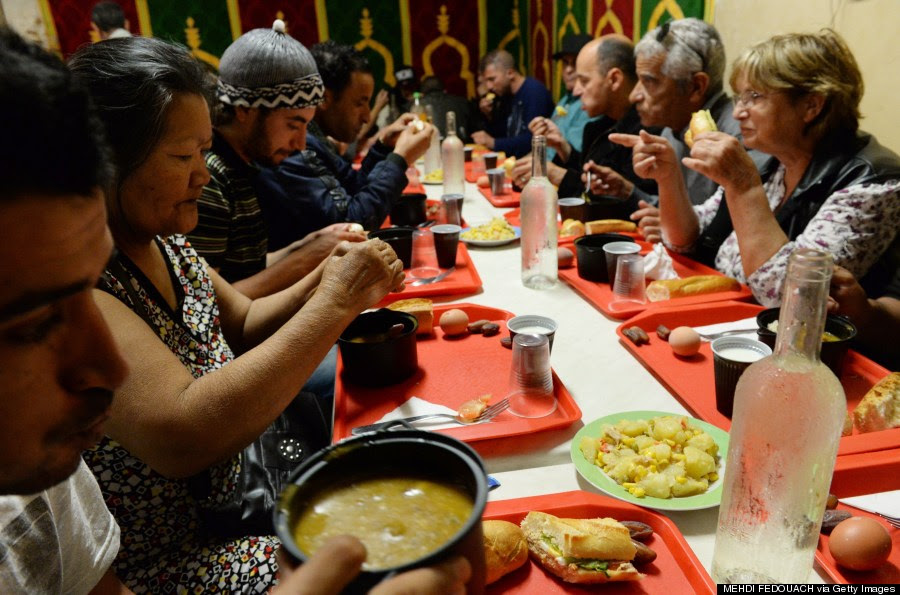
People eat at the breaking of fasting of the second day of Ramadan, in the premises of the Seeds of Solidarity ('Graine de Solidarite') association, on June 29, 2014, in Bordeaux. Founded in 1986, Seeds of Solidarity gives away free meals all year in the streets of Bordeaux, and serves up to 300 meals every night during Ramadan, to homeless and deprived people, regardless if they are Muslim or not. (MEHDI FEDOUACH/AFP/Getty Images)

ramadan
A Malaysian Muslim woman feeds her child as they break their fast on the first day of the holy Islamic month of Ramadan in Kuala Lumpur on June 29, 2014. (MANAN VATSYAYANA/AFP/Getty Images)

ramadan
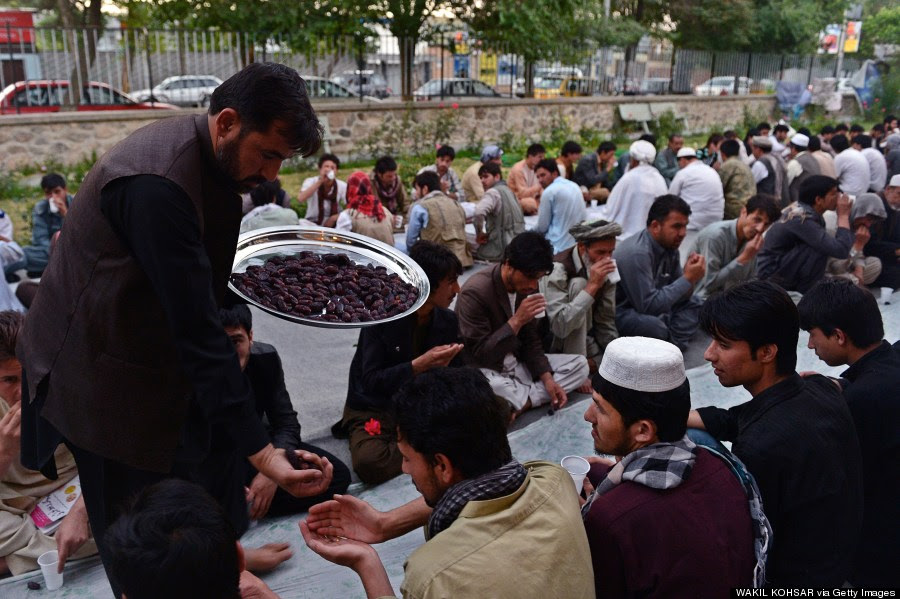
An Afghan resident distributes dates as others break their fast during the holy month of Ramadan at the Wazir Akbar Khan Mosque on June 29, 2014. (WAKIL KOHSAR/AFP/Getty Images)

ramadan
In this Sunday, June 29, 2014 photo, displaced Iraqi boys scramble to receive food to break their fast during the first day of the Islamic holy month of Ramadan, at an encampment for displaced Iraqis who fled from Mosul and other towns, in the Khazer area outside Irbil, northern Iraq. (AP Photo/Hussein Malla)

ramadan
Afghans pray before breaking their fasting during the Muslim holy month of Ramadan in Kabul, Afghanistan, Sunday, June 29, 2014. (AP Photo/Rahmat Gul)

ramadan
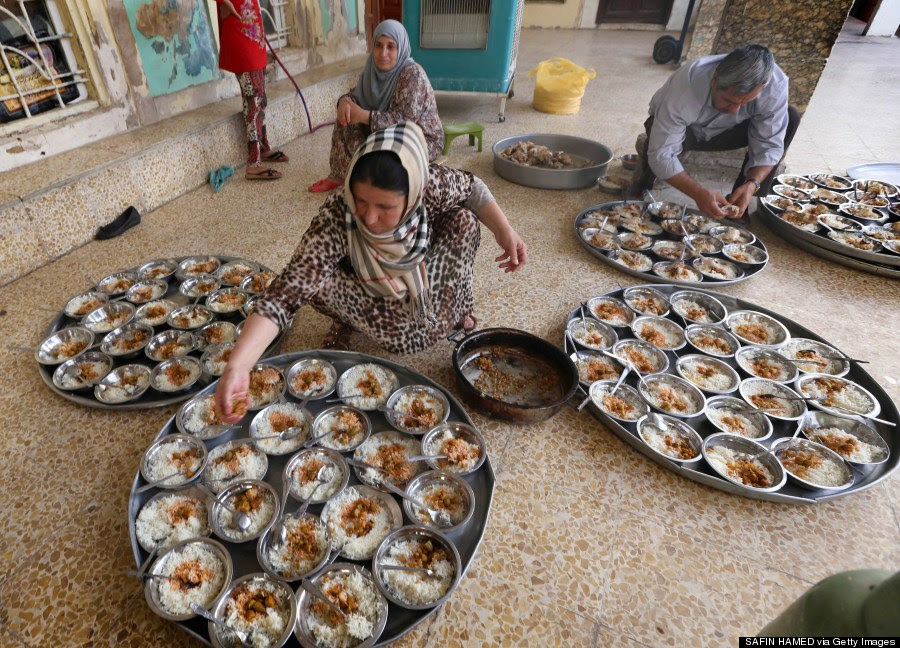
An Iraqi Kurdish woman puts the final touches to bowls of food on the first day of the holy Muslim month of Ramadan, for families who fled the violence in the northern province of Nineveh, at a mosque in Arbil, the capital of the autonomous Kurdish region of northern Iraq, on June 29, 2014. (SAFIN HAMED/AFP/Getty Images)

Bangladeshi street vendors prepare Iftar food to break the daytime fast on the first day of Ramadan at a bazaar in the old part of Dhaka on June 30, 2014. (MUNIR UZ ZAMAN/AFP/Getty Images)

Syrian Muslims break their fast on the first day of the holy Muslim month of Ramadan, in northern city of Aleppo on June 29, 2014. (ZEIN AL-RIFAI/AFP/Getty Images)

--