Tuesday, July 12, 2016

Kashmir Protests coverage by The Indian Express. Mumbai, India

http://indianexpress.com/article/opinion/editorials/afspa-manipur-kin-judicial-killing-army-supreme-court-petition-2907898/


The Indian Express

Editorial

Calling to account

Supreme Court makes it clear: AFSPA does not provide blanket immunity to army personnel.


By: Editorial | Published:July 12, 2016 12:00 am
The Supreme Court ruling on the petition filed by the Extra Judicial Execution Victims Families Association, a representative platform of people in Manipur whose kin have allegedly been summarily killed by security forces, is a strong critique of the manner of deployment of the Armed Forces Special Powers’ Act (AFSPA). The petition had alleged that there have been over 1,500 extra-judicial killings in the state and pleaded for the court’s intervention to deliver justice.
The state and its agencies, under the cover of AFSPA, had sought immunity from legal scrutiny. The SC order has refused to be imprisoned by the state’s security-centric framework and the resultant curtailing of the citizen’s fundamental rights.
The validity of the AFSPA, first introduced in 1958, has periodically come under scrutiny. A constitutional bench had upheld the act in the Naga People’s Movement of Human Rights , the Justice B.P. Jeevan Reddy committee advised the government to repeal it. Last week’s order does well to outline three crucial principles: One, the “order situation in Manipur is, at best, an internal disturbance. There is no threat to the security of the country or a part thereof either by war or an external aggression or an armed rebellion”; two, “for tackling the internal disturbance, the armed forces of the Union can be deployed in aid of the civil power. The armed forces do not supplant the civil administration but only supplement it”; three, “the deployment of the armed forces is intended to restore normalcy and it would be extremely odd if normalcy were not restored within some reasonable period, certainly not an indefinite period or an indeterminate period”. The court has refused to accept the state’s plea that the extra-judicial killings, which took place in “a war-like situation”, need not be investigated. The pointed reference to “restoring normalcy within some reasonable period” has particular resonance in Manipur, a state where the AFSPA has been in force for nearly six decades.
The AFSPA provides the framework for the armed forces but the law clearly lays down the operational procedure which is more often violated than followed. The court has made it clear that the state is bound by the direction of the Constitution bench that “every death caused by the armed forces” should be thoroughly inquired into if there is a complaint or allegation of abuse or misuse of power. In so doing, it disabuses the state of the notion that the AFSPA provides a blanket immunity to army personnel in anti-insurgency operations. To argue that the absence of such immunity could demoralise the forces, the court says, “unsettling and demoralising, particularly in a constitutional democracy like ours h. Commendably, the court has laid the ground for a framework of accountability that the state needs to adopt in its responses to insurgency.

Face the disillusion

In its new phase, the ‘azadi’ struggle in Kashmir is leaderless, and has a strong death wish.

Written by Nirupama Subramanian | Updated: July 12, 2016 7:50 pm
 Burhan Wani, Hizbul Mujahideen, wani killing, burhan wani killing, kashmir protest, kashmir violence, burhan wani violence, J&K, jammu and kashmir, Hizbul Mujahideen commander, kahmir militants, militants in kashmir, burhab wani militant, indian express columnThe security establishment may well conclude that there were faceless entities orchestrating the arrival of the tens of thousands of mourners from across the state over WhatsApp and other social media, that there were over ground workers in the crowd provoking the acts of violence. (Express Photo by Shuaib Masoodi)
Back in April, when Hizbul Mujahideen commander Burhan Wani was still alive, young boys in his home town of Tral declared they were readying for a long struggle in which there would be no leaders. My colleague Basharat Masood and I were in Tral to report on the new militancy centred in South Kashmir, and that remark came when we observed that Burhan and the other militants with him were likely to be captured soon as the police had already eliminated many of them and were said to be closing in on him.
“New militants will come. We are safe now because we have already transferred the struggle to the next generation. The cause is bigger than the individual. Even if [Hurriyat leader Syed Ali Shah] Geelani or [Hizbul Mujahideen leader Syed] Salahuddin side with India, our struggle will not end.” The Centre would try and engage with Kashmir, they said, “but they will find no one to engage with, because there will be no leaders, no one subscribes to any leaders any more”.

Leaders made compromises, they said. Even though many of these boys were not born or were infants at the time, in their minds was inscribed the notion that the previous generation of militants took up the gun because they wanted to become high officials in Kashmir, liberated or not. “Some of them thought, here comes azadi, now I can become a minister, may be even prime minister”. Burhan, on the other hand, was seen to be “pure”, because he had no such “greed”, no political ambition.
There were no leaders at Burhan’s funeral on Saturday. The security establishment may well conclude that there were faceless entities orchestrating the arrival of the tens of thousands of mourners from across the state over WhatsApp and other social media, that there were over ground workers in the crowd provoking the acts of violence.
kashmir-protest-759(Express Photo by Shuaib Masoodi)
That may or may not be true. But the mourners who streamed into Tral from all parts of the state did not believe that they were acting on anyone’s instructions. As they took over the roads leading to Tral, burning tyres and pelting stones, policing the massive influx of people, in their minds they were reacting in spontaneous anger.
As Kashmir boils over at the killing, it is this leaderlessness, and the new ideal of the “azadi” struggle as one that ends in death and a hero’s funeral that should worry the security and political establishment. Even a call for calm by Geelani has not helped defuse the situation. Young Kashmiris continue to revere him as the only leader who has “not compromised” but even he was not spared, as protestors jeered at his appeal.
This is not a situation that developed overnight. Since 2008, when the Mumbai attacks put talks with Pakistan in the freezer and all attempts at a restart tripped up repeatedly, the disillusionment of a new generation of Kashmiri youth has grown, with the continuing presence of the military, Centre’s insistence on keeping AFSPA, and continuing human rights violations, all erupting in the stone pelting agitation of 2010. Then, anger over the 112 deaths of young boys in that episode segued into popular discontent over the 2014 alliance between the PDP and BJP in the last two years, bringing the Valley closer to the bruising debates in the national arena over what to eat and who to marry.
Meanwhile, for a full decade now, since the round table exercise by the previous government under then Prime Minister Manmohan Singh, there has been no political initiative by the Centre in the Valley except the doomed three-member interlocutors panel set up to find out views on the ground and suggest ways to address the issue. Its report has lain in cold storage since 2011. It is the same with the recommendations of the round table committees. That has left the moderate factions of the Hurriyat, which participated in the round table process, in the cold. They had nothing to show for their compromise, and it diminished them in the eyes of a new generation of Kashmiris.
The NDA government has made it clear that it wants nothing to do with either the moderates or hardliners in the Hurriyat, nothwithstanding a cursory line in the BJP-PDP “agenda for alliance” that “the state government will facilitate and help initiate a sustained and meaningful dialogue with all internal stakeholders which includes political groups irrespective of their ideological views and predilections”. If the Centre is firm that it will deal only with the elected representatives in Kashmir and mainstream political parties, the NDA government has hardly been proactive in facilitating even the implementation of the doable political promises in the coalition’s common programme, despite entreaties by the PDP and Chief Minister Mehbooba Mufti.
With infiltration down and fewer incidents of terror strikes in Kashmir, the smugness in the political and security establishment has been apparent. Only a few thousand Kashmiris protesting on the streets, only a handful of militants, we can do encounters, we can do crowd control, it is all very manageable, has been the confident refrain.
kashmir-protest-759-1(Express Photo by Shuaib Masoodi)
But the problem with this is that it is almost entirely security driven. It has meant firing into crowds of youngsters with lethal weapons, resulting in deaths or life-impairing injuries — many boys hit by pellets are landing up at eye hospitals in Amritsar for treatment with their parents fearing their sons might be picked up by police if they went to local hospitals. It has meant taking out militants, which did not seem to matter so long as they were from across the border, but has taken on an entirely different meaning after Kashmiri boys began following Burhan’s example. The fierce resistance put up by local communities, from under 10-year-olds to senior citizens, at encounter sites, and the mass displays of anger more than grief at their funerals, is now all too well known. The police say that the death in encounter of a local militant is a sad event, yet security forces repeat such encounters and are each time taken by surprise at the public reaction.
What this approach has done is to bring out kids as young as 8 or 12-years old, to whom defiance of the Indian state is now as natural as playing cricket. Each death, of a militant or protestor, has become a celebration of this defiance, triggering more protests, adding more grievances, increasing the alienation. In death, Burhan has caused more turmoil in two days than in his six years as a militant. In April, Burhan’s father, Muzaffar Ahmad Wani, a school teacher, had told The Indian Express: “Kashmir is on fire. If India wants to douse it, they need to use water, not oil”. That, really, is the lesson from Kashmir’s weekend of fury.
---

Kashmir protests: Pellets take a toll, 92 eye surgeries and counting


Pellet guns have been regularly used to quell protests in Kashmir since 2010, when the state police introduced them as “non-lethal weapon”, their use has increased over the years.


Written by Muzamil Jaleel | Srinagar | Updated: July 12, 2016 7:45 pm
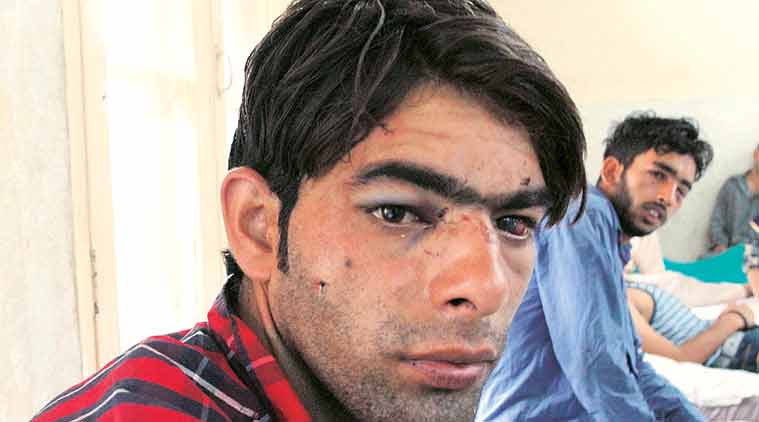
kashmir, kashmir violence, rajnath singh, burhan wani death, kashmir violence, kashmir hospital, jammu kashmir violence, kashmir grenade attack, kashmir clash, burhan wani killing, hizbul mujahideen, hizbul mujahideen commander burhan wani, kashmir curfew, news, india news, latest updates kashmir, india newsAll 72 beds in the ophthalmology ward of Srinagar’s SMHS hospital, where Yasin is recovering, are occupied — some by two patients. (Express Photo: Shuaib Masoodi)
Eighteen-year-old Mohammad Yasin lies on a hospital bed, his vision smeared with a white haze. He is not sure if he will ever see properly again.
All 72 beds in the ophthalmology ward of Srinagar’s SMHS hospital, where Yasin is recovering, are occupied — some by two patients. The patients are mostly young, many of them minors, including a 12-year-old girl. The hospital administration had to vacate half of the adjoining medicine ward to accommodate the rush of youths with injuries to their eyes, sustained in protests in the wake of Burhan Wani’s killing.
“We have already operated on 92 patients. Every hour, more young men arrive with pellet injuries to the eyes. We are overburdened,” said Dr Sajjad Khanday, an ophthalmologist.

He said the injuries are so severe that the damage is almost always permanent. “In most cases, the first people to speak to patients are policemen in plainclothes. They record their antecedents even before we can examine them,” he said. “We had to shut our operation theatre in the trauma unit because it was getting difficult to stop people from entering.”
Though pellet guns have been regularly used to quell protests in Kashmir since 2010, when the state police introduced them as “non-lethal weapon”, their use has increased over the years. The use of pellet guns in the current clashes, doctors said, is “unprecedented”.
The pellets, sources said, come in grades ranging from 5 to 12, depending on damage, range and speed; 5 being the most damaging. Sources said number 9 is preferred to control crowds but police often use the stronger number 6 or number 7 in villages.
“These pellets don’t kill you, which means there isn’t any body count, so police are fine with it. But once a young man loses one or both of his eyes, it is worse than death,” Khanday said. “Not just his life, his entire family is destroyed. We have seen families take their children to places like Chennai in the hope that vision can be restored. It takes years for a family to accept the fate. There are very few cases where intervention helps after a pellet has pierced the eye.”
Inside Ward 8, Yasin, a resident of Chursoo village, said he had gone to Tral on Saturday to participate in Burhan’s funeral. He was returning home when policemen fired pellets at a group of about 20 boys. “I was the only one hit. I remember something burning entering my eye. I felt an excruciating pain,” he said. “I walked many miles to reach Awantipora hospital. The doctors there told me they cannot help.”
He said he saw an ambulance van heading to Pampore and boarded it. Then he hopped into another ambulance which took him to Srinagar. “I have two pellets in my right eye. My family doesn’t know what has happened to me. I haven’t been able to reach them on the phone.”
An older boy, recovering on the same bed, was hit by a pellet on the left eye. Distributing biscuits to others in the ward, he said, “I can’t see a thing from my left eye. We were protesting. We were shouting slogans. They (the police) came and fired pellets.”
He then unbuttoned his shirt and said, “Look at the injury marks on my chest.”
Doctors said even patients who can see right now sometimes complain of vision loss after a few weeks. “These pellets are devastating for the eyes. They make a hole and destroy the tissue. We can do nothing to help. There are 10 such cases today,” Khanday said.
One patient, hit by a pellet on the right eye during a protest in Parimpora on Monday, said his only consolation is that “I can still see with one eye”. “I am very angry. They want us blinded for life. Is this the way to treat people who are seeking their rights?” he said.
Khanday said a lot of cases go unreported. “It took one patient two days to come from Achabal (south Kashmir) to the hospital. There are many who are not able to make it here,” he said. “One young man lost an eye to a pellet earlier. The healthy eye was hit by a pellet today.”
Another senior doctor at SMHS hospital who did not wish to be named said, “We have never seen anything of this magnitude. Everyone who came here has pellet wounds above the chest.”
A senior police officer said that while they are aware of devastating effects of such eye injuries, they don’t have an option. “The use of pellet guns to control protests is preferred to the use of live ammunition. Deaths attract a lot of attention. Plus there is a view that when a protester is hit with a pellet in the eye, it becomes a deterrent. I don’t agree with this, but that is what is happening,” the officer said.

Sunday, July 10, 2016

Modi is wrong, terrorism is not our gravest threat today - By Aakar Patel - The Times of India

http://blogs.timesofindia.indiatimes.com/aakarvani/modi-is-wrong-terrorism-is-not-our-gravest-threat-today/


The Times of India

Modi is wrong, terrorism is not our gravest threat today

 in Aakarvani | India | TOI

Author

Aakar PatelAakar Patel
Aakar Patel is a writer and columnist based in Bangalore. Why I Write, Patel’s book translating Saadat Hasan Manto’s non-fiction from Urdu to English was published in 2014. He has also translated the writing of India's prime minister Narendra Modi from Gujarati. Patel's book on India's culture, Low Trust Society, will be published in 2015. He is a former newspaper editor and has worked at publications across India.

What is the gravest threat to the world? The linguist Prof Noam Chomsky says it is two things: climate change and nuclear weapons. Many would agree, particularly with the first. Rising seas and an unpredictable monsoon will be extremely dangerous for us.
As Indians we can add other grave threats confronting us, some of them currently. Above all our poverty, which kills and continually hurts hundreds of millions of us. What else? More than five lakh Indian children die of malnutrition every year, meaning 10,000 each week. Thirty eight per cent of Indian children are stunted at age 2, forever denying them a fulfilling life, intellectually and physically. Then there are other types of grave threat. Full automation of industry under artificial intelligence and the spectre of mass unemployment may just be around the corner. There is no shortage of things for us to worry about.
So what does Prime Minister Narendra Modi think on this subject? ‘Terror gravest threat to world today, says Modi in Mozambique.’ That was the Times of India headline from July 8. Modi has said this often. He told the US Congress last month that ‘globally, terrorism remains the biggest threat’. In that speech he used the word ‘terror’ 10 times and poverty once, showing his priority.
ATM--Poverty
Malnutrition claims lives of five lakh Indian children every year.
Exactly what sort of threat is terrorism? In India, we have three conflict areas: the Northeast, the Adivasi belt and Jammu & Kashmir. Outside these three zones, in the areas where over a billion Indians live, the total number of those killed in terrorist attacks this year so far has been 21, most of those killed being armed combatants. Last year it was 23, in 2014 it was 4, in 2013 it was 25 and in 2012 it was 1. This includes those we have killed as terrorists. Clearly, terrorism is not a ‘grave threat’ and certainly not the ‘biggest threat’ to India. In fact, and this may be hard to swallow, the urban Indian, you and I, is safer than the average European and American when it comes to terrorism.
In Europe, a continent of 750 million, a total of 150 people died in terror attacks in 2015. But in the 1970s, over 400 Europeans a year died for many years, killed by various non-Islamist terror groups, including Irish and Basque separatists. So it would be incorrect to say terrorism is a bigger threat there today. In the US, the number of fatalities from terrorism is in the single digits annually on average. So why is terrorism considered a threat?
The big brand of terrorism today, Islamic State, elicits extremely negative views in all Muslim nations including Pakistan. It is unpopular and has difficulty in expanding. The whole of the IS army in Syria and Iraq numbers a third of the army of Bangladesh. The warriors of IS cannot match any modern army in set position warfare, which is required to hold territory. To assume IS is a threat to the world militarily is to know nothing about war.
If the facts are clear, and they are, why is terrorism such a big deal? The answer is that it is an issue which angers many of us, unlike malnourishment, poverty and illiteracy. I am not surprised when my uncle in Surat bangs his armchair and says we have to ‘fix Pakistan’ and ‘publicly hang these terrorists’. Responding to terrorism requires maturity and perspective that he lacks, and that is fine. He is no different from drawing-room experts elsewhere in the world. But I am worried when our Prime Minister buys into the same bunkum. When Modi chases after the ghost of terrorism, it damages us.
One example: the disproportionate focus the media, particularly the news channels, brings to terrorism becomes legitimised. What is essentially an upper-class anxiety becomes a global threat because it is elevated by Modi’s endorsement.
Our media needs to be weaned away from the silly idea that terrorism is in any way significant as a national issue, leave alone a global one, and focus on more serious things. We are damaged as a nation when our leader sets our global priorities in as wrong-headed a manner as Modi is doing.
Our gravest problem is not terrorism, and that is manifest. It is poverty. It is the inability of the state in India to help its citizens out by improving the quality of literacy and health. When he does not even acknowledge these failings as the priority, as Modi is doing when he goes on about terrorism being our ‘gravest threat’, the Prime Minister fails the majority of Indians.
DISCLAIMER : Views expressed above are the author's own.
---

Saturday, July 9, 2016

My friend, Union minister MJ Akbar By: Aakar Patel - www.abpliv.in

http://www.abplive.in/blog/my-friend-union-minister-mj-akbar

Inline image 1

My friend, Union minister MJ Akbar

By: Aakar Patel | Last Updated: Saturday, 9 July 2016 3:11 PM
    
1

TOTAL SHARES
My friend, Union minister MJ Akbar
MJ Akbar, who was made a minister on Tuesday, is from a time when English editors were national celebrities. Akbar was in his mid 20s when he became editor of Sunday magazine, published from Calcutta. He was in his 30s when he launched the Telegraph newspaper and in his 40s when he launched his own publication, Asian Age.
All this time, he also had a second career. He was a Lok Sabha MP from Bihar in Rajiv Gandhi’s second election, the one he lost to VP Singh in 1989. Syed Shahbuddin, whom Akbar defeated, said he was physically prevented from filing his nomination. Whether this was true or not it showed how strong was the desire of Akbar to come to power. Unfortunately for him, Akbar was only able to achieve the post of spokesman and after Rajiv Gandhi’s death, he was discarded by Narasimha Rao.
According to a story Akbar told, once he and Rajiv Gandhi were together when Rao entered the room. The old man had a small mishap, I think he tripped over his dhoti, and the two younger men laughed. Rao did not forget and Akbar’s career with Congress was shortlived.
I have known Akbar for over 20 years and believe he was the finest editor of English in India.
Better than Arun Shourie and Vinod Mehta and Pritish Nandy, and he knew it. When Shourie became a minister and Nandy a Rajya Sabha MP in the mid 1990s, Akbar would have felt jealous at seeing people who were his juniors in journalism achieve what he wanted and what he was convinced, he deserved more than they did.
When Sonia Gandhi took charge of the Congress, Akbar was hopeful for some time that he could return to favour but this did not happen. His newspaper also ran into financial trouble and he was fired from his post by the other partners. This began a long spell when he was on the margins and this is when, almost secretly, he began to cultivate Narendra Modi.
To me this is surprising for two reaons. First, because some of the sharpest criticism of Modi has come from Akbar. Attacking Hindutva policies in Gujarat, Akbar wrote an editoral under the headline ‘there must be a difference between a mob and a government’. In his regular column, he wrote “Narendra Modi has done enough by now to win the highest honor that a nation can give. Not our nation. What the chief minister of Gujarat truly deserves is the Nishan-e-Pakistan.”
He said that Modi had “served the interest of Pakistan” by “trying to destroy the idea of India as a nation in which every citizen is equal irrespective of his faith. He has provided the evidence that was once offered only as argument.”
He added: “Till he started his lynch-mob response to the cruel tragedy of Godhra, all the negative focus of South Asia was concentrated on Pakistan.”
The second reason I was surprised was because Akbar is truly secular in a way most of us are not. He keeps dozens of idols of Ganeshji in his office and has belief in the power of that god. He also is a regular, like his namesake the Mughal emperor Akbar, at the dargah of Moinuddin Chisti in Ajmer. He is not the sort of person who would ever subscribe to the RSS idea of India.
He can be described as a Nehruvian and his biography of India’s first prime minister is his most serious work of non fiction. Akbar’s ideology has been transferred to dozens of journalists who worked under him, like Sankarshan Thakur and Manini Chaterjee and Seema Mustafa. All were surprised when suddenly the news came that Akbar was joining the BJP, the party he has written against for decades.
But it is true that today, when he is in his mid 60s he has finally achieved his goal somewhat. I say somewhat because Akbar is not a Cabinet minister, nor a minister of state with independent charge. He is merely one among many ministers of state. He will be reporting to another minister and I am certain Akbar will feel that he is that individual’s intellectual superior.
Many years ago he one day said to me he wanted to be prime minister of India but could not because he was Muslim. At least he has become a minister. And if that has required discarding all the principles and disowning all of his own writing, to him that may not be a big price to pay.
First Published: Saturday, 9 July 2016 3:11 PM

Chilcot Report and Zionist Lobby’s Role in Iraq War – Gilad Atzmon

http://caravandaily.com/portal/chilcot-report-and-zionist-lobbys-role-in-iraq-war-gilad-atzmon/

Inline image 1


Home / COLUMNISTS / Gilad Atzmon / Chilcot Report and Zionist Lobby’s Role in Iraq War – Gilad Atzmon
Gilad Atzmon is an Israeli peace activist, writer, poet and popular musician who now lives in London. Hisrecent book, The Wandering Who? A Study of Jewish Identity Politics, is available on Amazon.com


Chilcot Report and Zionist Lobby’s Role in Iraq War – Gilad Atzmon


in Gilad AtzmonINSIGHT 1 day ago 0 368 Views
israel uk flags
Since the Iraq war, the same Jewish Lobby has mounted enormous pressure on western governments, promoting more Zio-centric interventionist wars in Syria, Libya and Iran. So why did the Chilcot Inquiry fail to address this topic? This crucial failure by Chilcot was to be expected. In 2010, highly respected veteran British diplomat Oliver Miles had something to say about the Jewish make-up of the Chilcot Inquiry. Two out of the five members of the inquiry were Jews, pro war and Blair supporters 
GILAD ATZMON | Caravan Daily
It took seven years for Sir Chilcot and his team to reach a set of conclusions that every Brit capable of thought understood back in November, 2013.
The inquiry produced a damning assessment of Blair’s conduct as well as the British military. But the Chilcot Inquiry failed to expose the crucial close ties between Blair’s criminal war, the Jewish Lobby and Israel.
At the time Britain entered the criminal war against Iraq, Blair’s chief funders were Lord ‘cashpoint’ Levy and the LFI (Labour Friends of Israel). The prime advocates for the immoral interventionist war within the British press were Jewish Chronicle writers David Aaronovitch and Nick Cohen. The attorney general that gave the green light for the war was Lord Goldsmith.
In 2008 The Guardian revealed that the “Foreign and Commonwealth Office (FCO) successfully fought to keep secret any mention of Israel contained on the first draft of the controversial.” Israel was conspicuously engaged in the vast production of WMDs. If Britain and America had any genuine concerns about WMDs, bombing Tel Aviv would have been the way to go.
In 2003 some intelligence experts insisted that the Iraq’s WMD dossier was initially produced in Tel Aviv and only ‘sexed up’ in London.
Since the Iraq war, the same Jewish Lobby has mounted enormous pressure on western governments, promoting more Zio-centric interventionist wars in Syria, Libya and Iran. So why did the Chilcot Inquiry fail to address this topic?
This crucial failure by Chilcot was to be expected. In 2010, highly respected veteran British diplomat Oliver Miles had something to say about the Jewish make-up of the Chilcot Inquiry. Two out of the five members of the inquiry were Jews, pro war and Blair supporters.
This is what Miles wrote in the Independent:
“Rather less attention has been paid to the curious appointment of two historians (which seems a lot, out of a total of five), both strong supporters of Tony Blair and/or the Iraq war. In December 2004 Sir Martin Gilbert, while pointing out that the “war on terror” was not a third world war, wrote that Bush and Blair “may well, with the passage of time and the opening of the archives, join the ranks of Roosevelt and Churchill” – an eccentric opinion that would seem to rule him out as a member of the committee. Sir Lawrence Freedman is the reputed architect of the “Blair doctrine” of humanitarian intervention, which was invoked in Kosovo and Afghanistan as well as Iraq.
Both Gilbert and Freedman are Jewish, and Gilbert at least has a record of active support for Zionism. 
Such facts are not usually mentioned in the mainstream British and American media, but The Jewish Chronicle and the Israeli media have no such inhibitions, and the Arabic media both in London and in the region are usually not far behind.”
Oliver Miles point was valid, and proved correct. The Chilcot Inquiry wasn’t just destined to fail. It was designed to subvert any scrutiny of Israel and its hawkish pro war lobby.
The Chilcot Report gave the British public what it wanted. It blamed Blair for failing in his responsibilities to them. But the report’s focus on Blair, diplomacy, the military and  intelligence failures concealed the Lobby that was pulling the strings.
---