Sunday, April 12, 2015

I Would Have Sentenced Rajiv Gandhi and Veer Bahadur Singh to Death - By Ilyas Azmi - ex MP Lok Sabha


http://www.urdumediamonitor.com/2015/04/11/i-would-have-sentenced-rajiv-gandhi-and-veer-bahadur-singh-to-death/

Urdu Media Monitor

I Would Have Sentenced Rajiv Gandhi and Veer Bahadur Singh to Death

By Ilyas Azmi
As the news of release of the perpetrators of Hashimpura Mass Murder case became public, the scenes of 28 years ago started re-playing in the minds of many people like me.
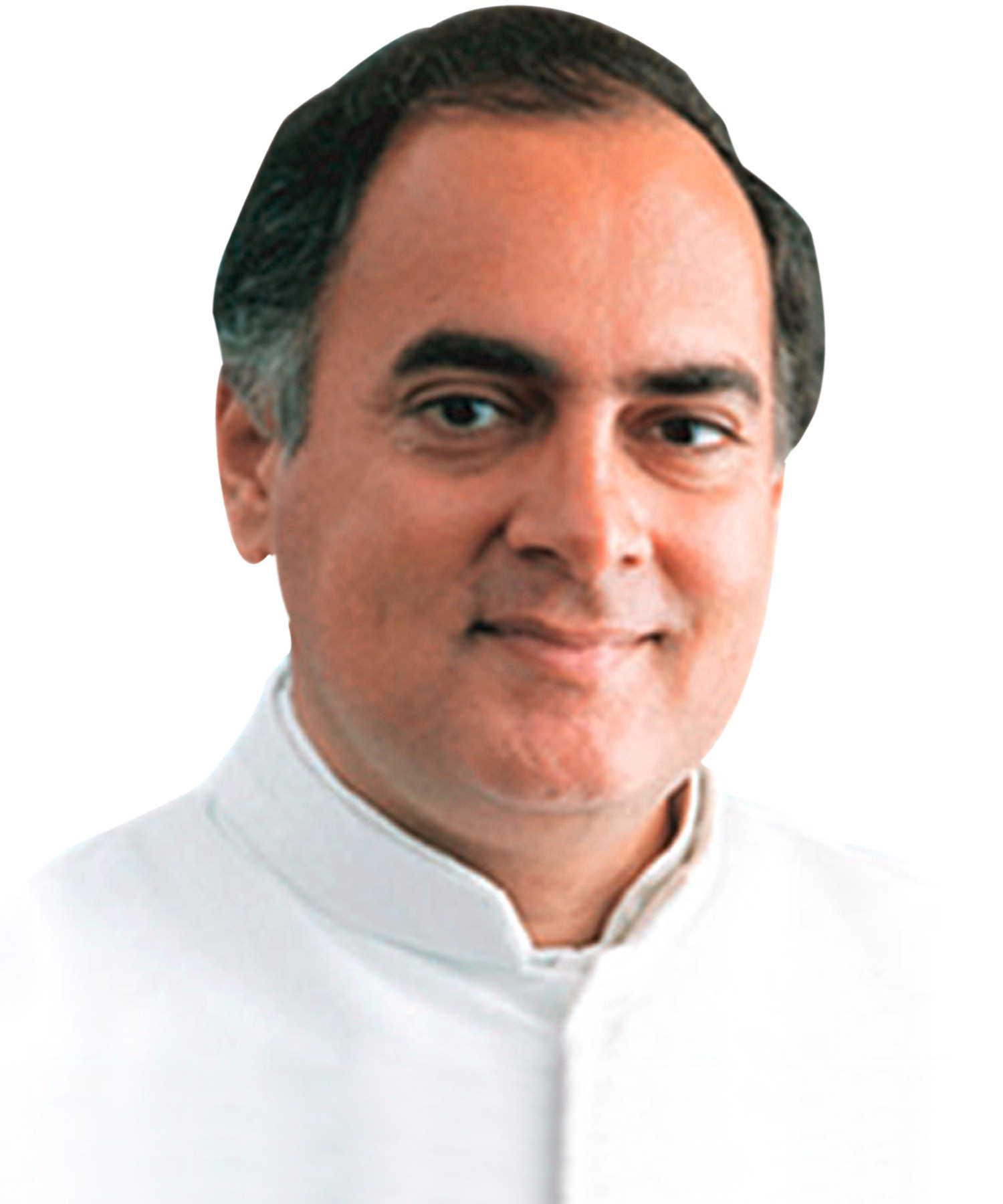
Rajiv Gandhi
Rajiv Gandhi

It was merely three years after departure of the British Rule that the shrewdest of the shrewd, Jawahar Lal Nehru had, by making it a legal requirement for a Dalit to be a Hindu to get provision of reservations guaranteed by the secular spirit of the Constitution, buried it with great pomp and show so deep in the Mughal Garden of Rashtrapati Bhawan that he had left no chance ever for it to come out of its grave.
Having been active in every national and popular movement launched in the country after the British had departed; I have the privilege to be an eye witness to most of the incidents that happened then.
The 1987 Meerut riot was one of those thousands of riots the foundation of which had been laid by Rajiv Gandhi on 1stFebruary 1986 by getting the infamous lock of Babri Mosque opened.
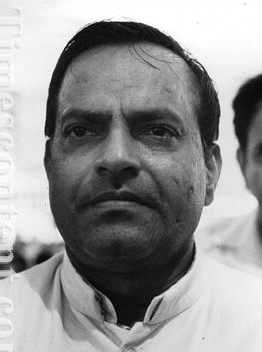
Veer Bahadur Singh
Veer Bahadur Singh

On the pretext of the Gomti river flood Rajiv Gandhi went to Lucknow. There he removed the Chief Minister Narayan Dutt Tiwari and replaced him with Veer Bahadur Singh. This is now no secret anymore that Veer Bahadur Singh was contracted as Chief Minister with a certain task to perform. Only few days later, Chairman of Waqf Board Farhat Ali was called from Allahabad to Lucknow. Veer Bahadur Singh then pressurised him and tried to bribe him with the promise of making him as Indian Ambassador to the US on condition that Waqf Board [relinquished its claim to and] handed over the Babri Mosque [to the Government]. But Farhat Ali was neither a clergy nor a political leader who could have succumbed to the offer. What was said to him during the next three days, Farhat Ali had then narrated to me word by word.
Having failed ‘Waqf Board Mission’, Rajiv Gandhi immediately sent a known Supreme Court Judge to Faizabad and got the District Judge Krishna Mohan Panday to agree to get the Mosque lock opened through a court order. This should be borne in mind that [as his reward] the said judge of the Supreme Court never retired from the service and continued acting as the Chairman of one or the other commission until his last breath.
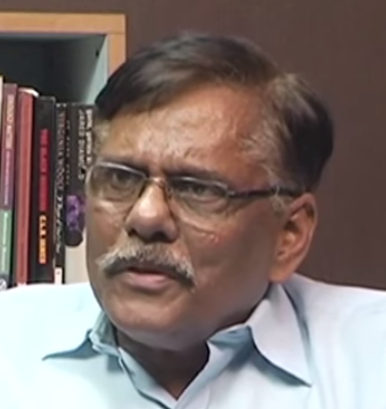
V. N. Rai
V. N. Rai

The 1987 Meerut riot, during Ramadan, was part of a series of several such riots that had broken out in different parts of the country after the reopening of Babri Mosque [for Hindu worship].As per Congress’ tradition Veer Bahadur Singh had hosted an Iftar Party at his residence and from Meerut he went straight to the Iftar party. There during the party Veer Bahadur Singh’s PA informed him of two phone calls from Delhi which he ignored. As food was being served and Veer Bahadur Singh had hardly taken a bite or so when his PA told him that the Prime Minister was himself on the line.
Veer Bahadur Singh stood up and few moments, without even seeing off the guests, left for the airport. In Delhi Rajiv Gandhi told Veer Bahadur Singh that the Muslims in Hashimpura and Imlian had become so rebellious that during the curfew they did not let the police enter in these areas and ‘This cannot be tolerated.’
Veer Bahadur Singh informed the Prime Minister that peace had been restored in Meerut. Yet, as ordered by the Prime Minister, next day he reached Meerut. There he met the commanders of different battalions of PAC.  All of them told him that the PAC had already gained notoriety and since peace had returned to the city and nothing else could [or should] be done. However, the commander of 41 Battalion of Ghaziabad was willing to obey the orders. Therefore, he was given instructions in private. [If this sounds surprising remember ‘Mr Clean’s’ role in 1984 anti-Sikh riots—UMM]
Veer Bahadur Singh spoke Bhojpuri and used to stammer.  The commander mistook Imlian for Maliana. Maliana was a village on the outskirts of the city around which temporary residential colonies had come up. During the riots not a single person had even his nose bleed. But due to Veer Bahadur’s stammer the wrath that was to befall on Imlian moved to Maliana.
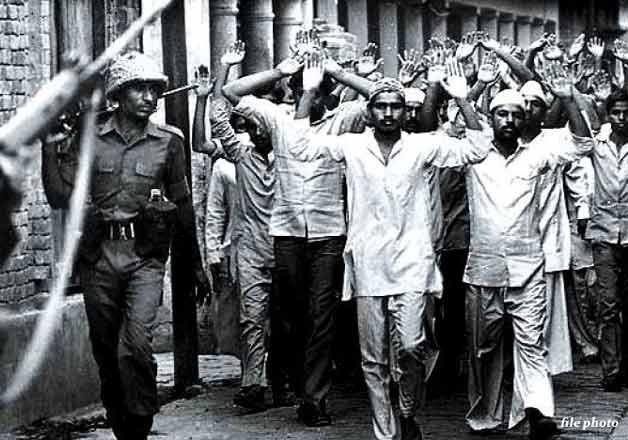
Muslims being taken away by the police

On 22 May 1987 it was not only Hashimpura that had witnessed massacre. During the day a company of PAC entered in Maliana village and opened fire blindly killing 62 people. Virender Sengar of weekly Chauthi Dunya happened to be in Maliana at the time. From there he reached Delhi and gave an eye witness account to Late Javed Habib. Javed Habib called for me. By the time I reached Zakir Nagar Virender Sengar had left for somewhere else. Javed Habib narrated the story to me on the basis of which I wrote an article and through the help of some of my people in Bombay got that published in daily Inquilab.
One part of 41 battalion of PAC was sent to Maliana and another to Hashimpura. In Hashimpura a large number of residents were taken into custody and were kept in four different police stations. What happened to them and how they were treated there I had been witnessing similar picture in Maunath Bhanjan and other places for years before. In the evening out of them 43 young men were selected and herded in four trucks. The destination of these trucks had already been decided. They were unloaded on the banks of Gang canal and Hindon river and were riddled with bullets. While their dead bodies were being thrown in the river, as the latch of the back of one of the trucks was opened the kidnapped youths therein jumped out in tandem and tried to escape. Rifles of the PAC started to shower bullets at them. Five of them who were injured managed to jump in the river or were thrown by the PAC for being mistaken as dead. On the banks of the river there are large villages of Muslims.  One of the injured named Zulfiqar, managed to reach one of those villages. The villagers took him to Delhi the same night. Another villager fished out four of the wounded and took them to Ghaziabad police station.
At that time Vibhuti Narain Rai was Senior Superintend (SSP) of Police in Ghaziabad. He recorded their verbatim statements in police register and got them hospitalised. On the other hand at that moment Veer Bahadur Singh was asleep in UP Niwas in Delhi. He was woken up at 4.00 a.m. and was informed that V.N. Roi had registered everything in police record. ‘Ei to gajab hoi gawa,  Ei to gajab hoi gawa’ [This is a disaster, this is a disaster] he screamed and ran towards his car barefoot. He reached Ghaziabad and suspended V. N Roy and ordered heavy police vigilance around the hospital where the wounded were admitted so that no one could meet or see them.
In those days a bridge was then being built on Highway No 24 in Masuri and due to that scaffoldings had been erected over the canal. Some of the bodies that came floating there got entangled in these scaffoldings. The residents of Masuri took these bodies out and performed their last rites and perhaps when they had already buried them then the news of it became public.
Later after a long period a magisterial inquiry was initiated by then in Uttar Pradesh the State Government had jumped out of the frying pan of ‘secularism’ into the fire of ‘socialism.’ The important thing is that the ‘socialism’ of Uttar Pradesh was ‘secular’ too i.e. karela woh bhi neem Chadha [to make the matter worse].
The Socialism of Uttar Pradesh is the rarest in the world and perhaps is the eighth wonder, of the world. In this no party rules but the Government is of a particular family and particular caste and no rule of law applies to it. If a large number of 19 accused of Hashimpura massacre belonged to the ruling caste, could any Government then dare plead its own case? Could it dare present evidences and witnesses in a court of law?
In Uttar Pradesh the rule of the fraudulant and fascist Congress party had come to an end the day when it got buried under the rubble of Babri Mosque. Its last rites were performed with the martyrs of Hashimpura and Maliana. Besides Congress there are BJPBSP and Samajwadi Partyand all of them have some sort of understanding all along among themselves. The election ofDimple Yadav from Kannauj is such a solid proof of what I am saying that after this only a mad person would ask for a proof.
The biggest truth of this tragedy is that Rajiv Gandhi had appointed Veer Bahadur Singh as a contract Chief Minister in order to make him perform some dirty tasks. Whenever Veer Bahadur’s conscience troubled him he used to open his heart to his friend Jai Parkash Shahi who used to use that information for his exclusives. When the [high command in] Congress realised that all these secrets were being given to Jai Prakash by Veer Bahadur Singh, as there was no other source that would have known the secrets discussed between the Prime Minister and the Chief Minister, then as soon as the contracted assignments were accomplished Veer Bahadur Singh was replaced with Narayanan Tiwari again. Few days later Veer Bahadur Singh was found dead in a hotel in Europe and soon Jai Prakash Shahi was also made to join him through a road accident. Are these mere coincidences? Long live Nehruvian secularism; long live Mulayam brand socialism on the basis of that the main accused killers of Maliana and Hashimpura were not even suspended from their posts. If I was the judge I would have still given them few years  in prison and would have tried Veer Bahadur Singh and Rajiv Gandhi, the real killers, and awarded them death sentences.
Human history has even in democracies witnessed the murderers like from Hitler to Bhutto, Mujiburrahman, Indira Gandhi, Rajiv Gandhi and Saddam Hussain and their ultimate end.
From the time of the Holy Prophet (PBUH) mothers of the Muslim Ummah have also given births to one hypocrite worse than the other. This article will not be complete without me mentioning that in both of the major parties each and every servant thereof is a masterpiece from the school of Abdulh ibn Ubayy Salool.  For as long as the Millat does not get rid of the burden of its collective sins its necks will remain cracking under this load. Mathura, Masuri, Faizabad and Muzaffarnagar will keep on being repeated and there is no other way of stopping them from being repeated.
Ilyas Azmi is a former MP and a senior leader of Aam Admi Party
Translated and slightly abridged from daily Sahafat, 9 April 2015, Delhi, by Urdu Media Monitor.Com

Saturday, April 11, 2015

What India Can Teach Us About Islam and Assimilation - By Shikha Dalmia - TIME Newsmagazine

http://time.com/3817133/india-muslim-assimilation-islam-us/

TIME NEWSMAGAZINE


IDEAS RELIGION

What India Can Teach Us About Islam and Assimilation

April 10, 2015

Shikha Dalmia is a senior policy analyst at Reason Foundation.

What Ayaan Hirsi Ali gets wrong about Muslim immigration

Ayaan Hirsi Ali, a Somali, Muslim-born émigré who is one of Islam’s fiercest critics in the West, warned in TIME that Americans should stop thinking of Charlie Hebdo-style massacres as something that “couldn’t happen here.” Sure, America doesn’t have Islamists calling for the “United States of Sharia,” as in Europe. But the Muslim population in America is on track to grow at over twice the rate of that in France over the next 15 years, she maintains. And this is a problem given that even moderate Muslims might be resistant to the American melting pot because they’ll want ultimately to live in a society governed by sharia. Therefore, they may instinctively “turn a blind eye to the use of violence and intimidation tactics…against apostates and dissidents.” And Americans need to wake up from their torpor and confront the threat.
The suggestion that Americans, who have spent trillions on multiple wars and an intrusive “homeland security” apparatus post 9/11, are insufficiently alarmed about Muslim extremism is more than a little bizarre. But setting that aside, how accurate is Hirsi Ali’s suggestion that Muslims are inherently incapable of assimilating in non-Muslim societies?


Not very, if the experience of India, the world’s most populous democracy, is any indication. Muslims make up almost 15% of India’s population, compared to 0.8% in America. And they couldn’t be any more dissimilar to the portrait drawn by Hirsi Ali.
If Hirsi Ali were right about the perennial allure of radicalism for Muslims, India, a country where I grew up and lived before moving to the United States and making Michigan my home, should be Ground Zero for Islamic militancy. Instead, Indian Muslims participate fully and enthusiastically in their nation’s civic and cultural life, including, remarkably, its majoritarian Hindu religious traditions, without experiencing too much cognitive dissonance. As of last year, four of them were known to have joined ISIS — while the total number who may have gone is unknowable, it appears to be far fewer than the numbers in Europe and America that Hirsi Ali plays up. Those known cases may be four too many. However, as I’ve pointed out elsewhere, there are always some malcontents in liberal societies who are attracted to illiberal ideologies. Some Americans left for the Soviet Union during the heyday of communism.
Muslims have lived in India for a millennium, first arriving in small pockets as traders and then in large numbers as invaders. They established the Mughal dynasty that ruled the country for 300 years till the Hindu majority took over and established a secular democracy after colonial rule ended in 1947. If Hirsi Ali were correct, the ignominy of being deposed from power and subjected to infidel rule would bring out their worst extremist tendencies.
Instead, India’s Muslims are no more prone to violence than anyone else. Muslim insurgency has broken out in some parts of India like Kashmir. But that’s at least partly a response to an abusive and obtuse central government that has ignored local needs, much like the Sikh separatist Khalistan movement in the 1980s. That’s why George W. Bush famously introduced Manmohan Singh to Laura Bush as “the prime minister of India, a democracy which does not have a single al-Qaida member in a population of 150 million Muslims.”
Rampant prejudice in housing and elsewhere — along with occasional outburst of Hindu nationalist violence — has hindered Muslim progress, relegating Muslims to the lowest socio-economic rungs. Yet, Indian Muslims have avoided the sword and eagerly seized the opportunities afforded to them by their country’s (imperfect) democracy.
Consider: Four Muslims have served as India’s president — a ceremonial but high office reserved for civilians of major accomplishment. One of them, A.P.J. Abdul Kalam, played a leading role in developing India’s ballistic missile and nuclear weapons program with no apparent qualms that he was boosting the military of a nation of infidels. The founder of Wipro, a software giant that is India’s pride and joy, is Prem Azmji, a Muslim man. Muslims are among India’s most prominent cricketers, a sport that means even more to India’s national pride than a moon landing may someday.
Muslims are an integral part of every facet of Bollywood, India’s 125-year-old film industry whose open veneration of romantic love is deeply subversive of puritanical Islamic strictures. Indeed, Bollywood’s three top male stars right now are Muslims (all with the last name of Khan) — and Muslim women have always been among Bollywood’s top actresses. Also, some of these stars are among India’s most vocal progressives fighting for the rights of gays,women, and minorities — not to mention sexual liberation.
But nothing speaks more to the depth of Muslims’ cultural assimilation in India than the fact that Muslims have written, composed and sung some of the most popular bhajans or Hindu devotional songs. The late Mohammad Rafi, a Muslim singer who is a household name in India, sang bhajans so poignant and soul stirring that they bring tears to the eyes even of a Hindu-turned-atheist like me. Iqbal, a Muslim poet, wrote the lyrics of arguably the most patriotic song in India that celebrates “Hindustan” as the best nation in the world. More recently, A.R. Rahman, an observant Muslim composer who won an Oscar for his score in Slumdog Millionaire, has recorded the most goose-bump-inducing rendition of Vande Mataram — an ode to the Hindu Motherland. (Conversely, Hindu musicians have created many moving Islamic Qawwalis or Sufi songs dedicated to allah.)
Indian Muslims are proud of their tradition of tolerance and moderation and guard it zealously from Wahhabi influence. They’ve even refused to bury the bodies of Muslim suicide bombers, including the Mumbai attackers, the ultimate punishment because it forever deprives the bombers of a spot in heaven. Indeed, in recent years many Indian Muslims have been fighting tooth-and-nail against Saudi-funded Wahhabis who are trying to take over India’s madrassas and Muslim shrines. Some even submitted a memorandum to Indian authorities demanding that madrassas be reformed to include modern education alongside traditional religious instruction.
In other words, the moral high ground among Indian Muslims is decisively on the side of moderates, not extremists — in complete contradiction to Hirsi Ali’s predictions for America.
Furthermore, notes William Dalrymple, a celebrated British writer who has written extensively about the Islamic world, Indian Muslims are not all that unique. Even in countries where they are the majority, Muslims are often doctrinally flexible, allowing a great deal of give-and-take with other religions and sharing their festivals and sacred spaces (Saudi Arabia and other countries where Islam is the sole religion are a different story). For example, he notes, the Coptic festivals in Egypt attract thousands of Muslims as do many Christian shrines in Syria, such as the pilgrimage church of Our Lady of Seidnaya outside Damascus, which attracts many Muslim couples seeking children. He is a friend of Hirsi Ali, and admires her spirit, yet regards her fears that Islam is inherently — and ineluctably — prone to extremism as “entirely wrong-headed.” Her reading of Islam is colored by her own tragic experience growing up in Somalia (where she endured genital mutilation), he argues, not from a wide-ranging familiarity with Islamic practices. “She has now spent much more of her life in Europe and the Beltway than in the Muslim world,” he says.
All of this suggests that if 150-million-plus Muslims have managed to “melt” in the “pot” of India’s young and fragile democracy without boiling over into violence, they’ll be able to do so in America even more easily, especially given that its democracy is stronger and more established, and their numbers are much smaller. What won’t help, however, is anti-Muslim fear mongering based on a narrative knit from gaudy acts of extremism that fails to take full measure of the broader Muslim reality.

Thursday, April 9, 2015

Cattle market gone, farmers vow to leave the infirm in Maha cities - Written by Parthasarathi Biswas - The Indian Express, Mumbai

"The ban is a result of pressure from sethjis* in the cities, so let them look after the animals."


* Sethji here may refer to the role of Jain, Marwari moneybags who now rule India with their backseat driving. This will be the first mass public reaction to such power management of Indian governance by the money class.


http://indianexpress.com/article/india/india-others/cattle-market-gone-farmers-vow-to-leave-the-infirm-in-maha-cities/

The Indian Express

Cattle market gone, farmers vow to leave the infirm in Maha cities

maharashtra beef ban, beef ban, cattle traders
Tupkar said farmers cannot afford the upkeep of the old cattle, which would cost them Rs 5,000 to Rs 6,000 every month.
Written by Parthasarathi Biswas | Pune | Updated: April 10, 2015 2:02 am
Farmers in Maharashtra have threatened to abandon their cattle in cities, a fallout of the ban on beef. Maharashtra’s new law has led to the closure of most cattle markets — 80 per cent as estimated by farmers as well as Department of Animal Husbandry officials — and the unsold stock is more than the already packed shelters can accommodate.
The cattle that farmers want to dump on the streets are the old, infirm ones, said Swambhimani Shetkari Sanghatana youth president Ravikant Tupkar. Farmers would otherwise have sold these off so that they could invest in new cattle. Such transactions mostly happen during April-May, allowing farmers to buy the new cattle ahead of June-July sowing season, Tupkar said.
Tupkar said farmers cannot afford the upkeep of the old cattle, which would cost them Rs 5,000 to Rs 6,000 every month. The normal life span of a cow or a bull is 20 years and it remains active for 10 to 12 years.  Farmers would soon transport these infirm animals to urban centres, Tupkar said.
“The ban is a result of pressure from sethjis in the cities, so let them look after the animals. With repeated droughts and a complete breakdown of the agrarian economy, the farmer will not be able to look after them,” Tupkar  said.
Until the ban, trade in Maharashtra’s cattle markets reached an average 3 to 4 lakh stock every year. Prices have dropped by half since the ban. “There are more than 100 cattle markets in the state where such trading happens. The biggest of such markets is near Ahmednagar, but since the ban has come into force, most of the markets have closed down.” Tupkar said.
Tupkar said the organisation is in the process of finalising a massive agitation. “If the government does not provide a financial package to help farmers look after such cattle, we will transport the animals to the sethjis who brought about the ban,” he said.
The question of dealing with such animals has been discussed by the animal husbandry department too. Its commissioner, A T Kumbhar, said since the government has banned the slaughter of animals of the cow progeny, they are implementing the ban. Asked what the government plans to do with the lakhs of such animals, Kumbhar conceded he has no answers. “We are waiting for government directions on this,” he said.
Senior officers too admitted that their office is not clear about how they should deal with the old and infirm animals whose numbers will keep swelling year after year. “The state has 140 cow shelters but all of them are run by private parties. The government should now clarify where we can accommodate these animals,” said a senior officer.
First Published on: April 10, 20151:49 am

Akbaruddin Owaisi mocks Thackerays in bastion, Shiv Sena fumes - ummid.com


Akbaruddin Owaisi mocks Thackerays in bastion, Shiv Sena fumes


Thursday April 9, 2015 11:38 AM, ummid.com & Agencies

Mumbai: Mounting a stringent attack on the Shiv Sena in the run-up to the April 11 by polls in Bandra (East), All India Majlis-e-Ittehadul Muslimeen (MIM) senior leader Akbaruddin Owaisi mocked Uddhav Thackeray and his party symbol, and also challenged him to visit Hyderabad if he is a real ‘tiger’.

"If you (Uddhav) are the Tiger, then why isn't the tiger stepping out? What type of tiger is this who roams only in his home, Mumbai and Maharashtra," Owaisi said amid the chants of ‘Sher Aaya, sher aaya, Hyderabad se sher aaya’.

"Look at us, we move around all over India. If you have the guts, you should come to Hyderabad," Akbaruddin Owaisi said while addressing an election rally on Monday in Bandra - home to Thackeray family and considered as Shiv Sena stronghold.

“Uddhav Thackeray calls us 'Hyderabad wale'. You are naive. Your entire life has been spent in the shadow of your father," he added.

“We came from Hyderabad to Nanded and then to Aurangabad and Byculla," he said.

On AIMIM leader Akbaruddin Owaisi's statement daring him to visit Hyderabad, Uddhav said if the former has courage, he should ensure better livelihood for Muslims. 

"The Owaisi brothers should understand that we treat our parents like God," he said Wednesday in a reference to Akbaruddin's remarks that Uddhav had always been under his father Bal Thackeray's shadow.

Uddhav also alleged, without elaborating, that Congress has offered crores to Owaisi. 

"We showed culture by not fielding candidate against the widow of RR Patil (NCP leader) in Tasgaon seat after the appeal made by Sharad Pawar, but NCP did not reciprocate and backed Congress in Bandra," added Uddhav.

Shiv Sena leader Sanjay Saut however criticised Akbaruddin Owaisi for his tirade against Thackeray.

"Who are these Owaisis? Is Hyderabad in Pakistan? Owaisis had earlier challenged Modiji. World saw he addressed a successful rally in Hyderabad. We will also go to Hyderabad", he said.

Meanwhile, with only two days left in polling, the election battle in Bandra (East) bypoll has intensified. In the constituency, while Sena is trying hard to retain the seat, Congress candidate Narayan Rane, who had lost the 2014 state election, too is in fray for an entry into the state assembly.

The elecion however has turned into a tri-lateral battle with the entry of the MIM. The MIM candidate, Siraj Rehbar Khan, who had bagged over 23,000 in the last election, is predicted to be front runner in the high profile bypoll.


Tuesday, April 7, 2015

The Lemmings of Hashimpura

The Lemmings of Hashimpura

March 26, 2015

Press Release


The largest incident of custodial killing, where officers of the notorious Provincial Armed Constabulary (PAC) shot dead 42 persons from the Muslim community and sought to destroy the evidence has resulted in acquittal because of the deliberately lackadaisical and shoddy investigation says Vibhuti Narain Rai, retired officer of the Indian Police Force (IPS) in an exclusive interview to Communalism Combat-Newsclick and Hillele.org. . Worse still, successive governments since 1987, over 20 years, belonging to different political parties, were never interested in punishing the guilty. .


and also at

“The sight that met my eyes the night of May 22, 1987 is something forever embedded in my psyche,” says Rai, adding, that “language is a very poor substitute for thought. Bodies lying half dead, fully dead, on the banks, flowing in the canal...every step I took I was scared I would step on someone’s head or limb. One lone survivor, Babuddin recounted the horror to us in an eye-witness account.”

Rai who’s seminal work on the Communal Bias in the Police machinery was first publicly written about in Communalism Combat (February 1995) later published the subject matter of his research in a book when the government that had granted him permission while in service to conduct it, disowned the work. He is the first officer to have squarely confronted the existence of this communal bias. Shahr Mein Curfew, (1988) his experiences of heading the police in Allahabad has also sold many copies.

In this exclusive interview conducted in collaboration between Communalism Combat, News click and Hillele TV, we discuss the Hashimpura massacre with the policeman who filed the first FIR in the case, retired IPS officer VN Rai. Given that 42 people did not just fall down and die, how can this judgment be explained?  Mr. Rai. tells us about what he saw on the night of 22nd May 1987 and the prevailing communal bias in police services. He explains how he believes that CID failed to adequately investigate and prosecute the matter. Mr Rai also addresses the issue of how steps can be taken to prevent any further incidents of this nature.

Hashimpura was the largest incident of custodial killing, where the senior leadership of the PAC and also the political leadership needed to be investigated but this ghastly massacre has never been acknowledged or treated as such by the state apparatus be it the National Police Academy, Hyderabad or State Police Academies. Representation of different sections of Indians, Minorities, Dalits, Adivasis and Women within the law and Order machinery is a policy measure that needs to be implemented to ensure a forces that reflects India’s diversity.

From the start, the Crime Investigation department (CID) ensured that the masterminds were not investigated and punished, says Rai in this interview. The decision to abduct and kill in cold blood 42 young Muslims has had to have been taken at the highest level and yet no attempt was ever made to investigate who gave the instructions for this horrific custodial killing. Massacres of this kind are a huge challenge before the Indian state and we have simply not faced up to the challenge.

Rai had not only recorded his statement before the CID but also deposed before the Court. His forthcoming book on the massacre he says is a repayment of a debt that has weighed heavily on his conscience since the dark night of May 22, 1987.

A 28 year battle for justice has ended at least for now, in abject failure, with a UP session’s court acquitting all the 16 accused in the infamous Hashimpura massacre case. Despite firsthand accounts from survivors of the incident, in which about 42 people of the Muslim community were allegedly picked up and brutally murdered by armed constabulary, the Sessions court held that the prosecution has failed to establish its its case beyond reasonable doubt, leading to serious questions about the investigating authorities competence and will to deal effectively with the case. The judgment raises critical and serious questions about the efficacy of our state institutions in dealing with cases involving minorities. 

Ends

'Reclaiming Australia' from Islam is really about reclaiming whiteness - By Yassir Morsi - The Guardian, UK

http://www.theguardian.com/commentisfree/2015/apr/07/reclaiming-australia-from-islam-is-really-about-reclaiming-whiteness


the guardian UK


'Reclaiming Australia' from Islam is really about reclaiming whiteness


Reclaim Australia’s rallies weren’t a reaction to a real ‘threat’ from Islam. On the contrary, Islamism gives racists a convenient vocabulary for their grievances
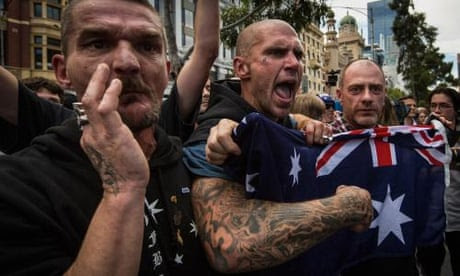
‘Muslims, as 2% of the population, possess little by way of political power, have no significant representation, and own no capacity to impose their will.’ ‘Muslims, as 2% of the population, possess little by way of political power, have no significant representation, and own no capacity to impose their will.’ Photograph: Richard Ashen/Demotix/Corbis
There are no Islamic courts, no practice of its jurisprudence, no laws from the Quran, and yet on Saturday we saw Reclaim Australia rally violently, their placards demanding the country say “No to Sharia!”
Seeing barricades, lines of mounted officers, rivals groups brawling over the truth of the “Islamification” of Australia, is a little overblown when we consider that Muslims, as 2% of the population, possess little by way of political power, have no significant representation, and own no capacity to impose their will.
The Muslim-Australian is hardly a political threat to the nation, and Muslims themselves continue to struggle with the scrutiny applied to them as part of the continued war on terror.
So while we could dismiss the Reclaim movement as paranoid and ignorant, I refuse to see racism as a natural response, like an immune system, to presence of a “real” threat. We need to recognise the powerful feeling of “owning the nation” that comes with white Australia saying “no” to foreigners.
Reclaim’s sentiments come from a social imaginary of Australia under attack, which is inundated with images of a violent Islam. But it’s not that racism is the result of the “presence” of Islamism. It is that Islamism gives racism its convenient vocabulary.
Ordinary people can imagine the erosion of their social surroundings in everyday terms of stories and images that are fed to them in an exaggerated form, of an existential fight between us and them over who owns even the minutiae of life: where we live, the languages we speak and, in the case of the halal certification “debate”, what we eat.
The beleaguered “community” increasingly becomes formed by these fantasies, fears, symbols, caricatures, stereotypes and nightmares. Racism then defaults to a kind of commonsense language, a no-bullshit bypass of political correctness. The community is provoked by a threatening Muslim, a foreigner whose presence is drenched in images of the inhuman violence we see circulated every day, and who is presumed to have an Asiatic capacity for cruelty and violation.
The Muslim as society’s folk devil is no mere illusion or fantasy. It represents deep-seated anxieties about control, displaced on to an Islam that has come to represent symbolically a sense of traditional loss and struggle in a changing global and multicultural world.
Any contest over what is “obvious” about Islam or “real” about Islamism, or whether Muslims need “fixing”, however, misses the point. The Reclaim Australia rallies were never about Islam in the first place, but were a clash of different ideas about being Australian.
Racism is rarely about the reality of the other. 
Racism is rarely about the reality of the other; the Reclaim protestors, without irony or self-reflection, were able to appropriate the Indigenous flag in their cry to reclaim Australia.
With the presence of swastika tattoos, and the general demography of the rally’s participants, it is obvious that race still remains central to our political culture in a constitutive sense; being “white” continues to play a formative role in how we construct what it means to be authentically Aussie.
For some, Aussie still simply means “white”, a sentiment that itself obscures the mostly forgotten English bigotry against the Irish, Australia’s first other.
These days the un-Australian is commonly a figure of colour, who is easily transmittable from one ethnic identity to another. The foreigner as a “form” always remains a thing to respond to, even as we openly acknowledge that, in Australia’s history, its content has always been interchangeable: Asian, African, Arab, Muslim – and yet, always Indigenous.
The foreigner is a piñata doll, the thing you beat so you can still feel you own a stick. It’s a thing to say “no” to, a thing whose integration is to be always measured against “our” standard and in doing so making that standard feel more real than it is.
In these cacophonies of “no” to foreignness, the foreigner is contradictory, fragmentary by its nature. Its truth is secondary to its function as a crude shorthand for the negating of difference and change.


No sensible adult could think Australia is becoming Islamic, and Reclaim Australia has little to do with halal, sharia, jihad or terrorism. These words are like traumas, a backdrop against which the repressed frustration of losing privilege plays out.
Yet despite official denunciation and celebration of diversity, racism as a concept in this country endures, adapting and readapting, chameleon-like to the changing social and political times. It does so because its aim, in part, is to address the sensitive needs of the dominant white nation’s sense of self.
---