Saturday, December 13, 2014

Where is Subramanian Swamy now? - By Ghulam Muhammed

Where is Subramanian Swamy now?

Barely 14 years back was he not advising RSS and its affiliates to shun petty politics?

He wrote in The Hindu:

“The BJP has set into motion the overhaul of the Constitution not just a mere amendment to it. It has commenced the rewriting of history. Its sister front organizations such as the VHP and the Bajrang Dal are already unleashing eerie and shadowy terror at the micro level of society. How can the BJP then speak of defending democracy?

A person honed by struggles against Emergency, has now sold his soul to the fascists. He has himself forgotten what sacrifices great leaders like Jay Prakash Narayan and Morarji Desai had made for the sake of democracy. Mere winning majority of votes and coming to power through democratic means and then subverting the very foundations of democracy, are not the choices Swamy should have upheld. He had sworn by composite India.

He wrote:

“It was the plurality and heterogeneity of Indian society that made people revolt against the authoritarian order. This is the crux of the Indian democratic paradigm. India is a democratic society in form because of the mutual gravitational pull of disparate sections that make the whole. Therefore, the lesson to be learned from the Emergency is that as long as the composite nature of Indian society survives, Indian democracy will survive. Hence, when attempts at seeking homogeneity of Indian society are carried beyond a point, it is dangerous for democracy, at least till we have reached a level of education when good men and women will dare to struggle for fundamental rights.
Edmund Burke had said: ``For evil to triumph, good men must do nothing''. India has to progress considerably before we can confront evil in our society head on. During the Emergency, those who were in a position to fight, with notable exceptions, did not.”

Swamy should reflect and understand that what we are witnessing in India today is nothing but another form of ‘Emergency’.

Ghulam Muhammed, Mumbai
ghulammuhammed3@gmail.com

----- ----- -----
http://www.thehindu.com/2000/06/13/stories/05132524.htm


Tuesday, June 13, 2000


Unlearnt lessons of the Emergency


By Subramanian Swamy
 
When attempts at seeking homogeneity of Indian society are carried beyond a point, it is dangerous for democracy... Those of us who can stand up, must do so now.

FOR TWO distinct reasons, it is ludicrous for the BJP to declare that it will hold meetings to remember the declaration of Emergency, whose 25th anniversary falls on June 26 this year. For one, during that 1975-77 period, most of the leaders of the BJP/RSS had betrayed the struggle against the Emergency. It is on the record in the Maharashtra Assembly proceedings that the then RSS chief, Balasaheb Deoras, wrote several apology letters to Indira Gandhi from inside the Yerawada jail in Pune disassociating the RSS from the JP-led movement and offering to work for the infamous 20-point programme. She did not reply to any of his letters. Mr. Atal Behari Vajpayee also wrote apology letters to Indira Gandhi, and she had obliged him. In fact for most of the 20-month Emergency, Mr. Vajpayee was out on parole after having given a written assurance that he would not participate in any programmes against the Government. The vivid description of other erstwhile Jana Sangh worthies who chose to walk out of prison on promise of good behaviour is given in a book written by the Akali leader, Mr. Surjit Singh Barnala.

Some of us vigorously opposed the Emergency in our own ways. The full credit for inspiring the struggle must, however, first go to Morarji Desai, who was 78 years old and kept in solitary confinement, and to Jayaprakash Narayan who lay in Jaslok Hospital after both his kidneys were mysteriously made to fail in Chandigarh jail. More significantly, JP's heart had been broken when he saw an India utterly passive to the death of democracy, while those who had earlier egged him on e.g., the RSS, were now repudiating him and offering to work for the nation's tormentors. But JP never gave up. He sent me a message where I was hiding just after he had reached the hospital in August 1975, that I should escape abroad and campaign from there. But he warned me that the struggle may be ``life long''. Morarji, however, was completely unyielding and sanguine. When Indira Gandhi offered him parole on promise of good behaviour, he told the emissary who had come to visit him in jail that no sooner was he out he would start the struggle again. His daughter-in-law, Padma, had wept copiously and implored him to agree because of his age but he told her that death was a better option.

I must add that not all in the RSS were in a surrender mode. The exceptions were Madhavrao Muley, Dattopant Thengadi and Moropant Pingle. Muley had taken a tremendous liking to me. He supported me fully while I was abroad, and while I was hiding in India. But a tearful Muley told me in early November 1976 and I had better escape abroad again since the RSS had finalised the document of surrender to be signed in end January of 1977, and that on Mr. Vajpayee's insistence I would be sacrificed to appease an irate Indira and a fulminating Sanjay whose names I had successfully blackened abroad by my campaign. I asked him about the struggle, and he said that in the country everyone had become reconciled to the 42nd Amendment, and democracy as we had known it was over.

Democracy was over for the RSS but not for all others. A few weeks later general elections to the Lok Sabha were declared. No one quite understood then what had made Indira Gandhi do that. But as a consequence, the RSS luckily did not need to sign the document of surrender.

It was an uncoordinated combination of forces that made Indira Gandhi declare elections, and the demise of the Emergency. My intensive campaign abroad and access to the American intellectuals had attracted the attention of the authorities, and especially the newly-elected President of the U.S., Mr. Jimmy Carter, who even before taking oath of office began to breathe down the Indian Government's neck about human rights, which quite unsettled Indira Gandhi. Then there was the unsung hero, Jiddu Krishnamurti, who was motivating her to withdraw the Emergency and acknowledge to her inner self that she had done wrong in imposing it. More pain came to Indira Gandhi when she prostrated before Sri Chandrashekhara Saraswati, the Kanchi Math Paramacharya, for 90 minutes but he had refused to even look at her, making it known that he thoroughly disapproved of the Emergency. And finally she had to contend with an unyielding Morarji Desai as head of the Lok Sangharsh Samiti who refused to withdraw the struggle or even acknowledge any good had come from the Emergency, which Indira Gandhi's emissaries implored him to say as a gesture. In other words, these moral and spiritual personages refused to legitimise the state of Emergency, the infamous 42nd Amendment to the Constitution, and accept a highly- shackled democracy as normal for India. Instead, they all held that the Emergency was subversion of the Constitution and viewed Indira Gandhi as the usurper.It was thus the sustained non- violent and moral approach that won the day, and not a foreign- financed terror. A violent resistance suited the advocates of the Emergency for justifying it, but that resistance had mercifully fizzled out early.

When Indira Gandhi called for elections, those who had failed in their violent resistance wanted to boycott the polls on the grounds that the Opposition parties had no chance in the circumstances since the illiterate masses would not be moved by the issue of democracy, and thus the polls would legitimise the Emergency. But Morarji and Charan Singh would have none of it. Obviously they had more faith in the Indian people than those who demagogically spoke in the name of the people.

It was the plurality and heterogeneity of Indian society that made people revolt against the authoritarian order. This is the crux of the Indian democratic paradigm. India is a democratic society in form because of the mutual gravitational pull of disparate sections that make the whole. Therefore, the lesson to be learnt from the Emergency is that as long as the composite nature of Indian society survives, Indian democracy will survive.

Hence, when attempts at seeking homogeneity of Indian society are carried beyond a point, it is dangerous for democracy, at least till we have reached a level of education when good men and women will dare to struggle for fundamental rights.

Edmund Burke had said: ``For evil to triumph, good men must do nothing''. India has to progress considerably before we can confront evil in our society head on. During the Emergency, those who were in a position to fight, with notable exceptions, did not. But, today we do not even have giants like JP and Morarji to defend civil liberty. Mr. H. R. Khanna chose to forego his Chief Justiceship of the Supreme Court rather than undermine judicially the concept of fundamental rights. Does anyone remember him? Further, luck too was on India's side then because Indira Gandhi decided to go for the polls. Had she not done so, it may have taken us a long time to unwind the Emergency.

Today, we are in a much weaker position than in 1975-77 to defend democracy. One reason is that the tall caste-neutral leaders of the Freedom Struggle are no more. Another reason is that a cadre- based fascist organisation is in control of the levers of power. This organisation has spawned lumpen front organisations, that do not hesitate to kill even defenceless missionaries of religion. Worse, there is every indication that institutions are being undermined by a creeping Emergency. This is the second reason why the BJP plan to celebrate the struggle against the Emergency is ludicrous. The BJP has set into motion the overhaul of the Constitution not just a mere amendment to it. It has commenced the rewriting of history. Its sister front organisations such as the VHP and the Bajrang Dal are already unleashing eerie and shadowy terror at the micro level of society. How can the BJP then speak of defending democracy?

Thus, 25 years later we still cannot take democracy for granted nor put the challenge to it behind us. It is today invisibly under siege. ``Eternal vigilance is the price of liberty'' said the American revolutionary Patrick Henry. Thus, those of us who can stand up, must do so now. That sums up the lesson of the Emergency in retrospect.


Send this article to Friends by E-Mail


Tuesday, October 14, 2014

Maharashtra polls: All eyes on Muslim votes - By Mayura Janwalkar , Tabassum Barnagarwala - The Indian Express, Mumbai

THE INDIAN EXPRESS

Maharashtra polls: All eyes on Muslim votes


Written by Mayura Janwalkar , Tabassum Barnagarwala | Mumbai | October 14, 2014 1:32 am


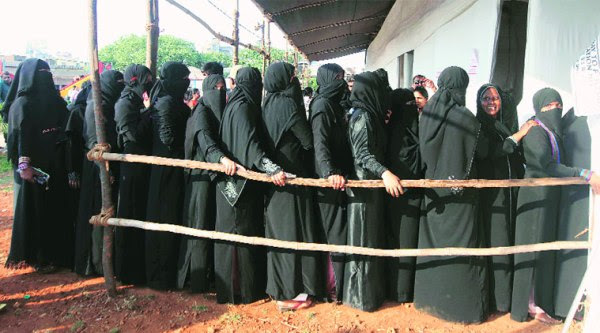
Several groups among the Muslims have indicated that they are not averse to voting for the BJP or the Shiv Sena. (Source: Express archive) Several groups among the Muslims have indicated that they are not averse to voting for the BJP or the Shiv Sena. (Source: Express archive)
From Jogeshwari to Malvani, Mohammed Ali Road to Mankhurd, there is immense curiosity regarding how pockets dominated by the Muslim community could vote on Wednesday, given the BJP’s big win in the Lok Sabha election and the Congress’s eroding support among its traditional votebanks. The presence of some MIM and Samajwadi Party candidates has queered the pitch further, and several groups among the Muslims have indicated that they are not shy of voting for the BJP or the Shiv Sena.

Jogeshwari (East), for example, carries the weight of a past chequered by communal violence. The ‘Caves Road’ that leads to the suburban railway station continues to be a physical division between the Muslim-dominated Prem Nagar and its non-Muslim neighbours. Here, the vote could simply be for whoever promises better development.

Soon after being elected in 2009, Shiv Sena MLA Ravindra Waikar – who had found a mention in the Shrikrishna Commission report for inciting a mob and shouting communal slogans against the Muslims- said that he wanted to work for the upliftment of Muslims in his constituency. The incumbent may have won the faith of a part of 45,000 to 50,000-strong voter bank in the area, but social workers and residents of the slum area say that Prem Nagar continues to grapple with inadequacies in infrastructure, sanitation, health care and education.

“Election here had never been about issues. It is driven by popular perception. When you ask people what has a certain candidate done for them, they don’t know. They just say that a candidate is good because ‘public’ says he is,” said Shaikh Sajid Akbar who runs the Modern Youth Association (MYA). His organisation has put up banners in the area with a slogan ‘Hamara vote Hamari Maang’ to make people aware of the parameters they should be testing Assembly election candidates on. The posters demand a Slum Rehabilitation Scheme, legal water connections, improved health care, fire fighting and a sports centre among others.

Rama Shyam and her husband Sheikh Masood Akhtar of NGO Saher (Society for awareness, harmony and equal rights) have been working in the Jogeshwari (East) area for over a decade. Akhtar who was born in Jogeshwari (East) said that there are certain basic issues that have received very little attention from the state and the residents of Prem Nagar too have shown complacency in dealing with them.

“During the civic polls (2012) we had a meeting with all aspiring corporators and asked them what they wanted to do for this constituency. None of them had any vision. They did not know what the area needs. They said you tell us what to do and we will do it,” Akhtar pointed out. While problems of sanitation continue to mount, they are compounded by narrow roads that hinder garbage pick-up trucks from entering the area. Shyam said that there are hardly any civic or state-run health centres or clinics in the locality that has led to quacks thriving.

The Muslim pockets of Jogheshwari (East) are estimated to comprise 13 per cent of the voting population in the suburb. At the other end of the city, marked by narrow lanes, old dilapidated matchbox buildings, and a significant Muslim population, the busy Mohammed Ali Road has been witnessing daily election rallies. Hawkers and shop owners cast quick glances at the proceeding rallies before returning to business, knowing nothing new is being said.

Amongst the several speeches, All India Majlis-e-Ittehadul Muslimeen (MIM) leader Akbaruddin Owaisi’s speech in Mumbadevi sparked an emotional chord — the 1993 riots.
“Bhendi Bazaar was the heart of Mumbai riots, Muslim beards cut, women’s breasts were cut, business destroyed. Pani ki kimat hai, par Musalman ki khoon ka koyi kismat nahi (Water has value, but Muslim blood does not seem to have any value),” he said at his rally.

While voters no longer base their decision to select a party solely on the riots that plagued the Bhendi Bazaar area two decades ago, the scar exists in their mind.

“There is anger, even though subdued, against political forces who supported it. But now people just want to chose a candidate who will look into their problems, not ones who will keep ranting about old issues,” said Muttam Khalid, a social activist.

However, Mustafa Arsiwala, resident of Bhendi Bazaar, said, “People here just want to go for work, come back home and sleep. Politicians who let us work peacefully are invited. But I don’t think there is anger of 1993 riots in our minds any longer.”

While Congress stands to lose several of its seats in the state owing to an anti-incumbency and an equally strong Modi factor working in tandem, the majority of Muslim population living in cramped 250 square ft flats — comprising Shia, Sunni, Bohras, Ismaili, Irani — continues to hold a similar political ideology.

The area is perhaps one of few pockets where despite anger against the existing state government, voters wish to see Amin Patel in the MLA’s throne.

A few shop owners come out to discuss their problems: old buildings and heavy traffic. While parties play on communal lines, voters know very few will address their basic problems.

“We are not very happy with the Congress but the MLA has done some work to repair our buildings. That matters,” said Shabbir Shaikh, a hawker who sits at the JJ Hospital junction.

The assembly constituency has 18 candidates contesting, 15 of whom are Muslims. “This may cause a dent in Congress vote share,” says Salim Alware, another activist who fights for Muslim rights.

Another example is Malvani, in Malad West, where the 80,000 Muslim voters appear to be gunning for change. Aslam Shaikh from the Congress may have been a clear winner, but with the BJP and Shiv sena splitting, the Shiv Sena’s Vinay Jain will be strong competition for Shaikh. According to the majority of Muslims who reside in Malwani at Malad (West) they are upset with Shaikh and would want a new MLA to represent them. Shafiulla Shaikh, a resident of Malwani, said, “Aslam has done nothing worth mentioning for his community. He has disappointed us.”

mayura.janwalkar@expressindia.com | tabassum.barnagarwala@expressindia.com

Monday, October 13, 2014

Owaisis making inroads into Muslim vote bank with promises of ‘justice’ - By Jyoti Punwani - Mumbai Mirror - A Times of India publication

http://www.mumbaimirror.com/mumbai/others/Owaisis-making-inroads-into-Muslim-vote-bank-with-promises-of-justice/articleshow/44797346.cms

Facebook|Log In|Sign Up|


Owaisis making inroads into Muslim vote bank with promises of ‘justice’

Mumbai Mirror | Oct 13, 2014, 09.10 AM IST

By Jyoti Punwani

A new sensation is sweeping Mumbai's Muslim pockets. Without being paid or carted in by trucks, Muslims are thronging the rallies of the Owaisi brothers from Hyderabad's Majlis e Ittihad al Muslimeen (MIM) and giving political veterans sleepless nights, be they the Congress's Amin Patel or NCP's Jitendra Avhad.

The MIM, which won 13 municipal seats in Nanded in its debut in 2012, has fielded 24 candidates in its maiden bid for the state assembly including 12 from Mumbai and Thane, all but two of them Muslim.

Most are unknown faces, riding on the appeal of Hyderabad MP Asaduddin and his younger brother, MLA Akbaruddin. The brothers follow distinct styles; the elder sober and reasonable, the younger fiery and provocative. In Mumbra on Friday night, as Akbaruddin recounted the litany of Muslim woes, the elderly were wiping tears, and younger ones shouting 'Nara-e-Takbeer'.

The MIM has one main plank: injustice to Muslims since Independence, and the promise to make the community's voice heard. Akbaruddin's speeches are replete with images of bloodshed and carnage, of women being raped and children orphaned. Every wrong done to Muslims is described, with the point hammered home that this is how "Hindustan has treated its Muslims".

Then follows an account of his injuries thanks to the many assaults he has suffered (in a property dispute in 2011— a fact he does not mention), his jail terms for speaking up for Muslims, and how he is ready to do so again. Incidentally, the same emotional arguments were used by Bal Thackeray while appealing to Hindus in the Sena mouthpiece, Saamna.

For Mumbai's Muslims, who have long felt betrayed by the Congress-NCP, Akbaruddin's words strike a deep chord. Said Gulam Nabi Idrisi, an NCP supporter, "He is both bebaak (fearless) and knowledgeable -- a rare combination in a Muslim leader."

The potential division of Muslim votes is making the BJP smile, and leaving politically aware Muslims aghast. "After the Congress-NCP split, this election would have shown candidates' true worth. Vote banks would not have counted. But the MIM with its communal appeal has ruined things for Muslims," said Farooq Mapkar, a 1992-93 riot victim.

Akbaruddin does not agree. "Did we make the so-called secular forces split? This is a sign from Allah. We just stepped into Maharashtra and all alliances split. Now those who were set to destroy our identity and those who've always divided us are themselves divided and attacking one another. This is a golden opportunity, don't throw it away. Allah doesn't help those who don't help themselves," he says at every meeting.

Akbaruddin defended the use of religion in his speeches, pointing to communal utterances of Hindutva leaders, the PM's tweet in support of RSS chief Mohan Bhagwat's Independence Day speech, and his gift of the Gita to world leaders.

"I'm a proud Muslim and a proud Indian. Why shouldn't I pray to my Allah for my country? Why does the issue of secularism come up only when a Muslim party speaks up for Muslims? What about the Samajwadi Party which speaks for Yadavs, BSP which speaks for Dalits? Why such narrow-mindedness? Can you build a nation by ignoring its minorities?" he told Mirror, adding: "The results will surprise all of us."

"Countering the communalism of the majority with Muslim communalism is no answer. The MIM is exploiting the sufferings of Muslims," says Afsar Usmani, general secretary of Movement for Peace and Justice. Similar tactics were tried earlier in Mumbai by SP chief Abu Asim Azmi, but today he stands rejected by the community who have tired of waiting for some actual work to be done. Will the same fate await the MIM?

----- ----- ----- ----- -----

Saturday, October 11, 2014

Despite a Petition Pending in the High Court Subedar Ishrat Ali’s Family Forced to Evacuate Military Quarter

India's Muslim Armyman, Maulavi Ishrat Ali, refusing to say Hindu religious slogans, Jai Sri Ram and Jai Mata Di. instead of the traditional Secular National slogans Jai Hind, was charged with disobedience and now thrown out with his family from his army accommodation, in most humiliating manner, even though his petition is pending with High Court. In popular reasoning, this is how BJP's Narendera Modi coming to power at the centre has drastically shifted India from its constitutional secular polity to extreme Hindutva agenda against Muslims as propagated by RSS. A day earlier, an 11-year old Muslim boy was drenched in gasoline and burnt alive by Armymen near a Military Camp area in Telegana/Andhra state.
Unless PM Modi sincerely commits himself to India's Secular constitution and comes down heavily against fissiparous elements, even though from his own milieu, India's integrity will be in serious danger.
Ghulam Muhammed, Mumbai
<ghulammuhammed3@gmail.com>

-----  ------ ----- ----- -----


http://www.urdumediamonitor.com/2014/10/09/despite-pending-petition-high-court-subedar-ishrat-alis-family-forced-evacuate-military-quarter/

Urdu Media Monitor

Despite a Petition Pending in the High Court Subedar Ishrat Ali’s Family Forced to Evacuate Military Quarter

Military Police Takes out Household Possessions and loads  on a vehicle. Shahnaz roams around with her possessions until late night

New Delhi (SNB): Military Police today ejected forcefully the family of Subedar Maulvi Ishrat Ali of Rajputana Rifle in his absence from their quarter in Delhi cantonment.


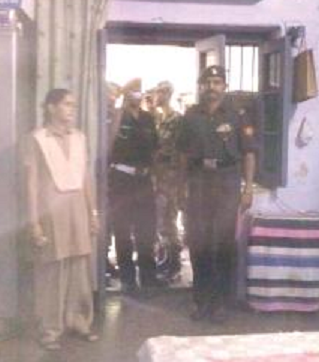
Subedar_Ishrat Ali's quarter

Subedar Ishrat Ali had been issued a notice for disobedience for refusing to chant ‘Jai Shri Ram’ and ‘Jai Mata di’ instead of ‘Jai Hind’ and had filed a petition in the High Court against the orders to evacuate immediately his quarter.

Military Police did not allow the police to enter the house that had been called by dialling 100. Maulvi Subedar Ishrat Ali’s wife Shehnaz Bano told Rashtriya Sahara, ‘Today in the afternoon at about 12.30 some 35-40 personnel of military police, including women police officers, entered the house. They pushed and forced me and my daughters out. Then they started throwing out the household possessions much of which has been damaged.’

According to Shahnaz Bano when she called the police by dialing 100, military police did not let the Delhi police in. ‘After this military police called a tempo and loaded our possessions on it saying, “Go wherever you want to go.”

‘My husband is in Bikaner and son is not home. Where will I go with my possessions? Give me at least one week but they did not budge and got us ejected from the centre.’ I said.

‘No one in the 3 Raj Rif Centre helped us. Hungry and thirsty for hours we stood there but no one even offered us a glass of water.’
She added, ‘With no option available to us, after a long wait we came to Sagar Pur where a friend of my son lives. My possessions are still on the tempo and son has gone in search of a house to rent.’
Shahnaz Bano further said, ‘We are being treated like this because my husband refused to obey his officers and chant ‘Jai Mata di’ and ‘Jai Shri Ram’ instead of ‘Jai Hind’.

In the meanwhile Kapil Deo, retired from Raj Rif, phoned Rashtriya Sahara and said, ‘I regard Subedar Ishrat Ali as my teacher. This behaviour of army officers with him is absolutely wrong. No one can be forced to act against his religion like this.’

Citing the example of Vice President Mohammad Hamid Ansari Kapil said, ‘He had also refused to worship in a temple which is his right. Similarly Maulvi Subedar Ishrat Ali cannot be forced to chant ‘Jai Mata di’. The slogan of ‘Jai Hind’ was coined by Subhash Chandra Bose and to oppose this slogan is akin to insulting Netaji.’

Subedar Ishrat Ali, working as a Maulvi with Rajputana Rifle, was transferred on 16th November 2013 to Rajputana Rifle Bikaner. His wife Shahnaz Bano is a heart patient and is being treatment at Base Hospital Delhi cantonment. In Bikaner there is a military hospital but it does not have cardiology department. On this basis Ishrat Ali had applied to stop his transfer but his application was rejected. 

Later, on 24 January 2014, he joined Bikaner Rajputana Rifle immediately after which he was ordered to vacate his military quarter P-13/8, Delhi Cantonment.

Translated from Rashtriya Sahara, 9 October 2014 by Urdu Media Monitor.Com


ALSO READ: ‘No “Jai Hind”, salute by saying “Ram, Ram” and “Jai Mata Di”.


Tuesday, October 7, 2014

For Israel, a Time of Self-Scrutiny - BY ROGER COHEN - The New York Times

http://www.nytimes.com/2014/10/07/opinion/roger-cohen-for-israel-a-time-of-self-scrutiny.html?emc=edit_th_20141007&nl=todaysheadlines&nlid=28904237&_r=0

The New York Times

The Opinion Pages | Op-Ed Columnist

The Community of Expulsion

For Israel, a Time of Self-Scrutiny

OCT. 6, 2014


Recent Comments

comp

33 minutes ago Roger, what is your solution? Hamas has said all along that they don't want their own state (most Jews, and Israelis, support a 2-state...

Jim Holstun

33 minutes ago Mr. Cohen, please brush up on the basics. Israel has no right, as an occupying power, to wage war on a territory it occupies. It can defend...

sandy

33 minutes ago Jews never had a country to go to after their expulsion from dozens of countries throughout diaspora history; no choices whatsoever. Arabs...


  • See All Comments (242)
  • Write a comment


LONDON — Attending services at a Reform synagogue during the High Holy Days in London I heard sermons of great worthiness from British rabbis. One was about Alzheimer’s and dementia among the elderly and the need to honor the “fragment of the divine in everyone.” Another was about changes to the prayer book, including the dropping of the term “Lord,” with its male overtones.

I listened with interest but without feeling challenged. The one subject not addressed was the one most on the minds of congregants: Israel and its recent war in Gaza, with the deaths of more than 70 Israelis and more than 2,100 Palestinians, including about 500 children. Surely I was not alone in hearing words like “fragment” and finding my mind turn to the moral dilemmas of the modern Israeli condition with its power and precariousness, its prosperity and violence, its uncertainty and contaminating dominion. The divine was in those dead Palestinian children, too.

They just happened to have lived their brief lives in the hell of encircled Gaza with its tunnels and terrorists and Hamas operatives bent on the destruction of Israel.

Every human instinct recoils from the killing of children. It recoils even as Israel’s right to defend itself from rockets is clear; and the excruciating difficulty of waging war against an enemy deployed among civilians is acknowledged; and the readiness of Israel’s foes to kill any Jew is confronted. However framed, the death of a single child to an Israeli bullet seems to betoken some failure in the longed-for Jewish state, to say nothing of several hundred. The slaughter elsewhere in the Middle East cannot be an alibi for Jews to avoid this self-scrutiny.

Throughout the Diaspora, the millennia of being strangers in strange lands, Jews’ restless search in the scriptures for the ethics contained in sacred words formed a transmission belt of Judaism. For as long as the shared humanity of the other is perceived and felt, such questioning is unavoidable. The terrible thing about the Holy Land today is the denial of this humanity to the stranger. When that goes, so does essential self-interrogation. As mingling has died, separation has bred denial and contempt.

Perhaps I should not have been surprised by the anodyne sermons in London. I had read my colleague Laurie Goodstein’s recent account of the incendiary sensitivity of Israel as subject matter, of the reticence of rabbis, of some feeling “muzzled,” and of the difficulties faced by one New York rabbi, Sharon Kleinbaum, when she read the names of Israeli soldiers and Palestinian children, alike, killed in Gaza. She was accused of spreading Hamas propaganda. No, she was trying, in a small brave way, to keep hearts and minds open.

That is the only way out of the impasse; neither people is going away. It is 67 years since the United Nations called for the establishment of two states, one Jewish, one Arab, in Mandate Palestine; 47 years since the Israeli occupation of the West Bank began; 42 days since the Gaza war ended. Palestinians have made a profession of failure. But to deny Israel’s share is to opt for delusion.

Of course, sermons are only part of the story. The High Holy Days are days to look inward, to be still. I found my eyes straying to a passage from Stefan Zweig’s “The World of Yesterday” reprinted in the prayer book. It read:

“Only now, since they were swept up like dirt in the streets and heaped together, the bankers from their Berlin palaces and sextons from the synagogues of Orthodox congregations, the philosophy professors from Paris, and Romanian cabbies, the undertaker’s helpers and Nobel prize winners, the concert singers, and hired mourners, the authors and distillers, the haves and the have-nots, the great and the small, the devout and the liberals, the usurers and the sages, the Zionists and the assimilated, the Ashkenazim and the Sephardim, the just and the unjust besides which the confused horde who thought that they had long since eluded the curse, the baptized and the semi-Jews — only now, for the first time in hundreds of years, the Jews were forced into a community of interest to which they had long ceased to be sensitive, the ever-recurring — since Egypt — community of expulsion. But why this fate for them and always for them alone? What was the reason, the sense, the aim of this senseless persecution? They were driven out of lands but without a land to go to.”

Two phrases leapt out: “community of expulsion,” and “driven out of lands but without a land to go to.” The second embodied the necessity of the Jewish state of Israel. But it was inconceivable, at least to me, without awareness of the first. Palestinians have joined the ever-recurring “community of expulsion.” The words of Leviticus are worth repeating for any Jew in or concerned by Israel today: Treat the stranger as yourself, for “you were strangers in the land of Egypt.”


You can follow me on Twitter or join me on Facebook.

----- ----- ----- ----- -----

Monday, October 6, 2014

Remembering India’s Forgotten Holocaust By RAKESH KRISHNAN SIMHA - TEHELKA MAGAZINE

Just like the Jews extracted reparation payments from Germany for their Holocaust, India too should demand and collect reparation payments from Great Britain for their Holocaust of 1943-44 in which 4 million Indians perished.

Ghulam Muhammed, Mumbai
<ghulammuhammed3@gmail.com>
 

---------- Forwarded message ----------
From: Faizur Rahman <a.faizur.rahman@gmail.com>
Date: Mon, Oct 6, 2014 at 11:34 AM
Subject: [The Moderates] Remembering India's Forgotten Holocaust
To: The Moderates <the-moderates@googlegroups.com>

Remembering India’s Forgotten Holocaust

British policies killed nearly 4 million Indians in the 1943-44 Bengal Famine
June 13, 2014, Issue 25 Volume 
Scorched earth By 1943, hordes of starving people were flooding into Calcutta and a huge number of them died on the city streets
Scorched earth By 1943, hordes of starving people were flooding into Calcutta and a huge number of them died on the city streets. Photo Courtesy: Wikimedia Commons
The Bengal Famine of 1943-44 must rank as the greatest disaster in the subcontinent in the 20th century. Nearly 4 million Indians died because of an artificial famine created by the British government, and yet it gets little more than a passing mention in Indian history books.
What is remarkable about the scale of the disaster is its time span. World War II was at its peak and the Germans were rampaging across Europe, targeting Jews, Slavs and the Roma for extermination. It took Adolf Hitler and his Nazi cohorts 12 years to round up and murder 6 million Jews, but their Teutonic cousins, the British, managed to kill almost 4 million Indians in just over a year, with Prime Minister Winston Churchill cheering from the sidelines.
Australian biochemist Dr Gideon Polya has called the Bengal Famine a “manmade holocaust” because Churchill’s policies were directly responsible for the disaster. Bengal had a bountiful harvest in 1942, but the British started diverting vast quantities of food grain from India to Britain, contributing to a massive food shortage in the areas comprising present-day West Bengal, Odisha, Bihar and Bangladesh.
Author Madhusree Mukerjee tracked down some of the survivors and paints a chilling picture of the effects of hunger and deprivation. In Churchill’s Secret War, she writes: “Parents dumped their starving children into rivers and wells. Many took their lives by throwing themselves in front of trains. Starving people begged for the starchy water in which rice had been boiled. Children ate leaves and vines, yam stems and grass. People were too weak even to cremate their loved ones.”
“No one had the strength to perform rites,” a survivor tells Mukerjee. “Dogs and jackals feasted on piles of dead bodies in Bengal’s villages.” The ones who got away were men who migrated to Calcutta for jobs and women who turned to prostitution to feed their families. “Mothers had turned into murderers, village belles into whores, fathers into traffickers of daughters,” writes Mukerjee.
Mani Bhaumik, the first to get a PhD from the IITs and whose invention of excimer surgery enabled Lasik eye surgery, has the famine etched in his memory. His grandmother starved to death because she used to give him a portion of her food.
By 1943 hordes of starving people were flooding into Calcutta, most dying on the streets. The sight of well-fed white British soldiers amidst this apocalyptic landscape was “the final judgement on British rule in India”, said the Anglophile Jawaharlal Nehru.
Churchill could easily have prevented the famine. Even a few shipments of food grain would have helped, but the British prime minister adamantly turned down appeals from two successive Viceroys, his own Secretary of State for India and even the President of the US .
Subhas Chandra Bose, who was then fighting on the side of the Axis forces, offered to send rice from Myanmar, but the British censors did not even allow his offer to be reported.
Churchill was totally remorseless in diverting food to the British troops and Greek civilians. To him, “the starvation of anyhow underfed Bengalis (was) less serious than sturdy Greeks”, a sentiment with which Secretary of State for India and Burma, Leopold Amery, concurred.
Amery was an arch-colonialist and yet he denounced Churchill’s “Hitler-like attitude”. Urgently beseeched by Amery and the then Viceroy Archibald Wavell to release food stocks for India, Churchill responded with a telegram asking why Gandhi hadn’t died yet.
Wavell informed London that the famine “was one of the greatest disasters that has befallen any people under British rule”. He said when Holland needs food, “ships will of course be available, quite a different answer to the one we get whenever we ask for ships to bring food to India”.
Churchill’s excuse — currently being peddled by his family and supporters — was Britain could not spare the ships to transport emergency supplies, but Mukerjee has unearthed documents that challenge his claim. She cites official records that reveal ships carrying grain from Australia bypassed India on their way to the Mediterranean.
Churchill’s hostility toward Indians has long been documented. At a War Cabinet meeting, he blamed the Indians themselves for the famine, saying they “breed like rabbits”. His attitude toward Indians may be summed up in his words to Amery: “I hate Indians. They are a beastly people with a beastly religion.” On another occasion, he insisted they were “the beastliest people in the world next to the Germans”.
According to Mukerjee, “Churchill’s attitude toward India was quite extreme, and he hated Indians, mainly because he knew India couldn’t be held for very long.” She writes in The Huffington Post, “Churchill regarded wheat as too precious a food to expend on non-whites, let alone on recalcitrant subjects who were demanding independence from the British Empire. He preferred to stockpile the grain to feed Europeans after the war was over.”
In October 1943, at the peak of the famine, Churchill said at a lavish banquet to mark Wavell’s appointment: “When we look back over the course of years, we see one part of the world’s surface where there has been no war for three generations. Famines have passed away — until the horrors of war and the dislocations of war have given us a taste of them again — and pestilence has gone… This episode in Indian history will surely become the Golden Age as time passes, when the British gave them peace and order, and there was justice for the poor, and all men were shielded from outside dangers.”
Churchill was not only a racist but also a liar.

India-hater Winston Churchill blamed Indians for the famine
Photo Courtesy: Wikimedia Commons
A history of holocaustsTo be sure, Churchill’s policy towards famine-stricken Bengal wasn’t any different from earlier British conduct in India. In Late Victorian Holocausts, Mike Davis points out that here were 31 serious famines in 120 years of British rule compared with 17 in the 2,000 years before British rule.
In his book, Davis tells the story of the famines that killed up to 29 million Indians. These people were, he says, murdered by British State policy. In 1876, when drought destituted the farmers of the Deccan plateau, there was a net surplus of rice and wheat in India. But the Viceroy, Robert Bulwer-Lytton, insisted that nothing should prevent their export to England.
In 1877 and 1878, at the height of the famine, grain merchants exported record quantities of grain. As the peasants began to starve, government officials were ordered “to discourage relief works in every possible way”. The only relief permitted in most districts was hard labour, from which anyone in an advanced state of starvation was turned away. Within these labour camps, the workers were given less food than the Jewish inmates of Buchenwald, the Nazi concentration camp of World War II.
Even as millions died, Lytton ignored all efforts to alleviate the suffering of millions of peasants in the Madras region and concentrated on preparing for Queen Victoria’s investiture as Empress of India. The highlight of the celebrations was a week-long feast at which 68,000 dignitaries heard her promise the nation “happiness, prosperity and welfare”.
In 1901, The Lancet estimated that at least 19 million Indians had died in western India during the famine of the 1890s. The death toll was so high because the British refused to implement famine relief. Davis says life expectancy in India fell by 20 percent between 1872 and 1921.
So it’s hardly surprising that Hitler’s favourite film was The Lives of a Bengal Lancer, which showed a handful of Britons holding a continent in thrall. The Nazi leader told the then British Foreign Secretary Edward Wood (Earl of Halifax) that it was one of his favorite films because “that was how a superior race must behave and the film was compulsory viewing for the SS (Schutz-Staffel, the Nazi ‘protection squadron’)”.
Crime and consequencesWhile Britain has offered apologies to other nations, such as Kenya for the Mau Mau massacre, India continues to have such genocides swept under the carpet. Other nationalities have set a good example for us. Israel, for instance, cannot forget the Holocaust; neither will it let others, least of all the Germans. Germany continues to dole out hundreds of millions of dollars in cash and arms aid to Israel.
Armenia cannot forget the Great Crime — the systematic massacre of 1.8 million Armenians by the Turks during World War I. The Poles cannot forget Joseph Stalin’s Katyn massacre.
The Chinese want a clear apology and reparations from the Japanese for at least 40,000 killed and raped in Nanking during World War II. And then there is the bizarre case of the Ukrainians, who like to call a famine caused by Stalin’s economic policies as genocide, which it clearly was not. They even have a word for it: Holodomor.
And yet India alone refuses to ask for reparations, let alone an apology. Could it be because the British were the last in a long list of invaders, so why bother with an England suffering from post-imperial depression? Or is it because India’s English-speaking elites feel beholden to the British? Or are we simply a nation condemned to repeating our historical mistakes? Perhaps we forgive too easily.
But forgiveness is different from forgetting, which is what Indians are guilty of. It is an insult to the memory of millions of Indians whose lives were snuffed out in artificial famines.
British attitudes towards Indians have to seen in the backdrop of India’s contribution to the Allied war campaign. By 1943, more than 2.5 million Indian soldiers were fighting alongside the Allies in Europe, Africa and Southeast Asia. Vast quantities of arms, ammunition and raw materials sourced from across the country were shipped to Europe at no cost to Britain.
Britain’s debt to India is too great to be ignored by either nation. According to Cambridge University historians Tim Harper and Christopher Bayly, “It was Indian soldiers, civilian labourers and businessmen who made possible the victory of 1945. Their price was the rapid independence of India.”
There is not enough wealth in all of Europe to compensate India for 250 years of colonial loot. Forget the money, do the British at least have the grace to offer an apology? Or will they, like Churchill, continue to delude themselves that English rule was India’s “Golden Age”?
----- ------ ----- ----- -----


.

Friday, October 3, 2014

Eid ul Ad’ha Mubarak

Eid ul Ad’ha Mubarak
to all ready to sacrifice for others
Ghulam Muhammed Siddiqui
Mumbai, India


.