Monday, July 7, 2014

Muslims gather for Iftar, around the world

 Muslims gather for Iftar, around the world
Muslims around the world gather at Mosques, homes and roadside to break their fast during Ramadan, eat together and come closer to God as a community.
Asif Khan
Chicago


People gather to buy food from a roadside vendor to break their fast during the holy month of Ramadan in Old Dhaka. Andrew Biraj/Reuters

Chinese Muslim men chat as they wait for the time to break their fast during the Muslim holy month of Ramadan at the Niujie mosque, the oldest and largest mosque in Beijing, China. Students and civil servants in China's Muslim northwest, where Beijing is enforcing a security crackdown following deadly unrest, have been ordered to avoid taking part in traditional fasting during the Islamic holy month of Ramadan. Andy Wong/AP


image
Chinese Muslims gather to break their fast during Ramadan at the Niujie mosque, the oldest and largest mosque in Beijing, on Wednesday. Andy Wong/Associated Press

image
Muslim Bosniak people break their fast with pizza at a fortress overlooking Sarajevo on Wednesday evening. Amel Emric/Associated Press

image
Pakistani Muslims break their fast during the holy fasting month of Ramadan in eastern Pakistan's Lahore, on Tuesday. Sajjad/Xinhua/Zuma Press

Ramadan: Muslims offer prayers, break their fast
A Muslim family prays before breaking their fast on the first day of holy month Ramadan at the Jama Masjid in New Delhi. (Source: AP)

Ramadan: Muslims offer prayers, break their fast
A Muslim family breaks its fast on the first Iftar of the holy month of Ramadan at the Jama Majid in New Delhi on Monday. (Source: PTI)

Ramadan: Muslims offer prayers, break their fast
People breaking their fast on the first day of Ramzan at Mahim on Monday. (Source: Express photo by Prashant Nadkar)

ramadan
In this Sunday, June 29, 2014 photo, displaced Iraqi citizens gather for a communal meal to break their fast during the first day of the Islamic holy month of Ramadan, at an encampment for displaced Iraqis who fled from Mosul and other towns, in the Khazer area outside Irbil, northern Iraq. (AP Photo/Hussein Malla)
ramadan
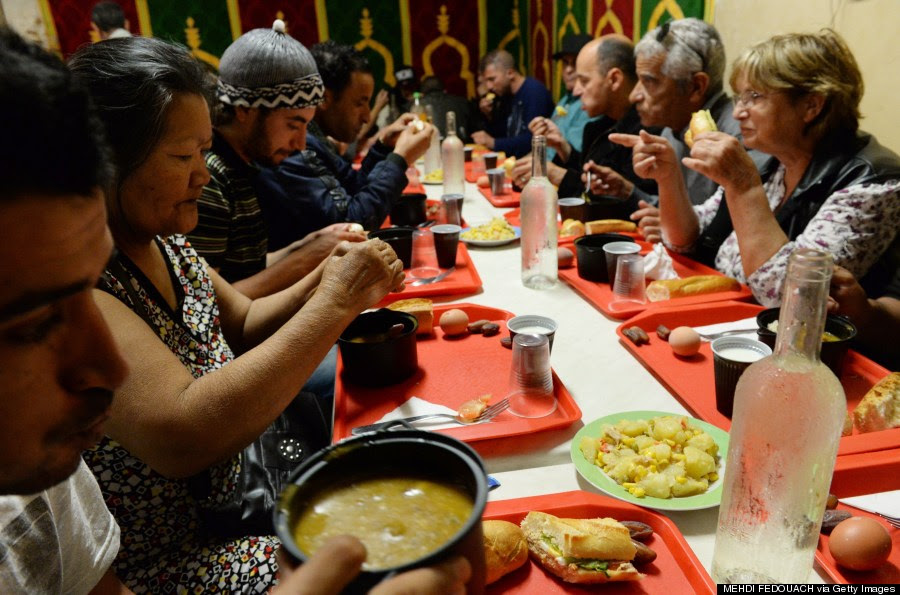
People eat at the breaking of fasting of the second day of Ramadan, in the premises of the Seeds of Solidarity ('Graine de Solidarite') association, on June 29, 2014, in Bordeaux. Founded in 1986, Seeds of Solidarity gives away free meals all year in the streets of Bordeaux, and serves up to 300 meals every night during Ramadan, to homeless and deprived people, regardless if they are Muslim or not. (MEHDI FEDOUACH/AFP/Getty Images)

ramadan
A Malaysian Muslim woman feeds her child as they break their fast on the first day of the holy Islamic month of Ramadan in Kuala Lumpur on June 29, 2014. (MANAN VATSYAYANA/AFP/Getty Images)
ramadan
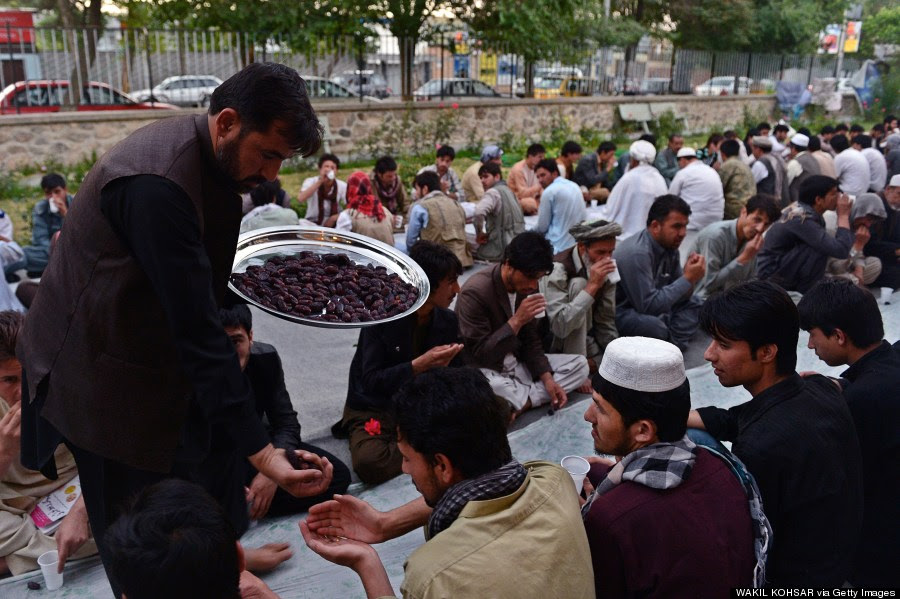
An Afghan resident distributes dates as others break their fast during the holy month of Ramadan at the Wazir Akbar Khan Mosque on June 29, 2014. (WAKIL KOHSAR/AFP/Getty Images)

ramadan
In this Sunday, June 29, 2014 photo, displaced Iraqi boys scramble to receive food to break their fast during the first day of the Islamic holy month of Ramadan, at an encampment for displaced Iraqis who fled from Mosul and other towns, in the Khazer area outside Irbil, northern Iraq. (AP Photo/Hussein Malla)

ramadan
Afghans pray before breaking their fasting during the Muslim holy month of Ramadan in Kabul, Afghanistan, Sunday, June 29, 2014. (AP Photo/Rahmat Gul)
ramadan
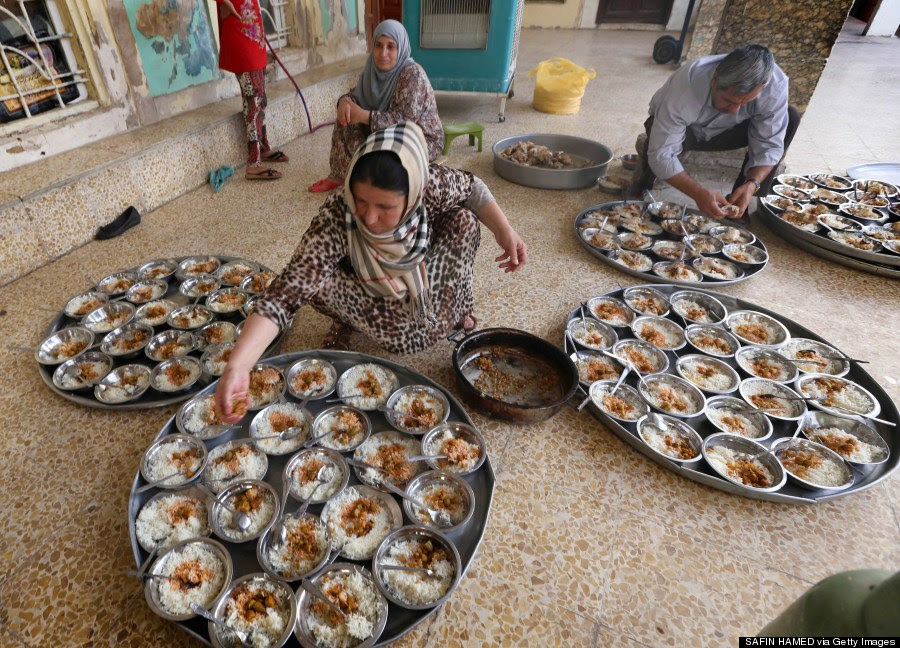
An Iraqi Kurdish woman puts the final touches to bowls of food on the first day of the holy Muslim month of Ramadan, for families who fled the violence in the northern province of Nineveh, at a mosque in Arbil, the capital of the autonomous Kurdish region of northern Iraq, on June 29, 2014. (SAFIN HAMED/AFP/Getty Images)

Bangladeshi street vendors prepare Iftar food to break the daytime fast on the first day of Ramadan at a bazaar in the old part of Dhaka on June 30, 2014. (MUNIR UZ ZAMAN/AFP/Getty Images)

Syrian Muslims break their fast on the first day of the holy Muslim month of Ramadan, in northern city of Aleppo on June 29, 2014. (ZEIN AL-RIFAI/AFP/Getty Images)

--

Sunday, July 6, 2014

India, Muslims and Khilafat - By Ghulam Muhammed

Sunday, July 06, 2014


India, Muslims and Khilafat

With the coming to power of Modi with a very comfortable majority at the center, India could be on the threshold of a new era with the Idea of India taking a distinct turn towards a rightist Hindutva ideological formulation.

In the comity of nations India will appear to be charting a new course that has yet to unfold the full flavor of its supposedly cherished ideals and aspirations deeply drawn from its distant past of continuous experimentation with spiritual and temporal affairs.

However, the most visibly obvious challenge that its Hindutva ideology faces is its undeniable confrontation with Islam and Muslims that has robbed it of any originality that the world could look forward to.

Unlike Nehru, who had drawn a silk curtain around India and isolated the nation to give it a breathing space and develop the fundamentals of its new independent social and economic status while keeping it non-aligned in world affairs; Modi's government is finding itself in the very vortex of conflicting pulls of forces that is not offering any respite to pause and develop its own course of short term and longer term priorities.

The worst part is that its top leadership is very rapidly getting out of touch with its rank and file who were brought up on their own emotional priorities that do not gel with the challenges faced by the new government.  

From the Hindutva ideology, honed for over a century now, take out its hatred of Muslims, their history in India, and there potential to dominate any plural society with their distinct and well–established religious and social profile, and the entire edifice of Hindutva collapses.

The big challenge therefore for the new Hindutva government is how to go out in the open world with its anti-Muslim baggage.

Of course, it has support of the West and Israelis who are more or less committed to accommodate the new India on the highest tables of the world affairs. However, India cannot afford to be independent as well as dependent on the West for its survival as a proud and confident nation.

To compound the trials and tribulations, it is now faced with international challenges that directly pitch it against the same adversary that it has supposed to have licked to be able to come to power.

From Afghanistan, Pakistan and now Iraq, Modi's anti-Muslim reputation is creating more open adversaries than friends that a new government would love to cultivate.

For merely under 50 nurses held up in the newly occupied areas of Iraq, by ‘Islamic State’ or ISIS, India went through an agonizing fortnight, reliving the old Kandahar hijack saga, with media virtually loading its news with war hysteria language. In future, how we will deal with millions in the Gulf, if things go wrong with the monarchies of the peninsula. The new diehards are openly critical of India’s role against its Muslim minority. They would not need any signal one way or another to make a pretext of holding India to ransom for acts of commission and omission.

Afghanistan will be another headache in not distant future. If Indian leaders feel that the Western alliance and Israel will stand by it in any untoward happening in the region, it must be realized that their own problems with the Muslim hotheads are not yet under control, to be able to come to aid of India. Instead, they would like to drag India in their own imbroglio, whether India is willing or not.

With such unsavory climes engulfing the future of the area, the new announcement of a new Caliph, for whatever it is worth, will not be something India can possibly ignore.

With map making, being the cursor of threats, the entire Indian subcontinent being mapped as ‘Khurasan’ of the historical reference, is very unsettling and would require Modi government to deeply review its future course in dealing with both propaganda as well as symbolic disruptions that may leave India helpless and at the mercy of others that will not always forgo demanding their pound of flesh.

The swiftness, with which ISIS had spread out and captured territory in Iraq, cannot be so easy as it appears to be. Somebody is playing double game. And those masters of double game can always be there to attend to India, if that fits their national interest.

Ghulam Muhammed, Mumbai

Saturday, July 5, 2014

Timeline of the Riots in Modi’s Gujarat - New York Times International

http://www.nytimes.com/interactive/2014/04/06/world/asia/modi-gujarat-riots-timeline.html#/#time287_8514

The New York Times
Asia Pacific
Timeline of the Riots in Modi’s Gujarat
Dec. 6, 1992


Hindus shouted and waved banners from the top of the Babri Masjid mosque in Ayodhya on Dec. 7, 1992.Douglas E. Curran/Agence France-Presse — Getty Images

Hindus Destroy Mosque in Religious Tinderbox

Tens of thousands of Hindus storm the Babri Masjid mosque in the northern city of Ayodhya, demolishing it with sledgehammers and their bare hands. They assert that the site was the birthplace of the Hindu deity Ram and was taken from Hindus in the 16th century by India’s first Mughal ruler, who built a mosque on the site.

Riots claim more than 1,000 lives, most of them Muslims, in the worst religious clashes since the nation's bloody partition of British India in 1947.

Despite an order from India's Supreme Court that the site remain intact, L.K. Advani, a prominent leader of the Hindu nationalist Bharatiya Janata Party, or B.J.P., and the nationalist World Hindu Council, mobilizes the mob.

The incident shakes India's secular identity, which is enshrined in its constitution. It is pivotal in the B.J.P.'s rise to power in 1998, after which it abandons its campaign pledge to build the Ram temple in order to win the backing of secular parties it needed to gain a parliamentary majority.

But the Ayodhya temple will remain a flashpoint, as later events in Gujarat reveal.

Related Article

Years Later, Destruction of a Mosque Still Echoes

  • Government Report on 1992 Mosque Raid
  • Feb. 27, 2002 at 7:43 a.m.
  • Coach S-6 carrying Hindu pilgrims is engulfed in flames at Godhra, a Muslim-dominated area in the western state of Gujarat.

  • Train Fire Kills Hindu Pilgrims

  • A train filled with Hindu pilgrims returning to Gujarat from Ayodhya stops in the town of Godhra, which is 40 percent Muslim and prone to religious violence. The Hindu activists had reportedly been chanting religious slogans. A scuffle begins with Muslim residents.

  • Within 15 minutes, Coach S-6 ignites, followed by cities, towns and villages across the western state of Gujarat.

  • The charred bodies of the 59 victims are displayed for the public in Ahmedabad, Gujarat’s largest city. Close aides of the state's chief minister, Narendra Modi, who has only been in power a few months, endorse a widespread strike. These two decisions will be widely criticized as stoking anti-Muslim sentiment.

  • In 2005, an Indian government investigation finds that the fire was an accident and not caused by Muslims. The report is one of a number of politically competing inquiries.

  • Ninety-four people were put on trial ; 31 were convicted, 20 given life sentences, and 11 sentenced to death.


  • Related Article
  • After Deadly Firestorm, India Officials Ask Why
  • Fatal Hindu Train Fire Laid to Accident, Not Mob
  • Feb. 28, 2002

A man walked past rubble in Ahmedabad a week into the worst episodes of Hindu-Muslim violence in India.Aman Sharma/Associated Press

Hindu Mobs Turn on Muslims For Weeks

Blaming Muslims for the deaths of the pilgrims, mobs of Hindus rampage, rape, loot and kill in a spasm of violence that rages for more than two months. Mothers are skewered, children set afire and fathers hacked to pieces.

About 1,000 people, mostly Muslims, are killed. Some 20,000 Muslim homes and businesses and 360 places of worship are destroyed, and roughly 150,000 people are displaced.

The two biggest massacres are in Naroda Patiya, where more than 90 people are killed, and at the Gulbarg Society, a Muslim housing complex where a rumor encouraged by a World Hindu Council leader incites a mob. Muslims take refuge in the home of Ehsan Jafri, a former member of Parliament from the Indian National Congress party. While the attacks continue for more than six hours, Mr. Jafri calls a number of influential people for help, but none arrive. Sixty-nine people are killed, including Mr. Jafri, who is hacked to pieces and burned.

There are widespread allegations that the B.J.P., which leads the state of Uttar Pradesh and the national governing party, and the World Hindu Council — both part of the same Hindu nationalist family — were complicit and in some cases instigated the mobs. The party and the council both deny the charges.

The day after the train attack, for example, police officers in Ahmedabad do not arrest a single person among the tens of thousands of angry Hindus.

A top state official tells one investigation panel that Mr. Modi ordered officials to take no action against rioters. That official was murdered. Thousands of cases against rioters are dismissed by the police for lack of evidence despite eyewitness accounts.


Video: Mr. Modi walked out of a CNN-IBN program, “Devil's Advocate” with Karan Thapar, in 2007 when questioned about the riots. Image: Shareefa Bibi with a portrait of her 18-year-old son who she said was killed by a mob. Kuni Takahashi for The New York Times

Modi Is Unapologetic

Mr. Modi is widely criticized for failing to console the state's Muslims. In the last New York Times interview he gave, in 2002, Mr. Modi expresses satisfaction with his handling of the Gujarat riots and says his only regret is that he did not manage the news media better.

In 2012, he apologizes for any mistakes he may have made as the state’s chief. "There may have been a time when I hurt someone or when I made a mistake," he says, adding, "I ask my 60 million Gujaratis to forgive me."

His remarks to Reuters in 2013 spark controversy:
If "someone else is driving a car and we're sitting behind, even then if a puppy comes under the wheel, will it be painful or not? Of course it is. If I'm a chief minister or not, I'm a human being. If something bad happens anywhere, it is natural to be sad."

He tweets in response to the furor:
In our culture every form of life is valued & worshipped. My original interview with Reuters http://t.co/4WNxHRFoS2 ...People are best judge

— Narendra Modi (@narendramodi) July 12, 2013


Video clip from the film "Final Solution" by the director Rakesh Sharma. J. Adam Huggins for The New York Times


Modi Is Re-elected

Prime Minister Atal Bihari Vajpayee of India chooses not to dismiss Mr. Modi for his handling of the riots. Instead, the B.J.P. calls for early elections. Mr. Modi begins a campaign based on Hindutva, or Hindu-ness, that aims to unite Hindus, and consolidate their votes, largely around a fear of Muslims. He frequently mentions the pilgrims who died in the train fire at Godhra, but never speaks of the Muslim victims of the subsequent riots.

Mr. Modi wins a landslide re-election victory in a referendum on his brand of politics and, some say, India's character. By recasting his image as a business-friendly politician, Mr. Modi is now serving his fourth consecutive term as chief minister.


2004

 
A convicted man consoles his son before being taken to prison for his role in the 2002 riots. Associated Press
 

Supreme Court Intervenes

Investigations and prosecutions of those involved in the riots stall. In response, India's Supreme Court reopens 2,000 cases, creates a special police team and transfers some trials out of Gujarat, resulting in hundreds of convictions.

Another crucial turning point comes when a top police official gives a lawyer representing the victims recordings of every cellphone call made during the worst of the rioting. The B.J.P. tries to suppress the investigation. The records are still being examined.

In late 2011, an Indian court finds 31 people guilty in the killing of 33 Muslims in Gujarat. They are sentenced to life in prison.

In 2012, a top lieutenant of Mr. Modi, Mayaben Kodnani, is given a 28-year prison term after being convicted of murder, arson and conspiracy. The judge says she is one of the key conspirators in the Naroda Patiya massacre.


2005


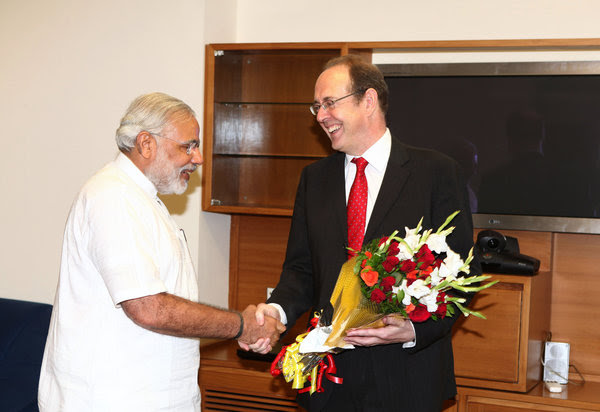
British High Commissioner James Bevan meeting Mr. Modi in 2012. Gujarat Information Bureau/Agence France-Presse — Getty Images

U.S. Imposes Visa Ban on Modi

In an unusual step, the United States imposes a visa ban to rebuke Mr. Modi for his role in the Gujarat riots. Senior American officials will not reach out to him until February 2014, when he becomes a candidate for prime minister of India.

Britain ends a 10-year diplomatic boycott of Mr. Modi in October 2012.


October 2007

 
An NDTV news report on Tehelka's investigation. Prakash Singh/Agence France-Presse — Getty Images


Leaders Are Taped Boasting About Roles in Violence


Tehelka, a weekly magazine, secretly videotapes senior police officers and politicians boasting about their roles in the 2002 killings — how they burned Muslim men, raped their wives and destroyed their homes.

The investigation renews focus on what role Mr. Modi might have played.
A B.J.P. politician says Mr. Modi had told him they had three days "to do whatever we could," according to a transcript the magazine published the following month.

Mr. Modi dismisses the claims as politically motivated.


Hindu devotees celebrating in Ayodhya after the decision was announced.Kuni Takahashi for The New York Times


Site of Mosque Is Divided

An Indian court divides the disputed holy site in Ayodhya, concluding a case that has languished in the legal system since 1950 and that set off riots that killed a total of 2,000 people, most of them Muslims.

Nearly 200,000 officers are deployed across Uttar Pradesh as a precaution, but the public remains calm.


Supporters of Mr. Modi after a court rejected a petition seeking his prosecution in December. Sanjeev Gupta/European Pressphoto Agency

Modi Again Exonerated

A court rejects a petition to prosecute Mr. Modi — filed by the widow of Mr. Jafri, who was killed during the 2002 rioting — saying there was insufficient evidence to prosecute him. This is the third time — in 2011, 2012 and 2013 — that Mr. Modi has been exonerated by Supreme Court panels.


The manner in which the investigation was conducted has been contentious.

Mr. Modi welcomed the news on Twitter:
सत्यमेव जयते! Truth alone triumphs.
— Narendra Modi (@narendramodi)

December 26, 2013
It is unlikely, though, that Mr. Modi will fully escape a cloud of accusations by rival political groups, victims and their families, and human rights groups.


By SHREEYA SINHA and MARK SUPPES


Wednesday, July 2, 2014

Fading of the strongman [Altaf Hussain - MQM] - By Khaled Ahmed - The Indian Express, Mumbai, India

The Indian EXPRESS

Fading of the strongman

Khaled Ahmed | July 3, 2014 12:02 am
The MQM violence was compounded by Pakhtun violence in the turf war that ensued.

Summary

Altaf Hussain is no longer the figure he was. Yet, the MQM draws support because its alternative is the Taliban.
khalid-ahmad
More From Khaled Ahmed
The 60-year-old Muttahida Qaumi Movement (MQM) leader-in-exile, Altaf Hussain, was dramatically arrested on June 3 from his home in North West London. He was to be interrogated on the recovery from his home of several hundred thousand pounds that he could not account for and was therefore exposed to a charge of money-laundering. He is currently out on bail.
 
On hearing the news, his “fortress” Karachi immediately closed down, with a few buses symbolically torched by his devotees. The MQM is the fourth-largest presence in the National Assembly of Pakistan. Karachi has 20 seats for the lower House, out of which 17 were won by the MQM in the 2013 election.

Altaf Hussain is the MQM’s leader with a cult. The charisma has arisen out of the fear — and resultant violence — a migrant arouses in the land he adopts after immigration. When, after 1947, Hindus vacated the four cities of Sindh where they formed majorities, they were not replaced by the rural Sindhi-speaking population but by the Urdu-speaking immigrants from India. On the basis of an odd rule, majority populations mostly live in the countryside while the vulnerable minorities feel safe in the cities. The Hindus of Sindh and Punjab were mostly urban while the Muslims were rural.

The cult of Altaf Hussain is based on the security he gave to the muhajir (migrant) by opposing local violence with migrant violence. A “gangster” MQM removed the stigma of a rogue organisation by taking part in elections and returning enough representatives from urban Sindh to parliament, to become a political make-weight in central alliances while ruling Sindh in tandem with the rural-based Pakistan People’s Party.

Hatred of the MQM is primal in Sindh because the migrants are “trespassers”. In Punjab too, there is an antipathy that is less easily explained. The outgoing Punjabi Hindu urban majorities were quickly replaced with rural Muslims from Pakistani Punjab and from Indian Punjab. The feeling against the Indian Punjabis was watered down by their shared language. But the Urdu-speaking urban Muslims arriving from India quickly found that they were not welcome in Lahore and, thereafter, most of them quickly took the train to Karachi where there were secretarial jobs waiting for them in the new capital.

The MQM’s dominance of Karachi and strong presence in the major cities of Sindh were disturbed by the influx of the Pakhtun through internal migration. In Karachi, the majority population is Urdu-speaking; but Karachi is also the biggest Pakhtun city in the world, comprising both Pakistani and Afghan Pakhtun. Because of the Pakistani state’s involvement in proxy wars, the Taliban Pakhtun turned against the state after it joined the global war against terrorism post-9/11. The MQM violence was compounded by Pakhtun violence in the turf war that ensued.

Altaf Hussain fled to the UK in 1992, fearing that his enemies, led by the state intelligence agencies, were closing in on him. His anti-Talibanisation, secular-liberal stance and his hold on urban Sindh appealed to a UK leadership worried about radicalisation creeping into expat British Pakistanis. He thereafter lived in London without distancing himself from the organisational pyramid of the MQM. He could have looked after himself much better had he the intellect to do so. A cult will always point to the implied godhead of its leader and eschew intellectual reasoning.

There are many cult figures in Pakistan who manifest a non-intellectual tendency to excess. This excess is often expressed in hate speech. Hate speech in turn is inculcated through the popular mode of address of the religious leader. The sermonising tradition in Pakistan is based on a sharp sense of the loss of utopia (injustice).

Altaf Hussain has been accused of hate speech in the UK. His telephonic addresses to Pakistan are violent to the point of being comic, but remain realistic because of his remote-controlled strategy of deploying party elements. The “angry” cult leaders in various degrees today are the following: Imran Khan, who, like Altaf Hussain, controls seats in parliament, but is given to heated rhetoric, now gradually seeping into his followers in the form of violence.

Another cult leader with violent rhetoric is Tahir-ul-Qadri, alias Sheikh-ul-Islam, at the top of the Pakistan Awami Tehreek (PAT), who has opted out of politics but pledges “revolution” through Islamic “street power”, which he controls from abroad like Altaf Hussain. But, unlike Hussain, he has looked after himself by reason of superior intellectual gifts. Unlike Hussain, he has abstained from excessive food consumption and managed his colossal global wealth much better.

Hafiz Saeed of the Jamaat-ud-Dawa (JuD) is a fiery hate-speech expert with untold wealth, backed by non-state actors, with a growing ability to penetrate the state and ultimately run it through his cult. He stays away from electoral politics but has the organisational skill comparable to Altaf Hussain and Tahir-ul-Qadri. Like Hussain, his health may be undermined by excessive food consumption. When the deep state needs a “long march” to scare off its perceived enemies, Saeed leads with money and men, to the astonishment and dismay of the other religious parties participating in the “long march”.

Living in London, Altaf Hussain is no longer the dapper figure he was. He should have managed his finances better too, like many Pakistani nationals and leaders who have their wealth stashed away in the UK. The technique of flying into a rage, borrowed from the religious cleric, should have been modified after the MQM became the only modern-liberal party in Pakistan, affording shelter to such minority victims of the predatory state as Shias, Ismailis, Ahmadis and Hindus. But the cult prevailed.

From Hitler to Saddam, the strongman fades after overreaching himself. This is the fate of the cult leader too, his lack of realism reinforced by his worshipping flock. Christ’s last words to his mother Mary were tough because as a mother she was scared that he would overreach, as he did when he attacked the Jewish temple, and didn’t really follow the cult. The cult leaders of Pakistan are threatened by this flaw of miscalculation that compels them to overreach.

In the prototype, the death of the cult leader leads to the death of his flock. Often, it is a collective suicide ritual. But on ground in Pakistan, the passage of the cult leader may lead to internecine violence among his followers. And if the MQM dies, the alternative will not be a peaceful Sindhi party but the Taliban, which thought should cause all Pakistanis to lose sleep.

That’s perhaps why Prime Minister Nawaz Sharif and most parliamentarian leaders, unwilling to die at the hands of the Taliban and the deep state’s non-state actors, have decided to side with the MQM as its leader faces a possible court trial in the UK.
Ideology undermines intellect, replacing free inquiry with the mantra of frozen agitprop. That’s why some Pakistani political parties are cult-led and non-intellectual. “Visceral” will not morph into “cerebral”. As the original leader fades away, charisma will not descend on any intellectual alternative but on the family of the cult leader. Altaf Hussain is too big to be replaced by his daughter.

The writer is consulting editor, ‘Newsweek Pakistan’

Tuesday, July 1, 2014

The Sunni Ramadan Offensive and the Lessons of Tet - By George Friedman - Stratfor


Stratfor Logo

The Sunni Ramadan Offensive and the Lessons of Tet

Tuesday, July 1, 2014 - 
Stratfor

By George Friedman

In February 1968, the North Vietnamese Army and the Viet Cong launched a general offensive in Vietnam during Tet, the Vietnamese New Year. From mid-1966 onward, the North Vietnamese had found themselves under increasing pressure from American and South Vietnamese forces. They were far from defeated, but they were weakening and the likelihood of their military victory was receding. The North Vietnamese decided to reverse the course of the war militarily and politically by marshaling available forces, retaining only limited reserves and going on the offensive throughout South Vietnam.

The attack had three strategic purposes. First, the North Vietnamese wanted to trigger a general uprising against the Americans and the South Vietnamese government. Second, they wanted to move the insurgency to the next stage by seizing and holding significant territory and resisting counterattack. And third, they wanted to destabilize their enemy psychologically by demonstrating that intelligence reports indicating their increasing weakness were wrong. They also wanted to impose casualties on the Americans at an unprecedented rate. The American metric in the war was the body count; increasing the body count dramatically would therefore create a crisis of confidence in the U.S. public and within the military and intelligence community.

General Offensives and Crises of Confidence


From a military standpoint, the offensive was a failure. The North Vietnamese military was crippled by its losses. While seizing Hue and other locations, the North Vietnamese were unable to hold them. But they succeeded psychologically and politically by raising doubts about U.S. intelligence and by creating a political crisis in the United States. In war, perception of the enemy's strength and will, and confidence in your own evaluation of those things, shifts the manner in which one fights. The U.S. intelligence estimate before Tet was more right than wrong, but by marshaling all forces for a general offensive, the North caused U.S. trust in that evaluation to collapse. Even though the North Vietnamese were militarily far weaker after the offensive, the military failure proved less relevant than this creation of a crisis of confidence.

The use of a general offensive to reverse military decline is not unique to Tet. The Germans did the same in their offensive in 1944 at the Battle of the Bulge. While the Germans also had a military intent, their psychological intent was as important. Before the battle, the Allies thought the Germans were finished. They were, and so the Germans had to show they still had power. They accordingly threw their reserves into a battle to break the Allies' nerve.

When launched at a time when it is assumed it could not be launched, the general offensive is a powerful weapon. Such an offensive is now underway in Iraq. When we step back, we see a broad offensive by Sunni jihadists underway in a range of countries. 

In Afghanistan, a massive summer offensive is underway in parts of the country once regarded as secure. To the south, the Pakistani Taliban launched a major offensive a few weeks ago that sparked a Pakistani counteroffensive, putting the Pakistani Taliban on the defensive. 

In Syria, while the Islamic State (formerly known as the Islamic State in Iraq and the Levant) has not surged, it also has not declined. Southern Jordan has meanwhile seen clashes between jihadists and government forces. In the Palestinian territories, Hamas has announced, though not launched, a third intifada. To the west, Egypt is experiencing terrorism, while in Libya jihadists have asserted themselves in various ways.

The Question of Coordination


Like the Vietnamese and Germans, the jihadists have, broadly speaking, been on the defensive in recent years, and in many cases they had been dismissed as broken. They differ from the Vietnamese and Germans in the sense that they do not constitute a single force. The question remains, however, whether there has been coordination between these offensives. Clearly, the Jordanian, Syrian and Iraqi offensives are linked. Not so clear is whether they are operationally linked to events in Afghanistan and Pakistan or North Africa. To the extent there was coordination, it would have come from Saudi Arabia. As one might imagine, Saudi actions are deliberately murky, so it is difficult to establish anything definitive here. But the Saudis are most threatened by the prospect of a U.S.-Iranian entente. The Saudis also find the jihadists useful for domestic political purposes and as a lever to maximize regional Saudi influence.


There are small hints here and there of coordination, such as this video. But mysteries always have small hints that one can pretend combine to prove something. So far, we see nothing definitive indicating overall coordination. But in a certain sense, it doesn't matter. These uprisings have occurred close enough to each other that they have had the same effect regardless of whether they were coordinated -- giving rise to a sense that the situation in the region is destabilizing dramatically and that jihadist strength has been underestimated.

In a sense, there was no need for coordination because in each theater jihadists were responding to the same three processes. First, there was the increasing evidence that the United States is drawing down its forces such that the door is open to broader jihadist military action. Second, American negotiations with Iran have created a fear among Sunnis, including in Saudi Arabia, that the entire political structure of the region is about to tilt massively against them. And third, Afghanistan, Iraq, Egypt and even Syria all saw recent elections intended to create lasting regimes unfriendly to the jihadists. Within the past few months, these factors combined to force action by the jihadists with or without overt coordination.

Redefining Politics


Jihadists in particular -- and many Sunni populations in mixed countries like Iraq -- either individually, regionally or in coordination launched an offensive designed to make their military power appear as large as possible and thereby redefine politics in areas where their political influence has declined in recent years. Iraq is the most obvious example of this.

The country is divided into three regions. The Shia, the largest group, control the Baghdad government and massive oil reserves in the south. In the north, the Kurds are well-organized and well-defended and also control oil supplies. The Sunnis have little access to oil, are smaller in numbers than the Shia and have become increasingly marginalized since the creation of the post-Saddam Iraqi government. Given that a new government was being formed after recent elections with the same structure as before, the Sunnis had to throw their reserves into the battle. If taken seriously, the threat of a Sunni military force that can seize the country gives the Sunnis a seat at the table, both politically and economically.

From news reports, it would appear that a massive Sunni army is marching in the country -- exactly the image the Islamic State wants to portray. The reality is more modest. This is less an invasion of Shiite or Kurdish territory than an uprising within the Sunni regions in favor of the Islamic State, which is limiting itself to consolidating power within the Sunni region. It is not clear how the group will cope if the Shia reorganize their military and strike north and west or if the Kurds were to attack. Still, the Sunni offensive has hit Iraqi Shiite self-confidence hard. Shiite self-confidence could shatter, or the Shia could draw together and counterattack. If the latter, the Islamic State might fight poorly or well against the Shia. The Islamic State hopes Shiite confidence collapses in the face of all this uncertainty.

This uncertainty has had the same effect on the Americans and Iranians that it has had on the Shia. Neither the United States nor Iran seems to have expected an attack of this magnitude. Both seemed to be operating on intelligence evaluations that made it appear that Iraq was stabilizing under a Shiite-dominated government and that the real issue was how to manage Kurdish oil sales. The Islamic State wants to make the United States and Iran wary of their respective intelligence estimates, and therefore wary of taking any political or military action in Iraq. So far, the Islamic State has succeeded in creating panic in Iraq and wariness in outside countries.

Gauging an Offensive's Success


We will soon start to learn if the general offensive has worked, destroying old assumptions and creating uncertainty. This will be measured differently in each country. Will the fighting in Jordan spread? Can the Afghan Taliban seize and hold territory as the United States draws down to limited forces? If the Pakistani military puts the Pakistani Taliban on the run but they survive, does their mere survival threaten the regime?

The general offensive from a position of weakness can work, but it takes a combination of fragmentation, indifference and misunderstanding. The Tet offensive is the classic success. The Bulge is the classic failure. The North Vietnamese made the American media vastly overestimate northern military strength. At the Battle of the Bulge, Patton was not impressed by the German offensive and urged that the Germans be allowed to roll on to Paris so as to burn up all their fuel. As with both earlier general offensives, first reports of jihadist military success should be taken with a grain of salt.

Evaluating the offensive will give us a better sense of Iraq as the Iraqi army tries to mount a counteroffensive. But we must not focus on Iraq: This is a broader general offensive from Pakistan to the Mediterranean, whether coordinated or not. Some theaters will see failure, others success as Tet did. And though Tet serves as an imperfect historical comparison, there is a powerful parallel: At a time when reasonable people thought that the fighting had been contained in Iraq and elsewhere in the region, they have discovered that there was no basis for that assumption. And that reminds us of Tet.


George Friedman is the Chairman of Stratfor, a company he founded in 1996 that is now a leader in the field of global intelligence. Friedman guides Stratfor’s strategic vision and oversees the development and training of the company’s intelligence unit.

Monday, June 30, 2014

Sai Baba Controversy: Shankaracharya should also speak on many other Hindu sects influenced by Islam and Muslims - By Abdul Rashid Agawan - Muslim Mirror

Muslim Mirror

sects influenced by Islam and Muslims

Sai Baba Controversy: Shankaracharya should also speak on many other Hindu sects influenced by Islam and Muslims


By Abdul Rashid Agwan, MM News,

Dwarakapeeth Shankaracharya Swami Swaroopanand is in the whirlwind of controversy by calling Hindus to refrain from Shirdi ke Sai Baba as he was a ‘Muslim Fakir’. He denounced that the cult of Sai Baba has become so much popular among Hindus that the total income of the Sai temple is nearing that of Tirupati temple. He also blamed that Sai Baba was said to be disinclined to take bath in Ganga River, a sign that he was not conforming to the Hindu beliefs. According to him, Sai Baba was non-vegetarian and hence cannot be revered by Hindus. He also blamed that Sai Baba was a product of the British design to divide Hindus.


imagesDwarakapeeth Shankaracharya Swami Swaroopanand


happened to visit Sai Mandir at Lodhi Colony, New Delhi in 1987 where we used to put a book stall of Islamic literature on every Thursday for the benefit of devotees coming over there. I saw at that time that there were no idols in the ground floor of the two-storied temple building and a clean green velvet sheet could be seen on a platform where devotees used to offer rose petals by scattering them on the sheet.  A kind of sweet called Sinni, typical of any Muslim Dargah, was distributed by the devotees who happened to pay homage at the ground floor to other devotees. At the upper story there was a typical Hindu section full of idols of Hindu pantheon along with an idol of Sai Baba himself.  Hindu rituals were practiced there during the worship of Sai Baba. Thus, Sai Temple at Lodhi Road seemed to me a curious example of mixed spirituality.

One strange incident happened there. After our earnest experiment on the site for the introduction of Islam to the thronging visitors for 2-3 Thursdays, some of the Hindu venders, selling various items of worship outside the temple, complaint to the management of the temple against selling of Islamic books there. A policeman along with a Pujari came and objected the presence of our stall. Just when I was arguing with them, a gentleman coming from outside interrupted. I saw the Pujari saluting him. The gentleman, we came to know during our talk that he was from Kanpur, heard our appeal and allowed us to continue our work and told that his father was in the top hierarchy of the temple management and he could be contacted if any one objects our initiative further. However, we could not continue our strange experiment in interfaith interaction any more, being unwanted there.

This reminiscence gives a distinct view regarding the Sai cult. May be it originated from a Muslim saint and preserved many features of Sufi traditions but it has fallen in total control of Hindu devotees who worship Sai Baba along with other Hindu deities; however, many of these devotees do not have any aversion against Islam and Muslims. 

Shankaracharya’s information that Muslims do not form part of the devotees of Sai Baba is only partially true as many Muslims could be seen visiting Sai temples in Delhi, Shirdi and other places but definitely their visibility is much less.

However, it looks strange why the Shankaracharya raised the issue at the present time and while rejecting a large group of Hindu devotees to be Sanatani Hindus?  His media reported comparison of the incomes of Tirupati Balaji Temple with Shridi Sai Temple may be taken as a clue.

Shirdi Saibaba Sansthan Trust has recorded Rs 1441 crore of income during five years ending in 2013, with 22 per cent higher donations received every year, whereas the current budget of Tirupati Devsthanam reached Rs 2400 crore this year. The annual income of Veshno Devi temple is considered to be around Rs 500 crore. The most revered shrines of Kedarnath and Badrinath respectively score incomes of Rs 10 crore and 5 crore a year.  

Jagannath Mandir’s income stands lower than Rs 150 crore. Thus, it is only the Shridi Sai Baba temple, which is competing with the richest deity in the country, Balaji of Tirupati.

It is reported that about 20,000 devotees used to visit the Saibaba’s shrine daily some five years back, but the present figures show that around 60,000 people come to visit the temple everyday and the number goes up to about one lakh on weekends. In terms of devotees, Sai Baba of Shirdi has overtaken the Balaji of Tirupati which is thronged by 50,000 pilgrims a day.

The Shankaracharya’s opinion that Sai Baba of Shirdi is coming in the way of Ayodhya movement may be substantiated from the fact that only 7000-8000 pilgrims visit Ayodhya per day as compared to eight times more visitors per day to Shirdi and all efforts to make Ayodhya acquire religious eminence among Hindus have so far failed.

The controversy has inadvertently brought Islam and Muslims into the debate. Sai Baba of Shirdi preached monotheism by inculcating that “Lord of all the people is One”. He spread his precepts from a small mosque in Shirdi village of the time, called by him as Dwarkamai Masjid. Such an approach instill a tolerant tendency among Hindus as regards other persuasions.

Sai Baba is not a single example of Muslim saints’ influence on the Hindu society. There are instances of many Sufi saints whom mainly Muslims revere but they also receive devotion of many Hindus. The typical example of the shrine of Hazrat Moinuddin Chishti at Ajmer may be considered here. Shirdi gives a reverse view wherein Hindus are the main devotees and Muslims are lesser in number. However, the Balaji Temple of Tirupati, many Rama temples of Ayodhya, Veshno Devi of Katra, Jagannath temple of Puri, Kedarnath-Badrinath temples, Kashi Vishvanath temple of Varanasi, etc enjoy exclusive devotion of Hindus.

Kabir Panth is a typical sect now pursued only by Hindus, although all the modern objective studies depict Kabir as a discrete Islamic preacher. Kabir’s preaching illuminated the way of many great saints of medieval time such as Guru Nanak. In a way the entire Bhakti movement echoes of Muslim influence under the waves of teachings of Kutban, Manjhan, Jayasi, Abdur Rahim Khankhana, Ras Khan, Dadu and many others. Raja Ram Mohan Roy formed Brahmo Samaj by synthesizing teachings of Islam, Christianity and Hinduism. Ram Krishna Paramhans is known for his appreciation for Islam. The modern maestros as Shri Ram Sharma, the founder of Gayatri Pariwar movement and J. Krishnamurti founder of another Hindu movement are said to be the descendants of lesser known chains of Muslim saints.

By raising a controversy on the increasing devotion of Hindus on Sai Baba of Shirdi, the Shankaracharya of Dwarka has only negated the whole legacy of Bhakti movement. His attempt to discredit any meaningful movement among Hindus having inclination towards a Muslim saint reveals the increasing intolerance among some sections of the country and also the frustration on the declining support for the Ayodhya movement in spite of all recent efforts by Hindu organizations.

The Shankaracharya blames the followers of Sai Baba cult for dividing the Hindu society but his own attempt to create an issue out of a non-issue may lead to this divide in an unimagined way. Already members of Ramakrishna Mission have declared themselves as non-Hindus. If the present controversy goes on unabated then the adherents of Sai Baba may also follow suit.


[The contributor is a known interfaith activist and an author of many books including his recent rendering “Islam in 21st Century: The Dynamics of Change and Future-making”. He may be contacted on agwan@rediffmail.com]

PIL for Uniform Civil Code: Delhi High Court roots for religious pluralism - By Saurav Datta - DNA

http://www.dnaindia.com/analysis/standpoint-pil-for-uniform-civil-code-delhi-high-court-roots-for-religious-pluralism-1997836

DNA logo


PIL for Uniform Civil Code: Delhi High Court roots for religious pluralism

Wednesday, 25 June 2014 - 7:49pm IST | Agency: DNA


On 28 May this year, a bench of the Delhi High Court dismissed a PIL which urged the Court to direct the state to enact a Uniform Civil Code (UCC). In its judgement, the Court harped upon the need not to act upon considerations of expediency or on the basis of reformist zeal to remedy what the judges felt are flaws in the religious laws of different communities. Rather, gradual changes and granting agency to the particular community is an indispensable part of the rule of law in a pluralist, democratic and secular society. Democracy and secularism are catechisms of the court’s jurisprudence, but the emphasis on pluralism was indeed a rare occurrence. 

For it has always been the reverse. In the matter of personal laws, the court’s uneasiness with legal pluralism has always been evident. In the contest between legal universalism, and especially in numerous cases regarding the UCC, judges have always sided with the latter. Not only that, in matters of Muslim personal law, a strain of Islamophobia has always lurked behind the courts’ ostensibly altruistic motivations and reformist zeal. 

The Shah Bano case, in which Justice Chandrachud criticised disparate loyalties to personal laws having conflicting ideologies with those of the majority’s Hindu law and slammed the state for lacking political courage to enforce reform, stands out as the most infamous. 

Justice Badar Durrez Ahmed’s critique of the Shah Bano judgement is telling. “The honourable Judges of the Supreme Court are men of great learning and legal acumen however they do not possess a complete knowledge of Arabic, of the Qur’an, the hadis and amal of the companions of the Prophet. The Supreme Court in its role of a qazi can certainly apply the Shariat. It cannot however change it or interpret the Qur’an on its own. … What the Supreme Court has done is to have expressed its ‘ra’y’ or private opinion or interpretation of the Aiyats. This is highly arbitrary and extremely dangerous. If this is permitted then the entire Shariat, nay, even the meaning of the Qur’an could be twisted. It is this act of the Supreme Court that has caused such a stir amongst the Muslims of India.” (emphasis supplied).

But these sagacious words were lost on the judiciary, many of whose members have played the role of what is commonly criticised as theologians in robes. There have been more egregious instances than Shah Bano. The sheer contempt for religious plurality and diversity, and the majoritarian strand of making the personal laws a sort of Tebbit Test visible in some judgements have contributed in no small measure to the onslaught against secularism. 

On 27 August 1947, Vallabhbhai Patel, speaking in the Constituent Assembly, minced no words in condemning those demanding separate electorates for the purpose of representation- they have no place in India and must go to Pakistan, he said. These judgements though not as strident, do no less.

One of the most notorious of cases is Rahmatullah and Khatoon Nisa (1994). The Allahabad High Court’s Justice Hari Nath Tilhari, in what was a dispute over an interpretation of the UP Land Ceiling Act, thought it fit to pronounce on the constitutional validity of triple talaq. The UP law in question was heavily loaded in favour of men, as most land ceiling legislations are, but Justice Tilhari’s profound concern for gender justice was limited to Muslim women only. It could have been a sort of a fig leaf if only he had relied upon theology instead of a random assortment of romantic couplets and novels. Not surprising, because immediately after the demolition of the Babri Masjid, the same judge allowed public worship of the Ram idols in the makeshift temple at the site on the ground that the revered god of the Hindus was a “constitutional identity”. 

The Sarla Mudgal (1995) was another case in point. It was a case challenging the practice of Hindu men converting to Islam to circumvent the criminal law of bigamy. Holding that the UCC was imperative "both for the protection of the oppressed and promotion of national unity and solidarity”, Justice Sahai directed the government to bring in the legislation without dragging its feet. 

When the court dons the mantle of protecting the oppressed in such cases, it snatches away a community’s agency- treating it as incapable of handling its own matters. Worse, making the promotion of national unity and solidarity contingent upon the UCC militates against every tenet of secular jurisprudence and governance. The naked communalism was on display in the very next pronouncement: "Those who preferred to remain in India after the Partition fully knew that the Indian leaders did not believe in the two-nation or three-nation theory. They were also aware that in the Indian Republic there was to be only one nation- the Indian Nation.” One would have to tilt at windmills in order to defend Justice Sahai if he is accused of espousing the cause of religious nationalism or the ‘Hindu Rashtra”, in simpler and more recognisable terms. 
 
In the immediate present, when the demands for “uniformity” get shriller, the onslaught against “minority status” gathers steam and when “Hindu Nationalism” is worn as a badge of honour by the country’s Prime Minister, the Delhi High Court sets a fine example for both India’s judiciary and polity.
