The
New York Time has come out with an excellent presentation of current history
of Egypt's Arab Spring turmoil and the merry go round of governments.
NYT being from US, has used some loaded language to show its own biases
that is apparent. Besides, the timing of the presentation makes out as if
this is the end of the history of Egypt's turmoil. This only
reflects the audacity and arrogance of US establishment including the
'free' media that hardly has the courage to show the mirror to the regime changers that continue the gruesome global wars through other means.
Other than that the TIME-LINE in a nut shell captures the calamitous series of events that will for ever remain fresh in the minds of people that were victims of the western organized Arab Spring.

Other than that the TIME-LINE in a nut shell captures the calamitous series of events that will for ever remain fresh in the minds of people that were victims of the western organized Arab Spring.
Ghulam Muhammed, Mumbai
Facebook
He won the pro forma presidential election with nearly 97 percent of the vote. Turnout was about 47 percent of eligible voters, far short of what he had sought to prove he had a mandate to lead and less than the 52 percent who voted in the 2012 election won by Mr. Morsi, whom Mr. Sisi overthrew last year. Foreign observers have said the election fell short of international standards.
He is sentenced to three years in prison. His sons, Gamal and Alaa, are each sentenced to four years for their roles in the embezzlement scheme. The court orders the three to pay penalties and make repayments totaling more than $20 million, apparently in addition to $17 million they have already repaid.
 Relatives
of the supporters of Mohamed Morsi, the ousted Egyptian president,
reacted to news of the verdict outside the courthouse in Minya. Agence France-Presse — Getty Images
Relatives
of the supporters of Mohamed Morsi, the ousted Egyptian president,
reacted to news of the verdict outside the courthouse in Minya. Agence France-Presse — Getty Images
Legal experts call the case the largest mass trial or conviction in the history of modern Egypt.
Another court in Cairo continues the trial of several journalists for Al Jazeera who have been charged with broadcasting false reports of unrest in Egypt as part of an Islamist conspiracy to bring down the new government.
 An Egyptian man carried an injured girl at the scene.Mahmud Khaled/Agence France-Presse — Getty Images
The bombs, all targeting the police, appear to trigger spontaneous outpourings of support for General Sisi, who led the ouster of Mr. Morsi last summer.
 An Egyptian received a ballot for the constitutional referendum at a polling station in Cairo on Tuesday.Tara Todras-Whitehill for The New York Times
The proposed charter is not radically different from the Constitution drafted by an Islamist-led assembly and approved by a margin of almost two to one slightly more than a year ago.
 Men inspected the destruction in the Egyptian city of Mansura on Tuesday after a powerful car bomb.Mahmoud Khaled/Agence France-Presse — Getty Images
The attack, the second on the headquarters since July, renews doubts about the government’s ability to provide security just weeks before millions of Egyptians are expected to vote in a referendum on a draft constitution.
The trial is Mr. Morsi’s first public appearance since his removal from office on July 3 and, in a dizzying turn for Egypt, the second criminal trial of a former head of state in less than three years. The trial was soon adjourned until Jan. 8.
 A
wounded supporter of the ousted President Mohamed Morsi was taken for
treatment amid clashes in Giza on the anniversary of the 1973
Arab-Israeli war. Mosaab Elshamy/European Pressphoto Agency
A
wounded supporter of the ousted President Mohamed Morsi was taken for
treatment amid clashes in Giza on the anniversary of the 1973
Arab-Israeli war. Mosaab Elshamy/European Pressphoto Agency
The next day, foes of the military-appointed government carried out three brazen attacks, killing six soldiers in a drive-by shooting near the Suez Canal, bombing a security building in the tourist-dependent southern Sinai that left at least three police officers dead, and firing grenades at a Cairo compound housing the country’s main satellite transmitter.
Instead, the ruling pushes the Brotherhood back underground, where it was for most of its 85-year history before the 2011 revolution that ousted Hosni Mubarak allowed the group to operate in the open.
 Former President Hosni Mubarak of Egypt was escorted Thursday into an ambulance at the Maadi Military Hospital.Reuters
 A
Coptic Christian walked out of the destroyed Church of the Virgin Mary
in the village of Nazla, about 70 miles south of the capital, Cairo.
After the military invaded two encampments in Cairo last week, killing
hundreds of supporters of the deposed president, Mohamed Morsi, the call
for revenge raced through the village and echoed from the loudspeakers
of mosques.Tara Todras-Whitehill for The New York Times
A
Coptic Christian walked out of the destroyed Church of the Virgin Mary
in the village of Nazla, about 70 miles south of the capital, Cairo.
After the military invaded two encampments in Cairo last week, killing
hundreds of supporters of the deposed president, Mohamed Morsi, the call
for revenge raced through the village and echoed from the loudspeakers
of mosques.Tara Todras-Whitehill for The New York Times
As Europeans and the United States consider cutting cash aid to Egypt, Saudi Arabia says that it and its allies will make up any reduction — effectively neutralizing the West’s main leverage over Cairo.
The country seems to descend into anarchy as more tha 1,000 people are killed in street battles.
He expresses outrage at the harrowing scenes this week in Egypt, while taking pains to preserve the American relationship with the Egyptian armed forces, which are underwritten by the vast bulk of the $1.5 billion a year in military and economic aid.
 Supporters
of the ousted president, Mohamed Morsi, tended to the wounded near the
Rabaa al-Adawiya mosque in the Nasr City district of Cairo.Narciso Contreras for The New York Times
Supporters
of the ousted president, Mohamed Morsi, tended to the wounded near the
Rabaa al-Adawiya mosque in the Nasr City district of Cairo.Narciso Contreras for The New York Times
Mohamed ElBaradei, the interim vice president and a Nobel Prize-winning former diplomat, resigns in protest, as General Sisi declares a one-month state emergency.
 This was the second mass killing of demonstrators in three weeks.Mohamed Abd El Ghany/Reuters
The tactics — many were killed with gunshot wounds to the head or the chest — suggest that Egypt’s security services felt no need to show any restraint.
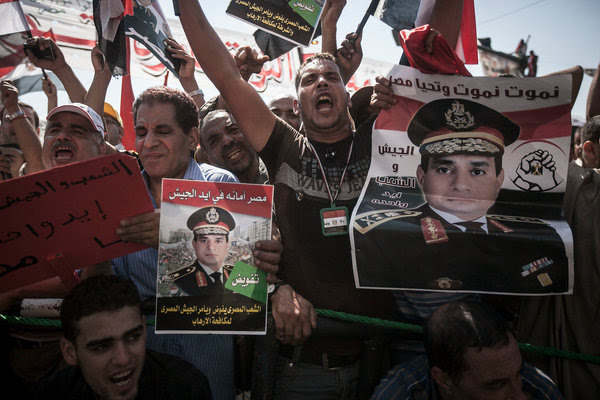 Supporters
of Egypt’s defense minister, Gen. Abdel-Fattah el-Sisi, demonstrated on
Friday during a rally in Tahrir Square in Cairo.Narciso Contreras for The New York Times
Supporters
of Egypt’s defense minister, Gen. Abdel-Fattah el-Sisi, demonstrated on
Friday during a rally in Tahrir Square in Cairo.Narciso Contreras for The New York Times
Early in the day, a judge orders the deposed president detained for an investigation into accusations that he had conspired with the Palestinian militant group Hamas to escape from prison in 2011.
A day earlier, the Obama administration concludes it is not legally required to determine whether the Egyptian military engineered a coup d’état in ousting Mr. Morsi, a senior administration official says, a finding that will allow it to continue to funnel $1.5 billion in American aid to Egypt each year.
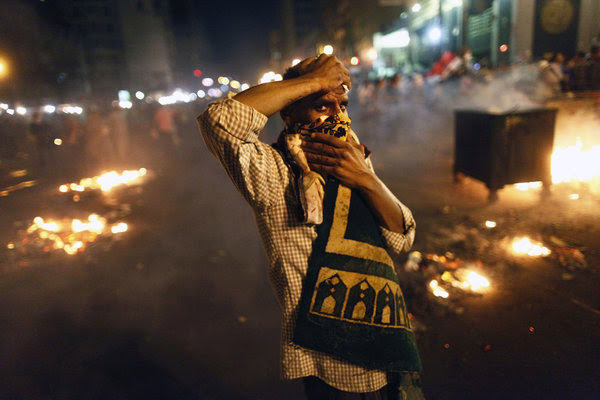 Muslim Brotherhood supporters tried to block the Six October Bridge in Cairo during demonstrations Monday into Tuesday morning.Mahmoud Khaled/Agence France-Presse — Getty Images
 An image of the military commander who executed the takeover, Gen. Abdel-Fattah el-Sisi, hangs inside a shop in Cairo.Narciso Contreras for The New York Times
In the turbulent period of military rule after Mr. Mubarak was ousted, many liberals and leftists stood shoulder to shoulder with Islamists to demand that the generals relinquish power to elected civilians. Now the liberals appear to have joined in a public amnesia about the abuses and scandals of that period — the forced virginity tests of female protesters; Coptic Christian demonstrators shot by soldiers or run over with armored vehicles; the videotaped stripping and kicking of a female demonstrator who became known as the Blue Bra Woman.
 Relatives
of Christians killed near Luxor, where Muslim mobs invaded Christian
homes and set them alight while besieging other Christians in their
homes.Ibrahim Zayed/Associated Press
Relatives
of Christians killed near Luxor, where Muslim mobs invaded Christian
homes and set them alight while besieging other Christians in their
homes.Ibrahim Zayed/Associated Press
The new military-led government accuses Mr. Morsi and his allies in the Muslim Brotherhood of a campaign to incite violence before and after his ouster as president.
 The interim Egyptian president, Adli Mansour, center, met with officials of the United Arab Emirates in Cairo on Tuesday.Egyptian Presidency European Pressphoto Agency
Saudi Arabia and the United Arab Emirates pledge $8 billion in cash and loans to Egypt, a decision that aims not only at shoring up a shaky transitional government, but also at undermining their Islamist rivals and strengthening their allies across a newly turbulent Middle East.
 Supporters
of Mohamed Morsi, Egypt’s ousted Islamist president, demonstrated
outside the Rabaa al-Adawiya mosque in Cairo on Monday.Yusuf Sayman for The New York Times
Supporters
of Mohamed Morsi, Egypt’s ousted Islamist president, demonstrated
outside the Rabaa al-Adawiya mosque in Cairo on Monday.Yusuf Sayman for The New York Times
A military spokesman, contradicting dozens of witnesses who say the attack had been unprovoked, says the violence had started when Brotherhood members attacked the officers’ club of the Republican Guard.
It is the single deadliest episode of violence since the final days before Mr. Mubarak's ouster.
 Violence
and political clashes on the streets of Egypt are rooted in the
country’s history. Former leaders have had little success creating
consensus among disparate groups.Channon Hodge and Mona El-Naggar
Violence
and political clashes on the streets of Egypt are rooted in the
country’s history. Former leaders have had little success creating
consensus among disparate groups.Channon Hodge and Mona El-Naggar
At the same time, security forces hold Mr. Morsi incommunicado in an undisclosed location, Islamist broadcast outlets are closed and prosecutors seek the arrest of hundreds of Mr. Morsi’s Brotherhood colleagues, in a sign that they have the most to lose in Egypt’s latest political convulsion.
The military intervention, which Mr. Morsi rejects, raises questions about whether the 2011 revolution will fulfill its promise to build a new democracy at the heart of the Arab world.
 People
celebrated on Monday after Egypt’s top generals gave President Mohamed
Morsi 48 hours to respond to a wave of mass protests demanding his
ouster. If he did not, they said, the military would impose a “road map”
to resolve the political crisis.Tara Todras-Whitehill for The New York Times
People
celebrated on Monday after Egypt’s top generals gave President Mohamed
Morsi 48 hours to respond to a wave of mass protests demanding his
ouster. If he did not, they said, the military would impose a “road map”
to resolve the political crisis.Tara Todras-Whitehill for The New York Times
The general says if Mr. Morsi does not take steps to address demands for a more inclusive government, the armed forces will move to impose their “own road map for the future.”
Protesters set fire to the headquarters of Mr. Morsi’s Muslim Brotherhood movement in Cairo, as clashes break out between Mr. Morsi’s opponents and supporters in several cities, killing at least seven people.
The demonstrations appear to exceed even the mass street protests in the final days of the uprising that overthrew Mr. Mubarak in 2011.
 Egyptian
men looked down at a massive traffic jam in Attaba, a neighborhood of
Cairo. In the two years since Egypt’s uprising, the birthrate has risen
to the highest levels in two decades, expanding a population that long
ago overwhelmed the country’s resources, according to preliminary
government figures.Tara Todras-Whitehill for The New York Times
Egyptian
men looked down at a massive traffic jam in Attaba, a neighborhood of
Cairo. In the two years since Egypt’s uprising, the birthrate has risen
to the highest levels in two decades, expanding a population that long
ago overwhelmed the country’s resources, according to preliminary
government figures.Tara Todras-Whitehill for The New York Times
Officials have dropped the awareness campaigns of the past, in an early indication of how the Islamist leadership is approaching social policy in the most populous Arab state.
 Egyptians in a gas line in the city of Luxor. Tara Todras-Whitehill for The New York Times
For months, the government has been negotiating a $4.8 billion loan on fairly easy terms from the International Monetary Fund. The thinking is that if the I.M.F. approved a loan, it could give the government the credibility it needs to unlock billions more dollars in aid and loans. But if a deal is reached, it will probably mean reducing subsidies for energy — a step many fear will incite the public.
In April, Egypt presses to increase the loan size, but discussions are pending and won't start again until October.
 A
soccer fan in Cairo celebrated after a court on Saturday sentenced 21
people to death for their role in a deadly soccer riot in Port Said last
year. Prosecutors had charged the Port Said fans with attacking their
Cairo rivals.Tara Todras-Whitehill for The New York Times
A
soccer fan in Cairo celebrated after a court on Saturday sentenced 21
people to death for their role in a deadly soccer riot in Port Said last
year. Prosecutors had charged the Port Said fans with attacking their
Cairo rivals.Tara Todras-Whitehill for The New York Times
The rioting is the sharpest challenge yet to the efforts of Egypt’s new Islamist rulers to re-establish order after the two years of turmoil.
Meanwhile, tens of thousands fill Tahrir Square to protest Mr. Morsi's expansive new powers.
 Supporters hail President Mohamed Morsi’s move to take new power and retry his predecessor.Mohamed Abd El Ghany/Reuters
The unexpected breadth of the powers he seizes raises immediate fears that he might become a new strongman.
 President Mohamed Morsi, right, accepted the oath of office from his new defense minister, Gen. Abdel Fattah el-Sisi.Egyptian Presidency, via Associated Press
Mr. Morsi also nullifies a constitutional declaration, issued by the military before he took office, that had gutted the authority of his office. He replaces it with his own declaration, one that gives him broad legislative and executive powers and, potentially, a decisive role in the drafting of Egypt’s still-unfinished new constitution.
For his new defense minister, Mr. Morsi chooses the head of military intelligence, Gen. Abdel Fattah el-Sisi, whose name surfaced last year when he acknowledged to Amnesty International that the military had subjected female protesters to “virginity tests.” The general defended the policy by saying it was imposed to “protect” soldiers from allegations of rape but said the tests would be stopped.
 Graffiti
in Tahrir Square in downtown Cairo, the epicenter of antigovernment
protests that led to the ouster of President Hosni Mubarak, depicts
members of the former government. From right are Mr. Mubarak; Field
Marshal Mohamed Hussein Tantawi, the chairman of the Supreme Council of
the Armed Forces who had acted as head of state until last week and will
maintain the title of defense minister; Amr Moussa, a former foreign
minister and presidential candidate; and the former general and
presidential candidate Ahmed Shafik. Tomas Munita for The New York Times
Graffiti
in Tahrir Square in downtown Cairo, the epicenter of antigovernment
protests that led to the ouster of President Hosni Mubarak, depicts
members of the former government. From right are Mr. Mubarak; Field
Marshal Mohamed Hussein Tantawi, the chairman of the Supreme Council of
the Armed Forces who had acted as head of state until last week and will
maintain the title of defense minister; Amr Moussa, a former foreign
minister and presidential candidate; and the former general and
presidential candidate Ahmed Shafik. Tomas Munita for The New York Times
The power struggle reflects dueling claims to Egypt’s emerging politics, with each side trying to frame the debate as a contest for ideals, legitimacy and democracy.
 President-elect Mohamed Morsi of the Muslim Brotherhood spoke to hundreds of thousands of supporters in Tahrir Square. Tomas Munita for The New York Times
Mr. Morsi, 60, an American-trained engineer and former lawmaker, is the first Islamist elected as head of an Arab state. He becomes Egypt’s fifth president and the first from outside the military. But his victory is an ambiguous milestone in Egypt’s promised transition to democracy.
 Protesters
gathered in Tahrir Square in Cairo as Egypt’s military rulers moved to
consolidate power on Friday, the eve of the Egyptian presidential runoff
election. The day before, the Supreme Constitutional Court moved to
shut down the Islamist-led Parliament, locking out lawmakers and seizing
the sole right to issue laws.Adam Ferguson for The New York Times
Protesters
gathered in Tahrir Square in Cairo as Egypt’s military rulers moved to
consolidate power on Friday, the eve of the Egyptian presidential runoff
election. The day before, the Supreme Constitutional Court moved to
shut down the Islamist-led Parliament, locking out lawmakers and seizing
the sole right to issue laws.Adam Ferguson for The New York Times
The military counsel also issues an interim constitution, all but eliminating the president's authority in an apparent effort to guard against a victory by the Muslim Brotherhood.
 Women in Cairo's Tahrir Square protested on the second anniversary of the revolution on Jan. 25, 2013.Mohamed Abd El Ghany/Reuters
Under Hosni Mubarak, the omnipresent police kept sexual assault out of the public squares and the public eye. But since Mr. Mubarak’s exit in 2011, the withdrawal of the security forces has allowed sexual assault to explode into the open, terrorizing Egyptian women.
 As early Egyptian election results reveal a strong showing for Islamists, the country’s secular voters react.Emily B. Hager and Ben Solomon
The party formed by the Muslim Brotherhood, Egypt's mainstream Islamist group, appears to have taken about 40 percent of the vote, as expected. But a big surprise was the strong showing of ultraconservative Islamists, called Salafis, many of whom see most popular entertainment as sinful and reject women's participation in voting or public life.
 Soldiers prayed on top of a tank during antigovernment protests and Friday Prayer in Tahrir Square. Carsten Koall/Getty Images
But the military leaders, who were seen as popular heroes, made it clear there would be limits to further dissent as soldiers and plainclothes security officers moved into the square, beating protesters and tearing down their tents, witnesses said.
 Few visitors were at the Temple of Queen Hatshepsut near Luxor. Tara Todras-Whitehill for The New York Times
Tourism provides direct jobs for nearly three million people, critical income to more than 70 industries and 20 percent of the state’s foreign currency — now desperately needed to prop up the plummeting Egyptian pound.
The move comes a day after the military consolidates its power, dissolving the feeble Parliament and suspending the Constitution, and stirring debate about the military's long-term intentions.
 David Kirkpatrick and Anthony Shadid report from Cairo on the aftermath of President Mubarak's resignation.Zena Barakat
The announcement, which comes after an 18-day revolt led by the young people of Egypt, shatters three decades of political stasis and overturns the established order of the Arab world.

- Google+
- Share
Published: July 2, 2013
Timeline of Turmoil in Egypt From Mubarak and Morsi to Sisi
Egypt’s
three-year experiment with democracy has ousted President Hosni Mubarak
and deposed Mohamed Morsi, the country’s first elected leader. Explore
key moments of their rule and the aftermath.
Sisi Sworn In as President and Vows ‘Inclusive’ Egypt
Gen. Abdel-Fattah el-Sisi, who gave himself the title field marshal earlier this year and led the military takeover nearly one year ago, is sworn in as president, testing the bet that a new strongman can overcome the economic dysfunction and political polarization that bedeviled Egypt’s three-year experiment with democracy.He won the pro forma presidential election with nearly 97 percent of the vote. Turnout was about 47 percent of eligible voters, far short of what he had sought to prove he had a mandate to lead and less than the 52 percent who voted in the 2012 election won by Mr. Morsi, whom Mr. Sisi overthrew last year. Foreign observers have said the election fell short of international standards.
- International Observers Find Egypt’s Presidential Election Fell Short of Standards
- Egypt’s New Strongman, Sisi Knows Best
- Citing Pressure and Threats, Egypt’s Answer to Jon Stewart Calls It Quits
- At Swearing-In, Ex-General Vows ‘Inclusive’ Egypt
- General Who Led Takeover of Egypt to Run for President
- Egypt’s Ruler Eyes Riskier Role: The Presidency
Mubarak Gets 3 Years for Embezzlement, and His Sons Get 4
A criminal court convicts Mr. Mubarak, who is 86 and living in a military hospital overlooking the Nile, of embezzling millions of dollars of public money for his personal use in private homes and palaces, in a case that rights advocates say could now implicate the current prime minister and spy chief.He is sentenced to three years in prison. His sons, Gamal and Alaa, are each sentenced to four years for their roles in the embezzlement scheme. The court orders the three to pay penalties and make repayments totaling more than $20 million, apparently in addition to $17 million they have already repaid.
Relatives
of the supporters of Mohamed Morsi, the ousted Egyptian president,
reacted to news of the verdict outside the courthouse in Minya. Agence France-Presse — Getty Images Hundreds of Egyptians Sentenced to Death
An Egyptian criminal court sentences 529 people to death after a single session of their mass trial, convicting them of murder for the killing of a police officer in the city of Minya during riots last summer after the ouster of Mr. Morsi.Legal experts call the case the largest mass trial or conviction in the history of modern Egypt.
Another court in Cairo continues the trial of several journalists for Al Jazeera who have been charged with broadcasting false reports of unrest in Egypt as part of an Islamist conspiracy to bring down the new government.
An Egyptian man carried an injured girl at the scene.Mahmud Khaled/Agence France-Presse — Getty ImagesDeadly Cairo Bomb Attacks Raise Fears of New Insurgency
Four separate bombings rock Cairo on the eve of the third anniversary of the Arab Spring revolt, killing at least six people, injuring more than 70, and evoking comparisons to Baghdad in a city that for decades has been among the most stable in the Arab world.The bombs, all targeting the police, appear to trigger spontaneous outpourings of support for General Sisi, who led the ouster of Mr. Morsi last summer.
An Egyptian received a ballot for the constitutional referendum at a polling station in Cairo on Tuesday.Tara Todras-Whitehill for The New York TimesEgyptians Vote on New Constitution in Key Referendum
The military-led government announces that Egyptians backed a charter with an extraordinary 98.1 percent of the vote, raising concern from Secretary of State John Kerry.The proposed charter is not radically different from the Constitution drafted by an Islamist-led assembly and approved by a margin of almost two to one slightly more than a year ago.
Men inspected the destruction in the Egyptian city of Mansura on Tuesday after a powerful car bomb.Mahmoud Khaled/Agence France-Presse — Getty ImagesBomb Rips Through Egyptian Police Building
A powerful bomb rips through a police headquarters north of Cairo, killing at least 15 people. It was Egypt’s deadliest bombing since militants began a campaign of assassinations and other attacks against the security services in July, when Mr. Morsi was ousted.The attack, the second on the headquarters since July, renews doubts about the government’s ability to provide security just weeks before millions of Egyptians are expected to vote in a referendum on a draft constitution.
Video from Egyptian state television of Mohamed Morsi, the deposed president, in court on Monday.Reuters
Morsi Goes on Trial
Mr. Morsi is on trial, facing charges of inciting the murder of protesters, but he rejects the court’s authority and proclaims himself to be the country’s legitimate ruler.The trial is Mr. Morsi’s first public appearance since his removal from office on July 3 and, in a dizzying turn for Egypt, the second criminal trial of a former head of state in less than three years. The trial was soon adjourned until Jan. 8.
Obama Expected to Reduce Military Aid to Egypt
The Obama administration plans to suspend a substantial portion of American military aid to Egypt, several administration officials say. The decision, which is expected to be announced in the coming days, will hold up the delivery of several types of military hardware to the Egyptian military, these officials said, including tanks, helicopters and fighter jets. But it will not affect aid for counterterrorism operations or for border security issues involving the Sinai Peninsula and Gaza.A
wounded supporter of the ousted President Mohamed Morsi was taken for
treatment amid clashes in Giza on the anniversary of the 1973
Arab-Israeli war. Mosaab Elshamy/European Pressphoto AgencyMayhem Returns After Surge of Violence
Grim, familiar scenes of violence returned to Egypt on Sunday, with at least 51 people killed and hundreds injured in street clashes across several Egyptian cities.The next day, foes of the military-appointed government carried out three brazen attacks, killing six soldiers in a drive-by shooting near the Suez Canal, bombing a security building in the tourist-dependent southern Sinai that left at least three police officers dead, and firing grenades at a Cairo compound housing the country’s main satellite transmitter.
Court Bans Muslim Brotherhood
An Egyptian court orders the dissolution of the Muslim Brotherhood and the confiscation of its assets, making it harder for the new military-backed government to fulfill its promises of a new, inclusive democratic process — one that would be open even to Mr. Morsi’s Islamist supporters.Instead, the ruling pushes the Brotherhood back underground, where it was for most of its 85-year history before the 2011 revolution that ousted Hosni Mubarak allowed the group to operate in the open.
Mubarak Removed From Egyptian Prison
Egypt’s military-appointed government transferred Mr. Mubarak from Tora Prison to the Maadi Military Hospital in Cairo, a day after an Egyptian court ruled that he could no longer be incarcerated. An Egypt Arrest, and a Brotherhood on the Run
The Egyptian police arrest Mohamed Badie, the spiritual leader of the Muslim Brotherhood, a red line the police had never crossed during Mr. Mubarak’s own crackdowns on the group.As Europeans and the United States consider cutting cash aid to Egypt, Saudi Arabia says that it and its allies will make up any reduction — effectively neutralizing the West’s main leverage over Cairo.
Mona El-Naggar and Reem Makhoul
Blood and Chaos Prevail in Egypt, Testing Control
Thousands of followers of the embattled Muslim Brotherhood march in Cairo to denounce a crushing assault by Egyptian forces on Wednesday, facing police officers authorized to use lethal force if threatened.The country seems to descend into anarchy as more tha 1,000 people are killed in street battles.
Courtesy of NBC
Obama Rebukes Egypt’s Leaders
President Obama announces that the United States has canceled longstanding joint military exercises with the Egyptian Army set for next month, using one of his few obvious forms of leverage to rebuke Egypt’s military-backed government for its brutal crackdown on pro-Morsi supporters.He expresses outrage at the harrowing scenes this week in Egypt, while taking pains to preserve the American relationship with the Egyptian armed forces, which are underwritten by the vast bulk of the $1.5 billion a year in military and economic aid.
Egyptian Forces Storm Pro-Morsi Sit-Ins
Security forces launch a bloody crackdown on two sit-ins by supporters of Mr. Morsi, setting off waves of violence in the capital and across the country. More than 600 are killed and 3,700 people injured in the the bloodiest day since Mr. Mubarak's ouster. Muslim Brotherhood supporters urge followers to take to the streets the next day.Mohamed ElBaradei, the interim vice president and a Nobel Prize-winning former diplomat, resigns in protest, as General Sisi declares a one-month state emergency.
- Hundreds Die as Egyptian Forces Attack Islamist Protesters
- Arab Spring Countries Find Peace Is Harder Than Revolution
- U.S. Condemns Crackdown but Announces No Policy Shift
- Assault on Morsi Supporters in Egypt
- Fierce and Swift Raids on Islamists Bring Sirens, Gunfire, Then Screams
- Cameraman for British Network Is Killed in Cairo
- Two Sit-Ins Test New Egyptian Leadership
Crackdown in Egypt Kills Islamists as They Protest
The Egyptian authorities unleash a ferocious attack on Islamist protesters, killing at least 72 people in the second mass killing of demonstrators in three weeks and the deadliest attack by the security services since Egypt’s uprising in early 2011.The tactics — many were killed with gunshot wounds to the head or the chest — suggest that Egypt’s security services felt no need to show any restraint.
Supporters
of Egypt’s defense minister, Gen. Abdel-Fattah el-Sisi, demonstrated on
Friday during a rally in Tahrir Square in Cairo.Narciso Contreras for The New York TimesMorsi’s Friends and Foes Stage Mass Rallies Across Egypt
Supporters and opponents of Mr. Morsi turn out in vast dueling demonstrations across Egypt, raising tensions further after a week of violence that left more than a dozen people dead.Early in the day, a judge orders the deposed president detained for an investigation into accusations that he had conspired with the Palestinian militant group Hamas to escape from prison in 2011.
A day earlier, the Obama administration concludes it is not legally required to determine whether the Egyptian military engineered a coup d’état in ousting Mr. Morsi, a senior administration official says, a finding that will allow it to continue to funnel $1.5 billion in American aid to Egypt each year.
Egypt’s New Government Doesn’t Include Muslim Brotherhood
Adli Mansour, Egypt’s interim president, swears in a new cabinet that is dominated by liberal and leftist politicians. Not one of the 34 cabinet members belongs to the Muslim Brotherhood or to any other Islamist party. The cabinet does include three women and three Coptic Christians, making it slightly more diverse, in some respects, than Mr. Morsi’s cabinet.
An image of the military commander who executed the takeover, Gen. Abdel-Fattah el-Sisi, hangs inside a shop in Cairo.Narciso Contreras for The New York TimesEgyptian Liberals Embrace Military, Stifling Doubts
A hypernationalist euphoria unleashed in Egypt by the toppling of Mr. Morsi sweeps up even liberals and leftists who slam any dissenters.In the turbulent period of military rule after Mr. Mubarak was ousted, many liberals and leftists stood shoulder to shoulder with Islamists to demand that the generals relinquish power to elected civilians. Now the liberals appear to have joined in a public amnesia about the abuses and scandals of that period — the forced virginity tests of female protesters; Coptic Christian demonstrators shot by soldiers or run over with armored vehicles; the videotaped stripping and kicking of a female demonstrator who became known as the Blue Bra Woman.
Relatives
of Christians killed near Luxor, where Muslim mobs invaded Christian
homes and set them alight while besieging other Christians in their
homes.Ibrahim Zayed/Associated PressSudden Improvements in Egypt Suggest a Campaign to Undermine Morsi
The sudden end of crippling energy shortages and the re-emergence of the police suggest that those opposed to Mr. Morsi had tried to undermine his administration.The new military-led government accuses Mr. Morsi and his allies in the Muslim Brotherhood of a campaign to incite violence before and after his ouster as president.
The interim Egyptian president, Adli Mansour, center, met with officials of the United Arab Emirates in Cairo on Tuesday.Egyptian Presidency European Pressphoto AgencyInterim Government Seeks Quick Elections
The military-led interim government enlists internationally recognized figures to serve as its public face and promises swift elections, but introduces a transitional plan that is widely criticized as muddled, authoritarian and rushed.Saudi Arabia and the United Arab Emirates pledge $8 billion in cash and loans to Egypt, a decision that aims not only at shoring up a shaky transitional government, but also at undermining their Islamist rivals and strengthening their allies across a newly turbulent Middle East.
Dozens of Morsi Supporters Are Killed in Cairo Protest
Soldiers and police officers open fire on hundreds of supporters of Mr. Morsi outside the facility where he is believed to be detained, killing at least 54 people and wounding more than 300.A military spokesman, contradicting dozens of witnesses who say the attack had been unprovoked, says the violence had started when Brotherhood members attacked the officers’ club of the Republican Guard.
It is the single deadliest episode of violence since the final days before Mr. Mubarak's ouster.
Interim President Is Sworn In
Adli Mansour, the chief justice of the Supreme Constitutional Court, is sworn in as acting head of state. The little-known judge says he looks forward to parliamentary and presidential elections that will express the “true will of the people.”At the same time, security forces hold Mr. Morsi incommunicado in an undisclosed location, Islamist broadcast outlets are closed and prosecutors seek the arrest of hundreds of Mr. Morsi’s Brotherhood colleagues, in a sign that they have the most to lose in Egypt’s latest political convulsion.
A
timeline of four critical days in Egypt as massive street protests on
Sunday kicked off a chain of events culminating in the army ousting
Egypt's president.Alyssa Kim and Shayla Harris
Army Ousts Egypt’s President; Morsi Denounces ‘Military Coup’
In an announcement read on state television, Gen. Abdel-Fattah el-Sisi, the Egyptian defense minister, ousts Mr. Morsi, the nation’s first freely elected president, suspending the Constitution, installing an interim government and insisting it was responding to the millions of Egyptians who had opposed the Islamist agenda of Mr. Morsi and his allies in the Muslim Brotherhood.The military intervention, which Mr. Morsi rejects, raises questions about whether the 2011 revolution will fulfill its promise to build a new democracy at the heart of the Arab world.
Army Issues Ultimatum to Morsi
In a statement read on state television, the head of the Egyptian military, Gen. Abdel Fattah el-Sisi, threatens to intervene in the country’s political crisis, warning Mr. Morsi and other politicians that they have 48 hours to respond to an outpouring of popular protests that have included demands for his resignation.The general says if Mr. Morsi does not take steps to address demands for a more inclusive government, the armed forces will move to impose their “own road map for the future.”
Video
shot by Simon Hanna for Ahram Online, an English-language offshoot of a
state-owned Cairo newspaper, showed protesters outside the presidential
palace in Cairo on Sunday.Ahram Online
By the Millions, Egyptians Seek Morsi’s Ouster
Millions of Egyptians stream into the streets of cities across the country to demand the ouster of Mr. Morsi, in an outpouring of anger at the political dominance of his Islamist backers in the Muslim Brotherhood.Protesters set fire to the headquarters of Mr. Morsi’s Muslim Brotherhood movement in Cairo, as clashes break out between Mr. Morsi’s opponents and supporters in several cities, killing at least seven people.
The demonstrations appear to exceed even the mass street protests in the final days of the uprising that overthrew Mr. Mubarak in 2011.
Egypt’s Birthrate Rises as Population Control Policies Vanish
President Mohamed Morsi remains silent about the future of the family planning programs put in place by the government of former President Hosni Mubarak, as the country's birthrate surges to a 20-year high.Officials have dropped the awareness campaigns of the past, in an early indication of how the Islamist leadership is approaching social policy in the most populous Arab state.
Egyptians in a gas line in the city of Luxor. Tara Todras-Whitehill for The New York TimesEgypt Struggles to Revive Ailing Economy
A fuel shortage has helped send food prices soaring. Electricity is blacking out even before the summer. And Egypt is struggling to pay the billions of dollars it owes foreign oil companies.For months, the government has been negotiating a $4.8 billion loan on fairly easy terms from the International Monetary Fund. The thinking is that if the I.M.F. approved a loan, it could give the government the credibility it needs to unlock billions more dollars in aid and loans. But if a deal is reached, it will probably mean reducing subsidies for energy — a step many fear will incite the public.
In April, Egypt presses to increase the loan size, but discussions are pending and won't start again until October.
A City in Egypt Erupts in Chaos Over Sentences
A court in Cairo hands down death sentences for 21 of those involved in the soccer riots a year ago that killed 74 and wounded more than 1,000. The violence that the verdict prompts, involving hard-core “ultra” supporters of both teams, the Egyptian team Al Masry, of Port Said, and players and fans from Al Ahly, of Cairo, kills at least 28 and wounds at least 300.The rioting is the sharpest challenge yet to the efforts of Egypt’s new Islamist rulers to re-establish order after the two years of turmoil.
The
Times’s David D. Kirkpatrick discusses the mounting anger in Egypt
despite signs that President Mohamed Morsi is retreating from an attempt
to vastly expand his power.Mac William Bishop, Vijai Singh and Channon Hodge
Egyptian Islamists Approve Draft Constitution Despite Objections
The Islamists drafting Egypt’s new constitution vote to approve a charter that human rights groups and international experts say is full of holes and ambiguities. The result will fulfill some of the central demands of the revolution. But it will also give the generals much of the power and privilege they had during the Mubarak era and will reject the demands of ultraconservative Salafis.Meanwhile, tens of thousands fill Tahrir Square to protest Mr. Morsi's expansive new powers.
Supporters hail President Mohamed Morsi’s move to take new power and retry his predecessor.Mohamed Abd El Ghany/ReutersMorsi Seizes New Power
With a constitutional assembly on the brink of collapse and protesters battling the police in the streets over the slow pace of change, President Mohamed Morsi issues a decree granting himself broad powers above any court as the guardian of Egypt’s revolution and uses his new authority to order the retrial of Hosni Mubarak.The unexpected breadth of the powers he seizes raises immediate fears that he might become a new strongman.
President Mohamed Morsi, right, accepted the oath of office from his new defense minister, Gen. Abdel Fattah el-Sisi.Egyptian Presidency, via Associated PressMorsi Forces Out Military Chiefs and Claims Powers
Mr. Morsi forces the retirement of his powerful defense minister, the army chief of staff and other senior generals.Mr. Morsi also nullifies a constitutional declaration, issued by the military before he took office, that had gutted the authority of his office. He replaces it with his own declaration, one that gives him broad legislative and executive powers and, potentially, a decisive role in the drafting of Egypt’s still-unfinished new constitution.
For his new defense minister, Mr. Morsi chooses the head of military intelligence, Gen. Abdel Fattah el-Sisi, whose name surfaced last year when he acknowledged to Amnesty International that the military had subjected female protesters to “virginity tests.” The general defended the policy by saying it was imposed to “protect” soldiers from allegations of rape but said the tests would be stopped.
Military and President Escalate Their Power Struggle
The battle between the Muslim Brotherhood and the military intensifies when Mr. Morsi summons back into session the democratically elected Parliament that the generals had dissolved after a hurried court ruling. Egypt's highest court and generals dismiss the order, but Parliament meets in defiance and votes to appeal the court's decision, creating a chaotic mess of conflicting legal authorities and jurisdictions.The power struggle reflects dueling claims to Egypt’s emerging politics, with each side trying to frame the debate as a contest for ideals, legitimacy and democracy.
President-elect Mohamed Morsi of the Muslim Brotherhood spoke to hundreds of thousands of supporters in Tahrir Square. Tomas Munita for The New York TimesMohamed Morsi of Brotherhood Sworn In as President
Mr. Morsi, of the Muslim Brotherhood, is the winner of Egypt’s first competitive presidential election, handing the Islamists both a symbolic triumph and a potent weapon in their struggle for power against the country’s top generals.Mr. Morsi, 60, an American-trained engineer and former lawmaker, is the first Islamist elected as head of an Arab state. He becomes Egypt’s fifth president and the first from outside the military. But his victory is an ambiguous milestone in Egypt’s promised transition to democracy.
Egypt’s Military Extends Its Power
Egypt's military rulers move to consolidate power on the eve of the presidential runoff election between Mohamed Morsi of the Muslim Brotherhood and Ahmed Shafik, a former prime minister to Mr. Mubarak. They shut down the Islamist-led Parliament, predicated on a court ruling a day before, and seize the sole right to issue laws even after a new head of state takes office. Their charter gives them control of all laws and the national budget, immunity from any oversight and the power to veto a declaration of war.The military counsel also issues an interim constitution, all but eliminating the president's authority in an apparent effort to guard against a victory by the Muslim Brotherhood.
Women in Cairo's Tahrir Square protested on the second anniversary of the revolution on Jan. 25, 2013.Mohamed Abd El Ghany/ReutersRise in Sexual Assaults in Egypt Sets Off Clash Over Blame
The increase in sexual assaults over the last two years sets off a new battle over who is to blame, and the debate has become a stark and painful illustration of the convulsions racking Egypt as it tries to reinvent itself.Under Hosni Mubarak, the omnipresent police kept sexual assault out of the public squares and the public eye. But since Mr. Mubarak’s exit in 2011, the withdrawal of the security forces has allowed sexual assault to explode into the open, terrorizing Egyptian women.
Islamists Say They Have Mandate in Egypt Voting
After days of clashes between the military and protesters, the first parliamentary elections since the ouster of Mr. Mubarak take place.The party formed by the Muslim Brotherhood, Egypt's mainstream Islamist group, appears to have taken about 40 percent of the vote, as expected. But a big surprise was the strong showing of ultraconservative Islamists, called Salafis, many of whom see most popular entertainment as sinful and reject women's participation in voting or public life.
Soldiers prayed on top of a tank during antigovernment protests and Friday Prayer in Tahrir Square. Carsten Koall/Getty ImagesMilitary Cracks Down on New Protest
Tens of thousands of protesters return to Tahrir Square, the site of demonstrations that led to the ouster of Mr. Mubarak, to keep up the pressure on Egypt’s military-led transitional government.But the military leaders, who were seen as popular heroes, made it clear there would be limits to further dissent as soldiers and plainclothes security officers moved into the square, beating protesters and tearing down their tents, witnesses said.
Egyptians Struggle as Wary Tourists Stay Away
Tourism begins to plunge. Over the next two years, some tourists start to return, but officials say they are mostly beachgoers rather than the more lucrative cultural tourists.Tourism provides direct jobs for nearly three million people, critical income to more than 70 industries and 20 percent of the state’s foreign currency — now desperately needed to prop up the plummeting Egyptian pound.
The Egyptian military has met with protest organizers to discuss a brisk timetable for electing the country's new leadership.Rob Harris
Egypt Army Sets Six-Month Blueprint
The governing military officers lay out a six-month timetable in which to draft constitutional amendments, submit them to a referendum and elect a new government.The move comes a day after the military consolidates its power, dissolving the feeble Parliament and suspending the Constitution, and stirring debate about the military's long-term intentions.
Mubarak Steps Down
Vice President Omar Suleiman announces that President Hosni Mubarak, 82, has turned over all power to the military, passed all authority to a council of military leaders and named his prime minister, Ahmed Shafiq, to lead the cabinet.The announcement, which comes after an 18-day revolt led by the young people of Egypt, shatters three decades of political stasis and overturns the established order of the Arab world.
Shreeya Sinha and Erin Banco





 Ghulam Muhammed