|
Tuesday, May 28, 2013
Awami Vikas Party writes to President on the gross injustice of a Presidential decree discriminating against Muslims


Tuesday, May 21, 2013
India should keep out of Afghanistan - Letter to the Editor - Ghulam Muhammed
Tuesday, May 21, 2013
Letter to the Editor
While Afghanistan's President Hamid Karzai is in India on a three-day visit, to meet Prime Minister Manmohan Singh this evening where he is expected to push for an expansion for India's security involvement in Afghanistan, one cannot help to note from a CNN Farid Zakaria interview of Daryl Dalrymple on the last British involvement in Afghanistan, back in 1860s when out of about 18000 British troops, only one survived the retreat, and in that expedition with the British were about 5000 Indians too – helpless coolies recruited to die, apparently not for the sake of their own country, India. Another episode blurs up the confusion on Afghanistan, when a British soldier, Joe Geldon, on Steven Sucker’s BBC Hardtalk program accuses that UK was merely hanging over the coattails of US and it has no business to be in Afghanistan. With so much world experience being articulated day in and day out even in current media programs, one hopes our Prime Minister will take heed and not drag us Indians into Afghanistan imbroglio, either hanging from the coattails of the US or Hamid Karzai – the later-day Shah Shuja --- whatever promise of gold at the end of the rainbow will be shown to him and his advisers. India should opt for a war-less future for the sub-continent and even with China, it should finalize a neighborly relations just like US has with Canada – open borders, open hearts.
Ghulam Muhammed, Mumbai
<ghulammuhammed3@gmail.com>

Letter to the Editor
While Afghanistan's President Hamid Karzai is in India on a three-day visit, to meet Prime Minister Manmohan Singh this evening where he is expected to push for an expansion for India's security involvement in Afghanistan, one cannot help to note from a CNN Farid Zakaria interview of Daryl Dalrymple on the last British involvement in Afghanistan, back in 1860s when out of about 18000 British troops, only one survived the retreat, and in that expedition with the British were about 5000 Indians too – helpless coolies recruited to die, apparently not for the sake of their own country, India. Another episode blurs up the confusion on Afghanistan, when a British soldier, Joe Geldon, on Steven Sucker’s BBC Hardtalk program accuses that UK was merely hanging over the coattails of US and it has no business to be in Afghanistan. With so much world experience being articulated day in and day out even in current media programs, one hopes our Prime Minister will take heed and not drag us Indians into Afghanistan imbroglio, either hanging from the coattails of the US or Hamid Karzai – the later-day Shah Shuja --- whatever promise of gold at the end of the rainbow will be shown to him and his advisers. India should opt for a war-less future for the sub-continent and even with China, it should finalize a neighborly relations just like US has with Canada – open borders, open hearts.
Ghulam Muhammed, Mumbai
<ghulammuhammed3@gmail.com>
Monday, May 20, 2013
America’s War on Islam 2.0 - By Stephen Lendman
America’s War on
Islam 2.0
By
Stephen Lendman on April 21, 2013
Waging war at home or abroad requires
enemies. America creates them when none exist. Imperial strategy demands
them.
Post-9/11, Muslims were targeted for
political advantage. Post-Boston bombings, America’s war on Islam
continues.
Muslims are “war on terror” scapegoats.
Washington’s Middle East, North Africa and Central Asia wars rage.
It’s the wrong time to be Muslims in
America. They’re persecuted for their faith and ethnicity. At times it’s for
their activism, prominence, and/or charity.
They’re dehumanized, spied on, set up
as patsies, hunted down, rounded up, held in detention, kept in isolation,
denied bail, restricted in their right to counsel, tried on secret evidence,
convicted on bogus charges, given long sentences, and treated harshly as
political prisoners.
The term “Islamofascism” was
popularized. Some call it Islamic radicalism or jihadism. The New Oxford
American Dictionary calls it “a controversial term equating some modern Islamic
movements with the European fascist movements of the early twentieth
century.”
The Urban Dictionary says it “refers to
the notion that Islam is not so much a religion as it is a political ideology
that in many ways resembles ‘fascism.’ ”
“An Islamofascist can either be an
Islamic fundamentalist, or someone who uses violence or bullying tactics to
impose Islamic principles on others….”
It’s used to describe groups like Al
Qaeda. In 2008, Fairness & Accuracy in Reporting (FAIR) headlined “The Dirty Dozen – Who’s who
among America’s leading Islamophobes.” (PDF)
FAIR called David Horowitz its “premier
promoter.” His 2007 “Islamofascism Awareness Week” attracted leading Muslim
haters.
Author Robert Spencer was called a
prominent Islam-basher. He publishes the “notoriously Islamophobic website”
“Jihad Watch.”
Daniel Pipes founded the Middle East
Forum think tank. Media scoundrels mischaracterize him as an Islamic “scholar.”
He defends racially profiling Arab Americans. He calls their presence a “true
danger” for Jews.
Michael Savage hosts “The Savage
Nation.” It’s a nationally syndicated radio talk show. He relentlessly uses
hateful language. He once endorsed killing a hundred million Muslims. He did so
on air.
Pat Robertson calls Islam violent and
irrational. It’s “not a religion,” he says. It’s a “worldwide political
movement.” It’s “meant to subjugate all people under Islamic law.” It’s a
“bloody, brutal type of religion.”
Others on FAIR’s list included Fox
News’ Sean Hannity and Bill O’Reilly, conservative political commentator Mark
Steyn, self-styled Islamic terrorist expert Steven Emerson, conservative
blogger/commentator Michelle Malkin, former Fox News host Glenn Beck, and
political commentator Debbie Schlussel.
Connect the dots. The Boston bombings
connect eerily to 9/11. Muslims were blamed both times. America’s war on terror
targets them. It continues at home and abroad.
Dzhokhar Tsarnaev’s a naturalized US
citizen. Senators Lindsey Graham (R. SC), John McCain (R. AZ) and Kelly Ayotte
(R. NH), as well as Rep. Peter King (R. NY) want him held as an “enemy
combatant.” They want him denied fundamental rights.
King chairs the House Homeland Security
Committee. He’s also an Intelligence Committee member. He wants more
surveillance. “It keeps us ahead of the terrorists who are constantly trying to
kill us,” he said.
Big Brother no longer is fiction. Total
surveillance is possible. New York, Chicago, Los Angeles, Washington, Boston,
and other cities use growing numbers of video cameras.
They monitor streets, commercial areas,
airports, highways, public and private transportation, shopping malls,
government and business buildings, as well as other places where people
congregate, work, reside, recreate, or inhabit for any reason.
King and others want more. Drone
surveillance may be expedited. Legislation authorized eye in the sky spying.
Civil libertarians call all forms of surveillance an unregulated privacy
threat.
In his April 20 weekly address, Obama
suggested perhaps what’s coming. He called Monday’s incident “an act of
terror….But in the days since….Americans refuse to be terrorized.”
“….Boston’s spirit remains undaunted.
America’s spirit remains undimmed….That’s what makes us strong. That’s why we
endure.”
“In the days to come, we will remain
vigilant as a nation.” Expect the worst to follow.
Tamerlan and Dzhokhar Tsarnaev are
called Islamic terrorists. Media scoundrels characterize them that
way.
Round-the-clock coverage pronounced
guilt by accusation. What’s most important to know is suppressed. Managed news
misinformation substitutes.
Both brothers were set up as patsies.
One’s dead. The other’s seriously wounded. He remains hospitalized. He’s at
Boston’s Beth Israel Deaconess Medical Center. He’s under heavy
guard.
He’ll be interrogated when able to
respond. He won’t be read his Miranda rights. On April 20, the ACLU headlined a
“Statement on Miranda Rights of Boston Bombings Suspect,” saying:
“The American Civil Liberties Union reacted to the apprehension of the suspect in the Boston Marathon bombing and statements from federal officials that he would be questioned without being read his Miranda rights.”“Every criminal defendant is entitled to be read Miranda rights. The public safety exception should be read narrowly. It applies only when there is a continued threat to public safety and is not an open-ended exception to the Miranda rule.”“Additionally, every criminal defendant has a right to be brought before a judge and to have access to counsel. We must not waver from our tried-and-true justice system, even in the most difficult of times. Denial of rights is un-American and will only make it harder to obtain fair convictions.”
The Center for Constitutional Rights
headlined “CCR Condemns Miranda Exception in Boston Marathon Suspect Case,”
saying:
“The Miranda warnings were put in place because police officers were beating and torturing ‘confessions’ out of people who hadn’t even been formally accused of a crime.”“We cannot afford to repeat our mistakes. If officials require suspects to incriminate themselves, they are making fair trials and due process merely option and not a requirement. To venture down that road again will make law enforcement accountable to no one.”“Like Obama’s expanded killing program and his perpetuation of indefinite detention without trial at Guantanamo, this is yet another erosion of the Constitution to lay directly at the President’s feet.”“Obama’s Justice Department unilaterally expanded the ‘public safety exception’ to Miranda in 2010 beyond anything the Supreme Court ever authorized.”“Each time the administration use this exception, it stretches wider and longer. However horrific the crime, continuing to erode constitutional rights invites continued abuse by law enforcement, and walks us down a dangerous path that becomes nearly impossible to reverse.”
Media scoundrels straightaway convicted
both brothers. They did so in the court of public opinion. Misreporting
continues. FAIR’s Peter Hart calls it a “rush to misjudgment,”
saying:
“We’ve seen reporting and commentary that talked about the Muslim or jihadist character of the bombs themselves: pressure cookers, ball bearings or nails used.”“These are things that are not unique to al-Qaeda or al-Qaeda-inspired terror attacks.”“We saw references to the Times Square bombing, trying to put this in the context of Islamic terror or previous instances of what the media like to refer to as Islamic terror.”“We even saw references to the fact that two bombs were there. It must have been a follow-up attack trying to hit the rescue workers when they show up – again, a Middle Eastern trait, we’re told.”“This is actually what the United States government has done in places like Iraq and in drone strikes in Pakistan.”“So we have seen this rush to characterize this bombing, without necessarily saying precisely that we know who the perpetrators are, but to put it in this context.”“And I think that creates a climate of fear and suspicion, particularly directed toward certain communities.”“We read headlines, you know, block letters across the front page of the USA Today, the day afterwards, “Terror Has Returned.”“This idea that the United States has not seen a terrorist attack since 9/11. This is a unique event right now.”
On April 19, Media Matters headlined
“Boston And The Right-Wing Media’s Collapse,” saying:
Glenn Beck’s web site (The Blaze) got it wrong saying a Saudi national student was “absolutely involved.” He called him a “dirt bag, possibly the ringleader.”Fox News host Sean Hannity claimed he previously was “involved with a terrorist or terror activity.”Media Matters said “too many players opted to just make stuff up. Prompting witch hunts, they cast innocents as would-be killers and then couldn’t be bothered with apologies.”Murdoch’s New York Post “seemed committed to getting as many stories wrong about the Boston attack as possible.”Before an arrest was made, CNN’s breaking news headlined “Sources: Arrest made in bombings case.” Reporter John King erroneously called him “dark-skinned.”
NAACP President Benjamin Todd Jealous
responded, saying:
“Our concern is that CNN used an overly broad, unhelpful and potentially racially inflammatory categorization to describe the potential suspect. History teaches us that too often people of color are unfairly targeted in the aftermath of acts of terrorism.”
Post-Boston bombings, media misreporting was deplorable. It didn’t surprise. “Rush to misjudgment” is commonplace. Washington Post editors headlined “In pursuit of terrorists.”Official reports were accepted as fact. The Tsarnaev brothers were blamed. A Chechen “extremist,” “Al Qaeda” or other “foreign group” connection was suggested.“Much as some in Washington might wish it, the war against terrorism is not over….The Tszrnaevs….may have intended more mayhem: They were reportedly carrying more bombs when they were cornered Thursday.”
Note: Media misreporting said at least
older brother Tamerlan wore an explosives vest. Photos of his body showed him
riddled with bullets and shrapnel head to toe. All limbs were intact. He wasn’t
blown to pieces.
New York Post editors headlined “The
unfinished war,” saying:
“….These have been scary days. (It was) chilling to see how successfully the suspects, Chechen Muslim immigrants, were – not just in allegedly killing people, but in instilling widespread fear, especially in the Northeast.”“The week served as a painful reminder that this nation remains in an ongoing fight against terror – and that the homeland is still vulnerable.”“The war on terror isn’t over. Alas, far from it.”
Boston Globe editors headlined “Boston
after the bombings: a show of character,” saying:
“(L)aw-enforcement officials and political leaders….put aside turf wars and expressions of egotism to focus on the killers….”“….Boston’s character needs no further validation. The city is strong, and getting stronger.”
Chicago Tribune editors headlined
“Accomplishing….nothing,” saying:
“….Boston bombing suspects (may) have had no motivation more complex than joyful cruelty.”“This level of preparation, though, suggests that they had some motive more sophisticated than merely marauding through the lives of innocents.”“The Boston massacre no doubt will help authorities worldwide rethink security preparations for mass events.”
Numerous print and broadcast reports
highlighted a Chechen Muslim connection. The New York Times was typical
headlining “Boston Attacks Turn Spotlight on Troubled Region of Chechnya,”
saying:
Possible motivations of both brothers aren’t yet known. “Yet, with at least one brother talking of Chechen nationalism on the Internet, their reported involvement in the marathon attack throws a spotlight on one of the darkest corners of nationalist and Islamic militancy….”“Whether the Boston bombing was tied to it is still unclear, but a generation of young Chechen men have never known a peaceful homeland (and have had) difficulties finding a place abroad.”
America’s war on terror continues.
Perhaps last week’s Boston bombings advanced it. Muslims remain America’s enemy
of choice. Expect Obama and Congress to take full advantage. Expect the worst of
times to follow.
Stephen Lendman lives in Chicago. He can
be reached at lendmanstephen@sbcglobal.net.
His new book is titled “Banker
Occupation: Waging Financial War on Humanity.” http://www.claritypress.com/
Links:
FAIR - Dirty Dozen - http://fair.org/article/the-
FAIR - Dirty Dozen - pdf - http://www.smearcasting.us/
Friday, May 17, 2013
Islam could be dominant UK religion in 10 years – census analysis - RT
http://rt.com/news/christianity-decline-uk-islam-rise-405/

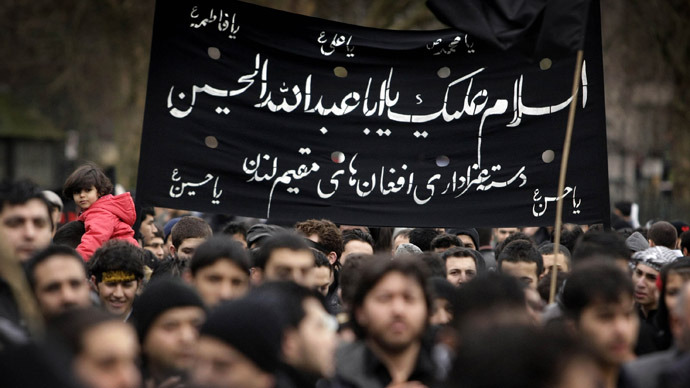 One in 10 people under 25 are Muslim, while
Christianity is in decline, the 2011 UK census reveals. An explosion in
the Muslim population and an aging Christian demographic could mean
Islam will be the dominant religion in the UK in 10 years.
One in 10 people under 25 are Muslim, while
Christianity is in decline, the 2011 UK census reveals. An explosion in
the Muslim population and an aging Christian demographic could mean
Islam will be the dominant religion in the UK in 10 years.
A new analysis of the 2011 census by the Office for National Statistics (ONS) showed that the number of Christians was falling 50 per cent faster than had previously been thought. Earlier analysis of the statistics showed only a 15 per cent decline, but the ONS found that this figure had been beefed up by 1.2 million foreign-born Christians.
Furthermore, the re-analysis showed that the majority of Christians were over the age of 60 and for the first time less than half of young people describe themselves as Christian. As a result the ONS has calculated that in a decade only a minority will classify themselves as Christians in England. Christianity is still the dominant religion in the UK with over 50 per cent of the population regarding themselves as believers.
However, this may be set to change as the British Muslim population has surged dramatically over the past 15 years, increasing by 75 per cent in England and Wales. The 2011 census puts the Muslim population of the UK at around 5 per cent, a total that has been boosted by around 600,000 Muslim immigrants who have arrived in the UK over the past decade.
 Keith Porteous Wood, executive director of the National Secular
Society, said to UK daily the Telegraph that the decline of
Christianity is
Keith Porteous Wood, executive director of the National Secular
Society, said to UK daily the Telegraph that the decline of
Christianity is
“inevitable.” “In another 20 years there are going to be more active Muslims than there are churchgoers,” he said.
Moreover the number of people identifying themselves as atheists has increased by 10 per cent, rising from 15 per cent to 25 per cent. The change has been dubbed as a “significant cultural shift” by the British Humanist Association, while the Church of England has shrugged off the statistics, maintaining they still retain a strong base of believers.
"While this is a challenge, the fact that six out of 10 people in England and Wales self-identify as Christians is not discouraging. Christianity is no longer a religion of culture but a religion of decision and commitment. People are making a positive choice in self-identifying as Christians," said a spokesperson for the Catholic Bishops' Conference of England and Wales told press in December.
In addition the census registered an increase in followers of Hinduism, Sikhism, Buddhism and Judaism.
Demos’ investigation revealed that new ethnic minorities like Somalis where moving into areas where older most established ethnic populations like Afro-Caribbeans had previously been dominant.
 The population of London is indicative of the change in the British
demographic with 600,000 white Londoners moving out of the capital
in the past decade. In spite of the fact that the British capital’s
population has grown by more than a million, the number of white
British residents has decreased from 4.3 million to 3.7
million.
The population of London is indicative of the change in the British
demographic with 600,000 white Londoners moving out of the capital
in the past decade. In spite of the fact that the British capital’s
population has grown by more than a million, the number of white
British residents has decreased from 4.3 million to 3.7
million.
“We do have an integration problem,” said Demos director David Goodhart to RT. The
“changing ethnic composition” of the British capital is causing a large exodus of ethnic white out of the city, he added.
Goodhart went on to say that the problem of integration was not confined to Great Britain and is prevalent all around the EU despite attempts to eradicate segregation.
“Part of the point of the euro was to disperse German power and prevent the rise of nationalism in Europe, but it has done precisely the opposite on both fronts. We now have serious national resentments in countries like Greece,” he stressed.
Trevor Phillips, the former chairman of the Equality and Human Rights Commission warned that the statistics did not spell good news for integration in the UK and warned the country was
Islam could be dominant UK religion in 10 years – census analysis
Published time: May 17, 2013 10:08
Shiite Muslims gather in Hyde Park in West London to mark the final day of Ashura. (AFP Photo/Shaun Curry)
A new analysis of the 2011 census by the Office for National Statistics (ONS) showed that the number of Christians was falling 50 per cent faster than had previously been thought. Earlier analysis of the statistics showed only a 15 per cent decline, but the ONS found that this figure had been beefed up by 1.2 million foreign-born Christians.
Furthermore, the re-analysis showed that the majority of Christians were over the age of 60 and for the first time less than half of young people describe themselves as Christian. As a result the ONS has calculated that in a decade only a minority will classify themselves as Christians in England. Christianity is still the dominant religion in the UK with over 50 per cent of the population regarding themselves as believers.
However, this may be set to change as the British Muslim population has surged dramatically over the past 15 years, increasing by 75 per cent in England and Wales. The 2011 census puts the Muslim population of the UK at around 5 per cent, a total that has been boosted by around 600,000 Muslim immigrants who have arrived in the UK over the past decade.
Muslims
attend Friday prayers on a rainy first day of Ramadan, at the courtyard
of a housing estate next to a small BBC community centre and mosque in
east London (Reuters/Chris Helgren)
“inevitable.” “In another 20 years there are going to be more active Muslims than there are churchgoers,” he said.
Moreover the number of people identifying themselves as atheists has increased by 10 per cent, rising from 15 per cent to 25 per cent. The change has been dubbed as a “significant cultural shift” by the British Humanist Association, while the Church of England has shrugged off the statistics, maintaining they still retain a strong base of believers.
"While this is a challenge, the fact that six out of 10 people in England and Wales self-identify as Christians is not discouraging. Christianity is no longer a religion of culture but a religion of decision and commitment. People are making a positive choice in self-identifying as Christians," said a spokesperson for the Catholic Bishops' Conference of England and Wales told press in December.
In addition the census registered an increase in followers of Hinduism, Sikhism, Buddhism and Judaism.
‘Sleepwalking into segregation’
The rising number of immigrants and different ethnicities in the UK has given rise to increasing levels of segregation. Think tank ‘Demos’ has labeled the phenomenon ‘white flight’, citing the falling number of ethnic whites in areas where they are minorities.Demos’ investigation revealed that new ethnic minorities like Somalis where moving into areas where older most established ethnic populations like Afro-Caribbeans had previously been dominant.
Muslims
attend Friday prayers on the first day of Ramadan, in the courtyard of a
housing estate next to a small BBC community centre and mosque in east
London (Reuters)
“We do have an integration problem,” said Demos director David Goodhart to RT. The
“changing ethnic composition” of the British capital is causing a large exodus of ethnic white out of the city, he added.
Goodhart went on to say that the problem of integration was not confined to Great Britain and is prevalent all around the EU despite attempts to eradicate segregation.
“Part of the point of the euro was to disperse German power and prevent the rise of nationalism in Europe, but it has done precisely the opposite on both fronts. We now have serious national resentments in countries like Greece,” he stressed.
Trevor Phillips, the former chairman of the Equality and Human Rights Commission warned that the statistics did not spell good news for integration in the UK and warned the country was
Tuesday, May 14, 2013
Two terror attacks, four sets of accused, two names in common By Muzamil Jaleel - The Indian Express, Mumbai, INDIA
http://www.indianexpress.com/

As Maharashtra ATS's 7/11 suspects go on trial, a look at
contradictions between its claims and those of Mumbai crime branch, and
the Malegaon connection
Between July and October 2006, Maharashtra's anti-terrorist squad arrested 13 people and claimed they had confessed they were responsible for that year's July 11 blasts that had killed 187 people in seven trains. The ATS filed a chargesheet that November 29. This was after all the accused had filed written submissions to a court on November 9, saying the confessions had been forced out of them under torture, but these received no attention against the ATS narrative.
The case against them is currently being heard in a special MCOCA court. During the years since their arrest, another set of people has been accused of the same attack by another wing of the police in the same state.
In 2008, the Mumbai police's crime branch arrested five alleged Indian Mujahideen men and claimed they were responsible for all major blasts since 2005, including 7/11. On October 7, 2008, a remand application was filed stating that "Afzal Usmani and the wanted accused who are part of the Indian Mujahideen have carried out the 7/11 train blasts, and all blasts in Mumbai since 2005".
Based on confessional statements attributed to these men, the Maharashtra additional chief secretary (home) in January 2009 and the Mumbai police commissioner in February granted sanction to prosecute Mohammad Sadiq, Ansar Sheikh and Arif Sheikh.
One confession was on October 18, 2008, recorded by DCP Vishwas Nangre Patil under section 18 of the MCOCA. "Sadiq stated that he, with the help of other IM members such as Riyaz Bhatkal, Arif Badar, Dr Shahnawaz and others, had carried out the 2006 train blasts, that they had also carried out all bomb blasts in Mumbai after 2005." The statements of Ansar Sheikh and Md Arif Sheikh, saying that "Sadiq told them that he had carried out the July 11, 2006, Mumbai train blasts" were recorded under MCOCA by DCPs Dilip Sawant and Milind Bharambe.
On February 17, 2009, the crime branch filed a chargesheet against a number of alleged IM operatives for hacking into email accounts and claiming responsibility for various attacks in the country. As reported in The Indian Express then, the chargesheet did not mention the initial claim that five of the accused were also guilty of 7/11. The defence case of the ATS's suspects, however, hinges around that initial claim.
Apart from the fact that two different sets of people were indicted for the same crime, there have been other question marks around the 7/11 probe. Call data records (CDRs) produced in the special MCOCA court have indicated that the phones of Ehtesham Siddiqui, Faisal Sheikh and Asif Bashir Khan, accused by the ATS of planting the bombs, weren't actually near the sites that day. On seven occasions, the ATS had cited CDRs to establish links between these accused and the Lashkar-e-Toiba while seeking their custody in courts, but then failed to produce the CDRs and claimed they had destroyed the records.
Another intriguing twist is that two of the 13 accused, Mohammad Ali Alam Sheikh and Asif Bashir Khan, were accused by the ATS in another case for which a fresh set of people was later indicted — the Malegaon blast of September 8, 2006. NIA investigations have since held a Hindu terror module responsible. These two are among nine ATS suspects; the other seven are out on bail but Sheikh and Asif remain in custody because of the 7/11 charges.
Though the ATS claimed to have arrested Sheikh on September 29, Sheikh claimed to have been in and out of police custody since August 1. Excerpts from his handwritten submission to the court on November 9, 2006:
Sheikh's statement
"I was detained illegally from August 1, 2006, to August 31 for enquiry at Kurla ATS office... On September 7, I was taken to ATS office, Nagpada, and detained there till September 28. I was told I need not worry and I would be allowed to go before Ramzan. On September 29, I was arrested and produced in court and I learnt that I was implicated in the train blast case...
"I was taken to my house and a pressure cooker was taken. When I asked what was happening, I was told they would make me a witness and that I shouldn't tell anybody. The ATS officers constantly asked me who all had come to my house and stayed how many days. I used to answer that no guests used to come as I live in a small house.
"On September 9, at around 6 pm, I was taken to the Nagpada office. I was taken to the office of (then ATS chief) K P Raghuvanshi by (ATS officer) Dinesh Ahir. Shailesh Gaikwad (ATS officer) also came. Raghuvanshi saab asked me if I know Mohammad Ali, a tailor, staying at Road No. 7. I said out of fear that I will enquire if there is such a person. Raghuvanshi saab told me that if I didn't find him, I was to be implicated.
"On September 26, around 5 pm, Raghuvanshi saab came to ATS Nagpada and I was threatened (and told) that my house has been used for working out the train blast. I denied it. I was told I would be given one hour to admit the same or else I would face the same consequences as the other accused.
"On October 3 (four days after the arrest), I told officer Sachin Kadam, 'Sir, why did you implicate me falsely?' On October 17, I was taken for a narco test. On October 20, around 11 pm, at Kala Chowki, Sachin Kadam showed me a photo of the Malegaon blast, abused me and said, 'What you have done in the Malegaon and Mumbai blasts, you have told us'. I told them... as I am not connected in any way in this case, how could I tell? I told the officers to show me the narco analysis CD. They started assaulting me.
"I was taken before Raghuvanshi saab, who had come to Kala Chowki. I begged for mercy. Raghuvanshi saab told me that if I didn't admit it and became an approver, I would be implicated in the Malegaon blast. Raghuvanshi saab hit me on the back. I sat down. I was assaulted on the head with a belt and blows from fists. I screamed in pain but officers Sachin Kadam and Raghuvanshi did not show any mercy. ACP Dhamle came and assaulted me and told me to confess to a false story... that if I don't create a story about the Malegaon blast, my entire family will be implicated.
"Raghuvanshi saab used to take the names of persons whom I had never heard of. He told me to say these persons had come to my house. I was also told by Raghuvanshi saab that Pakistanis had come to my house... I had to say yes to whatever they were saying as I was scared. Raghuvanshi saab had already prepared a story on the Malegaon blast and had written the following names on a piece of paper — Shabir Ahmad (Masiullah), Nurul Huda, Rayiz Ahmed, Dr Salman Farsi, Dr Waheed, Wajid.
"On October 20, 21 and 22, I was assaulted and hung upside down by ATS officers. On October 23, Raghuvanshi saab came to me and told me that now that the stories of both blasts had been prepared, I would be discharged and made an approver. And every month Rs 10,000 would be sent to my house.
"On October 24, A N Roy (then Maharashtra DGP) came with Raghuvanshi saab and told me that if I didn't become an approver and didn't sign on the confessional statement I would have to remain in jail for a long time, and if I cooperated with them, I would be released within one-and-a-half months.
"The ATS officers come to Arthur Road Jail and threaten all the accused. I apprehend the ATS officers will implicate me falsely in the Malegaon case."
Asif's statement
The name of the other man accused by the ATS in both 7/11 and Malegaon 2006, Asif Bashir Khan, had appeared in an alleged confessionn by Shabir Ahmad Masiullah. Masiullah told The Indian Express he was forced to sign on a paper and later found that Asif's name was part of it. Masiullah says he does not know Asif or Mohammad Ali Alam Sheikh. According to the ATS case, Asif had arranged the "leftover RDX" from the 7/11 blasts and given it to Masiullah and others for the Malegaon blast.
Excerpts from Asif's submission to the court on November 9, 2006:
"I was arrested by the ATS on October 3, 2006, from a friend's house in Belgaum. Police officers torture me and beat me brutally and take my signatures on blank pieces of paper... also threaten to shoot me in encounter.
"...I was taken to Bangalore for narco analysis on October 20... They again carried out a narco test on October 28 in Bangalore. On return, they kept me in custody and Mr Deshmukh Sir, police inspector, threatened me that if I did not confess, he would... implicate my brother and father, and my children would be sent to a remand home... The police also took me before the DCP, Borivali... he tried to force me to sign on a written document but I refused. I have been regularly tortured as I have refused to sign. The police also threaten that my family and I will be implicated in the Malegaon case."
Malegaon 2006
It was not the blast that led to the investigation. The probe had predated the attack; it was based on information on what was to come. In a statement that was treated as an FIR, assistant inspector Shripad Balkrishna Kale of Greater Mumbai Police, now DCB in Unit 7 at Ghatkopar, Mumbai, declared he "received information on August 1, 2006, through a reliable informant that one Shabir of Malegaon and Nafis of Shivaji Nagar, Govandi, Mumbai, who are connected with SIMI, were preparing to commit some sabotage acts in the Ganesh Festival". Kale said he informed his seniors and two squads were appointed, with senior inspector Rathod leading a squad to Malegaon and assistant inspector Kamble being sent to Shivaji Nagar, Govandi.
Kamble said the squads brought Masiullah, 38, who made and sold batteries and inverters, from Malegaon, and Nafis Ahmad Jameer Ahmad Ansari, 29, who worked as a computer operator in Mumbai's Shivaji Nagar, to the unit office. "On repeatedly and intensively interrogating the two persons, it was found that both of them are workers of SIMI. Further, it is learnt that both persons, through the said banned organisation, had gone from India to Pakistan via Dubai in or about May-June 2003 where they received arms training," Kamble said. "They had come back from Pakistan to Dubai and entered India from Kathmandu through the Bahraich border. Both of them had torn/destroyed their Indian passports at Kathmandu... the evidence of their having gone to Pakistan." The date of arrest in police records is August, 11, 2006, also the date of registration of the FIR.
Initially the case (FIR 1106/06 dated August 11, 2006) was registered with the Ghatkopar police station, then transferred to the DCB, CID Unit-7, the same day.
Masiullah and Nafis were charged under UAPA. Apart from the alleged plan to bomb the Ganesh festival on August 1, the ATS simultaneously accused Masiullah of planning the bombing of Muslim religious places on Shab-e-Baraat five weeks later in Malegaon. The ATS later alleged that Masiullah was the mastermind behind the 2006 Malegaon blasts. It claimed he and his accomplices had assembled the bombs in the last week of July, and kept them in a godown from where he ran his business of assembling inverters and batteries. He signed his "confession" on November 21, 2006; it was after that (on December 10) that the ATS raided his godown and claimed to have found traces of RDX in soil samples.
The ATS claimed that Mushiullah and Nafis were helping Riyaz Bhatkal, Tariq Sattar and Mohammad Ali Alam Sheikh. This is how Sheikh's name came up in that case. In the affidavit before the Unlawful Activities (Prevention) Tribunal, senior inspector Udaisingh of Kherwadi Police Station said Masiullah and Nafis "repeatedly met Sattar and Mohammad Ali Alam Shaikh @ Aziz who also induced them to encourage to go to Pakistan" and "helped Nafis in getting a passport and helped both the arrested accused get a visa and plane tickets to Dubai".
Final twist
The government decided to hand over the case to the CBI; the ATS hurried to file its own chargesheet. In December 2010, Swami Aseemanand gave a confessional statement indicating that a Hindu terror module was responsible for the Malegaon blast. In April 2011, the NIA started probing the case afresh. On November 16, Masiullah was granted bail and released with six others. Only the two also charged in 7/11 remained in jail.
On December 15, 2012, the NIA arrested Rajender Chaudhary alias Pehelwan from Ujjain in connection with the Samjhauta Express blasts and he reportedly admitted that he and others had planted the Malegaon bombs too. The NIA chargesheet is expected to be filed soon.
Two terror attacks, four sets of accused, two names in common
Muzamil Jaleel : Mon May 13 2013, 00:13 hrs
Between July and October 2006, Maharashtra's anti-terrorist squad arrested 13 people and claimed they had confessed they were responsible for that year's July 11 blasts that had killed 187 people in seven trains. The ATS filed a chargesheet that November 29. This was after all the accused had filed written submissions to a court on November 9, saying the confessions had been forced out of them under torture, but these received no attention against the ATS narrative.
The case against them is currently being heard in a special MCOCA court. During the years since their arrest, another set of people has been accused of the same attack by another wing of the police in the same state.
In 2008, the Mumbai police's crime branch arrested five alleged Indian Mujahideen men and claimed they were responsible for all major blasts since 2005, including 7/11. On October 7, 2008, a remand application was filed stating that "Afzal Usmani and the wanted accused who are part of the Indian Mujahideen have carried out the 7/11 train blasts, and all blasts in Mumbai since 2005".
Based on confessional statements attributed to these men, the Maharashtra additional chief secretary (home) in January 2009 and the Mumbai police commissioner in February granted sanction to prosecute Mohammad Sadiq, Ansar Sheikh and Arif Sheikh.
One confession was on October 18, 2008, recorded by DCP Vishwas Nangre Patil under section 18 of the MCOCA. "Sadiq stated that he, with the help of other IM members such as Riyaz Bhatkal, Arif Badar, Dr Shahnawaz and others, had carried out the 2006 train blasts, that they had also carried out all bomb blasts in Mumbai after 2005." The statements of Ansar Sheikh and Md Arif Sheikh, saying that "Sadiq told them that he had carried out the July 11, 2006, Mumbai train blasts" were recorded under MCOCA by DCPs Dilip Sawant and Milind Bharambe.
On February 17, 2009, the crime branch filed a chargesheet against a number of alleged IM operatives for hacking into email accounts and claiming responsibility for various attacks in the country. As reported in The Indian Express then, the chargesheet did not mention the initial claim that five of the accused were also guilty of 7/11. The defence case of the ATS's suspects, however, hinges around that initial claim.
Apart from the fact that two different sets of people were indicted for the same crime, there have been other question marks around the 7/11 probe. Call data records (CDRs) produced in the special MCOCA court have indicated that the phones of Ehtesham Siddiqui, Faisal Sheikh and Asif Bashir Khan, accused by the ATS of planting the bombs, weren't actually near the sites that day. On seven occasions, the ATS had cited CDRs to establish links between these accused and the Lashkar-e-Toiba while seeking their custody in courts, but then failed to produce the CDRs and claimed they had destroyed the records.
Another intriguing twist is that two of the 13 accused, Mohammad Ali Alam Sheikh and Asif Bashir Khan, were accused by the ATS in another case for which a fresh set of people was later indicted — the Malegaon blast of September 8, 2006. NIA investigations have since held a Hindu terror module responsible. These two are among nine ATS suspects; the other seven are out on bail but Sheikh and Asif remain in custody because of the 7/11 charges.
Though the ATS claimed to have arrested Sheikh on September 29, Sheikh claimed to have been in and out of police custody since August 1. Excerpts from his handwritten submission to the court on November 9, 2006:
Sheikh's statement
"I was detained illegally from August 1, 2006, to August 31 for enquiry at Kurla ATS office... On September 7, I was taken to ATS office, Nagpada, and detained there till September 28. I was told I need not worry and I would be allowed to go before Ramzan. On September 29, I was arrested and produced in court and I learnt that I was implicated in the train blast case...
"I was taken to my house and a pressure cooker was taken. When I asked what was happening, I was told they would make me a witness and that I shouldn't tell anybody. The ATS officers constantly asked me who all had come to my house and stayed how many days. I used to answer that no guests used to come as I live in a small house.
"On September 9, at around 6 pm, I was taken to the Nagpada office. I was taken to the office of (then ATS chief) K P Raghuvanshi by (ATS officer) Dinesh Ahir. Shailesh Gaikwad (ATS officer) also came. Raghuvanshi saab asked me if I know Mohammad Ali, a tailor, staying at Road No. 7. I said out of fear that I will enquire if there is such a person. Raghuvanshi saab told me that if I didn't find him, I was to be implicated.
"On September 26, around 5 pm, Raghuvanshi saab came to ATS Nagpada and I was threatened (and told) that my house has been used for working out the train blast. I denied it. I was told I would be given one hour to admit the same or else I would face the same consequences as the other accused.
"On October 3 (four days after the arrest), I told officer Sachin Kadam, 'Sir, why did you implicate me falsely?' On October 17, I was taken for a narco test. On October 20, around 11 pm, at Kala Chowki, Sachin Kadam showed me a photo of the Malegaon blast, abused me and said, 'What you have done in the Malegaon and Mumbai blasts, you have told us'. I told them... as I am not connected in any way in this case, how could I tell? I told the officers to show me the narco analysis CD. They started assaulting me.
"I was taken before Raghuvanshi saab, who had come to Kala Chowki. I begged for mercy. Raghuvanshi saab told me that if I didn't admit it and became an approver, I would be implicated in the Malegaon blast. Raghuvanshi saab hit me on the back. I sat down. I was assaulted on the head with a belt and blows from fists. I screamed in pain but officers Sachin Kadam and Raghuvanshi did not show any mercy. ACP Dhamle came and assaulted me and told me to confess to a false story... that if I don't create a story about the Malegaon blast, my entire family will be implicated.
"Raghuvanshi saab used to take the names of persons whom I had never heard of. He told me to say these persons had come to my house. I was also told by Raghuvanshi saab that Pakistanis had come to my house... I had to say yes to whatever they were saying as I was scared. Raghuvanshi saab had already prepared a story on the Malegaon blast and had written the following names on a piece of paper — Shabir Ahmad (Masiullah), Nurul Huda, Rayiz Ahmed, Dr Salman Farsi, Dr Waheed, Wajid.
"On October 20, 21 and 22, I was assaulted and hung upside down by ATS officers. On October 23, Raghuvanshi saab came to me and told me that now that the stories of both blasts had been prepared, I would be discharged and made an approver. And every month Rs 10,000 would be sent to my house.
"On October 24, A N Roy (then Maharashtra DGP) came with Raghuvanshi saab and told me that if I didn't become an approver and didn't sign on the confessional statement I would have to remain in jail for a long time, and if I cooperated with them, I would be released within one-and-a-half months.
"The ATS officers come to Arthur Road Jail and threaten all the accused. I apprehend the ATS officers will implicate me falsely in the Malegaon case."
Asif's statement
The name of the other man accused by the ATS in both 7/11 and Malegaon 2006, Asif Bashir Khan, had appeared in an alleged confessionn by Shabir Ahmad Masiullah. Masiullah told The Indian Express he was forced to sign on a paper and later found that Asif's name was part of it. Masiullah says he does not know Asif or Mohammad Ali Alam Sheikh. According to the ATS case, Asif had arranged the "leftover RDX" from the 7/11 blasts and given it to Masiullah and others for the Malegaon blast.
Excerpts from Asif's submission to the court on November 9, 2006:
"I was arrested by the ATS on October 3, 2006, from a friend's house in Belgaum. Police officers torture me and beat me brutally and take my signatures on blank pieces of paper... also threaten to shoot me in encounter.
"...I was taken to Bangalore for narco analysis on October 20... They again carried out a narco test on October 28 in Bangalore. On return, they kept me in custody and Mr Deshmukh Sir, police inspector, threatened me that if I did not confess, he would... implicate my brother and father, and my children would be sent to a remand home... The police also took me before the DCP, Borivali... he tried to force me to sign on a written document but I refused. I have been regularly tortured as I have refused to sign. The police also threaten that my family and I will be implicated in the Malegaon case."
Malegaon 2006
It was not the blast that led to the investigation. The probe had predated the attack; it was based on information on what was to come. In a statement that was treated as an FIR, assistant inspector Shripad Balkrishna Kale of Greater Mumbai Police, now DCB in Unit 7 at Ghatkopar, Mumbai, declared he "received information on August 1, 2006, through a reliable informant that one Shabir of Malegaon and Nafis of Shivaji Nagar, Govandi, Mumbai, who are connected with SIMI, were preparing to commit some sabotage acts in the Ganesh Festival". Kale said he informed his seniors and two squads were appointed, with senior inspector Rathod leading a squad to Malegaon and assistant inspector Kamble being sent to Shivaji Nagar, Govandi.
Kamble said the squads brought Masiullah, 38, who made and sold batteries and inverters, from Malegaon, and Nafis Ahmad Jameer Ahmad Ansari, 29, who worked as a computer operator in Mumbai's Shivaji Nagar, to the unit office. "On repeatedly and intensively interrogating the two persons, it was found that both of them are workers of SIMI. Further, it is learnt that both persons, through the said banned organisation, had gone from India to Pakistan via Dubai in or about May-June 2003 where they received arms training," Kamble said. "They had come back from Pakistan to Dubai and entered India from Kathmandu through the Bahraich border. Both of them had torn/destroyed their Indian passports at Kathmandu... the evidence of their having gone to Pakistan." The date of arrest in police records is August, 11, 2006, also the date of registration of the FIR.
Initially the case (FIR 1106/06 dated August 11, 2006) was registered with the Ghatkopar police station, then transferred to the DCB, CID Unit-7, the same day.
Masiullah and Nafis were charged under UAPA. Apart from the alleged plan to bomb the Ganesh festival on August 1, the ATS simultaneously accused Masiullah of planning the bombing of Muslim religious places on Shab-e-Baraat five weeks later in Malegaon. The ATS later alleged that Masiullah was the mastermind behind the 2006 Malegaon blasts. It claimed he and his accomplices had assembled the bombs in the last week of July, and kept them in a godown from where he ran his business of assembling inverters and batteries. He signed his "confession" on November 21, 2006; it was after that (on December 10) that the ATS raided his godown and claimed to have found traces of RDX in soil samples.
The ATS claimed that Mushiullah and Nafis were helping Riyaz Bhatkal, Tariq Sattar and Mohammad Ali Alam Sheikh. This is how Sheikh's name came up in that case. In the affidavit before the Unlawful Activities (Prevention) Tribunal, senior inspector Udaisingh of Kherwadi Police Station said Masiullah and Nafis "repeatedly met Sattar and Mohammad Ali Alam Shaikh @ Aziz who also induced them to encourage to go to Pakistan" and "helped Nafis in getting a passport and helped both the arrested accused get a visa and plane tickets to Dubai".
Final twist
The government decided to hand over the case to the CBI; the ATS hurried to file its own chargesheet. In December 2010, Swami Aseemanand gave a confessional statement indicating that a Hindu terror module was responsible for the Malegaon blast. In April 2011, the NIA started probing the case afresh. On November 16, Masiullah was granted bail and released with six others. Only the two also charged in 7/11 remained in jail.
On December 15, 2012, the NIA arrested Rajender Chaudhary alias Pehelwan from Ujjain in connection with the Samjhauta Express blasts and he reportedly admitted that he and others had planted the Malegaon bombs too. The NIA chargesheet is expected to be filed soon.
Monday, May 13, 2013
NIA [National Investigation Agency] chargesheet to debunk ATS claims | NIA to nail Hindu radicals in Malegaon chargesheet - TNN - THE TIMES OF INDIA, MUMBAI, INDIA
http://timesofindia.
 ..
..
Mateen Hafeez, TNN | May 13, 2013, 01.08 AM IST
MUMBAI: The country's premier anti-terror agency is set to file a chargesheet against four ultra-right Hindu activists for carrying out the 2006 Malegaon blasts. The National Investigation Agency's (NIA) probe has knocked the bottom off the Maharashtra anti-terrorism squad's (ATS) case that members of the banned Students Islamic Movement of India ( SIMI) had carried out the attack.
The chargesheet is expected to be filed any time this week. The blasts in the textile town on September 8, 2006, when people had gathered to observe the Shab-e-Baraat, had killed 37 people and injured 297.
The NIA, which started the probe in April 2011 on the Union home ministry's orders, has so far arrested four people — Dhan Singh, Lokesh Sharma, Manohar Singh and Rajendra Chaudhary — for the blasts. Three others, Sandeep Dange, Ramji Kalsangra and Raj Mehul, are wanted in the case. The agency says Chaudhary, Dhan Singh, Manohar Singh and Kalsangra planted the bombs.
A senior NIA official in Delhi refused to give more details citing the sensitivity of the case. Sharma, who is also an accused in the Samjhauta Express blast in 2007, and Chaudhary were members of the Bajrang Dal.
"There cannot be two sets of accused in one crime," said an NIA officer, adding the agency was examining if there was a larger conspiracy involved. Another officer said the agency might ask the court to dismiss the charges against the nine people arrested by the ATS. All were granted bail in November 2011.
On Friday, the NIA recorded the statement of Mohammed Atif, a prime witness in the case. The ATS had said Atif had witnessed the attackers making the bomb and later hid in the godown of one of the accused. Atif later told a court in his hometown in Uttar Pradesh that he was forced to give the statement.
The NIA says the decision to bomb the textile town was taken by senior members of the right-wing Hindu module, including former RSS pracharak Sunil Joshi, who was later murdered allegedly by his own accomplices; Kalsangra; and Dange. Kalsangra and Sharma were tasked with the execution, and they asked Chaudhary, Dhan Singh and Manohar Singh to plant the bombs.
The agency says the team first recced Malegaon to identify targets. On the day of the blasts, Sharma drove the team to Malegaon, where Kalsangra gave them the RDX explosive and also clothes to disguise themselves as pious Muslims. Kalsangra accompanied Dhan Singh, Manohar Singh and Chaudhary to place the bombs on bicycles at spots near the Hamidiya mosque at Bada Qabristan where many people had gathered. Sharma then drove them back to Indore.
The ATS — led by then joint commissioner K P Raghuvanshi and DIG Subodh Jaiswal — filed a chargesheet in the case on December 21 the same year. It had taken just 54 days to file the chargesheet; usually it can take up to 180 days in such cases. The Central Bureau of Investigation, after its own probe, had endorsed the ATS findings.
The NIA, set up in 2009, post the 26/11 Mumbai terror attacks, can deal with terror-related crimes without any special permission from state governments. The agency focused on Hindu right-wing groups after a confession by Swami Aseemanand, arrested in the 2007 Hyderabad Mecca Masjid bomb blast case, it told the court last November. The agency has a Rs 10 lakh reward for Kalsangra and Dange.
Malegaon had seen another attack in 2008 allegedly by right-wing Hindu groups. Sadhvi Pragya Singh and former Lt Col Srikant Purohit were later arrested in connection with that attack.
ATS's claims in 2006
* Blasts were carried out by Muslim youths in an attempt to spark communal riots
* The RDX for the bombs came from Pakistan and a Pakistani national, Muzammil, assembled them in Malegaon
* A bomb each was planted by accused Noor-ul-Huda, Raees Ali and Abrar Ahmed
* Zahid Majeed, an imam from Yavatmal, planted a bomb and returned the same day. (About 250 Yavatmal residents filed affidavits, saying Majeed was in the town at the time)
* Shabbir Masiullah, a battery shop owner, was part of the conspiracy. (At the time of the blasts, he was in the custody of the Mumbai crime branch in another case)
NIA claims
* The RDX was procured in India. The explosives were allegedly planted by Dhan Singh, Rajender Chaudhary, Ramji Kalsangra and Manohar Singh. Dhan Singh also connected with the Samjhauta Express and 2008 Malegaon blasts
* Another Samjhauta blast accused, Lokesh Sharma, provided logistical support
* The blasts were plotted by former RSS pracharak Sunil Joshi, Kalsangra, Sandeep Dange, and others. Kalsangra and Sharma tasked with the execution
* Chaudhary, Dhan Singh and Manohar Singh recced Malegaon to identify the targets
Legal Angle
Prominent criminal lawyer Majeed Memon, who represented several 1993 bomb blast accused in court, said two ideologically diagonally opposite groups cannot be responsible for a particular terror attack. Truth cannot have two faces. "The NIA has to necessarily discharge the earlier set of boys in this case, who were wrongly believed to be involved."
..
Mumbai Print Edition Headline:
NIA [National Investigation Agency] chargesheet to debunk ATS claims
TIMES OF INDIA WEBSITE HEADLINE:
NIA to nail Hindu radicals in Malegaon chargesheet
NIA to nail Hindu radicals in Malegaon chargesheet
Mateen Hafeez, TNN | May 13, 2013, 01.08 AM IST
MUMBAI: The country's premier anti-terror agency is set to file a chargesheet against four ultra-right Hindu activists for carrying out the 2006 Malegaon blasts. The National Investigation Agency's (NIA) probe has knocked the bottom off the Maharashtra anti-terrorism squad's (ATS) case that members of the banned Students Islamic Movement of India ( SIMI) had carried out the attack.
The chargesheet is expected to be filed any time this week. The blasts in the textile town on September 8, 2006, when people had gathered to observe the Shab-e-Baraat, had killed 37 people and injured 297.
The NIA, which started the probe in April 2011 on the Union home ministry's orders, has so far arrested four people — Dhan Singh, Lokesh Sharma, Manohar Singh and Rajendra Chaudhary — for the blasts. Three others, Sandeep Dange, Ramji Kalsangra and Raj Mehul, are wanted in the case. The agency says Chaudhary, Dhan Singh, Manohar Singh and Kalsangra planted the bombs.
A senior NIA official in Delhi refused to give more details citing the sensitivity of the case. Sharma, who is also an accused in the Samjhauta Express blast in 2007, and Chaudhary were members of the Bajrang Dal.
"There cannot be two sets of accused in one crime," said an NIA officer, adding the agency was examining if there was a larger conspiracy involved. Another officer said the agency might ask the court to dismiss the charges against the nine people arrested by the ATS. All were granted bail in November 2011.
On Friday, the NIA recorded the statement of Mohammed Atif, a prime witness in the case. The ATS had said Atif had witnessed the attackers making the bomb and later hid in the godown of one of the accused. Atif later told a court in his hometown in Uttar Pradesh that he was forced to give the statement.
The NIA says the decision to bomb the textile town was taken by senior members of the right-wing Hindu module, including former RSS pracharak Sunil Joshi, who was later murdered allegedly by his own accomplices; Kalsangra; and Dange. Kalsangra and Sharma were tasked with the execution, and they asked Chaudhary, Dhan Singh and Manohar Singh to plant the bombs.
The agency says the team first recced Malegaon to identify targets. On the day of the blasts, Sharma drove the team to Malegaon, where Kalsangra gave them the RDX explosive and also clothes to disguise themselves as pious Muslims. Kalsangra accompanied Dhan Singh, Manohar Singh and Chaudhary to place the bombs on bicycles at spots near the Hamidiya mosque at Bada Qabristan where many people had gathered. Sharma then drove them back to Indore.
The ATS — led by then joint commissioner K P Raghuvanshi and DIG Subodh Jaiswal — filed a chargesheet in the case on December 21 the same year. It had taken just 54 days to file the chargesheet; usually it can take up to 180 days in such cases. The Central Bureau of Investigation, after its own probe, had endorsed the ATS findings.
The NIA, set up in 2009, post the 26/11 Mumbai terror attacks, can deal with terror-related crimes without any special permission from state governments. The agency focused on Hindu right-wing groups after a confession by Swami Aseemanand, arrested in the 2007 Hyderabad Mecca Masjid bomb blast case, it told the court last November. The agency has a Rs 10 lakh reward for Kalsangra and Dange.
Malegaon had seen another attack in 2008 allegedly by right-wing Hindu groups. Sadhvi Pragya Singh and former Lt Col Srikant Purohit were later arrested in connection with that attack.
ATS's claims in 2006
* Blasts were carried out by Muslim youths in an attempt to spark communal riots
* The RDX for the bombs came from Pakistan and a Pakistani national, Muzammil, assembled them in Malegaon
* A bomb each was planted by accused Noor-ul-Huda, Raees Ali and Abrar Ahmed
* Zahid Majeed, an imam from Yavatmal, planted a bomb and returned the same day. (About 250 Yavatmal residents filed affidavits, saying Majeed was in the town at the time)
* Shabbir Masiullah, a battery shop owner, was part of the conspiracy. (At the time of the blasts, he was in the custody of the Mumbai crime branch in another case)
NIA claims
* The RDX was procured in India. The explosives were allegedly planted by Dhan Singh, Rajender Chaudhary, Ramji Kalsangra and Manohar Singh. Dhan Singh also connected with the Samjhauta Express and 2008 Malegaon blasts
* Another Samjhauta blast accused, Lokesh Sharma, provided logistical support
* The blasts were plotted by former RSS pracharak Sunil Joshi, Kalsangra, Sandeep Dange, and others. Kalsangra and Sharma tasked with the execution
* Chaudhary, Dhan Singh and Manohar Singh recced Malegaon to identify the targets
Legal Angle
Prominent criminal lawyer Majeed Memon, who represented several 1993 bomb blast accused in court, said two ideologically diagonally opposite groups cannot be responsible for a particular terror attack. Truth cannot have two faces. "The NIA has to necessarily discharge the earlier set of boys in this case, who were wrongly believed to be involved."
Saturday, May 11, 2013
Preventing a new Afghanistan by not creating a vacuum- http://tehelka.com
http://tehelka.com/pushing-

 .Shaik Ubaid
 Conflicting ideas A face-off between conservatives and atheists, Photo: AP
This past weekend, Bangladesh has moved closer to a civil war. With a population of 150 million, it is the third largest Muslim nation in the world. Due to its strategic location between India, China and Myanmar, any crisis it faces is bound to affect the entire region. If Bangladesh with its Vietnam-like terrain is allowed to destabilise, the consequences will be difficult to contain. Somalia then will look like child’s play and the Afghan problem a minor headache.
Bangladesh came into existence in 1971 with the active intervention of India during a bloody and ruthless civil war between East and West Pakistan. Over 3,00,000 people were killed and tens of thousands of women were raped. This war of independence is deeply embedded in the nation’s collective psyche. The only other instance in recorded history of such a narrative of national victimisation can be seen in Serbia and Armenia, two nations that have held on to the memory of their bloody conflict with the Ottoman Turkey.
When the civil war erupted, it was barely a quarter century since the region of East Bengal (earlier partitioned from West Bengal by the British) had secured independence from the colonial powers and become the eastern wing of Pakistan, the whole breadth of India separating the bifurcated new nation. Millions of Bihari Muslims from the contiguous areas of India had migrated to East Pakistan at the time. In 1970, after years of discrimination of the Bengali Muslims, an overwhelming majority in East Pakistan, rose up against the central (Pakistani) government. The Bihari Muslims wanted no part of the secession. Many Bengali Muslims who were ideologically aligned to Pakistan also refused to join the secession movement but a larger segment of the Bengali Muslim population supported it. In the ensuing disturbance, the Pakistani army unleashed a wave of terror that included mass murder and rapes.
The army used the excuse that they were not only trying to preserve the territorial integrity of Pakistan but were also fighting Bengali terrorists and Indian infiltrators who were killing and raping loyal Biharis. Members of right wing political parties such as Jamat-e-Islami and Muslim League formed armed militias and sided with the federal Pakistani forces.
India had been long hoping for the break-up of its arch rival and wasted no time in supporting the secessionists. Additionally, citing the influx of millions of refugees on its eastern border it invaded East Pakistan, forcing the Pakistani army to surrender after a short war.
Not one of the 90,000 Pakistani prisoners of war from that time were ever tried or brought to justice for war crimes. Shaikh Mujibur Rahman, the popular leader of the newly formed Bangladesh, focussed on rebuilding the poor and devastated nation and chose not to pursue those involved in the rapes and murder of Bengalis. The Bihari victims who had sided with the vanquished army bore the brunt of revenge rapes and murders. Countless victims from both sides were thus left to seethe in anger, their wounds raw and their hurts unhealed.
Within four years, the founder of the new nation along with most of his family members was murdered in a coup by the military which claimed that he had imposed a single party tyranny. The military rulers then used Islam to gain legitimacy amongst the shocked population just as General Zia-ul-Haq was to do a few years later in Pakistan.
Thanks to rampant corruption, new divisions based on wealth and class further polarised the country.
But the biggest chasm that went almost unheeded by all was the growing conflict between the traditionalist Muslims and the liberal elite. Bangladesh hosts the second largest religious assembling of Muslims, after the Haj in Mecca. The non-political Tablighi Jamat holds its annual ijtima (gathering) here. A small group of self-declared atheists have long been openly attacking Islam, ignoring the appeals of moderate mainstream atheists and liberals, not to antagonise the non-political traditional Muslim majority.
It is in this volatile context that the current government, facing low approval ratings, chose to politicise the issue of war crimes. Its main aim seemed to deflect criticism of rampant corruption and to decimate the mainstream Islamist party, Jamat-e-Islami, which is aligned to the Bangladesh Nationalist Party (BNP), the main Opposition party. The political calculation was that without the backing of Jamat-e-Islami, the BNP will not be able to defeat the ruling Awami League.
Instead of forming an impartial and independent war crimes tribunal, the government constituted a biased tribunal which has been criticised by the Human Rights Watch, Amnesty International and foreign bar associations. Leaked conversations between the chief judge and outsiders have established that the tribunal was acting like a kangaroo court. The chief judge was forced to resign but the tribunal went ahead and issued death sentences to leaders of Jamat-e-Islami.
Cautioning the government against destabilisation, many countries, including its biggest donors, such as Saudi Arabia and the United States asked it not to adopt a confrontational policy. However, with open support from India, the Bangladesh government rebuffed all such appeals.
As was to be expected, Jamat-e-Islami facing decimation and the BNP facing political isolation, have hit back.
The opportunity to launch the counter campaign was provided by the militant atheists, who in a lethal combination of ignorance and arrogance, initiated vulgar attacks on Islam and Prophet Muhammad. In a Muslim country, this is nothing short of suicidal. The proponents seem to have been carried away by the outpouring of nationalistic fervor unleashed by the belated (and politically motivated) punishment to the “traitors” of the war of independence. Hundreds of thousands of Bangladeshis have been demanding the death penalty for the traitors and war criminals in the Shahbagh Square in the capital Dhaka.
The traditionalists, who as a rule do not support political Islam as represented by the Jamat-e-Islami, were enraged at the “blasphemous attacks” and have mobilised the network of their madrassas. Those that had earlier chosen not to side with the Jamat-e-Islami and BNP have now taken to the streets.
Unfortunately, Bangladeshi Hindus have been caught in the crossfire of this conflagration because of their sympathies for the current government. Many Hindu temples were destroyed.
Unfortunately, the political Left in the country has not responded positively so far. Most of them are unwisely supporting the stand of the Indian security establishment that crushing the Islamists in Bangladesh is in India’s interest. This can, at best, be described as a most short-sighted perspective and at worst, a disastrous one.
The Bangladesh government and the militant atheists miscalculated badly. The government was slow in distancing itself from online vulgar attacks on Islam by the atheist bloggers.
If India does not stop its unconditional support of the Bangladesh government that has acted arrogantly and undemocratically, it will be seen by most Indians as Iran is viewed by most Syrians for its support of the unpopular Assad government.
This past weekend, Bangladesh has erupted in a fury.
After physically being put on the defensive as millions of common Muslims have taken to the streets, the ruling party has launched a media campaign in the West, pointing out to the similarity in the demands between the Bangladeshi traditionalists and the Pakistani Taliban.
The traditionalists have resorted to their own demonisation of “atheists”, a hated term used interchangeably with Marxists, that goes back to the times of the Cold War and the Soviet occupation of Afghanistan.
The war between “Talibans” and “atheists” is set to destabilise the whole region.
The world must act before Bangladesh reaches a point of no return. Prime Minister Shaikh Hasina Wajid is known to be stubborn and arrogant. It is imperative that she be brought under pressure by India to seek a solution to the current crisis in the form of an independent war crimes tribunal and a truth and reconciliation commission. The Indian Muslim seminary of Deoband that has considerable influence on the Bangladeshi traditionalists, must be asked to dissuade them from further confrontation. The mainstream liberals, atheists and Marxists in Bangladesh must rein in their militant wing from launching incendiary attacks on Islam.
The window to act is small and getting smaller by the day. Time is of real essence.
letters@tehelka.com
Pushing Bangladesh to the Right of Centre
The country is headed for a religious civil war as political crises hit the ceiling
.Shaik Ubaid
Conflicting ideas A face-off between conservatives and atheists, Photo: APThis past weekend, Bangladesh has moved closer to a civil war. With a population of 150 million, it is the third largest Muslim nation in the world. Due to its strategic location between India, China and Myanmar, any crisis it faces is bound to affect the entire region. If Bangladesh with its Vietnam-like terrain is allowed to destabilise, the consequences will be difficult to contain. Somalia then will look like child’s play and the Afghan problem a minor headache.
Bangladesh came into existence in 1971 with the active intervention of India during a bloody and ruthless civil war between East and West Pakistan. Over 3,00,000 people were killed and tens of thousands of women were raped. This war of independence is deeply embedded in the nation’s collective psyche. The only other instance in recorded history of such a narrative of national victimisation can be seen in Serbia and Armenia, two nations that have held on to the memory of their bloody conflict with the Ottoman Turkey.
When the civil war erupted, it was barely a quarter century since the region of East Bengal (earlier partitioned from West Bengal by the British) had secured independence from the colonial powers and become the eastern wing of Pakistan, the whole breadth of India separating the bifurcated new nation. Millions of Bihari Muslims from the contiguous areas of India had migrated to East Pakistan at the time. In 1970, after years of discrimination of the Bengali Muslims, an overwhelming majority in East Pakistan, rose up against the central (Pakistani) government. The Bihari Muslims wanted no part of the secession. Many Bengali Muslims who were ideologically aligned to Pakistan also refused to join the secession movement but a larger segment of the Bengali Muslim population supported it. In the ensuing disturbance, the Pakistani army unleashed a wave of terror that included mass murder and rapes.
The army used the excuse that they were not only trying to preserve the territorial integrity of Pakistan but were also fighting Bengali terrorists and Indian infiltrators who were killing and raping loyal Biharis. Members of right wing political parties such as Jamat-e-Islami and Muslim League formed armed militias and sided with the federal Pakistani forces.
India had been long hoping for the break-up of its arch rival and wasted no time in supporting the secessionists. Additionally, citing the influx of millions of refugees on its eastern border it invaded East Pakistan, forcing the Pakistani army to surrender after a short war.
Not one of the 90,000 Pakistani prisoners of war from that time were ever tried or brought to justice for war crimes. Shaikh Mujibur Rahman, the popular leader of the newly formed Bangladesh, focussed on rebuilding the poor and devastated nation and chose not to pursue those involved in the rapes and murder of Bengalis. The Bihari victims who had sided with the vanquished army bore the brunt of revenge rapes and murders. Countless victims from both sides were thus left to seethe in anger, their wounds raw and their hurts unhealed.
Within four years, the founder of the new nation along with most of his family members was murdered in a coup by the military which claimed that he had imposed a single party tyranny. The military rulers then used Islam to gain legitimacy amongst the shocked population just as General Zia-ul-Haq was to do a few years later in Pakistan.
Thanks to rampant corruption, new divisions based on wealth and class further polarised the country.
But the biggest chasm that went almost unheeded by all was the growing conflict between the traditionalist Muslims and the liberal elite. Bangladesh hosts the second largest religious assembling of Muslims, after the Haj in Mecca. The non-political Tablighi Jamat holds its annual ijtima (gathering) here. A small group of self-declared atheists have long been openly attacking Islam, ignoring the appeals of moderate mainstream atheists and liberals, not to antagonise the non-political traditional Muslim majority.
It is in this volatile context that the current government, facing low approval ratings, chose to politicise the issue of war crimes. Its main aim seemed to deflect criticism of rampant corruption and to decimate the mainstream Islamist party, Jamat-e-Islami, which is aligned to the Bangladesh Nationalist Party (BNP), the main Opposition party. The political calculation was that without the backing of Jamat-e-Islami, the BNP will not be able to defeat the ruling Awami League.
Instead of forming an impartial and independent war crimes tribunal, the government constituted a biased tribunal which has been criticised by the Human Rights Watch, Amnesty International and foreign bar associations. Leaked conversations between the chief judge and outsiders have established that the tribunal was acting like a kangaroo court. The chief judge was forced to resign but the tribunal went ahead and issued death sentences to leaders of Jamat-e-Islami.
Cautioning the government against destabilisation, many countries, including its biggest donors, such as Saudi Arabia and the United States asked it not to adopt a confrontational policy. However, with open support from India, the Bangladesh government rebuffed all such appeals.
As was to be expected, Jamat-e-Islami facing decimation and the BNP facing political isolation, have hit back.
The opportunity to launch the counter campaign was provided by the militant atheists, who in a lethal combination of ignorance and arrogance, initiated vulgar attacks on Islam and Prophet Muhammad. In a Muslim country, this is nothing short of suicidal. The proponents seem to have been carried away by the outpouring of nationalistic fervor unleashed by the belated (and politically motivated) punishment to the “traitors” of the war of independence. Hundreds of thousands of Bangladeshis have been demanding the death penalty for the traitors and war criminals in the Shahbagh Square in the capital Dhaka.
The traditionalists, who as a rule do not support political Islam as represented by the Jamat-e-Islami, were enraged at the “blasphemous attacks” and have mobilised the network of their madrassas. Those that had earlier chosen not to side with the Jamat-e-Islami and BNP have now taken to the streets.
Unfortunately, Bangladeshi Hindus have been caught in the crossfire of this conflagration because of their sympathies for the current government. Many Hindu temples were destroyed.
Unfortunately, the political Left in the country has not responded positively so far. Most of them are unwisely supporting the stand of the Indian security establishment that crushing the Islamists in Bangladesh is in India’s interest. This can, at best, be described as a most short-sighted perspective and at worst, a disastrous one.
The Bangladesh government and the militant atheists miscalculated badly. The government was slow in distancing itself from online vulgar attacks on Islam by the atheist bloggers.
If India does not stop its unconditional support of the Bangladesh government that has acted arrogantly and undemocratically, it will be seen by most Indians as Iran is viewed by most Syrians for its support of the unpopular Assad government.
This past weekend, Bangladesh has erupted in a fury.
After physically being put on the defensive as millions of common Muslims have taken to the streets, the ruling party has launched a media campaign in the West, pointing out to the similarity in the demands between the Bangladeshi traditionalists and the Pakistani Taliban.
The traditionalists have resorted to their own demonisation of “atheists”, a hated term used interchangeably with Marxists, that goes back to the times of the Cold War and the Soviet occupation of Afghanistan.
The war between “Talibans” and “atheists” is set to destabilise the whole region.
The world must act before Bangladesh reaches a point of no return. Prime Minister Shaikh Hasina Wajid is known to be stubborn and arrogant. It is imperative that she be brought under pressure by India to seek a solution to the current crisis in the form of an independent war crimes tribunal and a truth and reconciliation commission. The Indian Muslim seminary of Deoband that has considerable influence on the Bangladeshi traditionalists, must be asked to dissuade them from further confrontation. The mainstream liberals, atheists and Marxists in Bangladesh must rein in their militant wing from launching incendiary attacks on Islam.
The window to act is small and getting smaller by the day. Time is of real essence.
letters@tehelka.com
(Published
in Tehelka Magazine, Volume 10 Issue 20, Dated 18 May 2013) - See more
at:
http://tehelka.com/pushing-
Subscribe to:
Posts (Atom)