Monday, November 8, 2010

Partition myths must be broken to achieve peace - By Ghulam Muhammed

Tuesday, November 09, 2010

Partition myths must be broken to achieve peace

Sixty three years down the line, the two partitioned countries of the Indian sub-continent, India and Pakistan continue to harbor myths and keep feeding them to their people --- myths that cannot be substantiated by hard facts of history.

While Pakistan holds that partition was the solely created by their founding father, Mohammad Ali Jinnah’s astute leadership, people of Pakistan are not informed that the major credit/debit for carving out a part of British India --- though under the false and fraudulent pretext that it was to create a Islamic Homeland for the discriminated Muslims of India --- was in fact, the long term need of the western powers, Great Britain and the USA, to hold on to some perch on the sub-continent, as a military outpost, to safeguard their future interests in the region. Though Germany was defeated by Allied forces and Communist Russia and Europe was run over by the two sides, the rivalry between them in holding on to more and more conquered territory bode ill for the future cooperation between them. Soviet Union’s successes in war zone had alarmed Churchill and he rightly feared that a strong Russia will move south and may tread on Western area of colonial regimes. Besides, a ravaged and exhausted West had to rebuild and they were aware that Persian Gulf’s oil resources were the key to their rebuilding success. The ‘wells of power’ therefore had to be defended and even though they tried their best with the leaders of Indian National Congress, Nehru and Patel, to keep links with the Wealth, both fresh with heady intoxication of coming freedom, thought it best to get rid of the colonists one for all. They were prepared to burn their boats with their erstwhile colonizer and its allies in the West. That forced Churchill to exhort Lord Wavell, the then Viceroy of India, to ‘keep some part of India for us’. They both planned and moved fast and picked up Jinnah’s Muslim League as the pretext to truncate India and rebuilt a military outpost that would serve their interest in days to come. Mahatma Gandhi was fully aware of their ruse and had offered Prime Ministership of Free India to Jinnah in an apparent bid to avoid partitioning the country where the communal divide was getting more and more violent and bloody.

Nehru and Patel were more concerned with governing the country that was coming to them and thought the twin irritants of Colonial Britain and Jinnah’s demand for Pakistan had to be cut off once for all to secure a more manageable India with a majority of Hindus securely ensconced with unshared powers, to usher in the New Free India. (Little did they imagined that they cannot change the geography and would have to fight 3 wars with their neighbor, who they have thought to become so weak in days to come, that they could easily swallow back into their country ---- either by force of arms or by force of diplomacy. )

Pakistan as a new nation created outwardly as an Islamic haven for the Muslims of India was in fact had to fall back on the same West that had an old colonial agenda while facilitating the creation of Pakistan. The first check to pay for Pakistan’s civil service payroll and other budgetary allocations came from the USA. An especial emissary was sent to the US to collect the check, as soon as Mohammad Ali Jinnah was sworn in on August 14, 1947. That was only the first of many and many disbursements that Pakistan will receive in 63 years of its independence. The donors and funders, mostly the US, however, extracted their pound of flesh and heavily invested only in Pak Army as a bulwark for their own strategic agenda. That ‘farsightedness’ of their strategic planning in partitioning of Indian subcontinent did become relevant, when Pakistan was enlisted to wage an unconventional war against the occupying Soviet forces in Afghanistan.

[ Now Obama has come to court India, with its vast resources, both to exploit it in economic terms, but mostly to enlist India’s services to bolster Western strategic interests and involvement in the region, in the wake of another rising power, China, that US is treating as a potential adversary in days to come.]

For 63 years, Indian democracy has been immorally based on the hatred of an artificially created ‘The other’. The insidious propaganda to demonize Muslims and treat them as new out castes, in fact has sapped the energies of a great nation. That artificially generated hatred has not only poisoned the psyche of a major section of Indian people, but isolated India from its immediate neighbors in ways that is not conducive to a healthy living on this planet.

The myth of Muslims dividing the nation has been used to perpetrate a diseased vision of exclusive India. The limits of that diseased vision are fast approaching and are fraught with dire consequences.

Think of a United India, with Indian National Congress having farsighted vision to treat all its native people as assets and ready to accommodate the aspirations of the Muslims when it was apparent that both British and US are siding with Muslim League, just to get a toe-hold on the subcontinent. Their flawed decision to build a closed nation, robbed India of the headway that could have rivaled Chinese resurgence much early in the day.

Pakistan and Kashmir is the unfinished agenda of the partition. It must be viewed as unnatural developments, arising out of the narrow vision of the Indian leaders. At least some of the leading minds in the present ruling coterie are aware of the pitfalls and potentialities of the alternatives available to both India and Pakistan. They must gather up courage, rise above narrow religious, historical and ideological hang-ups and view the India of tomorrow with its multicultural society blooming in a heady march to a peaceful and prosperous future and make bold moves to settle differences with a new set of ideas to embellish the Idea of India, in more inclusive and expanding terms.


Ghulam Muhammed, Mumbai
http://www.nytimes.com/2010/11/09/opinion/09roy.html?_r=1&pagewanted=all


Op-Ed Contributor

Kashmir’s Fruits of Discord

A WEEK before he was elected in 2008, President Obama said that solving the dispute over Kashmir’s struggle for self-determination — which has led to three wars between India and Pakistan since 1947 — would be among his “critical tasks.” His remarks were greeted with consternation in India, and he has said almost nothing about Kashmir since then.

But on Monday, during his visit here, he pleased his hosts immensely by saying the United States would not intervene in Kashmir and announcing his support for India’s seat on the United Nations Security Council. While he spoke eloquently about threats of terrorism, he kept quiet about human rights abuses in Kashmir.
Whether Mr. Obama decides to change his position on Kashmir again depends on several factors: how the war in Afghanistan is going, how much help the United States needs from Pakistan and whether the government of India goes aircraft shopping this winter. (An order for 10 Boeing C-17 Globemaster III aircraft, worth $5.8 billion, among other huge business deals in the pipeline, may ensure the president’s silence.) But neither Mr. Obama’s silence nor his intervention is likely to make the people in Kashmir drop the stones in their hands.

I was in Kashmir 10 days ago, in that beautiful valley on the Pakistani border, home to three great civilizations — Islamic, Hindu and Buddhist. It’s a valley of myth and history. Some believe that Jesus died there; others that Moses went there to find the lost tribe. Millions worship at the Hazratbal shrine, where a few days a year a hair of the Prophet Muhammad is displayed to believers.

Now Kashmir, caught between the influence of militant Islam from Pakistan and Afghanistan, America’s interests in the region and Indian nationalism (which is becoming increasingly aggressive and “Hinduized”), is considered a nuclear flash point. It is patrolled by more than half a million soldiers and has become the most highly militarized zone in the world.

The atmosphere on the highway between Kashmir’s capital, Srinagar, and my destination, the little apple town of Shopian in the south, was tense. Groups of soldiers were deployed along the highway, in the orchards, in the fields, on the rooftops and outside shops in the little market squares. Despite months of curfew, the “stone pelters” calling for “azadi” (freedom), inspired by the Palestinian intifada, were out again. Some stretches of the highway were covered with so many of these stones that you needed an S.U.V. to drive over them.
Fortunately the friends I was with knew alternative routes down the back lanes and village roads. The “longcut” gave me the time to listen to their stories of this year’s uprising. The youngest, still a boy, told us that when three of his friends were arrested for throwing stones, the police pulled out their fingernails — every nail, on both hands.

For three years in a row now, Kashmiris have been in the streets, protesting what they see as India’s violent occupation. But the militant uprising against the Indian government that began with the support of Pakistan 20 years ago is in retreat. The Indian Army estimates that there are fewer than 500 militants operating in the Kashmir Valley today. The war has left 70,000 dead and tens of thousands debilitated by torture. Many, many thousands have “disappeared.” More than 200,000 Kashmiri Hindus have fled the valley. Though the number of militants has come down, the number of Indian soldiers deployed remains undiminished.

But India’s military domination ought not to be confused with a political victory. Ordinary people armed with nothing but their fury have risen up against the Indian security forces. A whole generation of young people who have grown up in a grid of checkpoints, bunkers, army camps and interrogation centers, whose childhood was spent witnessing “catch and kill” operations, whose imaginations are imbued with spies, informers, “unidentified gunmen,” intelligence operatives and rigged elections, has lost its patience as well as its fear. With an almost mad courage, Kashmir’s young have faced down armed soldiers and taken back their streets.

Since April, when the army killed three civilians and then passed them off as “terrorists,” masked stone throwers, most of them students, have brought life in Kashmir to a grinding halt. The Indian government has retaliated with bullets, curfew and censorship. Just in the last few months, 111 people have been killed, most of them teenagers; more than 3,000 have been wounded and 1,000 arrested.

But still they come out, the young, and throw stones. They don’t seem to have leaders or belong to a political party. They represent themselves. And suddenly the second-largest standing army in the world doesn’t quite know what to do. The Indian government doesn’t know whom to negotiate with. And many Indians are slowly realizing they have been lied to for decades. The once solid consensus on Kashmir suddenly seems a little fragile.

I WAS in a bit of trouble the morning we drove to Shopian. A few days earlier, at a public meeting in Delhi, I said that Kashmir was disputed territory and, contrary to the Indian government’s claims, it couldn’t be called an “integral” part of India. Outraged politicians and news anchors demanded that I be arrested for sedition. The government, terrified of being seen as “soft,” issued threatening statements, and the situation escalated. Day after day, on prime-time news, I was being called a traitor, a white-collar terrorist and several other names reserved for insubordinate women. But sitting in that car on the road to Shopian, listening to my friends, I could not bring myself to regret what I had said in Delhi.

We were on our way to visit a man called Shakeel Ahmed Ahangar. The previous day he had come all the way to Srinagar, where I had been staying, to press me, with an urgency that was hard to ignore, to visit Shopian.

I first met Shakeel in June 2009, only a few weeks after the bodies of Nilofar, his 22-year-old wife, and Asiya, his 17-year-old sister, were found lying a thousand yards apart in a shallow stream in a high-security zone — a floodlit area between army and state police camps. The first postmortem report confirmed rape and murder. But then the system kicked in. New autopsy reports overturned the initial findings and, after the ugly business of exhuming the bodies, rape was ruled out. It was declared that in both cases the cause of death was drowning. Protests shut Shopian down for 47 days, and the valley was convulsed with anger for months. Eventually it looked as though the Indian government had managed to defuse the crisis. But the anger over the killings has magnified the intensity of this year’s uprising.

Shakeel wanted us to visit him in Shopian because he was being threatened by the police for speaking out, and hoped our visit would demonstrate that people even outside of Kashmir were looking out for him, that he was not alone.

It was apple season in Kashmir and as we approached Shopian we could see families in their orchards, busily packing apples into wooden crates in the slanting afternoon light. I worried that a couple of the little red-cheeked children who looked so much like apples themselves might be crated by mistake. The news of our visit had preceded us, and a small knot of people were waiting on the road.

Shakeel’s house is on the edge of the graveyard where his wife and sister are buried. It was dark by the time we arrived, and there was a power failure. We sat in a semicircle around a lantern and listened to him tell the story we all knew so well. Other people entered the room. Other terrible stories poured out, ones that are not in human rights reports, stories about what happens to women who live in remote villages where there are more soldiers than civilians. Shakeel’s young son tumbled around in the darkness, moving from lap to lap. “Soon he’ll be old enough to understand what happened to his mother,” Shakeel said more than once.

Just when we rose to leave, a messenger arrived to say that Shakeel’s father-in-law — Nilofar’s father — was expecting us at his home. We sent our regrets; it was late and if we stayed longer it would be unsafe for us to drive back.

Minutes after we said goodbye and crammed ourselves into the car, a friend’s phone rang. It was a journalist colleague of his with news for me: “The police are typing up the warrant. She’s going to be arrested tonight.” We drove in silence for a while, past truck after truck being loaded with apples. “It’s unlikely,” my friend said finally. “It’s just psy-ops.”

But then, as we picked up speed on the highway, we were overtaken by a car full of men waving us down. Two men on a motorcycle asked our driver to pull over. I steeled myself for what was coming. A man appeared at the car window. He had slanting emerald eyes and a salt-and-pepper beard that went halfway down his chest. He introduced himself as Abdul Hai, father of the murdered Nilofar.

“How could I let you go without your apples?” he said. The bikers started loading two crates of apples into the back of our car. Then Abdul Hai reached into the pockets of his worn brown cloak, and brought out an egg. He placed it in my palm and folded my fingers over it. And then he placed another in my other hand. The eggs were still warm. “God bless and keep you,” he said, and walked away into the dark. What greater reward could a writer want?

I wasn’t arrested that night. Instead, in what is becoming a common political strategy, officials outsourced their displeasure to the mob. A few days after I returned home, the women’s wing of the Bharatiya Janata Party (the right-wing Hindu nationalist opposition) staged a demonstration outside my house, calling for my arrest. Television vans arrived in advance to broadcast the event live. The murderous Bajrang Dal, a militant Hindu group that, in 2002, spearheaded attacks against Muslims in Gujarat in which more than a thousand people were killed, have announced that they are going to “fix” me with all the means at their disposal, including by filing criminal charges against me in different courts across the country.

Indian nationalists and the government seem to believe that they can fortify their idea of a resurgent India with a combination of bullying and Boeing airplanes. But they don’t understand the subversive strength of warm, boiled eggs.


Arundhati Roy is the author of the novel “The God of Small Things” and, most recently, the essay collection “Field Notes on Democracy: Listening to Grasshoppers.”

Sunday, November 7, 2010

Obama’s Pak Bombshell hits India By Ghulam Muhammed

Sunday, November 07, 2010

Obama’s Pak Bombshell hits India

While India’s chattering panelist in practically all English channels had been focusing on how Obama is deliberately sidelining Pakistan – some openly called it a Pee word – while for them all across the board there was nothing more important than for Obama to denigrate Pakistan and force it on the 26/11 carnage. All through his first day, Obama kept a stoic silence and went through the 26/11 remembrance ceremonies with stock solemnity. However, on the second day in a Town Hall meeting at Mumbai’s 100-year old St. Xavier’s College, Obama took the question from a young college student --- why US is so much allied to Pakistan that so far Pakistan is not declared as a terrorist state. A wave of expectation went through the gathered crowd in the College grounds as well as millions watching the live telecast all around India, Pakistan and possibly world over, so how the cornered US President will justify America’s very confused and very convoluted relationship with Pakistan. However, nobody expected what Obama had to say. He came out in a very matter of fact soft tones and turned the table on India and Indians, putting all the onus of them to make peace with Pakistan as the first priority, if they do not want to get embroiled in a disastrous future to having a failed state as its neighbor. He said, it is in India’s best interest that its neighbor Pakistan should become a peaceful and stable country, so that India’s own progress towards a future of economic growth and prosperity can be assured of a steady and peaceful progression. Commentators on all English Channels exploded with open hostility while the speech was still on. Hawks like Times of India’s Washington correspondent termed it as giving in to Pakistan blackmail. Earlier the press community was mighty pleased that Obama has completely bypassed Pakistan in his trip. However, what Obama said at the Town Hall meeting was sure to gladden the heart of each and every Pakistani, as like the Indians, they too thrive on hating their neighbor  without even the leaders realizing how much poisonous this propaganda on both sides is not only feeding the hatred but even affecting the long term stability, peace and security of the entire region. There is no sign that Indian government uses its vast powers to advise the media to eschew the hate propaganda and set an example for Pakistan’s so-called free press to follow the lead.

Obama has clearly put out that India being the bigger nation, should take lead in setting a process, first to tackle smaller problems and then to move on to bigger problems. Obama said, he wants both countries to join in a new era of peace and friendship, so that the region could progress in an atmosphere of full security.

There is no doubt that India’s hawks are shaken. However, even in the large community of media commentators, there are many like Indian Express Editor, Shekhar Gupta, who had the courage to support the line that it is in India’s best interest to be magnanimous and indulgent toward Pakistan’s fledgling government to ensure that it earns the trust and confidence of its people, by ushering a new era of friendly relations between the two neighbors, obviating the threat of terror and war in the subcontinent.

Ghulam Muhammed, Mumbai

Friday, November 5, 2010

Why I Quit The Media By Sumir Lal - OUTLOOK Magazine, New Delhi

http://www.outlookindia.com/article.aspx?267554 
Why I Quit The Media

A mega sellout! Journalism outspaced, it was time to put my pen down.
By SUMIR LAL | outlook

THE Indian media formally abdicated from duty that morning in the early 1990s when theTimes of India (TOI) threw aside any remaining pretences and put up for sale its own 150-year-old masthead. Readers were greeted with their trusted newspaper proclaiming “Let The Times of India Wait”—an advertiser had been lured to pay for the additional words, with a pointer to the page where the actual advertisement was placed. The Times of India had just done some straight talking: forget the news, the journalism, the matters of public interest; go directly to the ads because that’s the real purpose of your newspaper. More deliberately, it said, everything that the toi name embodies—credibility, integrity, impartiality—is available for a price.

Samir Jain knew his times if not his Times. He took over his father’s company in 1982, and spent the 1980s remaking Bennett, Coleman & Co Ltd (BCCLl) into a ferociously aggressive and innovative marketing company. He had sensed the zeitgeist, and was perfectly poised when the liberalisation reform in 1991 unleashed a new Indian with money to spend and immediate desires to gratify. His business proposition was simple: he would connect sellers of goods to this vast market of consumers. To corral and expand this market, he did not need distractions like news journalism, but marketing strategies like undercutting and brand-building. BCCL and TOI have laughed all the way to the bank ever since. Awestruck and lemming-like, Samir’s generation of proprietors has aped his every move, so that today the Indian media industry has unapologetic clarity about the nature of its business: it sells the media platform to commercial clients, not news to readers.

With proprietors not interested in selling what good journalists produce, the crisis in India is not one of the media industry, but of the profession of journalism. This is the reverse of the West, where proprietor, journalist and recipients all agree on the relevance of the journalistic product, but the existential challenge before traditional media houses is how to take—in an economically viable manner—that product to the electronic spaces and mobile devices where today’s generations prefer to receive and interact with it.

India’s media barons are no longer in the news business, but news is unavoidable: after all, you do need something to fill the space between the ads, and must dupe enough consumers into picking up your ‘newspaper’ (or tuning in to your ‘news’ channel), else your real customers—advertisers—will not be interested. So ‘news’ today is sleight of hand: paid news by politicians, private treaties with advertisers, celebrity coverage for a fee, PR feeds masquerading as reportage, the business story slanted to serve the stockmarket, the deserving story not done. Alongside, since the Sensex must never fall, the tone is frothy, jingoistic and feelgood so as to keep the middle classes in permanent chest-thumping and optimistic mode. When—surprise, surprise—reality strikes and an inconvenient aspect of India shows up, then news coverage either reduces it to political sensation or morphs to orchestrate middle-class outrage. Investigation and expose, when it happens, is because someone had a score to settle. Instead of agenda-setters, journalists have become handymen, well-paid but increasingly adrift from the craft and ethics of their trade.

So where does that leave news as we knew it—you know, the story followed for its objective worth? The one based on verified fact and authentic source? That required legwork, questioning and research? That explored the human condition outside of the middle-class consumer bubble? That connected citizen with state?

Such a vision wasn’t so implausible in 1982. That year, while Samir was taking over TOI in Mumbai, the Telegraph was launching in Calcutta. I was 20 and all set to change the world. I had done some thinking, and had concluded that journalism was the most noble calling there could be. If you were intensely curious, concerned about what ailed your country, wanted to make a difference, were intrigued by why things happened and people behaved as they did, preferred to see things for yourself, and revelled in the elegance of connecting word with fact, passion and thought, then journalism alone was it. And in 1982 there were genuine heroes—Arun Shourie, M.J. Akbar, Aroon Purie, Vinod Mehta and S.P. Singh comprised a new generation of editors who had been blooded during the Emergency, and were now shaking the Indian press out of its stodginess with a new investigative, irreverent, attractively packaged journalism.

His Dancing Shoes: M.J. as editor of the Telegraph in his room at the ABP House in Calcutta, 1983. (Photograph by Anand Bazar Patrika)

Akbar launched the Telegraph with a handful of experienced colleagues and 40 wide-eyed kids. With breathtaking audacity, we took on the venerable Statesman, a newspaper generations of Calcuttans had grown up on and which was basking in the afterglow of its heroic stand during the Emergency. And what heady days those were. Akbar—choleric, foul-mouthed, intimidating, inspirational, genius—enabled those of us who could survive his high-stress style to live every ideal. Pursuing the story because it was a story and with no other interest, we investigated crime mafias, exposed government wrongdoing, travelled to fields and slums, and reported in a vivid, urgent manner the big events of the time: terrorism and separatism in Punjab, civil war in Sri Lanka, Indira Gandhi’s cynical politics, elections, riots, excesses by the state, assassination. The Telegraph was India’s first modern newspaper, speaking to its readers with a refreshing modular design, a strong emphasis on features, coverage of topics beyond politics, and a willingness to defy convention. Who can forget Akbar’s immortal headline: “Indira Gandhi Shot Dead, Nation Wounded”.

It was too good to last. Carried away by his own stardom and political ambition, Akbar subverted the paper to ingratiate himself with Rajiv Gandhi. Meanwhile, Samir was luring journalists to TOI (in Delhi) where he needed fresh blood to dislodge the editors he had inherited. I spent a desultory year there, observing from the middle ranks the big changes under way at BCCL.

The senior editorial team had an air of impotence, its discussions infused with second-guessing what management might want. Marketing managers clearly had more clout—each one’s worth could be measured in revenue numbers, but other than cartoonist R.K. Laxman, not even the most famous byline among the journalists could directly be linked to circulation figures. BCCL’s corporate interests tailored and constituted news. While company-sponsored cultural events got coverage, there were explicit instructions, for instance, to underplay the death of a famed classical musician. Nostalgia and a sense of community were out, you see, because there was no longer a reader with whom you had a psychological connection, only a statistic.

I reported from Ayodhya in 1990 on a storming of the Babri Masjid, the police firing, the many deaths, the mayhem. After filing my story, I called my wife to let her know I was safe. While BCCL was raking in record profits, the accounts department refused to reimburse me the few rupees for that call. The expense statement went all the way up to the general manager, who did not approve. On another occasion, a colleague covering an election in a sprawling constituency had his taxi bill turned down on the ground that he could have used a rickshaw. That epitomised the contempt for the newsgathering process of a paper that the BBC mysteriously certified as one of the world’s six greatest.

As a tribe we were still self-deluded. “How can you leave the best address in Indian journalism?” senior colleagues asked in surprise when I quit TOI for the uncertainties of thePioneer. There, Vinod Mehta bravely created a space where we could still practise professional journalism. It was a welcome prolonging of innocence.


Gentleman-businessman: Aveek Sarkar, the proprietor of the Telegraph, had a reputation of being an editor first. (Photograph by Indiatoday Images)

Aveek Sarkar, proprietor of the Telegraph, persuaded me to return to Calcutta in late 1993 as his deputy editor. Aveek had the reputation of being the best proprietor to work for because of his endearing self-image, at least in those days; that he was an editor first and businessman second. The Telegraph was just over 10 years old, and was now nipping at the heels of theStatesman. It needed a final push. And there was a potential threat: Akbar was back in town, launching his own paper, the Asian Age. In a great example of how I think editorial and marketing teams can work together, Aveek, the ABP’s senior managers and I revamped the paper with a new set of daily feature sections focused on assessed reader needs, expanded pagination, a redesign, technology upgrade, and yes, investment in the training of our younger journalists. The Asian Age never took off, and in 1995, the Telegraph went past theStatesman.


It is safe to say that the Telegraph defeated the Statesman with its editorial package—unlike the fierce battle in Delhi, where TOI took on the Hindustan Times (HT) on the basis of a price war and marketing gimmicks. But Samir’s mouthwatering commercial success made his formula contagious. Aveek at ABP, Shobhana at HT, and a savvy new generation of regional media proprietors all adopted his model.


To Market, To Market: Faced with a ruthless onslaught from TOI, HT’ S Shobhana Bhartia replicated her adversary. (Photograph by Jitender Gupta)

Through the mid-’90s, I observed the ABP management’s snobbery about Samir’s methods turn to grudging admiration, then sheer awe. The Telegraph now went in for the kill. Pandering to the new dictum that news must only entertain, I colluded in trivialising the front page. My greatest day of regret was one of the Telegraph’s best days of sale: a front-page banner headline I wrote during the 1996 cricket World Cup that screamed, “India Forces Pak to Surrender”. The headline could not have been any different or any bigger had it been a story on an actual war. The internal equations quickly shifted. The marketing department, represented by an empowered executive, was now directly advising Aveek on editorial strategy, while he reduced the stature of the editorial side by slicing the paper into sections to be managed by departmental editors. Branding events replaced newsroom initiatives as the means to expand readership, and advertiser imperatives routinely trumped over editorial sensitivities.

Shobhana had offered me the executive editorship of HT in 1996, which I had turned down for no other reason than Calcutta hubris. Now, in 1998, she asked me to edit her Sunday edition. Shobhana faced a ruthless onslaught from TOI even while contending with an entrenched bureaucracy, active unions, and much else internally. Her response was to replicate whateverTOI did, editorially or marketing-wise, so that very quickly there was little to differentiate the two papers except that TOI moved first. Shobhana, however, was gentler on her journalists and lacked, at the time, a well-oiled marketing department; this meant that I could push the envelope with the Sunday paper as long as I kept clear of the family’s traditional holy cows.


Say Cheese: Vir Sanghvi, left, with Samir Jain of TOI at the 75th anniversary celebrations of HT in 1999. (Photograph by Gireesh G.V.)
Then she brought in Vir Sanghvi as chief. Not a newspaperman, his career had been built around his access to Delhi and Mumbai’s A-listers, his celebrity talk show, and his column that delectably celebrated wines, cheeses, fine food, glamour and power. This was possibly Shobhana’s counter to the BCCL’s marketing arsenal, and her hope presumably was that Vir would attract high-end readers for high-end advertisers.

By now I was marking time. The space to practise genuine journalism depended too much on quirk of circumstance—a momentarily benevolent proprietor, or refuge in a niche not yet in the sights of the marketers. The choices were to swim with the tide, go guerrilla like Tarun Tejpal of Tehelka, or opt out. When an opportunity came, I withdrew—from the Indian media, but not from the attributes that made me a journalist. I am now more deeply immersed than before in the intersection of development, public policy and current issues, but free of the tyranny of the 500-word limit and the shrill headline. I am still the journalist, using my skills to assess political risk and stakeholder concerns in order to help improve the quality of development projects.

The Indian media has expanded exponentially—newspapers have opened editions all over, TV and cable have taken off, the web and social media are in. In a booming sector of a blossoming economy, proprietors would have made their money anyway. All the more tragic then that they had the most exciting, saleable story on their hands, but have missed it entirely: this unique historical moment when India is at once a rising power and a poor, misgoverned country. Instead of examining, probing and deliberating on the many fascinating aspects of an unequal nation in bold transition, they indulged in petty deceit of their public. (‘Consumers’, I firmly believe, never ceased being citizens, and have craved credible explanation and context; just load those market surveys with the right questions!) Nifty marketing of quality journalism—what a winner that would have been.

Thursday, November 4, 2010

The old lady of Bori Bandar doth protest too much! - By Ghulam Muhammed

Friday, November 05, 2010

The old lady of Bori Bandar doth protest too much!

While it is laudable that The Times of India and its most effective new channel, TIMES NOW, have taken up the corruption scandal around the spurious allotments of luxury flats in Adarsh Housing Society’s Tower at prime location in posh southern Mumbai area of Colaba ---- each apartment costing Crores of rupees, for a pittance of its market value, to Army personnel, politicians and bureaucrats, bending all rules and regulations; the week long campaign, both in front pages of Times and in prime time coverage on TIMES NOW channel, gives an appearance of some hidden agenda behind the seemingly noble act of exposing corruption in government circles.

The Old Lady of Bori Bandar, the nickname with which Times of India is known, does seem to protest too much --- to borrow the Shakespeare phrase. And that robs her of all her credibility.

Hasan Kamaal, an old Urdu Blitz editor and a seasoned media analyst in his editorial in Mumbai’s Urdu daily, Sahafat explains: The way a section of media, especially a big English newspaper and its English news channel is exerting all its power on exposing Adarsh Society scandal, it appears their objective is something else………. This section of the media is trying to drown out the scandal of horse trading and ‘Operation Lotus’ in the recent Karnataka upheaval, by their earsplitting cacophony on Adarsh Society scandal. (Free translation from Urdu).

While for people, the voice of media is regarded as speaking for the people, the way the so-called paid media is operating in India, its activity is bordering on criminality. It is covering up a major scandal that threatens the democratic institutions and thus encourages by default, if not be design, the corruption that is the core cancer of our society --- the political corruption of robbing or distorting the people’s mandate in myriad ways of short cuts and manipulations.

It is for people to judge, who is doing the more poisonous corruption, the corruption involving country’s resources, the corruption involving nation’s governance, or the corruption involving people’s brainwashing.

By selling out its commitment to be a bridge between the masses and the ruling classes, media has become more of a liability than an asset to the civil society. A more vigorous campaign should be initiated to expose the criminality of the paid press, which is abusing the trust of the people and indulging in activities in hiding the truth or at least the whole of the truth.

The immediate result of TOI/TIMES NOW campaign is the hardening of Congress High Command resolve to treat the exposing of Adarsh Society scandal as well as Commonwealth Games scandal running into thousands of Crores, as political gimmickry favouring BJP in its own political scandal of horse trading and buying of opposition members to prop up its majority in Karnataka assembly. TOI and TIME NOW are playing partisan games, that is sure to result in the serious erosion of their credibility with their readership and their viewers who are not necessarily in the Saffron camp, in which TOI/TIMES NOW are now stealthily sliding in.


Ghulam Muhammed, Mumbai

About 50 radicals linked to Hindu extremism, say officials - By Sahil Makkar - LIVEMINT.COM

http://epaper.livemint.com/ArticleText.aspx?article=04_11_2010_006_011&kword=&mode=1


TERROR MENACE -

About 50 radicals linked to Hindu extremism, say officials
BY SAHIL MAKKAR sahil.m@livemint.com ·························

························· NEW DELHI


Investigators estimate up to 50 people could be linked with Hindu extremism and in- volved in terror acts such as the blasts at the Ajmer dargah and Hyderabad's Mecca Masjid in 2007 and Malegaon in Mahar- ashtra a year later.

They are also widening their probe against radical Hindus to include more incidents of vio- lence that took place over the past four years, such as last month's shootout near Delhi's Jama Masjid, in which two for- eigners were injured.

“Our estimate is that they (Hindu extremists) are around 30 to 50 in number and scat- tered across the country. Many of them have been arrested, but quite a few are still at large.
Also, there are some communal groups, but it is not clear how many of them are terrorists. It should not be more than a handful of people,“ a senior Union home ministry official who is handling such cases, said, requesting anonymity.

This is the first time the home ministry has assessed the num- ber of people who could be in- volved in such anti-national ac- tivities. The phenomenon came to light when the Maharashtra Anti-Terrorist Squad (ATS) ar- rested 11 people for the 29 September 2008 blast at Malegaon, in which six people were killed.
Among those arrested by the ATS were retired Lt Col Prasad S. Purohit, who had floated the Hindu nationalist organization Abhinav Bharat in 2007; Sadhvi Pragya Singh Thakur, who al- legedly mobilized foot soldiers; and Dayanand Pandey, said to have motivated the conspiracy.

Rakesh Dhawade allegedly made arrangements for training those who carried out the blasts, and Ajay Rahirkar is sus- pected of raising funds.

Thakur is a former member of the national executive of the Akhil Bharatiya Vidyarthi Pari- shad (ABVP)--the student wing of the Rashtriya Swayamsevak Sangh (RSS), which is widely regarded as the ideological par- ent of many Hindu social, cul- tural and political organiza- tions, including the Bharatiya Janata Party (BJP).
RSS spokesman Ram Madhav described it as a political at- tempt to defame his organiza- tion. “We will protest this by launching nationwide protest on 10 November. We deny all charges made against our or- ganization and men,“ he said.

Professor Sudha Pai of the Centre for Political Studies at Jawahar Lal Nehru University (JNU) said the RSS does not have the history of getting into terrorism.

“They may communalize and definitely had a hand in the de- molition of the Babri Masjid.
There could be small fringe ele- ments that could be involved.

There could be a few disgrun- tled people, but the RSS cannot be behind all such activities,“ she said.
“I think (the ) Congress is po- liticizing the issue by using it against the BJP, which has now started distancing itself from such organizations,“ she added.

The investigators of the Malegaon blast realized the same set of people were also behind the Ajmer and Hydera- bad blasts.

Devendra Gupta, a former RSS member who is an accused in the Ajmer blast, confessed to the police that the conspiracy was hatched and executed by Sunil Joshi, Sandeep Dange, Ramji Kalsangra and Lokesh Sharma. While Joshi was mur- dered, Kalsangra and Sharma have been arrested and chargesheeted. Dange is ab- sconding. Gupta was close to Joshi, who had floated the radi- cal outfit Jai Vande Mataram along with Sadhvi Pragya.

According to the Rajasthan ATS chargesheet, a self-styled godman called Swami Aseema- nand from the Dangs in Gujarat has emerged as a key figure in the planning and execution of bombings.
He brought together Purohit and Sadhvi Pragya, who eventually merged their groups.

Aseemanand's arrest, officials say, is crucial to uncovering the entire network of Hindu ex- tremism.
The home ministry official quoted earlier said there is no proof that senior office bearers of the RSS and affiliated organi- zations such as the Vishwa Hin- du Parishad and Bajrang Dal are involved in terror activities.

“We believe that a handful of people in these organizations are hardcore and radicals.“

Senior RSS leader Indresh Kumar has also been named in the ATS chargesheet, although some officials close to the in- vestigation say there isn't enough proof to nail him.

“As of now, there is not enough evidence against In- dresh to chargesheet him as an accused,“ said a senior official at the Central Bureau of Inves- tigation (CBI), which is probing the Mecca Masjid blast.
“We are waiting for the ATS to complete its investigation.

We will question Indresh once their investigation is complet- ed,“ the official said, adding that the same group was behind the Malegaon, Ajmer and Mec- ca Masjid blasts.

Kumar denied the charges levelled against him. “The mat- ter is in court. Let the court de- cide whether I am guilty,“ he said.

Home minister P.Chidambaram had warned top police officers at a conference in August to be cautious with regard to Hindu extremism.

Another home ministry offi- cial, who also did not want to be identified, said: “It is a very disturbing phenomenon that people from the majority com- munity are adopting extremist ideology. But the government believes that once the people who are at large get arrested and trials of other accused start in court, chances are less that these people would regroup.“

An intelligence bureau offi- cial, who monitors radical groups, agreed that once arrest- ed, these people will not re- group. “But there is no guaran- tee that people in future will not take it (Hindu extremism) up. We got up late to such kind of extremism, but are now keeping a close tab on such ac- tivities.“
The official added that some retired military officers and bu- reaucrats are sympathizers of these groups. “They get money through NGOs (non-govern- mental organizations) and groups like Abhinav Bharat acts as a platform for radicals to come together.“

S.D. Pradhan, a former depu- ty national security adviser, said the agenda of Hindu terror groups seems to be revenge against the “minority commu- nity for the terrorist attacks where most of the victims be- long to the majority communi- ty“. He was referring to a series of terror attacks carried out by Muslim groups in recent years.

Probe agencies such as the National Investigation Agency, which was formed to look into terror cases in the wake of the Mumbai attack, are now ex- panding their probe against Hindu extremism.

Indian Mujahideen, a Mus- lim terror group, was initially linked with last month's shoot- ing near Delhi's Jama Masjid.

But some investigating officials said their probe is now leading them towards Hindu radicals.
Appu Esthose Suresh contrib- uted to the story.

EMAIL
sahil.m@livemint.com

Wednesday, November 3, 2010

Lauren Booth: I'm now a Muslim. Why all the shock and horror? By Lauren Booth - Guardian.com

http://www.guardian.co.uk/world/2010/nov/03/lauren-booth-conversion-to-islam


Lauren Booth: I'm now a Muslim. Why all the shock and horror?

News that Lauren Booth has converted to Islam provoked a storm of negative comments. Here she explains how it came about – and why it's time to stop patronising Muslim women


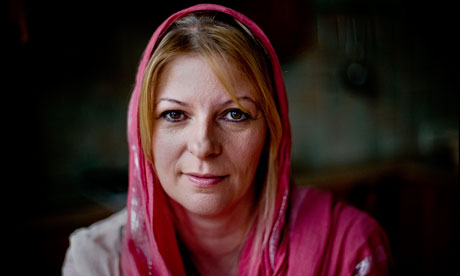
Lauren Booth Lauren Booth . . .

How hard and callous non-Muslim friends and colleagues began to seem'. Photograph: Sarah Lee for the Guardian

It is five years since my first visit to Palestine. And when I arrived in the region, to work alongside charities in Gaza and the West Bank, I took with me the swagger of condescension that all white middle-class women (secretly or outwardly) hold towards poor Muslim women, women I presumed would be little more than black-robed blobs, silent in my peripheral vision. As a western woman with all my freedoms, I expected to deal professionally with men alone. After all, that's what the Muslim world is all about, right?

This week's screams of faux horror from fellow columnists on hearing of my conversion to Islam prove that this remains the stereotypical view regarding half a billion women currently practising Islam.

On my first trip to Ramallah, and many subsequent visits to Palestine, Egypt, Jordan and Lebanon, I did indeed deal with men in power. And, dear reader, one or two of them even had those scary beards we see on news bulletins from far-flung places we've bombed to smithereens. Surprisingly (for me) I also began to deal with a lot of women of all ages, in all manner of head coverings, who also held positions of power. Believe it or not, Muslim women can be educated, work the same deadly hours we do, and even boss their husbands about in front of his friends until he leaves the room in a huff to go and finish making the dinner.

Is this patronising enough for you? I do hope so, because my conversion to Islam has been an excuse for sarcastic commentators to heap such patronising points of view on to Muslim women everywhere. So much so, that on my way to a meeting on the subject of Islamophobia in the media this week, I seriously considered buying myself a hook and posing as Abu Hamza. After all, judging by the reaction of many women columnists, I am now to women's rights what the hooked one is to knife and fork sales.

So let's all just take a deep breath and I'll give you a glimpse into the other world of Islam in the 21st century. Of course, we cannot discount the appalling way women are mistreated by men in many cities and cultures, both with and without an Islamic population. Women who are being abused by male relatives are being abused by men, not God. Much of the practices and laws in "Islamic" countries have deviated from (or are totally unrelated) to the origins of Islam. Instead practices are based on cultural or traditional (and yes, male-orientated) customs that have been injected into these societies. For example, in Saudi Arabia, women are not allowed to drive by law. This rule is an invention of the Saudi monarchy, our government's close ally in the arms and oil trade. The fight for women's rights must sadly adjust to our own government's needs.

My own path to Islam began with an awakening to the gap between what had been drip-fed to me about all Muslim life – and the reality.

I began to wonder about the calmness exuded by so many of the "sisters" and "brothers". Not all; these are human beings we're talking about. But many. And on my visit to Iran this September, the washing, kneeling, chanting recitations of the prayers at the mosques I visited reminded me of the west's view of an entirely different religion; one that is known for eschewing violence and embracing peace and love through quiet meditation. A religion trendy with movie stars such as Richard Gere, and one that would have been much easier to admit to following in public – Buddhism. Indeed, the bending, kneeling and submission of Muslim prayers resound with words of peace and contentment. Each one begins, "Bismillahir rahmaneer Raheem" – "In the name of God, the Merciful, the Compassionate" – and ends with the phrase "Assalamu Alaykhum wa rahmatullahi wa barakatuh" – Peace be upon you all and God's mercy and blessing.

Almost unnoticed to me, when praying for the last year or so, I had been saying "Dear Allah" instead of "Dear God". They both mean the same thing, of course, but for the convert to Islam the very alien nature of the language of the holy prayers and the holy book can be a stumbling block. I had skipped that hurdle without noticing. Then came the pull: a sort of emotional ebb and flow that responds to the company of other Muslims with a heightened feeling of openness and warmth. Well, that's how it was for me, anyway.

How hard and callous non-Muslim friends and colleagues began to seem. Why can't we cry in public, hug one another more, say "I love you" to a new friend, without facing suspicion or ridicule? I would watch emotions being shared in households along with trays of honeyed sweets and wondered, if Allah's law is simply based on fear why did the friends I loved and respected not turn their backs on their practices and start to drink, to have real "fun" as we in the west do? And we do, don't we? Don't we?

Finally, I felt what Muslims feel when they are in true prayer: a bolt of sweet harmony, a shudder of joy in which I was grateful for everything I have (my children) and secure in the certainty that I need nothing more (along with prayer) to be utterly content. I prayed in the Mesumeh shrine in Iran after ritually cleansing my forearms, face, head and feet with water. And nothing could be the same again. It was as simple as that.

The sheikh who finally converted me at a mosque in London a few weeks ago told me: "Don't hurry, Lauren. Just take it easy. Allah is waiting for you. Ignore those who tell you: you must do this, wear that, have your hair like this. Follow your instincts, follow the Holy Qur'an- and let Allah guide you."

And so I now live in a reality that is not unlike that of Jim Carey's character in the Truman Show. I have glimpsed the great lie that is the facade of our modern lives; that materialism, consumerism, sex and drugs will give us lasting happiness. But I have also peeked behind the screens and seen an enchanting, enriched existence of love, peace and hope. In the meantime, I carry on with daily life, cooking dinners, making TV programmes about Palestine and yes, praying for around half an hour a day.

Now, my morning starts with dawn prayers at around 6am, I pray again at 1.30pm, then finally at 10.30pm. My steady progress with the Qur'an has been mocked in some quarters (for the record, I'm now around 200 pages in). I've been seeking advice from Ayatollahs, imams and sheikhs, and every one has said that each individual's journey to Islam is their own. Some do commit the entire text to memory before conversion; for me reading the holy book will be done slowly and at my own pace.

In the past my attempts to give up alcohol have come to nothing; since my conversion I can't even imagine drinking again. I have no doubt that this is for life: there is so much in Islam to learn and enjoy and admire; I'm overcome with the wonder of it. In the last few days I've heard from other women converts, and they have told me that this is just the start, that they are still loving it 10 or 20 years on.
On a final note I'd like to offer a quick translation between Muslim culture and media culture that may help take the sting of shock out of my change of life for some of you.

When Muslims on the BBC News are shown shouting "Allahu Akhbar!" at some clear, Middle Eastern sky, we westerners have been trained to hear: "We hate you all in your British sitting rooms, and are on our way to blow ourselves up in Lidl when you are buying your weekly groceries."

In fact, what we Muslims are saying is "God is Great!", and we're taking comfort in our grief after non-Muslim nations have attacked our villages. Normally, this phrase proclaims our wish to live in peace with our neighbours, our God, our fellow humans, both Muslim and non-Muslim. Or, failing that, in the current climate, just to be left to live in peace would be nice.