Tuesday, December 30, 2014

Did The Saudis And The US Collude In Dropping Oil Prices? – Analysis - By OilPrice.com

http://www.eurasiareview.com/29122014-saudis-us-collude-dropping-oil-prices-analysis/?utm_source=feedburner&utm_medium=email&utm_campaign=Feed%3A+eurasiareview%2FVsnE+%28Eurasia+Review%29

West Texas Oil Pumpjack

West Texas Oil Pumpjack


Did The Saudis And The US Collude In Dropping Oil Prices? – Analysis


By

By Andrew Topf

The oil price drop that has dominated the headlines in recent weeks has been framed almost exclusively in terms of oil market economics, with most media outlets blaming Saudi Arabia, through its OPEC Trojan horse, for driving down the price, thus causing serious damage to the world’s major oil exporters – most notably Russia.
While the market explanation is partially true, it is simplistic, and fails to address key geopolitical pressure points in the Middle East.

Oilprice.com looked beyond the headlines for the reason behind the oil price drop, and found that the explanation, while difficult to prove, may revolve around control of oil and gas in the Middle East and the weakening of Russia, Iran and Syria by flooding the market with cheap oil.


The oil weapon

We don’t have to look too far back in history to see Saudi Arabia, the world’s largest oil exporter and producer, using the oil price to achieve its foreign policy objectives. In 1973, Egyptian President Anwar Sadat convinced Saudi King Faisal to cut production and raise prices, then to go as far as embargoing oil exports, all with the goal of punishing the United States for supporting Israel against the Arab states. It worked. The “oil price shock” quadrupled prices.

It happened again in 1986, when Saudi Arabia-led OPEC allowed prices to drop precipitously, and then in 1990, when the Saudis sent prices plummeting as a way of taking out Russia, which was seen as a threat to their oil supremacy. In 1998, they succeeded. When the oil price was halved from $25 to $12, Russia defaulted on its debt.
The Saudis and other OPEC members have, of course, used the oil price for the obverse effect, that is, suppressing production to keep prices artificially high and member states swimming in “petrodollars”. In 2008, oil peaked at $147 a barrel.

Turning to the current price drop, the Saudis and OPEC have a vested interest in taking out higher-cost competitors, such as US shale oil producers, who will certainly be hurt by the lower price. Even before the price drop, the Saudis were selling their oil to China at a discount. OPEC’s refusal on Nov. 27 to cut production seemed like the baldest evidence yet that the oil price drop was really an oil price war between Saudi Arabia and the US.
However, analysis shows the reasoning is complex, and may go beyond simply taking down the price to gain back lost marketshare.

“What is the reason for the United States and some U.S. allies wanting to drive down the price of oil?” Venezuelan President Nicolas Maduro asked rhetorically in October. “To harm Russia.”

Many believe the oil price plunge is the result of deliberate and well-planned collusion on the part of the United States and Saudi Arabia to punish Russia and Iran for supporting the murderous Assad regime in Syria.


Punishing Assad and friends

Proponents of this theory point to a Sept. 11 meeting between US Secretary of State John Kerry and Saudi King Abdullah at his palace on the Red Sea. According to an article in the Wall Street Journal, it was during that meeting that a deal was hammered out between Kerry and Abdullah. In it, the Saudis would support Syrian airstrikes against Islamic State (ISIS), in exchange for Washington backing the Saudis in toppling Assad.

If in fact a deal was struck, it would make sense, considering the long-simmering rivalry between Saudi Arabia and its chief rival in the region: Iran. By opposing Syria, Abdullah grabs the opportunity to strike a blow against Iran, which he sees as a powerful regional rival due to its nuclear ambitions, its support for militant groups Hamas and Hezbollah, and its alliance with Syria, which it provides with weapons and funding. The two nations are also divided by religion, with the majority of Saudis following the Sunni version of Islam, and most Iranians considering themselves Shi’ites.

“The conflict is now a full-blown proxy war between Iran and Saudi Arabia, which is playing out across the region,” Reuters reported on Dec. 15. “Both sides increasingly see their rivalry as a winner-take-all conflict: if the Shi’ite Hezbollah gains an upper hand in Lebanon, then the Sunnis of Lebanon—and by extension, their Saudi patrons—lose a round to Iran. If a Shi’ite-led government solidifies its control of Iraq, then Iran will have won another round.”

The Saudis know the Iranians are vulnerable on the oil price. Experts say the country needs $140 a barrel oil to balance its budget; at sub-$60 prices, the Saudis succeed in pressuring Iran’s supreme leader, Ayatollah Ali Khamanei, possibly containing its nuclear ambitions and making the country more pliable to the West, which has the power to reduce or lift sanctions if Iran cooperates.

Adding credence to this theory, Iranian President Hassan Rouhani told a Cabinet meeting earlier this month that the fall in oil prices was “politically motivated” and a “conspiracy against the interests of the region, the Muslim people and the Muslim world.”


Pipeline conspiracy

Some commentators have offered a more conspiratorial theory for the Saudis wanting to get rid of Assad. They point to a 2011 agreement between Syria, Iran and Iraq that would see a pipeline running from the Iranian Port Assalouyeh to Damascus via Iraq. The $10-billion project would take three years to complete and would be fed gas from the South Pars gas field, which Iran shares with Qatar. Iranian officials have said they plan to extend the pipeline to the Mediterranean to supply gas to Europe – in competition with Qatar, the world’s largest LNG exporter.

“The Iran-Iraq-Syria pipeline – if it’s ever built – would solidify a predominantly Shi’ite axis through an economic, steel umbilical cord,” wrote Asia Times correspondent Pepe Escobar.

Global Research, a Canada-based think tank, goes further to suggest that Assad’s refusal in 2009 to allow Qatar to construct a gas pipeline from its North Field through Syria and on to Turkey and the EU, combined with the 2011 pipeline deal, “ignited the full-scale Saudi and Qatari assault on Assad’s power.”

“Today the US-backed wars in Ukraine and in Syria are but two fronts in the same strategic war to cripple Russia and China and to rupture any Eurasian counter-pole to a US-controlled New World Order. In each, control of energy pipelines, this time primarily of natural gas pipelines—from Russia to the EU via Ukraine and from Iran and Syria to the EU via Syria—is the strategic goal,” Global Research wrote in an Oct. 26 post.


Poking the Russian bear

How does Russia play into the oil price drop? As a key ally of Syria, supplying Assad with billions in weaponry, President Vladimir Putin has, along with Iran, found himself targeted by the House of Saud. Putin’s territorial ambitions in the Ukraine have also put him at odds with US President Barack Obama and leaders of the EU, which in May of this year imposed a set of sanctions on Russia.

As has been noted, Saudi Arabia’s manipulation of the oil price has twice targeted Russia. This time, the effects of a low price have hit Moscow especially hard due to sanctions already in place combined with the low ruble. Last week, in an effort to defend its currency, the Bank of Russia raised interest rates to 17 percent. The measure failed, with the ruble dropping another 20 percent, leading to speculation the country could impose capital controls. Meanwhile, Putin took the opportunity in his annual televised address to announce that while the economy is likely to suffer for the next two years and that Russians should brace for a recession, “Our economy will get diversified and oil prices will go back up.”

He may be right, but what will the effect be on Russia of a sustained period of low oil prices? Eric Reguly, writing in The Globe and Mail last Saturday, points out that with foreign exchange reserves at around $400 billion, the Russian state is “in no danger of collapse” even in the event of a deep recession. Reguly predicts the greater threat is to the Russian private sector, which has a debt overhang of some $700 billion.

“This month alone, $30-billion of that amount must be repaid, with another $100-billion coming due next year. The problem is made worse by the economic sanctions, which have made it all but impossible for Russian companies to finance themselves in Western markets,” he writes.


Will it work?

Whether one is a conspiracy theorist or a market theorist, in explaining the oil price drop, it really matters little, for the effect is surely more important than the cause. Putin has already shown himself to be a master player in the chess game of energy politics, so the suggestion that sub-$60 oil will crush the Russian leader has to be met with a healthy degree of skepticism.

Moscow’s decision on Dec. 1 to drop the $45-billion South Stream natural gas pipeline project in favor of a new pipeline deal with Turkey shows Putin’s willingness to circumvent European partners to continue deliveries of natural gas to European countries that depend heavily on Russia for its energy requirements. The deal also puts Turkey squarely in the Russian energy camp at a time when Russia has been alienated by the West.

Of course, the Russian dalliance with China is a key part of Putin’s great Eastern pivot that will keep stoking demand for Russian gas even as the Saudis and OPEC, perhaps with US collusion, keep pumping to hold down the price. The November agreement, that would see Gazprom supply Chinese state oil company CNPC with 30 billion cubic meters of gas per year, builds on an earlier deal to sell China 38 bcm annually in an agreement valued at $400 billion.

As Oilprice.com commented on Sunday, “ongoing projects are soldiering on and Russian oil output is projected to remain unchanged into 2015.”

“Russia will go down with the ship before ceding market share – especially in Asia, where Putin reaffirmed the pivot is real. Saudi Arabia and North America will have to keep pumping as Putin plans to uphold his end in this game of brinksmanship.”

Source: http://oilprice.com/Energy/Oil-Prices/Did-The-Saudis-And-The-US-Collude-In-Dropping-Oil-Prices.html


OilPrice.com

OilPrice.com is the fastest growing energy news site online. Analysis focuses on Oil and Gas, Alternative Energy and Geopolitics.

Monday, December 29, 2014

How Winston Churchill 'flirted' [?] with Islam - By Patrick Sawer - Gulfnews.com

http://gulfnews.com/news/world/how-winston-churchill-flirted-with-islam-1.1433473


How Winston Churchill 'flirted' [?] with Islam

'Please don’t become converted to Islam' says British Prime Minister's future sister-in-law in a letter

  • By Patrick Sawer, DT
  • Published: 14:30 December 29, 2014
  • Gulf News


  • Image Credit: Supplied
  • Winston Churchill.

London: He is indelibly associated with the fight to preserve Britain and its Empire from Nazi invasion and his subsequent denouncement of Soviet totalitarianism’s Iron Curtain.


In the public eye, Sir Winston Churchill’s long political career earned him a place among the greatest of Britons.


But what may come as a surprise is that he was a strong admirer of Islam and the culture of the Orient — such was his regard for the Muslim faith that relatives feared he might convert.


The revelation comes with the discovery of a letter to Churchill from his future sister-in-law, Lady Gwendoline Bertie, written in August 1907, in which she urges him to rein in his enthusiasm.

In the letter, discovered by Warren Dockter, a history research fellow at Cambridge University, she pleads: “Please don’t become converted to Islam; I have noticed in your disposition a tendency to orientalise [fascination with the Orient and Islam], Pasha-like tendencies, I really have.”


Lady Gwendoline, who married Churchill’s brother Jack, adds: “If you come into contact with Islam your conversion might be effected with greater ease than you might have supposed, call of the blood, don’t you know what I mean, do fight against it.”


In a letter to Lady Lytton in the same year Churchill wrote: “You will think me a pasha [rank of distinction in the Ottoman Empire]. I wish I were.” Churchill’s fascination led him and his close friend Wilfrid S. Blunt, the poet and radical supporter of Muslim causes, to dressing in Arab clothes in private while in each other’s company.


Dr Dockter said of the letter from Lady Gwendoline: “Churchill had fought in Sudan and on the North West frontier of India so had much experience on being in ‘Islamic areas’.


“But during this period Churchill was in the Liberal phase of his career, having switched to the Liberals in 1904.


“He often came to loggerheads on imperial policies with hard-line imperialists such as Frederick Lugard, the High Commissioner of Northern Nigeria. Churchill was opposed to Lugard’s punitive expeditions against Islamic tribes in northern Nigeria.”


The letter was discovered by Dr Dockter while researching his forthcoming book, Winston Churchill and the Islamic World: Orientalism, Empire and Diplomacy in the Middle East.


He points out that Lady Gwendoline’s concerns may not have been so wide of the mark.


Not only did Churchill appear to regard Islam and Christianity as equals — a surprisingly progressive notion for the time — but he also admired the military prowess and history of expansion of the Ottoman Empire.


In October 1940, as Britain faced its darkest hour against Nazi Germany, Churchill approved plans to build a mosque in central London and set aside pounds 100,000 for the project.


He continued to back the building of what became the London Central Mosque in Regent’s Park — which he hoped would win support for Britain in the Muslim world at a crucial moment — even in the face of public criticism.


In December 1941, he told the House of Commons: “Many of our friends in Muslim countries all over the East have already expressed great appreciation of this gift.”


Churchill’s attitude may appear hypocritical, given his forthright defence of the British Empire — which at its height ruled over millions of Muslims across India, Egypt and the Middle East.


In his book The River War (1899) — his account of the frontier wars of India and Sudan — he was scathing of the fundamentalist, ultra conservative Mahdiyya form of Islam adopted by the Dervish population of North Africa.


Dr Dockter says a closer examination of Churchill’s attitude to the wider Muslim world reveals it to be “in stark contrast to the purely imperialistic and orientalist perspective of many of his contemporaries”.


In his book, he states: “His views of Islamic people and culture were an often paradoxical and complex combination of imperialist perceptions composed of typical orientalist ideals fused with the respect, understanding and magnanimity he had gained from his experiences in his early military career, creating a perspective that was uniquely Churchillian.”


The revelation that Churchill had a close affinity for Muslim culture comes at a time when tensions between the three great monotheistic faiths, Christianity, Judaism and Islam are greater than they have been for centuries.


Ironically, many of the fault lines between Islam and the West have their roots in the world Churchill helped shape after the collapse of the Ottoman Empire and the redrawing of the Middle East at the end of the First World War.


The settlements between the region’s colonial powers, brokered by Churchill, with T.E Lawrence — ‘Lawrence of Arabia’ — as an adviser, gave birth, in Dr Dockter’s words, to “the Middle East we know, warts and all”.


Dr Dockter, who assisted Boris Johnson on his book The Churchill Factor, said: “Not many people are aware that Churchill and T.E Lawrence were friends or that they worked together to solve the riddles of the Middle Eastern settlements. Understanding these settlements is paramount to understanding the legacy of Britain in the Middle East.”


Of course, Churchill did not convert to Islam, and Dr Dockter concludes that his fascination was “largely predicated on Victorian notions, which heavily romanticised the nomadic lifestyle and honour culture of the Bedouin tribes”.

As Dr Dockter points out, at least he had the good sense to ask the question in the first place, regarding an issue which bedevils the West’s involvement in the region to this day.


* * *

http://www.firstpost.com/living/new-letters-show-churchill-flirted-idea-converting-islam-family-begged-2020249.html

New letter shows Churchill wanted to convert to Islam, family begged him not to

by FP Staff  Dec 29, 2014 12:27 IST

#British PM   #Churchill   #Islam   #NewsTracker   #Ottoman Empire   #Prime Minister   #Winston Churchill
Former British Prime Minister Winston Churchill, credited with leading his nation and the Allies to victory against Nazi Germany during World War II, wanted to convert to Islam and family members had to beg for him not to do so, according to various news reports.

The reports have surfaced after a letter written by Churchill's sister-in-law Lady Gwendoline was discovered by a history research fellow at Cambridge University, points out a report in The Independent. Lady Gwendoline Bertie was married to Churchill's brother as this report in The Telegraph notes and she wrote the letter in 1907 before she got married to Churchill's brother.

The contents of her letter go like this, "Please don’t become converted to Islam; I have noticed in your disposition a tendency to orientalise [fascination with the Orient and Islam], Pasha-like tendencies, I really have...If you come into contact with Islam your conversion might be effected with greater ease than you might have supposed, call of the blood, don’t you know what I mean, do fight against it."

Apparently in another letter to Lady Lytton, Churchill also referred to himself as a 'pasha' and wished he were one. The report in The Independent points out that "he even took to dressing in Arab clothes in private."

Winston Churchill in this archival photo. Getty Images

So did Churchill really consider conversion or was his future sister-in-law over-reacting? According to the researcher Warren Dockter, while the British leader had a fascination for the Islamic culture, he "never seriously considered converting."

"He was more or less an atheist by this time anyway," Dockter told The Independent on Churchill's spiritual leanings.

No doubt though, his fascination with Islam was such that during the war, he put aside £100,000 for the purpose of a Mosque in central London in the "hope of winning the support of Muslim countries in the war", adds the report in The Independent.

Dockter told The Telegraph that Churchill's view of Islamic culture "were an often paradoxical and complex combination of imperialist perceptions composed of typical orientalist ideals fused with the respect, understanding and magnanimity he had gained from his experiences in his early military career."

But while there might have been some admiration for the religion, the former UK Prime Minister was unabashedly critical of Islamic laws. So his sister-in-law might just have over-reacted a bit to Churchill's personal fascination with Islamic culture.

----- ----- ----- -----

sad demise of Mr. Saiyid Hamid TODAY at 5:15 in Majidia Hospital of his University Jamia Hamdard, New Delhi. - Inna Lillahe Wa Inna Ilaihe Raajeoon


Inna Lillahe Wa Inna Ilaihe Raajeoon.
TO HIM WE BELONG AND TO HIM WE SHALL RETURN
Dear  Friends,
Assalam Alaikum. 
With a very heavy heart and acceptance of Allah The Almighty's will, I came to know about the sad demise of  Mr. Saiyid Hamid TODAY at 5:15 in Majidia Hospital of his University Jamia Hamdard, New Delhi. 
He breathed his last after a prolonged illness.

The 94-year-old educationist Saiyid Hamid, a retired IAS officer who is regarded as a reformer, was also one of the members of the high level committee headed by Justice Rajendra Sacchar which was appointed by the Prime Minister in 2005.
After retiring from a long and distinguished career in the Indian Administrative Service (IAS), he was appointed Vice Chancellor of his alma mater Aligarh Muslim University AMU).
He later succeeded Hakeem Abdul Hameed, Founder of Hamdard Dawakhana (now Hamdard (Wakf) Laboratories) as the Chancellor of Hamdard University in Delhi. He was also appointed by Hakeem sahib as Secretary of Hamdard Education Society to look after Hamdard Public School and Hamdard Study Circle.
He is a winner of several national level awards, including Sanskriti Award for literature, Urdu Academy Delhi award, Hindi Academy Delhi award and National fellowship award by Ministry of Culture, Government of India.
He has many books to his credit, two novels, three full length plays and many short story books for neon-literates.

He was, he is and he shall ever remain as one of the tallest figures of Muslims in India. We have lost yet another stalwart who was a light of beacon to all Indians and specially Muslims.
On my behalf and behalf of AMUOBA Riyadh, I extend sincere condolences to all family members, and pray to Almighty Allah to forgive all his shortcomings and  reward immensely for all his good deeds, and place him in Jannat-ul-Firdaus with great honor, respect and ease.

May Allah make these hard times easy on all the members of his family including us. Aameen.
Regards,
Dr. Mohammad Ahmad Badshah
Associate Professor
King Saud University
&
President
AMU Alumni Riyadh Chapter

Monday, December 22, 2014

The Hindu rate of oath - By Shyamlal Yadav - The Indian Express, Mumbai, INDIA

  Hindu rate of conversion?
 

The Hindu rate of oath

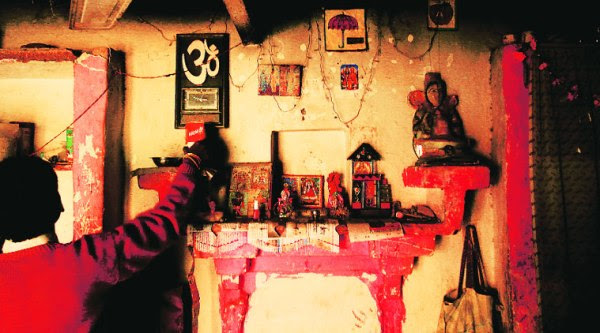
At the home of an alleged convert to Christianity in Aligarh’s Haridaspur village. He says he never gave up his Hindu faith. ( Source: Express photo by Praveen Khanna) At the home of an alleged convert to Christianity in Aligarh’s Haridaspur village. He says he never gave up his Hindu faith. ( Source: Express photo by Praveen Khanna)

Written by Shyamlal Yadav | Posted: December 22, 2014 4:12 am
 
When RSS chief Mohan Bhagwat on Saturday strongly defended the Sangh’s conversion campaign, it only confirmed what its Dharma Jagran Samanvay Samiti (DJSS) has been insisting. The heated exchanges in Parliament all of last week as the Opposition tried to get Prime Minister Narendra Modi to commit on the religious conversion issue notwithstanding, this is the busiest time of the year for the Samiti. And December 23, the day the Winter Session ends, marks the start of its mass programmes linked to Ghar Wapsi across the country — like every year. Perhaps the only place missing this time out of at least 300 on its list would be Aligarh.

DJSS insiders laugh at the suggestion that the Aligarh “controversy” made them pause. Instead, they say, the only thing that went wrong in Aligarh was that DJSS convenor for western Uttar Pradesh Rajeshwar Singh, also an RSS pracharak, was too outspoken.
“There was less work, more controversy,” as another pracharak puts it.

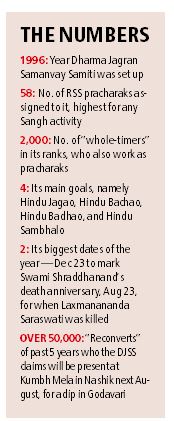
So the DJSS “projects”, planned for December 23-31 every year, stand as scheduled. While the dates coincide with Christmas Day, the DJSS insists their programmes have got nothing to do with it. They picked December 23 because that’s the day in 1926 that Swami Shraddhanand, an Arya Samaji leader involved in “reconverting” Muslims to Hinduism, was killed in Delhi.

Before Ghar Wapsi, the DJSS creates the “atmosphere” for it, including through Hindu Sammelans up to the village level in places where Hindus have allegedly converted to Islam or Christianity, distribution of Hindu literature and iconography, making “converts” aware of their “Hindu ancestry”, and by persuading leaders of various Hindu castes to accept with dignity if someone returns to Hinduism.

***
ima

The DJSS was started by the RSS in 1996 when it was felt that the VHP, assigned the same task, had got reduced to an organisation fighting for a Ram temple at Ayodhya. So the brief to the DJSS was clear and four-fold: “Hindu Jagao (Make Hindus Aware), Hindu Bachao (Protect Hindus), Hindu Badhao (Increase Hindu Population), and Hindu Sambhalo (Hold Hindus in Hinduism)”. The message was simpler: Increase Hindu population by 2021, the next Census, though RSS sources concede that may be difficult.
Headed by Mumbai-based Mukund Rao Panshikar now, the DJSS has 58 RSS pracharaks (the maximum for any Sangh activity) and around 2,000 “whole-timers” on rolls. The “whole-timers” are those who work as pracharaks but take a small honorarium to support their families.

A well-organised cohesive outfit, the DJSS has units up to almost every district level. Each district unit includes the head known as sanyojak (convenor), a pariyojna pramukh (in charge of projects), a prashashanik sampark pramukh (to liaise with the administration), a sanskriti pramukh (to work with sadhus etc), a nidhi pramukh (cashier), and a vidhi pramukh (who runs the legal cell).

After areas with reports of conversions to Islam or Christianity are identified, the DJSS first constitutes a Dharma Raksha Samiti comprising around 100 prominent people of the area, including leaders of different Hindu castes. It is the Dharma Raksha Samiti that facilitates the way to a Ghar Wapsi. “We do Ghar Wapsi where everything is ready,” says an RSS pracharak. “We create the atmosphere where there is a problem.”

A pracharak in eastern Uttar Pradesh says their job is also to ensure “Hindus remain Hindus”, even if they don’t manage to “reconvert”.

The other big date on the DJSS calendar is August 23, the day Swami Laxmanananda Saraswati was killed in 2008, in Orissa. Usually a week of programmes around this date start on Krishna Janmashtami as Laxmanananda was killed that festival day.
In every state the DJSS has two meetings every month to take stock of ongoing work. Last month there was a conclave in Nagpur of over 1,200 people working with the DJSS with Mohan Bhagwat present all three days.

This year, after the December 23-31 programmes, there will be a four-day conclave of all of the Sangh’s state-level pracharaks, including those associated with the DJSS, in Cuttack in February. Following this, the DJSS will hold a day-long chintan baithak of its state-level pracharaks there. In the end, a report on the DJSS activities will be presented at the Akhil Bharatiya Pratinidhi Sabha meeting of the RSS in March in Nagpur.

All-India convenor Panshikar admits all programmes barring Aligarh’s are on schedule. “Programmes are planned by state units as per local situation,” he says. “Our Agra (western UP) unit cancelled the Aligarh event. We will compile information on our other programmes in our annual report later.”

***

The areas to focus on are sometimes identified on the basis of caste names of “reconverts”. For example the Beawar district of Rajasthan where RSS sources claim that around 90,000 Muslims have “returned to Hinduism” in the past 10 years. Says an RSS spokesperson who doesn’t want to be named, “In Beawar, there is a sizeable population of descendants of Prithviraj Chauhan called Mehrat and Kathat. Their rituals are a mix of that of Hindus and Muslims. They were forcibly converted to Islam.”

However, he adds, “There have been no planned conversions here ever. As and when Muslims realise their original roots, they themselves want to get back to Hinduism… Even the Meo Muslims in Alwar were all Meenas. Recently during one of our interactions with the Muslim community in Shastri Nagar in Jaipur, we learnt that there were Pawars who are Muslims.”

A DJSS leader claims the Kshatriyas and Baniyas of western Uttar Pradesh form a majority of those who got converted to Islam because of poverty or lack of respect within their own community. So the RSS is looking at Chauhans and Soms in Meerut, Jats, Tyagi and Gurjars in Muzaffarnagar, and Sisaudiya in Noida and adjoining districts.

***

In Uttar Pradesh, the spark for the recent controversy, the DJSS has been operating for more than 15 years, with focus mainly in western and eastern UP. RSS sources say the total “reconversions” here number nearly five lakh, mostly of Christians.

The DJSS in the state is divided into Awadh, Kanpur, Kashi, Gorakhpur, Braj and Paschim (west) prants. RSS office-bearer Ram Lakhan heads the Kashi, Gorakhpur, Awadh and Kanpur prants, with Ram Chandra Pandey as assistant. Pandey was called back from South Africa, where he was posted as in-charge of RSS Vishwa Vibhag.

Rajeshwar Singh heads the wings in Braj and Paschim as well as in Uttarakhand. It is the Braj and Paschim wings, including both Agra and Aligarh, that have been targeting Muslims. In the other areas, the focus is on Christians. In 2013, for example, the DJSS claims to have “reconverted” around 150 Muslims and 6,000 Christians in west UP.

There are at least 150 DJSS volunteers at work in each district of UP. A DJSS source says a volunteer is allowed to spend up to Rs 5 lakh each a year, for visiting identified families, remaining in touch with them over phone and helping them “in times of need”.

Asked if they had been set any targets, a senior RSS office-bearer says,

“The target is to reduce the number of converted Muslims and Christians so that no political party can appease them. The larger target is to make the country free of converted Muslims and Christians by December 31, 2021.”

***

In Gujarat, the VHP and the RSS’s Hindu Jagran Manch, which have become active again since Modi moved on to Delhi as PM, are part of the reconversion exercise. However, there are few willing to talk about it. A BJP leader in Vadodara says they have been told to “lie low” given that Gujarat is Modi’s home state.

In the Nineties, it was the Hindu Jagran Manch that spearheaded mass tribal “reconversions” from Christianity in the Dangs area of the state, leading to riots.

As the RSS and its associated factions scout for potential communities in Vadodara to “reconvert”, their target are the ‘Mohr-e-Islam Rajputs’, more popularly known as Garasiya Muslims, located on the outskirts of the city.

Says Hemant Kishorkar of the Hindu Jagran Manch, “The Mohr-e-Islam Rajputs were Hindus who were converted to Islam but even today they pray to Hindu goddesses, follow Hindu rituals and are treated as outcastes by Muslims.”

VHP leader Pravin Togadia was on a Gujarat tour presiding over Viraat Hindu Sammelans recently, and in a meeting in Vadodara warned about the “diminishing” Hindu population.

On November 9, nearly 335 Christians were “reconverted” to Hinduism in Valsad district by the Dharma Prasar Vibhag of the VHP, which is active in the tribal-dominated belt of the state. “The main fight is against Christian missionaries. As far as Muslims are concerned, our focus is mainly the border areas of Kutch,” says a member.

***

Since the Raman Singh government came to power in Chhattisgarh in 2003, state DJSS head Radheshyam claims, over 57,000 Christian families have been converted to Hinduism by them alone.
The late BJP leader Dilip Singh Judeo led one of the most well-known Ghar Wapsi programmes in the state, as well as the country. After these ran into a controversy, such “reconversions” had almost come to a halt till they saw a resurgence in the summer of this year, particularly in tribal Bastar. One of the first such programmes was led by Bastar BJP MP Dinesh Kashyap. There were clashes when some gram sabhas in Bastar barred non-Hindu missionaries from entering their villages.

The VHP too has been lending a hand. While in September, 240 Christian families were brought to the Hindu fold in Pathalgaon block of Jashpur in Bastar, in October, the VHP “reconverted” over 30 Christian families of Madhota village in the area.

Earlier this month, the DJSS held a Satnam Sandesh Jagran Yatra to woo the Satnami community, a sub-caste of Dalits.

The DJSS in Chhattisgarh operates through a Dharma Sena of male youths and a woman force of Dharma Raksha Vahini. While the Dharma Sena works in the villages persuading Muslims and Christians to “reconvert”, it is the Dharma Raksha Vahini of “Hindu mothers” that is the DJSS’s most interesting addition for Chhattisgarh. The “25,000 members of the Vahini” are meant to counter Christian women who, the DJSS claims, are enticing Hindu men to their fold.

***

Despite Laxmanananda being one of the faces of the DJSS reconversion campaign, conversion activities in Orissa have slowed down considerably since his killing. The riots triggered by the death in Kandhamal almost put an end to all proselytisation activities of missionaries as well as bodies like the VHP. But in the past three-four years, the Parishad has again become visible, though in other areas. The RSS, on the other hand, doesn’t appear to be as active.

On November 23 this year, 349 tribals who had become Christians several years ago in Mayurbhanj district were “reconverted” to Hinduism by the Dharma Prasar Vibhag of the VHP. “The tribals told us they had been misled into Christianity. They were assured of some miracles which never happened,” says Achyutananda Kar, the VHP in-charge of conversion activities.

Early this year, the VHP “reconverted” around 90 Dalit Christian families in Jeypore town of Koraput district at a similar function. Kar claims the Dalits made notarised affidavits before becoming Hindu. Last year, around 80 tribal Christian families had been converted to Hinduism in Sundargarh district.

There have been no claimed “reconversion” of Muslims though in the state.

Kar says the number of VHP men involved in such “reconversions” in Orissa is very small. “There is no whole-timer.”

***

The focus of the DJSS’s Punjab campaign is different, as here “reconversions” are targeted at getting Christians back into not just Hindu but also the Sikh fold. It claims to have enabled some 8,000 “reconversions” in the past three years alone. The orthodox Sikhs as well as BJP ally Akali Dal are worried as the RSS views Sikhs as part of the larger Hindu culture.

For the first time, the RSS is holding Dharma Jagran Yatras in the border districts of Punjab, to be organised over the next one month, where it will showcase its “returnees” as well as conduct Ghar Wapsi ceremonies. Granthis of local gurdwaras have been contacted to assist in the ceremonies.

Says Dinesh who heads the Ghar Wapas Pariyojana in Punjab, “It is only last year that we took up the Punjab project in earnest.”
Hoshiarpur district has seen the maximum Ghar Wapsis followed by Amritsar and Batala.

***

In Kerala, where the RSS and the Church have been long locked in a conflict, the VHP has launched a helpline for those who want to get “reconverted” to Hinduism. Coordinator Aneesh Balakrishnan says they have received 100-odd calls, mainly from SC and ST members who had got “converted to Christianity”.

While Balakrishnan admits he is unsure of how many would turn up, Ghar Wapsi programmes are planned for all 14 districts of the state on December 25.

***

There are problems though. Noting that one of the crucial aspects of the DJSS campaign is persuading Hindus to accept the “reconverted” Muslims and Christians, a pracharak says, “A majority of those converted to Christianity are Dalits and tribals and they face no problem being accepted within their communities on ‘reconversion’. But if a Muslim is ‘reconverted’, it is a tough task to convince Hindus to accept them. They face difficulties in getting their children married.”

Caste remains a reality too, with VHP central secretary Vyankatesh Abdeo saying recently that those seeking to “reconvert” should be given the option of choosing the caste they want.

In fact, despite propagating that Hindavah Sodarah Sarve (all Hindus are real brothers), the RSS leadership itself is dominated by upper-caste Hindus with not many examples of inter-caste marriages in their families.

Says RSS prachar pramukh Manmohan Vaidya, “Many people in the country want to come back to their origins. The Hindu Samaaj must welcome them.”

***

When Bhagwat sought an anti-conversion Bill on Saturday, he was reiterating what the RSS has been demanding for decades. The first time they raised it was in 1979, in response to a private member’s Bill. Before the present row, the Sangh had demanded such a Bill after Laxmanananda’s murder.

The RSS argument is that the Bill would check “large-scale conversions” that are allegedly currently on from the Hindu side, and hence end need for its own Ghar Wapsi programme.

By openly backing the conversion campaign on Saturday, Bhagwat also underlined what has been clear in the Sangh ranks. That there is no cause to hurry, or to stop. Says a pracharak working with the DJSS, “It is time-taking. ‘Reconversion’ is not possible overnight.”

In fact, sources say, the very day the issue was first raised in Parliament following the Agra and Aligarh row, a call had gone out to various Union ministers, BJP leaders and their colleagues from the Sangh. The RSS clearly told them to be aggressive on the issue — “There is no need to be defensive.”

With inputs from Lalmani Verma, Aditi Raja, Ashutosh Bhardwaj, Debabrata Mohanty, Chander Suta Dogra and Shaju Philip

Sunday, December 21, 2014

My Jewish Feminist Problem - By Phyllis Chesler