Thursday, January 3, 2013

The enemy within: Soldier suicides outpaced combat deaths in 2012 - By Bill Briggs, NBC News contributor - usnews.nbcnews

USA pays heavily in unleashing wars abroad. It is time American people made the key warmongers, in politics, media, army and 'defense' industry accountable for such horrific count of soldiers' suicide death on return.

Ghulam Muhammed, Mumbai
<ghulammuhammed3@gmail.com>

-----

http://usnews.nbcnews.com/_news/2013/01/03/16309351-the-enemy-within-soldier-suicides-outpaced-combat-deaths-in-2012?lite

The enemy within: Soldier suicides outpaced combat deaths in 2012

By Bill Briggs, NBC News contributor

More soldiers took their own lives than died in combat during 2012, new Department of Defense figures show. The Army's suicide rate has climbed by 9 percent since the military branch launched its suicide-prevention campaign in 2009.

Through November, 177 active-duty soldiers had committed suicide compared to 165 during all of 2011 and 156 in 2010. In all of 2012, 176 soldiers were killed in action -- all while serving in Operation Enduring Freedom, according to DOD.

Army suicides have increased by at least 54 percent since 2007 when there were 115 — a number the Washington Post then called "an all-time record." An Army spokesman said Wednesday it is uncertain if 177 marks a new annual high (with December numbers still to come), or if suicides have ever outpaced combat deaths in a single year, because the Army has not always tracked suicides.

Some Army families who recently lost members to suicide criticize the branch for failing to aggressively shake a culture in which soldiers believe they'll be deemed weak and denied promotion if they seek mental health aid. They also blame Army leaders for focusing more heavily on weeding out  emotionally troubled soldiers to artificially suppress the branch's suicide stats versus embracing and helping members who are exhibiting clear signs of trouble.

Furthermore, in September, two U.S. lawmakers pressured the Pentagon to immediately use unspent money specifically appropriated to the agency to help slow the suicides within the military. Rep. Jim McDermott, D-Wash., and Rep. Leonard Boswell, D-Iowa, also pushed for increased anti-suicide funding for the Department of Defense in 2013.

“The Pentagon hasn’t spent the money that it has for suicide prevention for this year — and that money wasn’t nearly enough money to reach all the soldiers who need help. Now we are hearing about bureaucratic technicalities at the Pentagon that are preventing them from acting. This is unconscionable,” Rep. McDermott said. “The Pentagon is funded to help soldiers and needs to do much more on the epidemic of suicides."  

But the Department of Defense contends that anti-suicide programs installed throughout the armed services soon will curb military suicides — and that such initiatives already have helped douse mental-health stigmas.

"We have seen several programs that we are optimistic are going to start making a dent in this issue," said Jackie Garrick, acting director of the DOD suicide prevention office. "We’ve asked all of the services to use the same messaging, the same talking points. So the Army, included in that, is trying to adapt and promote those same messages because we realize that this is an across-the-board problem."

The Army could not provide a suicide-prevention officer to comment, but an Army spokeswoman did forward NBC News a link to the “Army Suicide Prevention Program.”

Within that initiative, soldiers are taught to “Ask, Care, and Escort” any Army buddy who mentions considering suicide, to usher them to behavioral-health provider, chaplain, or a primary-care provider, and to “never leave your friend alone." The U.S. military also installed a prevention “lifeline:” 1-800-273-TALK.

What's more, soldiers are assured that seeking mental-health counseling will not harm their chances at gaining a security clearance. And on that website, a videoshows Sgt. Maj. Raymond F. Chandler III, the Army's top non-commissioned officer, speaking to other NCOs: “Know your soldiers. Know the resources available to them when they are in crisis ... Encourage your soldiers to seek help ... Seeking help is a sign of courage.”

The anti-suicide strategy was rolled out in April 2009 by Army Vice Chief of Staff Gen. Peter W. Chiarelli.

In July 2010, the Army released a report that sought to explain its suicide epidemic. Some Army families were irked by one of the key findings: Loosened recruitment and retention standards — due to the furious pace of repeated deployments — had allowed more than 47,000 people to remain in the Army despite histories of substance abuse, misdemeanor crime or “serious misconduct.”

Chiarelli further frustrated many Army families who had lost members to suicide when, amid the release of that same report, he added: “I think it’s fair to say in some instances it would be a soldier that’s possibly married, couple of kids, lost his job, no health care insurance, possibly a single parent.” Those types of soldiers, he added, are “coming in the Army to start all over again, and we see this high rate of suicide.”

Two days before Charielli’s comments, 28-year-old Army soldier Brandon Barrett showed up at his parents' home in Tucson, Ariz. The family believed he was on leave following a brutal, year-long deployment in Afghanistan with the 5th Stryker Brigade during which he saw several buddies killed or wounded by bombs and did some killing himself.

During that visit, Barrett’s family thought his Army experience seemed to be helping him to mature, recalls his brother, Shane Barrett, a detective with the Tucson Police Department.
In August, Brandon Barrett left his parents’ home and drove — for unknown reasons — to Salt Lake City where he donned his combat fatigues, boots and helmet, grabbed his AR-15 rifle, went to a hotel and told an employee to call the police. As he waited for the officers, Barrett paced the hotel parking lot as if he was on patrol, a hotel video showed. A police officer arrived. Barrett shot him in the leg. The officer returned fire and killed Barrett with a bullet to the head. His family believes Barrett intended to commit “suicide by cop,” his brother acknowledged. 
Courtesy Barrett family
Brandon Barrett confided to a chaplain within his unit, the Barrett family learned since his death, revealing that his year of combat in Afghanistan had left him depressed and anxious.
“He’d been home for nearly a month,” Shane Barrett told NBC News. “We had no contact from anybody in the Army until my brother’s incident. And then, after the fact, it was: ‘Your brother was AWOL (absent without leave).’ Really? We didn’t know that.
“If a guy goes AWOL, the Army is supposed to notify the family immediately. We never received phone calls, letters. We were blindsided. At the police department where I work, they ran all kinds of record checks on him. But they found absolutely nothing (about an AWOL report).
“My mother has always believed he was declared AWOL after the fact just so the Army could get him off the rolls and not have his suicide count against the Army,” Shane Barrett said. “To just discard him, like he never existed, is just wrong. And there’s no paper trail, no nothing to back up the AWOL claim.”
The Barrett family later learned that Brandon had confided to a chaplain within his unit, revealing that his year of combat in Afghanistan had left him depressed and anxious. And possibly mulling suicide.
“From talking to a couple of other guys in his unit, he didn’t want to come forward (to seek mental-health help) because you’d be red-flagged. It would be your exit out of the Army,” Shane Barrett said. “The guys in the Army are just flat-out afraid to come forward.”
At the Department of Defense, anti-suicide chief Garrick was asked if the Army is indeed clinging to a culture of “suck it up" and handle your own problems,” as some Army families contend.
Andrew P Johnson / The News Herald via AP file
In an Oct. 10, 2012 photo, MaKayla Merritt holds her brother William Busbee's uniform with her mother Libby Busbee, right, and sister Tiffany Merrit in the family's living room in Panama City, Fla. U.S. Army Spc. William Busbee committed suicide in March of 2012. Busbee is one of 177 Army suicides in 2012 -- more than the number of soldiers killed in combat for the year.
“No, I think all of the services have done a pretty good job of trying to get a message out. The Army ... they’ve done the 'shoulder-to-shoulder,' (approach, and have said) ‘no soldier stands alone.' That’s been some of their messaging, now going back a while,” Garrick said.
“The Secretary of Defense (Leon Panetta), this past year, issued a statement talking about how our service members are our most valuable resource and that we need to do everything we can to take care of our people. So we’re doing everything we can to prevent suicides in the military, recognizing that it’s a complex and urgent problem.”
More content from NBCNews.com:
Follow US news from NBCNews.com on Twitter and Facebook

Tuesday, January 1, 2013

Turki Bin Faisal Al-Saud | How to win in the Middle-East - Live Mint & THE WALL STREET JOURNAL

http://www.livemint.com/Opinion/dx8VPXPq64lnVMXoMd4VOP/How-to-win-in-the-MiddleEast.html


Turki Bin Faisal Al-Saud | How to win in the Middle-East

The region has been losing for too long because its leaders have been seeking to win in their own way, for their own purposes, and at everyone’s cost but their own
Comment E-mail Print
First Published: Mon, Dec 31 2012. 07 42 PM IST
The victims of the conflicts in Syria, Iran, and Palestine; the friends and families of the victims; those who hope for peace: all lost—
a grim reminder that when it comes to killing one another, repeatedly missing opportunities for peace, and botching all efforts at progress, no one can beat the Middle East. Photo: Reuters
The victims of the conflicts in Syria, Iran, and Palestine; the friends and families of the victims; those who hope for peace: all lost— a grim reminder that when it comes to killing one another, repeatedly missing opportunities for peace, and botching all efforts at progress, no one can beat the Middle East. Photo: Reuters
Updated: Mon, Dec 31 2012. 09 24 PM IST

Analysts the world over are assessing the situation in the Middle East in 2012 by listing the region’s “winners” and “losers”. Hamas won. Egypt’s President Mohamed Mursi won, then lost. US Secretary of State Hillary Clinton won. Syria lost. Iraq lost. Iran had a draw (tougher sanctions, but closer to nuclear-weapons capability), as did Saudi Arabia (growing clout, but unable to stop the killings in Syria or Gaza) and Israel (avoided massive bloodshed, but became even more isolated).

All of these lists, however, are merely the pastimes of policy wonks. In the bloody, hostile miasma of the Middle East, being a “winner” in any sense of the word is fallacious. The region continues to breed only losers. The victims of the conflicts in Syria, Iran, and Palestine; the friends and families of the victims; those who hope for peace: all lost.
 
This is a grim reminder that when it comes to killing one another, repeatedly missing opportunities for peace, and botching all efforts at progress, no one can beat the Middle East. In 2012, the region proved once again that it is truly the best at perpetrating the worst.

When will these vital, eclectic, and prosperous (or potentially prosperous) countries stop their ravenous infighting and start nurturing, protecting, and sustaining their people? While there have been many prescriptions, I will provide my own 2012 Middle East roundup, with a look towards what must happen in 2013 if we want it to bring fewer losses.
 
The Israeli killing machine must be stopped by a determined US using its leverage to bring about implementation of the land-for-peace principles of United Nations Security Council resolutions 242 and 338, the Madrid Conference, the Oslo Agreement, and the Abdullah Peace Initiative.

This is the only way out of the current unworkable predicament.

Borrowing a term from nuclear strategy, the situation between Israel and the Palestinians can be described only as “mutually assured destruction”, also known, fittingly, as MAD. It benefits no one, so why let it continue? Only the US has the ability to push the Israelis out of their MAD-ness, so I look forward to the Obama administration recognizing and acting on that moral obligation in the coming year.

The Assad killing machine must also be stopped. In this case, it is through the West agreeing with Saudi Arabia to arm the Free Syrian Army with the defensive weapons that it needs to ground Bashar al-Assad’s aircraft and immobilize his tanks and artillery. Unlike some conflicts in the region, this is a case with a clear and simple solution. Those being attacked merely need weapons to defend themselves; if they get them, the entire dynamic of the conflict will shift, in turn ending the bloodshed.

By now, all of the actors in Syria are known. There are no hidden jihadis, terrorists, or gangsters. They are all well documented. So the moderates are the ones who should get the anti-aircraft and anti-tank weapons. Having them, their prestige among other fighters will soar, and so will support for their moderate stance.

Iranian intervention in Iraq must stop. It is tearing Iraq apart and endangering the countries around it. Western and Iranian support for Nouri al-Maliki’s government, which is controlled by Iran’s Basij militia, must be withdrawn, enabling the Iraqi people to determine freely their own destiny.

Did the Americans defeat Saddam Hussein, and did more than 100,000 Iraqis die in the process, so that their country could become a puppet of the hostile Iranian regime? Iran’s meddling in Bahrain, Kuwait, Yemen, and other Gulf states must end as well.

In addition to these major tasks, Palestine’s main political rivals, Hamas and Fatah, must reconcile and turn their united efforts towards improving the lives of the Palestinian people. Egypt must get over its post-revolutionary squabbling and reassume its leading role among the Arab states. And all Arab states must coordinate their efforts to realize common ambitions, rather than continuing to pursue only narrow national interests.

Central to all of these tasks is a Gulf Cooperation Council (GCC) that is united into a confederation that can meet the challenges of Iran’s regional ambitions and bring major military deployments to bear on regional conflicts. If anything has become clear in the last year, it is that states like Israel, Iran, and Syria will act with impunity if no one is ready, willing, and able to stand up to them. It is time for the GCC, anchored on Saudi Arabia’s power, to take up that role.
 
The Middle East has been losing for too long, because its national leaders have been seeking to win in their own way, for their own purposes, and at everyone’s cost but their own. Such unilateralism is impossible in today’s globalized world. We must join together, or else we will rip each other to shreds. The choice is simple: Do we want to be winners or losers? ©2012/Project Syndicate

Turki bin Faisal Al-Saud, chairman of the King Faisal Center for Research and Islamic Studies, was the director general of Al Mukhabarat Al A’amah, Saudi Arabia’s intelligence agency from 1977 to 2001, and has served as Saudi Arabia’s ambassador to the UK and the US.


Comment E-mail Print

Monday, December 31, 2012

Top 5 Islam-bashing Republicans to watch in 2013


http://www.malaysia-chronicle.com/index.php?option=com_k2&view=item&id=45887:top-5-islam-bashing-republicans-to-watch-in-2013&Itemid=2

Malaysia Chronicle

Monday, 31 December 2012 17:16

Top 5 Islam-bashing Republicans to watch in 2013


NEW YORK, - When Muslim-American organizations and activists concerned with Islamophobia woke up the day after the election, on November 7, they were elated. Key members of what had been dubbed the House Republican “Islamophobia caucus” had been voted out of office. These Tea Party-affiliated Republicans included Joe Walsh (Republican-Illinois), who had warned in August that Islamists were “trying to kill Americans every week” and were lurking in the Chicago suburbs, and Allen West (Republican-Florida), who linked the entire religion of Islam to terrorism.

These fear-mongers won’t be able to spread their hysteria from the bully pulpit of a House seat any longer. But that doesn’t mean that the House Republican caucus has rid themselves of the scourge of anti-Muslim politicians who stoke that sentiment for political gain. On the contrary, the House Republican caucus remains the place where the ugly head of Islamophobia rests comfortably.

Here are five House Republicans who spread anti-Muslim sentiment routinely. Activists concerned with Islamophobia should watch these players in the year to come. The fight against Islamophobia in this country is far from over, and many members of the Republican Party remains wedded to that hateful ideology.

1. Michele Bachmann

This Minnesota Tea Party favorite catapulted herself into the spotlight again by hawking a wacky conspiracy theory first propagated by a former Reagan administration official and now chief Islamophobe. She narrowly won re-election in November despite spending twelve times as much as her opponent, Democrat Jim Graves.

Last summer, Bachmann garnered national attention when she and other Republicans alleged that the Muslim Brotherhood, an Egyptian-based political movement that spread throughout the Middle East, had “penetrated” the U.S. government. Specifically, Bachmann singled out a prominent Muslim-American aide to Secretary of State Hillary Clinton named Huma Abedin as being part of the conspiracy. The Minnesota congresswoman made the allegations in letters sent to U.S. government officials.

The letter questioned whether there was “direct influence” on the intelligence community from “[Muslim] Brotherhood operatives.” And the letter also mentioned that Abedin has “family members” connected to the Muslim Brotherhood.

Needless to say, the allegations were bogus, and some Republican leaders blasted Bachmann for going on a witch hunt. “Accusations like this being thrown around are pretty dangerous,” said Speaker of the House John Boehner (R-OH). But other Republican officials backed up Bachmann. “Her concern was about the security of the country,” said Eric Cantor (R-VA).

Her letter to U.S. government officials made clear that Bachmann got her ideas from Frank Gaffney, a former Reagan aide and prominent neoconservative. Gaffney is a leading anti-Muslim activist in the U.S., and has produced a 10-part online series about the Muslim Brotherhood’s influence in the U.S. But the idea that the Muslim Brotherhood is plotting from within is a McCarthyite theory that casts aspersions on Muslim-Americans within the U.S. government. There is also no evidence to support the theory.

This summer 2012 episode was hardly the only iteration of Bachmann’s Islamophobia, though. In 2011, she stoked fear about sharia law--Islamic law-- taking over U.S. courts.

2. Peter King

He may have lost his chairmanship of the Homeland Security committee due to party-imposed term-limits, but you can count on King stoking the flames of fear towards Islam next year. King, a Republican hailing from Long Island, used his post as chair of the House Homeland Security Committee to specifically target the problem of terrorism within the Muslim community--and nowhere else, despite right-wing extremism being on the rise. After serving for seven years, King is no longer the head of the committee, though he will remain a member.

King has a penchant for singling out Muslim-Americans. He held a total of five separate hearings on Islam and terrorism in the United States, ostensibly to focus on the threat of “homegrown” terrorism from Muslims. But as Rep. Bennie Thompson (D-MS), a fellow member of the Homeland Security Committee, pointed out: 

“According to a polling of state law enforcement agencies conducted by the Department of Homeland Security’s START Center of Excellence, there are a variety of domestic extremist groups more prevalent in the United States than Islamic extremists, including neo-Nazis, environmental extremists, anti-tax groups, and others.”

His first hearing sparked the most controversy. Titled “The Extent of Radicalization in the American Muslim Community and that Community’s Response,” it was based on King’s assumption that the Muslim community in the U.S. is prone to breeding extremists. 

In 2004, King claimed that “80%, 85% of the mosques in this country are controlled by Islamic fundamentalists." Despite this claim becoming a right-wing meme, there was no evidence to back it up. In fact, as the Leadership Conference on Civil and Human Rights pointed out in a letter to King before his first hearing, “experts have concluded that mosque attendance is a significant factor in the prevention of extremism.”

King courted even more controversy based on one of his star witnesses at the first hearing: Zuhdi Jasser, an activist who has become the right’s darling Muslim. Jasser is the head of a group called the American Islamic Forum for Democracy, which is funded by anti-Muslim figures like the right-wing Christian Foster Friess. 

Many Muslim organizations say that Jasser has little following among American Muslims. Jasser narrated an Islamophobic film put out by an Israeli-settler and neoconservative linked outfit called the Clarion Fund. The film, titled “The Third Jihad,” was shown to New York Police Department officers as training and claims that Muslim extremists are plotting from within to take over the U.S.

Other statements in King’s past show that his motivation to root out Muslim extremism in the U.S. is based on faulty assumptions. He has stuck to his claim about mosques in the U.S. being run by radical extremists and has also claimed that “the Muslim community does not cooperate anywhere near to the extent that it should” on terrorism-related cases. But that statement ignores the fact that Muslims are tipped off law enforcement to break up the small number of plots that do exist.

3. Mike McCaul

For the House Homeland Security Committee, it’s out with one Islamophobe as chief of the panel, and in with another. McCaul, a Republican hailing from Texas, has dutifully served alongside King on the committee. And now, he’s getting his chance to run it on his own.

Since King was forced out of the top spot due to party-imposed parameters, McCaul has been tapped to lead the Homeland Security Committee. McCaul’s history of Islamophobia shows why he will likely lead the committee similar to how King did.

In fact, McCaul strongly supported the King-led hearings focusing on Muslim-Americans. McCaul praised King’s hearings as a way to “end the era of political correctness.” During the hearing itself, McCaul said: “I am mystified by the controversy that has followed from this.”

After King’s fifth set of hearings, McCaul said that the “U.S. should not overlook the correlation between Islam and national security.”
And McCaul also runs around with the players behind the wave of Islamophobia that has swept the nation since 9/11. McCaul appeared on Frank Gaffney’s radio show last year--the same radio show where Gaffney has spread his toxic theories about sharia law and the Muslim Brotherhood in the U.S. And McCaul didn’t bat an eye, or mutter any response, when Gaffney carried on about the “Muslim Brotherhood’s operations in the United States.” When he got a chance to speak, McCaul indulged in speculation about the “threat” of Hezbollah, the Lebanese armed group, in the Western Hemisphere--a threat for which there is little evidence for, according to PolitiFact.

4. Louie Gohmert

This Texas Republican has promoted anti-Muslim sentiment too many times before. Gohmert was widely mocked for his August 2010 assertion that Middle Eastern terrorists were plotting new attacks on the U.S. by sending their pregnant wives to this country whose children “could be raised and coddled as future terrorists.” 

The phrase “terror babies” entered the political lexicon after Gohmert’s outlandish statements. Yet, as Mother Jones noted at the time, there’s not “a morsel of evidence to support Gohmert's terror baby tale, which the congressman says he learned of from a woman on a plane while en route to the Middle East and from a retired FBI agent.”

The next year, Gohmert again made headlines with remarks about Islam and President Barack Obama. He suggested that Obama’s allegiances were with Islamic states instead of the U.S. “I know the president made the mistake one day of saying he had visited all 57 states, and I'm well aware that there are not 57 states in this country, although there are 57 members of OIC, the Islamic states in the world,” Gohmert said on the House floor. “Perhaps there was some confusion whether he'd been to all 57 Islamic states as opposed to all 50 U.S. states. But nonetheless, we have an obligation to the 50 American states, not the 57 Muslim, Islamic states...This administration [has been] complicit in helping people who wants [sic] to destroy our country.”

Gohmert’s speech played into the right-wing conspiracy theory that Obama was a secret Muslim in league with anti-American Islamists. In line with that theory, Gohmert has also suggested that Obama listens to advisers from the Muslim Brotherhood.

And finally, Gohmert was one of four other Republicans to sign onto the Bachmann letter on Muslim Brotherhood influence within the U.S. government. When other, more sane Republicans questioned the letter, Gohmert lashed out. “I wish some of these numbnuts would go out and read the letter before they make these horrible allegations about the horrible accusations we’re making,” Gohmert said.

Expect 2013 to see a lot more of Gohmert’s conspiracy-laden theories about Muslims in the U.S.

5. Trent Franks

In recent years, Arizona Republican Trent Franks has taken to demonizing Muslim-Americans.

In 2009, Franks was one of four Republicans to call for an investigation of the Council on American Islamic Relations (CAIR), the nation’s leading Muslim civil rights group and a favorite target of the Islamophobic right. The GOP members claimed an investigation was needed into whether CAIR was “spying” on Congressional offices in order to influence policy. The evidence for that charge was a 2007 CAIR memo that called for placing Muslim interns in key Congressional offices in order to influence policy on issues important to Muslim-Americans--something that every interest group does in Washington. As Glenn Greenwald pointed out at the time: “They stand accused of plotting to influence members of Congress and trying to help interns obtain positions in Congress in order to advance their political agenda. That’s consistent with what virtually every political advocacy group in the nation does; it’s normally called activism and democracy.” But for House Republicans, Muslim-Americans working on Capitol Hill is a step down the road towards sharia law.

The House GOP members’ initial source for the entire CAIR debacle was a book titled Muslim Mafia: Inside the Secret Underworld That’s Conspiring to Islamize America.

Franks’ anti-Muslim fear-mongering didn’t stop in 2009, though. The next year, he showed support for Frank Gaffney’s theory that sharia law was on the march in the U.S., led by Muslim-American organizations with links to the Muslim Brotherhood who were plotting from within.

Predictably, the latest iteration of Franks’ Islamophobia was his signature on Bachmann’s McCarthyite letter about Muslim Brotherhood influence in the U.S. government and Clinton aide Huma Abedin.

So while Allen West and Joe Walsh have to take a breather from spreading fear and hysteria about Muslims, they have plenty of colleagues to pick up the slack. Some of the leading purveyors of anti-Muslim bigotry may have been booted out of office, but you can still expect 2013 to have its fair share of Islamophobic hate.

-AlterNet


When schoolchildren dream of start-ups.. By Saritha Rai - The Indian Express

 LET US COME OUT OF MACAULAY'S SHADOWS


http://www.indianexpress.com/news/when-schoolchildren-dream-of-startups/1052246/0

The Indian Express

When schoolchildren dream of start-ups..

Saritha Rai : Mon Dec 31 2012, 03:15 hrs
Entrepreneurship is steadily becoming a desirable goal for the middle class

There were groups making block-printed cloth bags, coasters from recycled material, miniature toys, chocolate-frosted cupcakes and office stationery. They talked of modest venture capital, marketing tactics, and balancing expenses and income. But the most arresting feature of the presentation? The budding entrepreneurs were a roomful of energetic, enthusiastic 11-year-olds.

Just as striking was the fact that the exercise was being replicated across eight branches of the National Public School, or NPS, a Bangalore-headquartered school chain that has built a brand around grooming its students to ace the IIT and medical entrance exams and more recently, the SATs for admission into American colleges. 

The event is amongst the early signs that the traditional Indian education system, long criticised as being designed to create only employees and a “workforce”, is poised for change.

Through slick PowerPoint presentations that morning, the students described their projects. They had worked collaboratively in teams of five or six to come up with ideas. They would draw on available material, buying only limited items, and all the products would be handmade. To get started, they would each tap their parents for a couple of hundred rupees, which would be their venture capital. All profits from the sales would go to a charitable cause.

One sixth-grader said her group was inspired by Abdul Kalam’s statement that India needs job creators, and not job-seekers. Teased by an audience member on whether that meant creating work for their parents, the girl shot back, “I want to first create a job for myself so that I don’t have to work in a boring office.”

India is poised on the brink of change, as there is a generational shift in students’ thinking on entrepreneurship, said Bindu Hari, who steers the NPS school chain founded by her father, K.P. Gopalakrishna in 1959. “At one time, the top goal of a student was to find government employment and later, it was an MNC job,” she said. “But the current generation is willing to take risks and go out to grab opportunities.”

Even parents were more amenable to kids branching away from conventional career paths, Hari said. On 11-year-olds grasping the concepts of starting up a venture, she said she was often amazed by the maturity of fifth and sixth graders today. It is necessary to sow the seeds of entrepreneurship at a young age, said Hari.

The school first worked on a pilot project before transplanting it to all schools in its chain, including a school each in Chennai and Singapore. It works with four modules: raising capital, designing the product, marketing and understanding the balance sheet. “The most crucial part is that students work in groups and the exercise becomes as collaborative as entrepreneurship is in real life,” said Hari.

Entrepreneurship is becoming a more acceptable option amongst India’s middle class, said Ravi Venkatesam, the parent of an 11-year-old NPS student. “In the last two decades, many traditional, middle class Indians have turned successful entrepreneurs, not just in information technology, but in a variety of other fields,” said Venkatesam who runs his own BPO consulting practice. That NPS was running a module on entrepreneurship was a reflection of what middle-class parents seek for their children, he said.

The interest amongst youngsters in the world of business and in entrepreneurship is startling, said Subroto Bagchi, co-founder and chairman of outsourcing firm MindTree and author of the book, MBA@16. “Business is not the taboo word it used to be when I was growing up,” Bagchi said. While researching his book, he was surprised that the teenagers did not have a uni-dimensional view of entrepreneurship. “A lot of them were interested in entrepreneurship as an agent of social change.”

While his book only deals with an urban sample, Bagchi said entrepreneurship as is also spreading to small-town India. The recent demand for translations of the title into Indian languages such as Hindi and Telugu is evidence, said Bagchi.

saritha.rai@expressindia.com

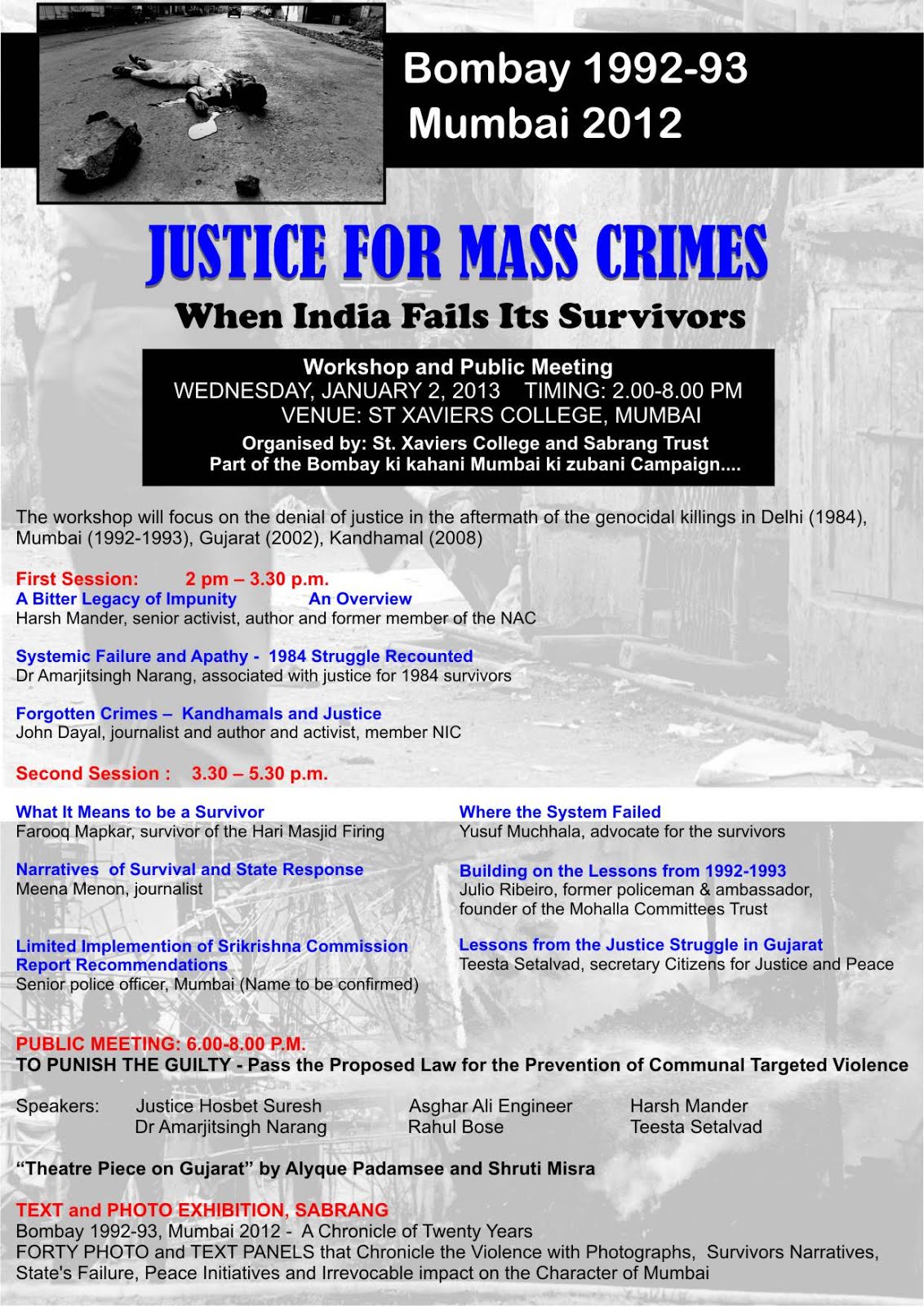
Justice for Mass Crimes - Workshop and Public Meeting - Mumbai

Sunday, December 30, 2012

Films sanctify pestering and stalking of women - By Swaminathan S A Aiyar - The Economic Times, Mumbai, INDIA

Just as Hollywood's Jewish Movie Moghals promote wars, aggression, violent crimes to earn a living on blood and gore and support America's War Industry so that it can wage wars overseas to protect Israel; Bollywood unwittingly has been overwhelmingly engaged in sex and demeaning of Indian women in films after films, without any fear or accountability from Indian Censor Board. People are still unaware if there is some method to this madness. In depicting the real-time social status of our women, it is encouraging rather than discouraging crimes against them. The more Macho the film depicts, the more box office rakes in crores. Nobody bothers about the social affects of such sordid criminal assaults, physical and social, against innocent women, who are daughters, sisters, mothers and should not be made targets of dehumanizing by Bollywood movies. Government is more interested in collecting taxes. It is most insensitive to the wider implication of such organized sex trade, that is eating the vitals of our society, where women are half of our citizens and should have equal rights, dignity and respect. In the name of freedom of expression, the new holy cow of our liberal intellectuals, women is being depicted in the movies, in advertising and in workplace, as fair game for the evil minded. The the irony is that the same liberals are now minding the barricades, burning candles and keeping long vigils over one single case of the unfortunate Nirbhaya, whole hundreds and thousands of Nirbhaya's lives are threatened day and night with fear and demeaning indignities throughout the length and breadth of our nation. They must reflect and review their own obsessions in the noble cause of the greater good of the people. They too bear heavy responsibility in promoting a culture that puts women in distinct disadvantage in facing the challenges of the new times.

Ghulam Muhammed, Mumbai
<ghulammuhammed3@gmail.com>


------
http://economictimes.indiatimes.com/opinion/columnists/swaminathan-s-a-aiyar/films-sanctify-pestering-and-stalking-of-women/articleshow/17816536.cms

The Economic Times

30 Dec, 2012, 10.10AM IST, TNN

Films sanctify pestering and stalking of women


By Swaminathan S A Aiyar
 
The ghastly assault and rape of a female paramedic in Delhi has produced an avalanche of protest and comment on why we treat women so badly. But a major cause, the film industry, has hardly been mentioned. It has fostered thoroughly retrograde male attitudes that are at least partly responsible.

Some feminists focus on the commodification of women in Bollywood's "item numbers", sex-laden dances by Isha Koppikar, Mallika Sherawat and others. Others highlight the popularity of rape scenes to titillate audiences. Old-time villain Ranjeet did close to 100 rape scenes, with the audience almost cheering him on.

Yet item numbers and rape scenes are not the main problem. After all, cabaret dancers and villains are not role models. What's truly terrible is the manner in which film heroes have for decades pestered, stalked and forced their unwanted attentions on heroines in a thousand films, yet ended up getting the girl. That sends the most outrageous of all messages to the public: pestering girls is what heroes do, and a girl's "no" actually means "yes."

Hit film songs that glorify harassment and stalking have compounded the problem. These are perpetuated in memory and social attitudes through repeated humming of the songs and viewing of video clips.

Dev Anand was the great romantic lover of my youth. We watched him serenade Nalini Jaywant in the film Munimji ("jeevan ke safar mein rahi&rdquo, while pawing and pestering her. He was equally obstreperous with Nutan in the film Paying Guest, with the hit song "Mana janab ne pukara nahin." The song's words frankly admit that although he is not welcome at all, he must insist on gaily forcing his attentions on her. For decades after audiences sang these songs, barely conscious of the sordid values they implied.

Raj Kapoor couldn't be far behind. In his opus Sangam he sang a megahit while pestering a bathing Vyjianthimala: "Mere man ki Ganga, aur teri man ki Yamuna, bol Radha bol sangam hoga ke nahin." As justification for this boorishness, he stuck a feather in his hair in imitation of Lord Krishna, who also harassed bathing gopis. Whereas Krishna played on the flute, Raj Kapoor played on Scottish bagpipes, a variation difficult to explain except as a side-effect of the actor's fondness for Scotch whisky.

Amitabh Bachchan strode the Bollywood scene like a colossus. His biggest contribution to female degradation was in the film Hum. In this, he and a gang of maybe 300 leering males demand a kiss from actress Kimi Katkar—the hit song "Jumma chumma de de."

Katkar sings back that she will not give a kiss. The male leerers insist on a kiss and douse her with a hosepipe. Ultimately, after several refusals, the song ends with Bachchan finally getting his kiss. He emerges grinning from the melee with lipstick smeared across his face. There could hardly be a more graphic message: if only you harass a woman enough, no matter how often she says no, she will ultimately say yes.

The greatest Hindi film of all time was probably Sholay. This had Dharmendra giving his version of how to win a girl. He jumps on the tonga (horse carriage) of tongawali Hema Malini, serenading her and grabbing her from behind. She fights him off, knocking him off the tonga. But he once again climbs aboard and continues with his musical harassment. The song goes, "Koi hasina jab rooth jati hai to, aur bhi hasin ho jati hai." (translation: when a beautiful girl gets pissed off with you, she becomes even more beautiful). Does he go to jail for this behaviour? Alas no, she falls into his arms! Great are the rewards of harassment.

I don't see films in other India languages. Some say they are even cruder, so let's not blame Bollywood alone. I'm told such crudity doesn't happen in big Bollywood films any more. Really? I saw Rockstar, in which Ranbir Kapoor forces his attentions on a girl, who initially resists but then asks him to take her to a raunchy film!

Let the last word come from somebody in the film business."There are films in which romantic wooing has been replaced by a kind of harassment of the heroine. The heroes of these films could be considered stalkers in some civil societies. Now imagine that this actor is a role model to millions... wouldn't his fans think this behaviour is okay? Now imagine that this actress is a role model to millions... what message does it send to women across the country?"

These are the words of actor-director Farhan Akhtar. When he says things are getting worse, please pay attention.

Download ET's mobile applications for iPad, iPhone, Android,

Saturday, December 29, 2012

Lessons from history for Muslims

Lessons from history for Muslims


How Christian colonists divided land conquered from the defeat of Ottoman Caliphate and a glimpse of their secret strategies:
.


Urdu travelogue of six countries by Late Maulana Ali Mian, (Dean of Nadwa University at Lucknow), titled as,'Darya e Kabul sey darya e Yarmook Tak'. (From Kabul River to Yarmook River)

Writing about Lebanon, he says:

Translation Begins:

I have hinted in the lines above that non-Muslim powers worked in a planned way to reduce the importance and the role of the Muslim
majority and to give to the Christians permanent power. Fortunately a documentary proof of this scheme has been found recently in French in a Lebanese Church.It was distributed to Christian leaders and workers secretly by the French government.

Here is its translation:

From the Mother Govt. to its sincere Sons

O Sons of Jesus Christ!

O those who tolerated insults and ruswai for the sake of safeguarding your beliefs;remember these TEN pieces of ADVICE always:

1. This country has come into existence for you alone so that you may remain united and enjoy the fruits of freedom after the historic(First world War_ Ed. ) war.You should firmly believe that Christian means Lebanese and the Arabs who came from the desert must go back to the desert.

2 We have made all arrangements here  for you to ensure a good life for you such as : Ownership of land, Foreign Agencies, Political
Situation,Finance.It is now your duty to safeguard these and  enhance these all the time.

3. Try to capture places of entertainment and tourism and eject the
Arabs from their areas of residences.Try to build a Reserve Port in a place where there are no Muslims;whenever there is an opportunity to do so.

4. Try to be as powerful as possible such as by Exercising the body,
Procuring Arms and Forming Youth Associations.Take interest in the Armed Forces.Keep your matters a secret,Trust only your associates because the battle with the Enemies is long and continuous.

5.Take the leadership of the field of Literature in your hands e.g.
Publishing of books and the Management of all the Associations and Academies should be in your hands. Do not ever accept that the literature of your language( Arabic _ Ed. )belongs to Muslims.Wage an unrelenting war with all those who  oppose your thoughts and ideas.

6. Do not allow your internal differences to go beyond shallow and
nazari levels for your very life depends upon your unity against the
kafir enemy.In any case you are the sons of Jesus Christ who has given us the lesson of mutual love.

7 Always study the plans of others and always  work with them so that you may know their programmes. There is no harm in agreeing with them when required but all of you must always keep in touch with your Church and its Leaders and must never go against the commands of your sincere fathers.

8. At all high forums,keep your heads and your specifically Christian appearances and acts alive and high and be assured that all the great powers of the world will soon be with you....but work in such a way as if you know nothing of this fact.

9.Try to draw near the Arab Kings and Leaders through personal and medical services to them;as this is the easiest route to achieve this closeness.This will open a large field for your work,will bring vast wealth to you and will easily enable you to enter countries where it is difficult to enter.

10. The battle of Lebanese Nation is very important . Take great care and work with great wisdom so that you may guard your Majority Rights or else all your efforts will go waste.

Translation Ends
_____________

The time line for this document must be is around World War One after which the Turkish Khilafat was abrogated and its territories divided as the Spheres of Influence of the British,the French and Fiefdoms of their Arab collaborators.As a part of this sharing of the spoils of war,Lebanon was separated from Syria; a part of which it had been for long and made into a very small country ,even smaller than Kuwait once a majority of Christians was established through a dishonest census.

_____________