Sunday, July 24, 2016

The world of Zakir Naik - Written by Kavitha Iyer , Rashmi Rajput - The Indian Express

http://indianexpress.com/article/india/india-news-india/zakir-naik-speech-pro-terror-islamic-preacher-zakir-naik-peace-tv-dhaka-attack-2933858/

The Indian Express

The world of Zakir Naik


His sermons are said to have inspired everyone from the Dhaka attackers to the alleged Islamic State sympathisers. What is it about this televangelist that makes it hard for investigators to pin him down?


Written by Kavitha Iyer , Rashmi Rajput | Published:July 25, 2016 3:47 am
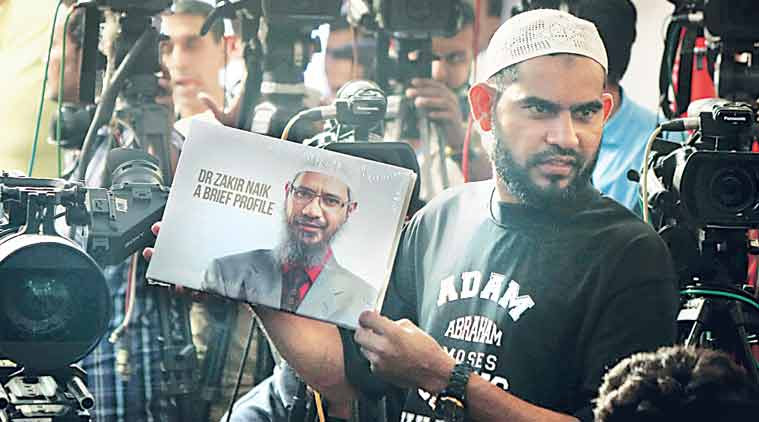
zakir naik, zakir naik speech, islamic preacher zakir naik, zakir naik dhaka attack, zakir naik is, zakir naik islamic state, mumbai, zakir naik, zakir naik speeches, peace tv, zakir naik preacher, islamic preacher naik, mumbai police, nashik, bangladesh attack, dhaka attack , india news, latest newsAt the press conference Zakir Naik had over Skype on July 15. Naik resorted to his usual style, weaving around his statements qualifications, stipulations. (Expres Photo: Prashant Nadkar)
AFTER three days of repeatedly rescheduling a press conference, Dr Zakir Naik couldn’t have stumbled on a worse moment to finally have a heart-to-heart, via Skype, with journalists. On July 15, a Friday morning, as a small hall in south-central Mumbai packed to the rafters waited for a technical glitch to be ironed out before Naik, who spoke from Medina in Saudi Arabia, finally appeared on screen, the Bastille Day attack in Nice was only a few hours old. Its lone wolf attacker had picked a method with eerie similarities to the Glasgow attack of 2007 by Kafeel Ahmed of Bangalore, driving an explosives-laden vehicle into his target. The irony was lost on nobody. Kafeel Ahmed was found to have been inspired by, among others, Zakir Naik.
Then, at Friday’s press conference, the televangelist in the eye of a storm returned to a style his detractors have long taken issue with, weaving around his statements clever qualifications and stipulations, nuances of interpretation peppered with ifs and buts. Suicide attacks are condemnable, he declared, the subordinate clause glued on, “where innocents are targeted”. As a war tactic, well, that’s a different story, he said.
It is pointless arguing that the two Dhaka attackers who were reportedly inspired by him believed they were waging war for their Caliphate. Speaking to The Indian Express when that news broke, the 50-year-old medical doctor-turned-preacher said he would not refer to the Islamic State (IS) as Islamic, for that itself would be a condemnation of Islam. “I call them the anti-Islamic State of Iraq and Syria,” he said, adding that the name IS had been coined by the “enemies of Islam” though he wouldn’t name these enemy countries. After the Dhaka attack, Maharashtra ordered a probe into Naik’s speeches.

A handful of previous terror detainees have reportedly claimed to be inspired by the English-speaking Naik, who has 14 million followers on Facebook, the large majority of them youngsters. Afghan-American Najibulla Zazi (New York subway bombing plot, 2009), Dr Kafeel Ahmed (Glasgow 2007), Rahil Sheikh (Mumbai serial train blasts, 2006), Feroz Deshmukh (Aurangabad arms haul case, 2006), alleged IS sympathisers (Kalyan, 2016) were all found to have listened to Naik’s sermons. Besides, at least some among the 21 people from Kerala who are missing and who are rumoured to have joined the IS are said to have been inspired by Naik. On January 20, an alleged member of Naik’s Islamic Research Foundation (IRF) was arrested on charges of “radicalising” one of the 21.
zakir naik, zakir naik speech, islamic preacher zakir naik, zakir naik dhaka attack, zakir naik is, zakir naik islamic state, mumbai, zakir naik, zakir naik speeches, peace tv, zakir naik preacher, islamic preacher naik, mumbai police, nashik, bangladesh attack, dhaka attack , india news, latest newsThe one probe the police imagine could be productive is the Centre’s proposed investigation into finances of the IRF and Peace TV. Previous probes into Peace TV activities include one in the UK.
But try to pin down the founder of Peace TV and his now stock replies flood the conversation. Saying he has been quoted “out of context”, that it is utter “misinformation” to suggest that he supported terror attacks of any kind, that he was being “branded” without evidence — all now appear to be verbal tics for the Islamic scholar.
“He’s just confusing people, especially impressionable young Muslims, with this sort of rhetoric,” says Syed Noorie of Mumbai’s Raza Academy. “What is the need to say some kind of suicide bombing is acceptable? For youngsters who believe they are right, this serves as encouragement. Islam prohibits suicide, simple.”
It’s increasingly clear that for all the self-professed width of his reach and expanse of his Peace TV empire, which is said to have nearly 200 million viewers worldwide, Naik has strong detractors among conservative Muslims too. Muslim scholars and elected representatives speak warily about Naik’s run-in with a large section of imams in 2008 over his comments on Imam Hussain, a key figure in Islam. The battle of Karbala was fought for political reasons, he contended in a two-minute video clip that was widely shared and condemned by Sunni and Shia scholars. “He hasn’t spared Muslim icons, so it’s only to be expected that he will speak against gods of other religions,” Noorie says, demanding a probe into the alleged “Wahabi” funding for Naik’s Peace TV and other ventures.
When he is not travelling the world on lecture tours, Naik mostly spends his time in Dubai, but his Mumbai roots remain firm.
Naik was schooled in Mazgaon’s St Peter’s High School, not far from the hall where journalists crammed in on Friday to attend his Skype address. In a previous interview to this newspaper, Naik had said he was an average student despite his ability to memorise huge amounts of text. A shy teenager, he also had a stammer, something, he says, he overcame when he began “speaking about the Trust”. In the late 1980s, he obtained his medical degree from Topical College that’s attached to BYL Nair Hospital, and appeared set to join his family’s busy medical practice. His father Abdul Karim Naik was a respected psychiatrist and also an active member of the community. In 1987, Naik attended a sermon in Mumbai by the late South Africa-based preacher Ahmed Deedat and that changed the course of his life. Like Deedat, Naik then memorised the Quran, dived into other religions’ scriptures and began sermonising on comparative religion, using Deedat’s style of reaching out to young Muslims with English and technology.
In 2006, he burst on to the radar of terror investigators when one of those arrested in connection with the Aurangabad arms haul case turned out to be an employee of the Islamic Research Foundation, a trust Naik established in 1991 and which has its headquarters in a nondescript building in Dongri, south Mumbai.
By 2012-13, his sermons began to get noticed and the Hindu right-wing organisations sought a “ban” on him.
Every year, Naik would organise public meetings at the KG Somaiya Ground in Central Mumbai. The setting was always opulent, with a replica of the Taj Mahal at one such rally. “He put up these extravagant sets to attract the commoner,” explained a senior police officer who spoke on the condition of anonymity.
It was after one such meeting in 2012, where he spoke about Hindu god Ganesha, that a series of cases began to be registered against him. In the video, Naik is purportedly heard saying, “If your god is unable to recognise his own son, how will he know that I am in danger?” On Naik’s plea, all the cases were clubbed and he was granted anticipatory bail by the Bombay High Court. The case is still being probed.
“The 2012 incident also pushed the Mumbai Police to deny permission for Naik’s annual gatherings,” said the officer.
Women’s rights activists too have been railed against him for long, terming him a regressive chauvinist in the garb of an educated theologist.
In one YouTube video they cite, Naik is seen clarifying whether he really ever advised men to not leave a mark on their wives after a beating. “That’s a portion of my answer,” he is seen saying, a phrase he now uses repeatedly. “What I really said”, he says, falling back upon another phrase he uses over and over, is that a wife who is disloyal may be beaten “symbolically”, “with a toothbrush”.
These multiple demands for a probe have flummoxed law enforcement agencies, who acknowledge that previous efforts to pin Naik down yielded little.
In the 2006 Aurangabad arms haul case, where 40 kg of RDX, 17 AK-47 assault rifles and 50 hand grenades were seized, the arrests made by the Maharashtra Anti-Terrorism Squad led them to Zakir Naik. Rahil Ahmed Sheikh, an alleged Lashkar-e-Toiba (LeT) operative and one of the main conspirators in the case, had worked as a volunteer with the IRF. Feroz Deshmukh, another person the ATS held in the case, was allegedly a librarian with Naik’s IRF. According to a retired officer who was part of the team that probed the case, the ATS questioned Naik but there wasn’t much to ‘link’ him to the case.
While the Mumbai Police is investigating his speeches, with many of the arrested IS sympathisers from India claiming to have been inspired by Naik, the televangelist has never been too far from the NIA radar.
“These young men who are taken in by this idea of fighting for the Caliphate get indoctrinated online and Naik’s videos are a key resource material. We suspect his videos are deliberately shared by handlers so that the potential recruits connect to him as one of their own — an Indian Muslim,” said a source in the police.
So far, the investigations into the videos have yielded little. But the one probe the police imagine could be productive is the Centre’s proposed probe into the finances of IRF and Peace TV. While the IRF was registered in 1991 in Mumbai, beginning its operations by producing video tapes of Naik’s sermons to be aired by local cablewallahs, it now runs various charitable initiatives, a women’s wing as well as a school and junior college. Peace TV, set up in 2005-06, gathered steam almost immediately. Previous investigations into its activities include one in the UK over allegations of extremist messages.
Former Mumbai Police chief Satyapal Singh, who is now BJP MP from Baghpat in Uttar Pradesh, has claimed that during his stint in the Mumbai Police, he had sought a ban on the IRF for contravening the provisions of the Foreign Contribution (Regulation) Act. Singh alleges that his report against the IRF’s funding was ignored by the then UPA government.
Peace TV, which operates from Dubai, used to have a small studio set-up in Mumbai for recordings, but this is now reportedly not in use. Among the allegations against Peace TV is one regarding its funding, with charity funds raised by the IRF allegedly backing the channel. While Peace TV remains available in some parts of Mumbai, the big operators have discontinued it in recent years. Those who continue to view the channel on demand in Mumbai would rather not talk about it.
With the government refusing to grant a downlinking licence to Peace TV, its transmission by cable operators becomes illegal. In his Friday briefing, Naik had blamed the Centre for not allowing this “messenger of peace” to carry out his duties. Following the Dhaka blast, the Bangladesh government recently banned Peace TV in that country.
Speaking to The Indian Express, an IRF spokesperson said they were ready to face any probe. “Questions are being raised on how the charitable institute is being funded but we have nothing to hide. In 2014, there was a probe by the Enforcement Directorate into the financial dealings of the IRF. We later learnt that they found nothing,” he said.

Monday, July 18, 2016

Uniform Civil Code -- It isn't about women - By Nivedita Menon - The Hindu

http://www.thehindu.com/opinion/lead/nivedita-menon-on-uniform-civil-code-it-isnt-about-women/article8850353.ece?homepage=true

Inline image 1

OPINION » LEAD

July 15, 2016
Updated: July 15, 2016 01:11 IST

It isn’t about women

COMMENT (177)   ·   PRINT   ·   T  T  
1

The talk of a Uniform Civil Code has nothing to do with gender justice. It has entirely to do with a Hindu nationalist agenda to ‘discipline’ Muslims

For nearly eight decades, the women’s movement has discussed and debated the desirability and feasibility of a Uniform Civil Code, and has ended up posing a simple question — what is the value of uniformity? Is it for the “integrity of the nation” that uniformity in laws is required, as some judicial pronouncements have suggested? If so, who exactly is the beneficiary? Which sections of people benefit from “integrity of the nation”, that abstract entity which is not exactly at the top of your mind as your husband throws you out on the street?
Or are uniform laws meant to ensure justice for women in marriage and inheritance? In that case, a Uniform Civil Code would simply put together the best gender-just practices from all Personal Laws. So yes, polygamy and arbitrary divorce would be outlawed (a feature derived from Hindu Personal Law). But conversely, as feminist legal activist Flavia Agnes has often pointed out, a Uniform Civil Code would require the abolition of the Hindu Undivided Family, a legal institution that gives tax benefits only to Hindus, and all citizens of India would have to be governed by the largely gender-just Indian Succession Act, 1925, currently applicable only to Christians and Parsis.
A stick to beat Muslims with

Muslim Personal Law is already modern in this sense, since it has since the 1930s enshrined individual rights to property, unlike Hindu law, in which the family’s natural condition is assumed to be “joint”. In the decades of the 1930s and 1940s, contrary to later discourses about Muslim law being backward, it was Hindu laws that were considered “backward” and needing to be brought into the modern world of individual property rights.
Again, since the Muslim marriage as contract protects women better in case of divorce than the Hindu marriage as sacrament, all marriages would have to be civil contracts. Mehr, in Muslim Personal Law, paid by the husband’s family to the wife upon marriage, is the exclusive property of the wife and it is hers upon divorce, offering her a protection Hindu women do not have. So, the Uniform Civil Code would make the practice of mehr compulsory for all while abolishing dowry.
The patent absurdity of these suggestions arises not from the ideas themselves, but from the fact, recognised by everybody, that the talk of a “Uniform Civil Code” has nothing to do at all with gender justice. It has entirely to do with a Hindu nationalist agenda, and is right up there with the beef ban and the temple in Ayodhya. A Uniform Civil Code is meant to discipline Muslims, teach them (if they didn’t know it already) that they are second-class citizens, and that they live at the mercy of “the national race” (the Hindus), as M.S. Golwalkar decreed.
The real issue of gender justice

So let us pose the question differently — who suffers in the absence of a Uniform Civil Code? Is it Muslim women, victims of polygamy and triple talaq, as Hindutvavadi wisdom has it? But for decades, feminist legal practice has successfully used both the Protection of Women from Domestic Violence Act, 2005 — that is available to all Indian citizens regardless of religious identity — as well as the Muslim Women (Protection of Rights on Divorce) Act, 1986, to deal with polygamy and triple talaq, and to obtain maintenance, child custody and rights to matrimonial home for countless Muslim women. In addition, feminist legal activists have used the landmark Shamim Ara v. State of U.P. (2002) ruling to buttress their claim that arbitrary triple talaq is invalid.
Moreover, polygamy is not exclusive to Muslims. Hindu men are polygamous too, except that because polygamy is legally banned in Hindu law, subsequent wives have no legal standing and no protection under the law. Under Sharia law, on the contrary, subsequent wives have rights and husbands have obligations towards them. If gender justice is the value we espouse, rather than monogamy per se, we would be thinking about how to protect “wives” in the patriarchal institution of marriage. “Wives” are produced through the institution of compulsory heterosexual marriage, the basis of which is the sexual division of labour. This institution is sustained by the productive and reproductive labour of women, and almost all women are exclusively trained to be wives alone.
Thus, when a marriage fails to fulfil its patriarchal promise of security in return for that labour, all that most women are left with is the capacity for unskilled labour. Or they remain trapped in marriage with children to provide for, while men marry again, legally or otherwise, producing still more dependent, exploited wives and children for whom they take no responsibility. If gender justice is the point of legal reforms, the centrality and power of the compulsory heterosexual, patriarchal marriage, and the damage it can do to women, is what must be mitigated. This would mean recognising the reality of multiple “wives” as a common practice across communities, and the protection of the rights of all women in such relationships.
In this sense, recent Supreme Court rulings that have granted rights to second wives in Hindu marriages dilute the legal standing of monogamy for Hindus but empower women.
A survey conducted by the Bharatiya Muslim Mahila Andolan, a significant voice in the debate, found that more than 90 per cent of Muslim women in India want a ban on “triple talaq” and polygamy in Muslim Personal Law. That is, the demand is made within the framework of codifying Muslim Personal Law, not in favour of a Uniform Civil Code, partly because there is no clarity on what a uniform code would look like, but also because the demand comes from clearly Hindutvavadi quarters which have shown that both women and minorities are expendable for them.
Lessons from the Goa experience

The only example of a uniform code in India is the Portuguese Civil Procedure Code (1939) of Goa, which is neither ‘uniform’ nor gender-just. Marriage laws differ for Catholics and people of other faiths, and if a marriage is solemnised in church, then Church law applies, permitting, for example, arbitrary annulment at the behest of one of the parties. The “customs and usages” of the Hindus of Goa are recognised, including “limited” polygamy for Hindus.
The positive aspect of Goa’s Civil Code is the Community Property Law, which guarantees each spouse 50 per cent of all assets owned and due to be inherited at the time of marriage. However, this provision can be sidestepped in practice, given the power relations in a marriage, and studies show that it has not made any impact on the incidence of domestic violence.
Clearly, if gender justice is not prioritised, both uniformity as well as its dilution can reinforce patriarchy and majoritarianism.
The woman at the centre of this recent round of debate on the Uniform Civil Code is Shayara Bano, who received talaq by post. Her lawyer, instead of using any of the three recourses available discussed above — the Protection of Women from Domestic Violence Act, 2005, the Muslim Women (Protection of Rights on Divorce) Act, 1986, or the citation of the Shamim Ara v. State of U.P. (2002) judgment — decided to file a Public Interest Litigation in the Supreme Court challenging triple talaq on the grounds of violation of Fundamental Rights. Ms. Bano is now in the media spotlight, spiritedly criticising patriarchy in the Muslim community.
Revealingly, a recent interview with her in a national newspaper concluded with a startling question — “What about the ‘Bharat Mata ki Jai’ slogan controversy?” Ms. Bano replies, “I feel all Muslims should say Bharat Maa ki Jai.”
Does the question seem irrelevant in the context of Ms. Bano’s fight for personal justice? What does compulsory chanting of “Bharat Mata ki Jai” have to do with a woman fighting patriarchy?
But the question does not seem irrelevant at all; it seems to be at the heart of the interview. This alone should alert us to what the demand for a Uniform Civil Code is actually about.
Nivedita Menon, a feminist scholar, is a professor at Jawaharlal Nehru University, New Delhi.
---
177 comments
  • AAmardeep  
    The problem with the opponents of UCC has always been an inability to accept a discussion on the merits of UCC. More than 65 years after it was put onto our constitution, not by Hindutava proponents, but by people who hated Hindu majoritism to their core, we are still not ready to discuss it. It is almost as if certain sections do not want to see themselves as Indians under the law but as various religious identities, Hindu, Muslim, Christians, etc under the law. It is not a question of questioning their patriotism but is a question of what is seen more effective, a law drafted by Manu in ancient India or in Arabia centuries ago or a law drafted in Europe in the dark ages or a law drafted in contemporary India for our contemporary problems irrespective of the religious faith of the person on whom it is applicable? I would choose the later. Moreover having different civil laws violates the principle of secularism of our constitution as it brings religion into public space.
    155
    about 22 hours ago
     (0) ·  (0)
     
    • AAmardeep  
      The author says this,
      "Mehr, in Muslim Personal Law, paid by the husband’s family to the wife upon marriage, is the exclusive property of the wife and it is hers upon divorce, offering her a protection Hindu women do not have. So, the Uniform Civil Code would make the practice of mehr compulsory for all while abolishing dowry."

      Why would Meher be made a part of the UCC? Just as triple talaq would be abolished the failure of payment of maintenance would also be abolished. Moreover does the author want regressive practices like Meher to be followed? Yes unlike Hindu Dowry it is paid to the bride family, but it is not a ridiculous amount of Rs 25. So whether it is better than dowry or more is moot. That is the problem with the various civil code of India. They are not fair. But just because one existing civil code is not good in one aspect does not make UCC should not be discussed or implemented. UCC can overcome most of the drawbacks of various civil codes of India.
      155
      about 22 hours ago
       (0) ·  (0)
       
      • OIOpinionated Indian  
        The tone of this article is shocking. A Uniform Civil Code is just that, a Uniform Civil Code, not a Hindu Civil Code applied to all communities. I am ashamed that my country has different rules for different people. Believe it or not, there are many people like me with no Hindutva agenda who think like this.Ms. Menon seems to suggest that it doesn't matter that Shayaro Bano was humiliated. It is the soft bigotry of lowered expectations to think that there are no people within the community who also want the removal of triple Talaq."Feminists" who put ideology and Regressive Leftism above all else, and throw women under the bus because they are inconvenient to their narrative are not feminists at all.
        2 days ago
         (3) ·  (1)
         
        Annoyed · Ashish · Govind Up Voted
        kinky Down Voted
        • SSunil  
          The writer seems to have ridiculous arguments and laughable opinions. UCC is much needed to give more rights and for protection of women. All are citizens of this country and have equal rights and duties. Parallel laws and government is not acceptable. The people support the present government with absolute majority, thanks to such non-sense opinions. Pls ask the writer not to misguide the nation in the name of liberalism..
          2 days ago
           (0) ·  (1)
           
          kinky Down Voted
          • SPSajeev P  
            Ms Menon's opinion is one sided. It is loaded with the stigma usually associated with the social science department of the JNU. UCC is not a question of Hindus or Muslims. Our country is a democratic republic. so, as we adhere to common criminal procedure coded, it is customary to follow civil laws. Personal laws hasn't any relevance. what if the citizen of India behave as his own, according to certain personal laws of his choice?
            so that is not the case. We should adhere to our constitution. Women are discriminated under various personal laws. the most obvious case is Muslim personal law. Through Hindu code bill Hindu personal laws are codified. Undivided Hindu family is another case. whenever the case of UCC arises, it is divided on Hindu-Muslim lines. It is pertaining to all religion. Indian citizens should follow once set of rules in matters of marriage, inheritance, maintenance and other similar issues. The archaic laws of the middle ages haven't any say in the modern times.
            2 days ago
             (0) ·  (1)
             
            kinky Down Voted
            • VVenkatamv  
              Selective interpretation of rights and equality is the norm of some. No wonder these so-called activists and liberals write so...Uniform civil code is needed and it has nothing to do with a Hindu and Muslim. Of Course, it can and has to debated before implementation. When in a democracy everyone has equal rights., why not this?
              2 days ago
               (0) ·  (1)
               
              kinky Down Voted
              • AMAshish Mattoo  
                i would like to make it clear to Miss Nivedita Menon that the Uniform civil code is not the invention of BJP but honorable Supreme court of India in October 2015 said there was total confusion due to various Personal Laws and sought to know if the government was willing to implement a Uniform Civil Code. It observed: “What happened to it? Why don’t you (the government) frame and implement it?” However, the apex court later declined to direct Parliament to bring in a Uniform Civil Code while allowing a PIL filed in this regard to be withdrawn.
                Supreme court of India has, on number of occasions directed the central govt. to implement uniform civil code and adhere to Article 44 of our constitution.
                So referring this decision, as communal doesnt make sense.
                2 days ago
                 (0) ·  (0)
                 
                • Rrohin  
                  what about shahbano case ?? do you think muslim personal law acted with a liberal approach . please for god sake use your pen for fighting for right issues .
                  2 days ago
                   (0) ·  (1)
                   
                  kinky Down Voted
                  • Ssam  
                    Author seems quite biased here... Indeed hindutava forces have been demanding it for UCC for a while. But it is not for appeasing the hindu brigade. this code would be the betterment of muslim community. laws,written 1400 years ago, do not fit in to modern world. Author like menon gives rise to hindutava forces. They usually forget people of this nation have become smarter than before and i see people commenting here , mostly disagree with the views of author. We dont need a pseudo intellectual who could speak on the behalf of Indian youth. today we have social media sites and comment sections on every news paper site on which we express our views and the views of intellectual common people are always against the pseudo intellectuals like menon. So u just keep ur views confined to urself .. Youth of india has been risen from the ashes. it is the first step in the advancement of the nation. Knowledge of all kind has been divided among the youth and this trend is on rise. We dont need u
                    2 days ago
                     (0) ·  (1)
                     
                    kinky Down Voted
                    • Suchindranath Aiyer Protean, polyglot, polymath, healer, global human, Brahmin. 
                      True to PANGOLIN* type:

                      *Note: PANGOLIN: An enemy of India who believes in inequality under law, exceptions to the rule of law and persecution of some for the benefit of others. At present, the sole purpose of the Indian Republic, Constitutional or otherwise, is to pamper and provide for certain constitutionally preferred sections of society who the British found useful to hold and exploit India at the cost of those who the British hated and persecuted. The Pangolin is a creature that is unique to India and feeds on ants that are known in nature to be industrious and hard working if not quite as fruitful as bees who flee to better climes. (PANGOLIN is an acronym for the Periyar-Ambedkar-Nehru-Gandhi-Other (alien) Religions-Communist Consensus that usurped the British Mantle and has worn it with elan to loot, plunder, and rape India since 1921 and re write History and laws to their exclusive benefit since 1947)
                      265
                      2 days ago
                       (0) ·  (1)
                       
                      kinky Down Voted
                      • VVaibhav  
                        people talk about gender equality , independent women etc,. and there are people who talk about obtaining their share of property after divorce...hypocricy all over..
                        And about polygamy today with the rising divorce cases specially in the so called educated class represents that none of the gender is ready to accept the imperfections in the other. so its really about understanding the sanctity of marriage and not just playing with by just making laws then and now. polygamy should not be apart of any law. you can be attached to a single woman emotionally not plenty in todays times its challenging to save the institution of marriage... UCC should be debated to its fullest before coming in shape by all religious scholars (scholars and not frauds please.)
                        And please dont take the issue of feminism and women empowerment in wrong direction.. like deepika s my choice etc....
                        2 days ago
                         (3) ·  (1)
                         
                        Rahul · TSK · Anirudh Up Voted
                        kinky Down Voted
                        • SSundar  
                          That's like saying 'the issue must be discussed to the fullest, but please don't say what I don't want to listen to.'
                          1330
                          2 days ago
                           (0) ·  (0)
                           
                        • RLRoshan Lal  
                          There couldn't be more atrocious or ridiculous statement than what M/S Menon , Professor of JNU made that BJP is using Common Civil Code as stick to beat Muslims ! All,of us swear by Our Costitution & our Secularism day &! day out hence it passes over my head as why so far Common Civil Code was not implemented! To my mind not having Common Civil Code is against basic tenets of ou Constitution Human Rights ! In the name of personal civil code , untold cruelty has been & is still inflicted by Muslims on women that one shiver at the thought of it ! Besides making numerous other follies by Mr.Nehru & congress not having Common Civil Code for our country too is one of them ! There can't be any compromise on not having Common Civil Code at the earliest ! Further no compromises should be allowed to come in the way to adopt modern & humane Civil Code keeping in view our basic tenets of Secularism as enriched in our country's constitution!
                          105
                          2 days ago
                           (6) ·  (2)
                           
                          kuldeep · HARESH · Subrahmanyam · CSampath · TSK · prakash Up Voted
                          Kamill · kinky Down Voted