Tuesday, September 16, 2014

Maharashtra Muslims to go for elections without strategy but with miraculous expectation - By A.Mirsab - TwoCircles.net

http://twocircles.net/2014sep16/1410837598.html

TwoCircles.net

Delivering news, not profit

Maharashtra Muslims to go for elections without strategy but with miraculous expectation


Submitted by TwoCircles.net on 16 September 2014 - 8:49am
 
By A.Mirsab, TwoCircles.net,

Mumbai: Maharashtra assembly elections are round the corner, 288 seats to go for polls on 15th October and as usual the anxiety of Muslims in the state have started to build up for two major reasons – to keep communal parties at bay and to increase Muslim representation in the assembly.

These worries of Muslims always crop up only days before elections - parliamentary or assembly. Barely a section of the community in reality bothers about the actual strategy months before elections to achieve these two goals in the elections which basically rest at almost all Muslims’ heart.
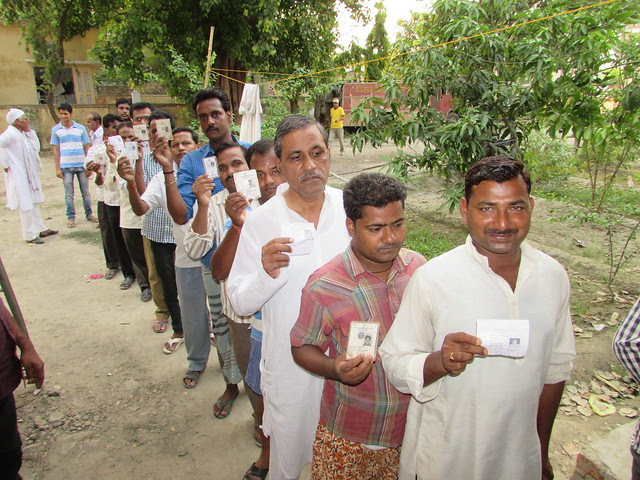

Lok Sabha Election 2014: Muzaffarpur
File photo of Lok Sabha Election 2014

Even though these are main concerns of Muslims but the community never prepares a united strategy to accomplish the common objective. Muslims make up 11-12% of the population in the state and hence have the possible strength in proving vital during elections if their votes are not divided.

Presently in the state there are set of Muslim led or so called pro-Muslim parties who are eying to fight assembly polls from Muslim majority areas. These are Indian Union Muslim League (IUML), Awami Vikas Party, Welfare Party of India, Samajwadi Party (SP) and All India Majlis-e-Ittehadul-Muslemeen (AIMIM).

Although SP is not purely Muslim party but is the strongest Party mostly preferred by Mumbai Muslims.

As of now these parties have not allied together plus there is no apparent possibility of alliance between SP and AIMIM. Even if these parties get together they will pose main hurdle for INC-NCP than Shiv Sena (SS) – BJP alliance as Muslims in the communally sensitive state are known to least vote for SS and BJP rather they are identified to choose INC-NCP candidates due to their secular stand.

AIMIM has made a grand entry into Maharashtra with Akbaruddin Owaisi holding a huge rally in Mumbai this week where he announced of fielding candidates from Muslim majority areas in the upcoming elections with the motive of increasing Muslim representation in the assembly so as to raise community issues more rigorously.

Indian Union Muslim League (IUML) which has a strong presence in Kerala has announced of fighting from all 20 Muslim majority seats in and around Mumbai. Former police commissioner Shamsher Khan Pathan led Awami Vikas Party has also announced of fielding candidates from all Mumbai seats. Three years before launched Welfare Party of India has also declared of fighting on 80 seats.

These sections of Muslim parties are indeed going to disturb the equation of Muslim votes in the state especially for already struggling INC-NCP in the state. Learning parables from the defeat in the parliamentary elections and with the worry of impact of debuting AIMIM in the state, Samajwadi Party (SP) state Chief Abu Asim Azmi has already declared of going into seat sharing with INC-NCP.

“One cannot deny that the AIMIM’s candidates will divide the Muslim votes. To avoid the division, we have decided to support the secular parties and may field only 8 to 10 candidates in seat sharing arrangements with the Congress and the NCP,” Abu Asim Azmi reportedly told HT.

In present political scenario in the state some short sighting Muslims are expecting of a miracle in their community favor from the elections while Muslims having awareness are worried with the announcement of fighting election by the number of Muslim parties.

Advocate A.W. Shaikh, resident of Mumbra in Mumbai told TwoCircles.net, “At a time when communal forces are at rise and minority voices are suppressed, there is no need of such Muslim parties as an alternative in the elections rather they should increase awareness in the minority people and unit their vote for secular candidate in the region”.

Sajid Shaikh, a government employee residing at Bandra in Mumbai said, “Even though we learn lessons in every elections but the community never comes up with united strategy that could help the community as a whole. Rather than launching new Muslim party in the elections the community leaders should compel the already existing secular parties to listen to their problems and to implement schemes in the community favor”.

Till now, Vidarbha Muslims have not recovered from the shock of Lok Sabha election results from where all the 10 seats were won by SS-BJP alliance and hence are not optimistic about the upcoming assembly elections.

Talking TCN, social activist A. Raza from Vidarbha said, “I have found Muslims in the area to be less enthusiastic about the election this time. They are feeling that their votes have no meaning as in the Lok Sabha elections majority of the Muslims in the region had voted to defeat saffron party but none of the candidate they voted won in the election”.

Although some Muslim youths in Marathwada region who are energized with Owaisi brothers speeches are seeing a hope in AIMIM and are expecting the party to deliver same performance as like in Hyderabad.

“This is the party we were waiting for. I am not party worker but wish to soon work for it”, said Saleem, a vendor at the Nanded train station.

“We supported congress against Shiv Sena many times but congress has not lifted Muslim issues and hence we feel AIMIM will be the better option for Muslims”, said a young businessman from Aurangabad who wished to be identified with only his last name Khan.

In such a mixture of hope and worry for the Muslims in the state, Jamaat-e-Islami Hind is the only organization working to unite Muslim votes. It has announced last week that it is going to hold a state-wide campaign highlighting its various demands.

The organization aims to reach out to at least six crore voters through various means, including door-to-door campaigning, corner meetings, symposiums and rallies between September 12 and 21.

Aslam Gazi, senior member of Jamaat-e-Islami and resident of Kurla in Mumbai said to DNA, "At the end of the day, a winnable candidate is someone who can trounce a communal person. We look to consolidate votes instead of dividing them. If votes get divided, that will affect us. If both the major candidates happen to be from the same community, or a non-Muslim stands in a sure-shot secular seat, we look at the standing of the person in the community. In the past this has happened: Muslims were put up, but non-Muslims have won if they were better."

All political parties will begin their campaigning soon in the state and it is exciting to watch how INC-NCP alliance play its cards this election so as to defeat grand Mahayuti (BJP-SS-RPI) alliance while winning over Muslims vote which will otherwise go to the set of debuting Muslim parties in the state.

Fingers crossed!

Sunday, September 14, 2014

U.S. intelligence agencies remain uncertain about danger posed by Islamic State - By Greg Miller and Juliet Eilperin - THE WASHINGTON POST

THE WASHINGTON POST

U.S. intelligence agencies remain uncertain about danger posed by Islamic State


Comments 1097


Hours before President Obama announced a new U.S. military offensive against the Islamic State, one of his top counter­terrorism officials testified to Congress that the al-Qaeda offshoot had an estimated 10,000 fighters.

The next day a new assessment arrived from the CIA: The terrorist organization’s ranks had more than doubled in recent months, surging to somewhere between 20,000 and 31,500 fighters across Iraq and Syria.

The enormous discrepancy reflects, in part, significant uncertainty among U.S. intelligence agencies over the dimensions of and danger posed by America’s latest Islamist adversary.

But the trajectory of those numbers — and the anxiety that they have induced among U.S. counter­terrorism and military officials — also helps to explain Obama’s decision to go to war against an Islamist group that has yet to be linked to any plot against the United States.

In his speech, Obama laid out a rationale that leaned heavily on what-ifs. The United States has “not yet detected specific plotting against our homeland,” Obama said. But Islamic State leaders “have threatened America and our allies,” he said, and are on a path to deliver on those threats “if left unchecked.”

The emphasis on hypotheticals was notable for a commander in chief who presided over the creation of a counter­terrorism doctrine in which U.S. strikes are supposed to be contemplated only in cases­ of imminent threat of violent attack. Faced with a terrorist group that is expanding faster than U.S. spy agencies can chart it, the “imminent” threshold appears to have been set aside.

Lisa Monaco, assistant to the president for homeland security and counterterrorism, said in an interview Saturday that the speed at which the Islamic State has grown and amassed re­sources and its efforts to recruit Western fighters have prompted officials to respond differently than they did to terrorist groups elsewhere. “At least at this stage, it’s a really different type of threat that it poses,” she said.

When asked about the revised estimates of Islamic State fighters Friday, White House press secretary Josh Earnest said it indicates “that the group has had some recruitment success after the battlefield ad­vances that they demonstrated back in June, and it reflects some better insight that the intelligence community has been able to gain into the activities” of the Islamic State.

Several factors have fed U.S. anxiety. The Islamic State’s seizure of large chunks of territory in Iraq and Syria has been particularly unnerving to U.S. officials and agencies still haunted by the extent to which a haven in Afghanistan served as an incubator for al-Qaeda and the Sept. 11, 2001, attacks.

U.S. officials have also cited the danger posed by the massive flow of foreign fighters into Syria — including at least 2,000 holding Western passports, enabling them to emerge from the Syrian civil war with Islamist contacts, lethal training and the potential ability to travel throughout Europe and North America unimpeded.

There may also be a significant emotional component. The expanded U.S. strikes were ordered just weeks after most Americans were introduced to the Islamic State on the most brutal terms: through the release of videos in which two U.S. journalists were beheaded by a masked militant speaking with a British accent.

Late Saturday, a new video was posted online showing the beheading by Islamic State of British aid worker David Haines, who was abducted in Syria near the Turkish border in March 2013.
Some terrorism experts have questioned Obama’s decision to open a multi­year campaign against the Islamic State — also known as ISIS or ISIL — citing concern that it is being driven more by psychological factors and fear than by evidence that it can significantly harm the United States.

U.S. airstrikes in Iraq targeting Islamic State

“The American public has come to equate ad­vances in the Middle East by this one group, ISIS, with the danger of another 9/11,” said Paul Pillar, a former deputy director of the CIA’s Counter­terrorism Center.

Pillar said that the Islamic State is following a playbook that is in many ways the opposite of al-Qaeda’s and that making the group the target of a U.S.-led campaign risks turning its focus toward the United States.

“For them to seize and maintain territory is a major digression from terrorist operations in the West, rather than a facilitation of such operations,” Pillar said.

U.S. strikes can certainly degrade the organization, but “there will be a revenge factor,” he said. “The killing of the two captive journalists was depicted by the group explicitly as retaliation for strikes that had already occurred.”

Attention to that issue and others has been scarce in the limited Washington debate so far over the Islamic State, a debate that has often been dominated by more dire projections.

“There is no contain policy for ISIL,” Secretary of State John F. Kerry said this month. “They’re an ambitious, avowed genocidal, territorial-grabbing, Caliphate-desiring, quasi-state within a regular army. And leaving them in some capacity intact anywhere would leave a cancer in place that will ultimately come back to haunt us.”

Sen. Dianne Feinstein (D-Calif.), the chairman of the Senate Intelligence Committee, wrote in a recent op-ed that “the threat ISIS poses cannot be overstated.” She went on to describe the group as “the most vicious, well-funded and militant terrorist organization we have ever seen.”

Although aspects of Kerry’s and Feinstein’s characterizations are accurate, confusion about the group stems to a large degree from the difficulty in extrapolating its danger to the United States from such adjectives.

The Islamic State emerged from the remnants of an al-Qaeda affiliate in Iraq that was largely dismantled before U.S. forces left the country in 2011. But the organization has taken advantage of the chaos in Syria’s civil war and sectarian tensions in Iraq to regroup.

Beyond its swelling ranks of fighters, the organization has amassed resources at a rapid rate. Its seizure of cities in Iraq this year has enabled it to build an arsenal that includes U.S.-provided weaponry. It also generates an estimated $1 million a day in revenue from black-market oil sales, kidnappings and other criminal enterprises.

Matt Olsen, director of the National Counterterrorism Center, said recently that the Islamic State has vastly eclipsed al-Qaeda in its use of the Internet to spread propaganda and entice recruits.

The White House considered that targeting the Islamic State directly could intensify its motivation to strike the United States, Monaco said, which is part of why the president and others have made a point of questioning its religious credentials and overall legitimacy. But she noted that the group has already made clear its intent to target the country.

“We conduct that analysis, but they’ve already shown their brutality,” she said.

The threat the Islamic State poses to the region is in some ways more insidious than direct. Its fighters have swept through Sunni areas of Iraq and Syria where local security forces­ were already weak or disinclined to fight. It would be harder to take on the loyal armies of other countries in the region.

Of greater concern is the flow of foreign fighters, including thousands of Saudis, Jordanians and Tunisians who have probably learned lethal skills in Syria and been drilled in extremist ideology.

There have already been demonstrations in support of the Islamic State in Jordan; its flag flutters over some Sunni communities in Lebanon; and Saudi Arabia has conducted sweeps to detain dozens of suspected supporters.

For Saudi Arabia and other gulf nations, there is little incentive to join a military assault on the Islamic State, said Jamal Khashoggi, a prominent Saudi journalist who runs the Al-Arab News Channel. “Nobody wants to be in the middle of a bloody sectarian war,” he said. “And if we go into Syria, do we side with the rebels” or Syrian President Bashar al-Assad?

Similar anxieties have spread across Europe, as thousands of Muslims from France, Germany, Britain and other countries have flocked to the conflict in Syria, a country easier for Western militants to reach than al-Qaeda havens in Yemen or Pakistan.
French authorities earlier this year arrested an Islamic State-linked militant who had returned to that country and was discovered with a stockpile of explosives. Another fighter with ties to the group killed four in an attack on a Jewish museum in Belgium. It is unclear whether either had been acting on direction from the Islamic State.

The number of Western fighters in Syria has dwarfed the migrations to other insurgent hot spots in the past. “No more than 50 to 75 American foreign fighters” made it to Afghanistan between 1986 and 2001, said Evan Kohlmann, a terrorism consultant at Flashpoint Partners. “It’s very difficult for law enforcement to monitor this large a number of people.”

U.S. officials have said that about 100 Americans have either traveled to Syria or attempted to and that perhaps a dozen have linked up with the Islamic State. Moner Mohammad Abusalha — who fought with another extremist group, Jabhat al-Nusra, and was the first known suicide bomber in Syria to come from the United States — recorded a video before his death in May describing how he had eluded FBI surveillance.

The Islamic State’s rivalry with al-Qaeda has emerged as another source of worry for U.S. officials. The group severed ties with al-Qaeda this year, mocking the older network’s leader, Ayman al-Zawahiri, as too timid and declaring itself the founder of a restored Islamic caliphate.

U.S. counter­terrorism officials have warned that a struggle over adherents and resources­ could lead to competition between the two groups. Nicholas Rasmussen, deputy director of the National Counterterrorism Center, warned in a recent briefing for reporters that the “competition for primacy in global jihad” could lead to competition in staging spectacular attacks, compounding the danger to the United States. The rivalry, Rasmussen said, makes each side “more unnerving than it might be if judged purely on its own terms.”

And groups such as al-Qaeda could recruit some of the Islamic State’s most talented foreign fighters, making them better positioned to strike the West, said Frank J. Cilluffo, director of George Washington University’s Homeland Security Policy Institute.

Even so, U.S. officials have drawn significant distinctions between the Islamic State and al-Qaeda affiliates in Yemen and other countries. The Iraq-based group mixes military and terrorist tactics but is not seen as a patient cultivator of elaborate trans­national plots. And there is no indication that its leaders have the technical bomb­making expertise that has enabled al-Qaeda in the Arabian Peninsula to devise devices­ that evaded detection on U.S.-bound aircraft.

“ISIL’s ability to carry out complex, large-scale attacks in the West is currently limited,” Rasmussen said in testimony before a Senate committee last week. The Yemen-based Al-Qaeda in the Arabian Peninsula “remains the al-Qaeda affiliate most likely to attempt trans­national attacks against the United States.”


Liz Sly in Beirut and Julie Tate contributed to this report.

Friday, September 12, 2014

Hinduism losing its benign face… no one at top stepping in: Fali S Nariman - The Indian Express

My comments posted on Indian Express article: Hinduism is losing its benign face:
 

  • Hold on, this is waiting to be approved by Indian Express.

    "Can anybody in India see the hand of neocon/CIA in supporting another Hindu Taliban movement just like they did in Afghanistan, to fish in troubled waters. They first support such fascist movements,and later when their clients go on rampage, they turn around, demonize them and come in to 'save' the country. In the NDTV interview, Sheshadri has very mildly alluded to this danger. However, the media is still happy with its circulation and TRP games. Let the country go to hell."

----- ----- ----- ----- -----
http://indianexpress.com/article/india/india-others/hinduism-losing-its-benign-face-no-one-at-top-stepping-in-nariman/99/

Saturday, Sep 13, 2014
 

Hinduism losing its benign face… no one at top stepping in: Fali S Nariman

nariman-main Fali S Nariman delivers a lecture on “ Minorities at Cross Roads : Comments on Judicial Pronouncements” in New Delhi on Friday. (Source: PTI)
 
Express News Service | New Delhi | Posted: September 12, 2014 10:14 pm | Updated: September 13, 2014 8:08 am

Hinduism is losing its traditional tolerance because some Hindus have started believing that it is their faith that has brought them political power — and because this belief is not being challenged by “those at the top”, Fali S Nariman, one of India’s most celebrated jurists, said on Friday.

Nariman said he agreed that the “majority government at the Centre” had done nothing to stop the recent repeated tirades by individuals or groups against members of minority communities.

Tweets
 
Nariman criticised the NCM for not carrying out its “main task”, the “protection of the interests of the minorities”.
 
The eminent constitutional expert delivered the Annual Lecture at the National Commission for Minorities (NCM), titled ‘Minorities at Crossroads: Comments on Judicial Pronouncements’.

Nariman, who began the lecture by saying that he welcomed the single-party majority government at the Centre but also feared it because of “past experience with majoritarian government(s)”, said Hinduism has traditionally been the most tolerant of all Indian faiths.

“But — recurrent instances of religious tension fanned by fanaticism and hate speech has shown that the Hindu tradition of tolerance is showing signs of strain. And let me say this frankly — my apprehension is that Hinduism is somehow changing its benign face because, and only because it is believed and proudly proclaimed by a few (and not contradicted by those at the top): that it is because of their faith and belief that HINDUS have been now put in the driving seat of governance,” he said.

[Underlining and capitals Nariman’s; text of the speech made available by the Ministry of Minority Affairs.]

“We have been hearing on television and reading in newspapers almost on a daily basis a tirade by one or more individuals or groups against one or another section of citizens who belong to a religious minority and the criticism has been that the majority government at the Centre has done nothing to stop this tirade,” Nariman said. “I agree.”

BJP MP Yogi Adityanath has delivered a series of speeches at election meetings in the recent past, for which the Election Commission reprimanded and cautioned him on Thursday, and ordered that an FIR be registered against him. RSS chief Mohan Bhagwat has described India as a “Hindu nation”, and several political leaders linked to the Sangh Parivar have made allegedly provocative statements since the Narendra Modi government came to power.

Nariman criticised the NCM for not carrying out its “main task”, the “protection of the interests of the minorities”.

“Every government…will do or not do whatever it considers expedient to advance its own political interests… This is why…Parliament has…set up an independent Minorities Commission…

“…The main task of the Commission is ‘protecting the interests of minorities’. And how does one protect the interest of minorities who (or a section of which) are on a daily basis lampooned and ridiculed or spoken against in derogatory language? The answer is by invoking the…law enacted in the Penal Code and the Criminal Procedure Code. Otherwise the Commission is not fulfilling its main task which is the protection of the interests of the minorities…

“Those who indulge in hate speech must be prevented by Court processes initiated at the instance of the Commission because that is the body that represents Minorities in India. Whoever indulges in such hate speech or vilification (whatever the community to which they belong) they must be proceeded against and the proceeding must be widely publicised,” Nariman said.

The remarks were made in the presence of Minority Affairs Minister Najma Heptulla, who presided over the function. Later, asked by reporters about the minister’s silence on recent instances of hate speech, Nariman said, “You should ask her that.”

Nariman lauded the role of the Supreme Court in upholding minority rights on many occasions, describing it as a “Super Minorities Commission”. However, he said, the judicial outlook has undergone gradual change since the early 1990s when the BJP introduced the phrase “appeasement of minorities” in the political lexicon.

“The label stuck; ‘minority’ became and has become an unpopular word. And after the same political party had included in its Election Manifesto in the general election of May-June 1991 the party’s resolve if and when it came into power to amend Article 30 to the disadvantage of minorities, ‘minority rights’ got less and less protected by Courts (including the Supreme Court of India) than they were before,” Nariman said.

Heptulla, in her presidential address, reiterated the NDA government’s commitment to “sabka saath sabka vikas”. “One of the important constituents of such an approach is the need for safeguarding the constitutional and legal rights of the minorities and provide them protection and equal opportunity to ensure their economic and social betterment… Government is doing its best for communal harmony and will continue to do so,” she said.

She later defended the government, saying Prime Minister Narendra Modi had told her that Muslims had been “deprived” of their basic rights all these years, and that he wanted her to fulfil the promises the BJP had made to minorities in its manifesto.

She said Modi believed in “inclusive development”, and that there would be no discrimination against anyone on the grounds of religion, language or caste.

----- ----- ----- ----- -----


.

UP 2014, like Punjab 1947 - By Rajmohan Gandhi - The Indian Express

http://indianexpress.com/article/opinion/columns/up-2014-like-punjab-1947/99/

Opinion  

Friday, Sep 12, 2014

UP 2014, like Punjab 1947

The supposed civilisational war between the West and Islam, and the emergence of fanatical groups like the ISIS, are directly relevant to the 40 million or more Muslims living in UP. 
The supposed civilisational war between the West and Islam, and the emergence of fanatical groups like the ISIS, are directly relevant to the 40 million or more Muslims living in UP.


Written by Rajmohan Gandhi | Posted: September 12, 2014 12:14 am | Updated: September 12, 2014 8:42 am

Not long ago, while working on a history of undivided Punjab, I found that in 1914 that vast province was seen as the subcontinent’s hope for economic progress and inter-communal understanding. Yet, in 1947, both halves of divided Punjab saw carnage that no part of the world should witness.

Recent events in Uttar Pradesh should caution Prime Minister Narendra Modi and others that this state, with its immense population, may now be drifting towards a tragedy the nation must never allow again. The Punjab tragedy involved the Empire. On February 20, 1947, London announced that it was about to leave all of India including Punjab, without saying who would inherit the province.

Either “the existing provincial government” would take over, said Her Majesty’s Government, or another arrangement that “may seem most reasonable” would be made. That word triggered two things. One was a Muslim League-led mass movement, which in a fortnight forced out the province’s coalition ministry, led by Khizar Hayat Khan of the rapidly declining Unionist Party but mainly sustained by the Congress and the Sikhs. The other was the creation of separate militias, Muslim, Hindu and Sikh, to force the future of different parts of Punjab.


After the killings in early March 1947 in the towns and villages of Rawalpindi and Multan, Lieutenant General Frank Messervy, the region’s top British officer, recorded his shock that “the normally chivalrous and decent Punjabi Muslim peasant” had been “aroused to such frenzied savagery”, and added: “There has also been a widespread desire to rid many areas of all Sikhs and Hindus, entirely for ever.”

Messervy had identified ethnic cleansing, but the Empire in retreat chose to look away. While London was focused on the safe return of India-based soldiers to Britain, there were elements in the Empire that did not mind an all-out conflict between Indians. Five months after Messervy wrote his note, the great bloodletting of August-September 1947 took place. A major incident, now entirely forgotten, had also occurred in western UP. In November 1946, a number of Muslims were massacred in Garhmukteshwar, not far from Meerut, Muzaffarnagar or Moradabad.

There is a global context for UP’s current tensions too. The supposed civilisational war between the West and Islam, and the emergence of fanatical groups like the ISIS, are directly relevant to the 40 million or more Muslims living in UP. Also of relevance to UP’s Muslims is the national and provincial context. From India’s ruling establishment, which includes the RSS and other workers/ warriors for Hindutva, two distinct and conflicting suggestions have emanated: build and burn. Construct bullet trains, bathrooms, bank accounts for the poor, bright cities and so forth — this is Prime Minister Modi’s call. The other appeal, voiced by many in the ruling establishment though not in the government’s name, is for polarisation and an apparent readiness for violence, but a violence that justifies itself as a reply. In their script, the initiators of violence are always, without any exception, Muslims, even though almost always, a majority of the violence‘s victims are Muslims.

Where Hindus are a clear majority but Muslims a substantial minority (as is the case in UP and some other places), polarisation-riot followed by heightened polarisation-bigger riot is a sequence that has fetched electoral benefits for the BJP. However, riots interrupt and reverse growth.

Not only would the BJP like to have its own government in UP, the party president, Amit Shah, has said he wants the party to command more than 50 per cent of the state’s vote. But are elections won for presiding over a burning state?

Already, UP has seen localised ethnic cleansing, which the state’s SP government seems unable to prevent or rectify. UP’s police has frequently appeared to be out of its depth in coping with acts of violence. The civilian administration also seems helpless. And the state’s secular political parties seem lost on how to deal with the BJP’s provocative — and electorally promising — strategy of focusing on a supposed “love jihad”.

Yogi Adityanath, the BJP MP from Gorakhpur, has tried to relate violence in different parts of UP to their Muslim percentage. But the question can also be posed: how should UP’s 40 million Muslims respond to a Lok Sabha from which they are totally excluded? Not one of the 80 MPs from UP in the current Lok Sabha is a Muslim, a whitewash that has not occurred before.

Among the many voices reaching these 40 million Muslims are those of the ISIS and similar groups, who push the line that the West, backed by India and Israel, is out to get the world’s Muslims, and that the latter must hit back.

A large factor in Punjab’s 1947 tragedy was the inability of politicians to engage with the Other. The Indian National Congress in Punjab was in effect only a Hindu party, and also only an urban party. As for the Muslim League and the Sikh parties, these groups did not even pretend to be interested in persons outside their communities.

Today, few Hindu politicians in UP openly ask for Muslim votes, and few Muslims for Hindu votes. As is true of UP today, Punjab in 1947 contained a large number of decent citizens who easily outnumbered the bad guys. Many saw what was coming but did not or could not intervene. Citizen groups did not protect lines of communication across communal borders, or between communities and the police.

Are UP’s good citizens asking themselves what they can do to help? Lest we forget, independent India solemnly assured equal rights to all, irrespective of caste, religion or class. But since the stakes are so high, Prime Minister Modi, who represents a UP constituency, and Home Minister Rajnath Singh, a former chief minister of the state, must also intervene. Bringing on board Mulayam Singh, Mayawati and others with influence, they should convene a “save UP” roundtable, where exercises to burn are identified and abandoned.

The writer is research professor at the Centre for South Asian and Middle Eastern Studies, University of Illinois at Urbana-Champaign, US

-----


.

Forced Conversion: the untold truths - By Dr Javed Jamil


Forced Conversion: the untold truths

What is however is not being debated at all in the mainstream media is that if any forced conversion is taking place in India, it is the conversion of Muslims to Hinduism. In most cases, such conversions take place under compulsion or as a result of lucrative offers. To make it look technically correct considering the fact that Hinduism does not permit conversion, the term “Re-conversion” is used.

Dr Javed Jamil

If the media reports and the statements emanating from the Hindutva brigade are believed, it would appear that conversion in India is a one way affair, with Hindus converting to Islam. Whatever the reasons of the conversion, the picture which is presented for public consumption is of a large-scale conspiracy, most likely a part of the global effort, aimed at converting Hindus to Islam so that the demography of the country tilts in favour of Muslims. ”Love Jihad”, they seem to argue, is the latest in a series of the methods used for the purpose. The idea that even if any conversion to Islam is taking place in the country, it is not only very low in magnitude but is also voluntary in most cases is conveniently forgotten. Even the conversions as a result of love marriages are mostly voluntary if not by heart, the reason being that most of Muslim boys do not like to flout its religious position, which disallows marriages with polytheists. Fallen in love, girls prefer to marry even if it means abandoning their religion. This is among many compromises that the couples make in order to marry one another.
What is however is not being debated at all in the mainstream media is that if any forced conversion is taking place in India, it is the conversion of Muslims to Hinduism. In most cases, such conversions take place under compulsion or as a result of lucrative offers. To make it look technically correct considering the fact that Hinduism does not permit conversion, the term “Re-conversion” is used. The way things are looking, Re-conversion can soon become a national campaign. If one surfs the Internet, one will easily find such news items on the websites dedicated to Hinduism. A report entitled, “More than 5500 Christians and Muslims returned to Hinduism in UP” says:
A Great News from the heart land of Uttar Pradesh. Thousands of converted Hindus have been opted again their faith of their forefathers and returned to Hinduism again.
“On the eve of Christmas there was a hue and cry that the saffron brigade of RSS (Rashtriya Swamsevak Sangha), VHP (Vishwa Hindu Parishad), Bahrag Dal, Arya Samaj and Hindu Yuva Vahini would march forward to accept and assimilate their own brothers and sisters who shifted out of faith decades back in a spell of blunder and within an fraudulent ambit of allurement of the evangelical groups or the repressive Islamic elements empowered with inhumane forces.
“On the very 25th Dec this year 2013, more than five thousand people returned to Hinduism and said  goodbye  to Christianity in a vast area of  Uttar Pradesh  in the localities of Agra, Aligarh, Kasganj, Bareilly, Badaun, Bijnor, Shahjahanpur, Mainpuri  and Firojabad.
The highest re-conversion (Suddhi) in Aligarh, where 2000 Christian became Hindus, was held by Dhrama Jagran Samiti, a specific unit of VHP to make special efforts to sensitize the sense of Dharma in the marginal Hindus in any vulnerable condition, likely to be grabbed by the evangelic elements or other vicious elements like Zakir Naik .
“Chanting of Vedic mantras,  purification with Ganga Water,  wearing of sacred threads and sacrifice to the fire God were the prime rituals that had helped the aspirants to get an warm entry to Hinduism once gain and for ever. Most of the people who took the refuge of Hinduism in these programmes, told that they went to another faith by allurements and embraced Christianity . Seven Muslims in Shahjahanpur also adopted Hinduism.
“Upon a complaint, details of conversion in Bijnor, the administration is trying to get exact numbers of such ‘returned to home’ (gar wapsi). From a source it is known that more than five hundred families (1600 people) became Hindu again. These people are mainly hailed from Malkan Rajput and belonging to  Jat Muslim clan.
“Mayor of Agra Town, Sri Indrajit Arya was also present in the program. In the ceremony held at Saraswati Vidya Mandir at Kasganj, 350 families (about 1,000 people) and Firojabad 66 families (200 people) rejected Christianity and returned to their traditional faith Hinduism once again.
“Prominent RSS , Vishwa Hindu Parishad, Hindu Vahini, Arya Samaj and Bajrang Dal leaders  and the saints of  Hindu organizations were present in these religious programmes. In Bareilly, six hundred people embraced Hinduism. Swami Yaswashi Arya of Arya Samaj  sprinkled the holy Ganges water to the aspirants and initiated them with sacred thread (Yajna-Upaveetam).
“With chanting of Veda mantra and offering sacrifice in fire the converted Hindus in dilemma, strongly returned back in Hinduism with full dignity and assurance of the Hindus society in every respect. In the programme of Draupadi Devi Inter College campus in Badaun, some 918 people of two hundred and twenty families were accepted Hinduism again by rejecting Christian hegemony and discrimination in such ‘homecoming’ program.
“Various Hindu organisations have declared to extend their utmost support for providing the free education, health and rehabilitation for these brothers and sisters came to their own fold of faith almost a decade after”.
Earlier, some 325 Muslim members of 150 families of Eta, Farukhabad, Pilbhit, Kashganj, Mainpuri, Bareilly and Badaun were assembled in Eta Arsha Gurukul, where they were reconverted into Hindu Dharma again in presence of Jagadguru Swami Rajrajeswaram of Badrinath Dham. The Swami initiated all the aspirants in the Hindu Dhrama without discriminating any caste or creed.
“Saikh Jabbar of Farukhabad and Mohammad Rauf of Pilvit told that they had a very low position in Muslim society as their forefathers went to Muslim community from a poor section of Hindu society.
“Though some Hindi media like Aaj Tak and Jagran highlighted this news of huge mass re-conversion in Hinduism, the English media (both print and electronic) skipped the same in a very strange manner.”

The long report is enough to indicate the scale of conversion, the active involvement of Hindu organizations in the exercise, open programmes of conversion in big gatherings and the lure of better worldly life and opportunities. There is also a visible expression of excitement, happiness and aggression. .

There is another report which tells how Hindutva activists created horrible conditions for a family that converted to Islam resulting in the “Ghar waapasi”:

“Four men of a family who were arrested on Wednesday in Madhya Pradesh's Shivpuri for converting to Islam have done a U-turn. On Thursday, hours after being released by the police, they embraced Hinduism at a local temple in presence of Bajrang Dal activists.

”Religious conversions are allowed in the state only if they are not forced. The people converting have to declare that it is voluntary and seek the state's permission. This was what the men - Tularam Jatav, his son Keshav and relatives Maniram and Makhubhai Jatav - had apparently failed to do when they converted to Islam nine months ago.

”So on Tuesday, these four men accompanied seven of their family members who wanted to convert to Islam to the district magistrate to seek his approval, but activists from Bajrang Dal and the Vishwa Hindu Parishad protested and tried to convince the family to give up the idea. A day later, they again took their relatives to the magistrate but were arrested and booked under Madhya Pradesh Freedom of Religion Act 1968.

”Seven other family members, including three women, were detained for questioning. If found guilty, the men would have been sent to jail for two years.

”On Thursday, the police, without disclosing any information, let off the four arrested men on bail and the seven detained. The Jatavs reached their village in Thaniyadana area, offered their prayers at a local temple and after a "shuddhikaran" or purification ceremony, again adopted Hinduism.

"I feel I am happy to return back to my religion. We had converted earlier to Islam as we were being discriminated, whereas in Islam, everyone is treated equally. But now that the family and relatives convinced me, I have re-converted," said Maniram.

”Local Bajrang Dal leader Manoj Kumar said, "These people were misled and now they have come back to their own religion. We are happy to welcome them back."

”The VHP and Bajrang Dal are both part of the Rashtriya Swayamsevak Sangh-led pro-Hindu conglomerate that includes the state's ruling BJP.”


Yogi Sikand, a social scientist who converted to Islam several years back and married a Muslim girl later, has also written on the subject, and has described how certain communities like Rajputs and Jats, particularly in Rajasthan and Haryana, are vulnerable to the efforts of the Hindutva organisations. These communities living in the midst of a dominant and aggressive Hindu majority find hard to resist the pressures built on them by Hindutva forces. Once back in the Hindu fold, they are offered lucrative jobs and other supports. The numbers of such conversions, according to the writer, are large.


The Hindutva ideologues and political leaders are busy proving that the number of Muslim boys marrying Hindu girls is much greater than the number of Hindu boys marrying Muslim girls. This may be true. But the reasons are not what they are trying to prove. If Muslim boys are marrying Hindu girls, the reason is simply that Muslim boys come into contact with greater number of Hindu girls than Muslim. In my college, King George’s Medical College, Lucknow, for example, there were 9 Muslim boys in my batch out of a total number of 170 students. There were around 40 girls, with only 2 being Muslims. If none of my Muslim batch mates happened to marry a Hindu girl, it was not because they did not get the opportunity. If they had chosen, at least some of them would have easily married Hindu class fellows. But they preferred to marry within their own religion on account of the obvious reasons.

Not only Hindu girls are more in number, they tend to be more open to love marriages. Muslim families resist love marriages more than Hindus. Majority of Muslims also tend to have stronger religious convictions than majority of Hindus. Moreover, love marriages with Muslim boys more often than not are solemnised without any dowry, and this may be one of the reasons why Hindu parents tend to accept these marriages.

As far as the issue of converting to Islam is concerned, I know many Hindu men and women who have converted to Islam without a love affair. Most of them had to face serious threats from the Hindutva activists. I know some Hindus who did not convert to Islam despite the fact that they loved it just because of the social complications it created. The truth is that if any Hindu is accepting Islam in India, this is not due to any pressure from Muslims but despite the pressure by Hindu organisations and families against converting.

Muslims have already clarified in no uncertain terms that if there are any cases of fraudulent marriages involving Muslims, they do not support them and all these cases must be dealt with in accordance with the law of the country. This is another matter that many laws relating to such marriages need to be revisited. Fraudulent marriages are increasingly becoming the order of the day in the country, and an overwhelming majority of these marriages has nothing to do with religion or caste.

The conversion for the sake of allurements like money and under compulsion has no place in Islam. Such “Muslims” are no Muslims in the sight of God. But it appears that conversions from Islam to Hinduism for similar reasons are openly relished by the Hindutva lobbies.  The campaigns against “Love Jihad” and “forced conversion to Islam” are only aimed at justifying their own sinister plans for the future. They have no love for their religious principles; they are only interested in dominating the country through consolidation of Hindus on the plank of hatred. Mercifully for the country, the true Hindus who love their religion are too many to let these forces prosper for long. But the dangers loom large on the solidarity of the nation.


* Dr Javed Jamil is India based thinker and writer with over a dozen books including his latest, “Muslims Most Civilised, Yet Not Enough” and “Muslim Vision of Secular India: Destination & Road-map”. Other works include “The Devil of Economic Fundamentalism”, “The Essence of the Divine Verses”, “The Killer Sex”, “Islam means Peace” and “Rediscovering the Universe”. He can be contacted at doctorforu123@yahoo.com or 91-8130340339. For his shayri visit http://urduyouthforum.org/shayari/poet-Dr-Javed-Jamil.html

----- 


.