Tuesday, April 23, 2013

Sowing the seeds of terror - Editorial - DNA, India

http://www.dnaindia.com/analysis/1825380/editorial-dna-edit-sowing-the-seeds-of-terror


Home > Analysis > Editorial

dna edit: Sowing the seeds of terror

Monday, Apr 22, 2013, 9:00 IST | Agency: DNA


The Boston bombings and the blasts in India and elsewhere bring into focus the new face of terror: The educated man or a regular teenager we encounter on our way to work, at the workplace, in an eatery or a theatre.
But, why would a man with a rational mind give in to the doctrine of hate? The answer lies in the approach the so-called forward nations have adopted towards other cultures and sensibilities that do not conform to their notions of civilisation and justice.

Driven by the idea of a superior civilisation, best articulated by Samuel Huntington’s 1998 book The Clash of Civilizations and the Remaking of the World Order, the US and its allies have perpetrated massacres in the name of restoring order in Iraq, Afghanistan and other parts of the world.

And, worst of all, it has painted the entire Muslim world with the same brush. Tortured to silence, people have resorted to blasts to make themselves heard. 

If the West wants to counter terror, it can begin by encouraging other voices. Voices that speak reason and articulate the frustrations of oppressed peoples. Voices that will work as counter-point to the West’s ‘infallible logic of aggrandizement’.

As Nobel Laureate Amartya Sen has argued in his critique of Huntington, ‘humanity cannot be classified into distinct and discrete civilizations’. The man behind the act of terror is a victim of that foggy notion.

By choosing to overlook his many identities, and focussing only on his religion or ethnicity, the West has managed to alienate itself from the common concerns of humanity.

In India too, we have fallen into this trap that has widened the cracks between communities after every blast. We view the ‘other’ with suspicion, our vision blinded by prejudice and hatred.   

Terror is only a desperate tool for those who believe that it can lead to empowerment. It is a message to the Goliath of a US that it is breeding Davids in its backyard.

Monday, April 22, 2013

Syed Shahabuddin - Luminaries laud life and works of iconic Syed Shahabuddin: By Mumtaz Alam, Muslim Mirror

http://muslimmirror.com/eng/luminaries-laud-life-and-works-of-iconic-syed-shahabuddin/


MUSLIM MIRROR

Luminaries laud life and works of iconic Syed Shahabuddin

April 22, 2013 in Home Slider, Indian Muslim | 1 Comment

By Mumtaz Alam, Muslim Mirror,
 
Syed Shahabuddin
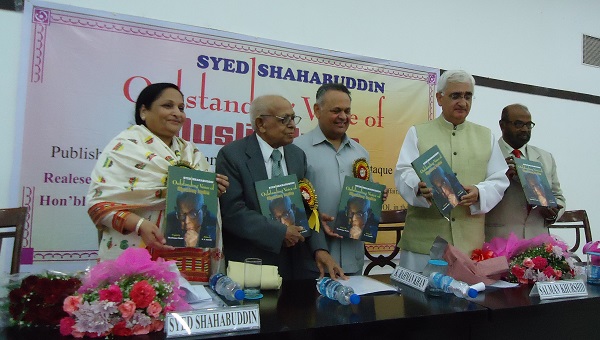
L-R: Abida Inamdar, Syed Shahabuddin, PA Inamdar, Salman Khurshid and Mushtaque Madni

New Delhi, April 22: The road outside the Constitution Club was almost deserted and silent due to Sunday, but the evening inside the hall was reverberating with applauds and clapping at regular interval. The ceremony was simple but studded with luminaries from different walks of life. Renowned educationist and edupreneur of Maharashtra Mr. PA Inamdar was launching a book Syed Shahabuddin – Outstanding Voice of Muslim India.

“He lit a light for the political discourses in the country. His contribution in the field of politics will be felt by the future generation,” said Mr. Salman Khurshid, External Affairs Minister. He was talking about 78-year-old former diplomat and parliamentarian Mr. Syed Shahabuddin.

“Some narrow minded people say he raised the issue of Babri Masjid and Personal Law for petty politics. This is wrong. The fact is we could not take full benefit of him as much we should have,” Mr. Khurshid said.

Turning to Mr. Shahabuddin who was sitting on the dais, Mr. Khurshid said: “You speak strongly and clearly.

If someone who does not know you were a diplomat he would never know it from your personality. You have ruled over the hearts of men and women. We got in you a leader, an icon, a role model.”

Earlier in his opening remark, publisher of the volume and himself a stalwart in the field of education, Mr. PA Inamdar said he was repaying a debt – publishing a book on his life was one way to appreciate the works and life of Mr. Shahabuddin.

DSC00198

“I set up a B.Ed. college in 1992 without prior permission of the Maharashtra government, using the benefit of Article 29 and 30. But it was objected by the government and matter taken to the court. In those days, we got huge support from the writings of Syed Shahabuddin sahib highlighting the constitutional guarantees and judgments of courts in his Muslim India magazine. This presentation is part of my gratitude. Today my Azam Campus in Pune has 29 institutions with 25000 students. I wanted to repay that debt,” said PA Inamdar, president of Maharashtra Cosmopolitan Education Society, Pune.

“Publishing a book on the life of iconic personalities like Syed Shahabuddin is one way to appreciate his works and tireless struggle,” said Mr. Inamdar.

“His stand, however debatable it may have been, had the stamp of complete honesty and total dedication for social, educational and economic upliftment of Muslim community. He became controversial because he was public figure fully armed with the constitutional equipments to challenge his adversaries,” said Mr. Inamdar.
Speaking on the occasion, Mr. Syed Shahabuddin recalled his diplomatic and political days.

“It is said diplomats tell lies and politicians mint money. But in 20 years of diplomatic career, I never told a lie. And despite three terms in Parliament (one in Lok Sabha and two terms in Rajya Sabha), I remained a darwesh. When I was resigning in the 1970s Atal Bihari Vajpayee was External Affairs Minister. He called me thrice and asked me not to resign,” said Mr. Shahabuddin.

Talking about the controversy when he brought up Muslim India, Mr. Shahabuddin said: “When I started Muslim India in 1982 some people said I wanted to become a second Jinnah. I said if ever I would like I would like to become second Nehru, not second Jinnah.”

Syed Shahabuddin

In his presidential address Mr. K Rahman Khan, Minority Affairs Minister said: “Syed Shahabuddin sahib is an anjuman, he is an institution. He is fearless, frank and honest. His magazine Muslim India has vast materials for future historians.”

“He struggled for Muslims to get a place in India. He left a mark in every field he worked – whether it is diplomacy, politics, journalism or social activism,” said Mr. Khan adding that he is indeed outstanding voice of Muslims in India.

The 112-page volume Syed Shahabuddin – Outstanding Voice of Muslim India has 24 articles on Syed Shahabuddin’s life and personality, ideas and thoughts written by renowned personalities including M. Hamid Ansari, Vice President of India, Justice AM Ahmadi, former chief justice of India, Justice Rajindar Sachar, former chief justice of Delhi High Court, Justice Aftab Alam, Judge, Supreme Court of India, Dr. Subramanian Swamy, politician and legalist, Prof. Muchkund Dubey (IFS), Salman Haider, former diplomat, Asghar Ali Engineer, writer and author, Kaleem Kawaja, eminent Indian American personality based in Washington.

In his foreword, Vice President Hamid Ansari says: “A passionate espousal of causes he believed in, regardless of consequences, distinguishes Syed Shahabuddin from most of his contemporaries. As a result, he is as much understood as misunderstood.”

Mr. Ansari further says that Syed Shahabuddin is “A patriot to the core of his being, wedded in letter and spirit to the Constitution of India, motivated by the belief that selective justice leads to injustice, and propelled by an urge to rectify it meaningfully led him in his public life to seek avenues for furthering his quest.”

Mr. PA Inamdar has earlier published similar volumes on other stalwarts of the Muslim community including Dr. Mumtaz Ahmed Khan and Saiyid Hamid

Sunday, April 21, 2013

FBI's failure brings entire US nation into grief - Comments by Ghulam Muhammed on NYT article : Bombing Inquiry Turns to Motive and Russian Trip

My comments posted on New York Times article on Boston Bombings:

  1. If FBI has done its job properly, the contrived stigma over the entire Muslim world could have been avoided and those few terrorists, could be managed in isolation, rendering them ineffective in their criminal plans. America and its media could have avoided the avalanche of propaganda that usually follows such terrorist attacks, stereo-typing and demonizing Muslims and Islam. The aftermath of overreaction to 9/11 and two bloody wars that costs hundreds and thousands of lives on both sides, without solving the essential problem of de-fanging small groups that are the real criminals. Bush/Cheney and their American Jewish Noe-con adviser would appear to be not interested in controlling and managing 'terrorists' but had agenda that was not in the wider interest of the majority of the people of the USA. Obama has rightly remained cautious and working on the problem, without bring the entire nation in the front-line of fighting the world in the name of terrorism.
--- --- ---
http://www.nytimes.com/2013/04/21/us/boston-marathon-bombings.html?nl=todaysheadlines&emc=edit_th_20130421&_r=0&pagewanted=all

The New York TimesThe Global Edition of The New York Times

Bombing Inquiry Turns to Motive and Russian Trip

Eric Thayer for The New York Times
A visitor to a memorial near the Boston Marathon bombings site on Saturday, a day after the younger suspect was captured.
By , and
Published: April 20, 2013 359 Comments
WASHINGTON — With one suspect dead and the other captured and lying grievously wounded in a hospital, the investigation into the Boston Marathon bombings turned on Saturday to questions about the men’s motives, and to the significance of an overseas trip one of them took last year.
Multimedia
Gretchen Ertl for The New York Times
A news conference in Boston on Thursday during which images of the two bombing suspects were released to the public.
Matt Rourke/Associated Press
Investigators worked near the location where a suspect in the marathon bombings was arrested.

Readers’ Comments


Federal investigators are hurrying to review a visit that one of the suspected bombers made to Chechnya and Dagestan, predominantly Muslim republics in the north Caucasus region of Russia. Both have active militant separatist movements. Members of Congress expressed concern about the F.B.I.’s handling of a request from Russia before the trip to examine the man’s possible links to extremist groups in the region.
Tamerlan Tsarnaev, who died early Friday after a shootout with the police in Watertown, Mass., spent six months in Dagestan in 2012, and analysts said that sojourn might have marked a crucial step in his alleged path toward the bombings.
Kevin R. Brock, a former senior F.B.I. and counterterrorism official, said, “It’s a key thread for investigators and the intelligence community to pull on.”
The investigators began scrutinizing the events in the months and years before the fatal attack, as Boston began to feel like itself for the first time in nearly a week.
On Monday, the twin bombings near the finish line of the Boston Marathon killed three people and wounded more than 170. The tense days that followed culminated in Friday’s lockdown of the entire region as the police searched for Mr. Tsarnaev’s younger brother from suburban backyards to an Amtrak train bound for New York City.
Dzhokhar Tsarnaev, 19, was taken into custody Friday night after he was found, bloody and weakened, hiding on a boat in a driveway in Watertown. He was still too wounded to speak on Saturday, said Gov. Deval Patrick of Massachusetts. Special counterterrorism agents trained in interrogating high-value detainees were waiting to question him, according to a law enforcement official. An issue arose about the administration’s decision to question him for a period without giving him a Miranda warning, under an exception for questions about immediate threats to public safety.
The brothers’ motives are still unclear. Of Chechen heritage, they had lived in the United States for years, according to friends and relatives, and no direct ties have been publicly established with known Chechen terrorist or separatist groups. While Dzhokhar became a naturalized American citizen last year, Tamerlan was still seeking citizenship. Their father, Anzor, said Tamerlan had made last year’s trip to renew his Russian passport.
The significance of the trip was magnified late Friday when the F.B.I. disclosed in a statement that in 2011 “a foreign government” — now acknowledged by officials to be Russia — asked for information about Tamerlan. The request was “based on information that he was a follower of radical Islam and a strong believer, and that he had changed drastically since 2010 as he prepared to leave the United States for travel to the country’s region to join unspecified underground groups.”
The senior law enforcement official said the Russians feared he could be a risk, and “they had something on him and were concerned about him, and him traveling to their region.” Chechen extremists pose a greater threat to Russia than they do to the United States, counterterrorism specialists say, though some of the groups have had ties to Al Qaeda.
But the F.B.I. never followed up on Tamerlan once he returned, a senior law enforcement official acknowledged on Saturday, adding that its investigation did not turn up anything and it did not have the legal authority to keep tabs on him. Investigators are now scrambling to review that trip, and learn about any extremists who might have influenced, trained or directed Tamerlan while he was there.
President Obama and Republican lawmakers devoted their weekly broadcast addresses to the Boston attack, with both sides finding a common voice. Mr. Obama also met with his national security team for an update on the investigation.
“Americans refuse to be terrorized,” Mr. Obama said. “Ultimately, that’s what we’ll remember from this week.”
Since 1994, Russia and the United States have routinely exchanged requests for background information on residents traveling between the two countries on visa, criminal or terrorism issues.
The F.B.I. responded to the request in 2011 by checking “U.S. government databases and other information to look for such things as derogatory telephone communications, possible use of online sites associated with the promotion of radical activity, associations with other persons of interest, travel history and plans, and education history,” it said in a statement.
In January 2011, two counterterrorism agents from the bureau’s Boston field office interviewed Tamerlan and family members, a senior law enforcement official said on Saturday. According to the F.B.I.’s statement, “The F.B.I. did not find any terrorism activity, domestic or foreign,” and conveyed those findings to “the foreign government” by the summer of 2011.
Federal officials said on Saturday that the Department of Homeland Security, however, had decided not to grant a petition from Tamerlan for United States citizenship after officials found a record in his files that he had been interviewed by the F.B.I. His petition was held for further review.
As the law enforcement official put it, “We didn’t find anything on him that was derogatory.”
The Russian state news agency RIA Novosti quoted the father of the Tsarnaev brothers recalling the F.B.I.’s close questioning of his elder son, “two or three times.” He said they had told his son that the questioning “is prophylactic, so that no one sets off bombs on the streets of Boston.”
In an interview in Russia, Zubeidat Tsarnaeva, the mother of the two men, said that the agents had told her that Tamerlan was “an excellent boy,” but “at the same time, they told me he is getting information from really extremist sites, and they are afraid of him.”
After Tamerlan’s visit to Dagestan and Chechnya, signs of alienation emerged. One month after he returned to the United States, a YouTube page that appeared to belong to him was created and featured multiple jihadist videos that he had endorsed in the past six months. One video featured the preaching of Abdul al-Hamid al-Juhani, an important ideologue in Chechnya; another focused on Feiz Mohammad, an extremist Salafi Lebanese preacher based in Australia. He also created a playlist of songs by a Russian musical artist, Timur Mucuraev, one of which promoted jihad, according to the SITE Intelligence Group, which monitors statements by jihadists.
The Boston bombings have led to increased cooperation between Washington and Moscow, a jarring shift coming amid weeks of rancor over American criticism of Russia’s human rights record. Presidents Obama and Vladimir V. Putin spoke by telephone late Friday night, in a conversation initiated by the Russian side, the Kremlin announced. The Kremlin’s statement said both leaders expressed “the building of close coordination between Russian and American intelligence services in the battle with global terrorism.”
Nevertheless, there were glaring questions about the case, among them how Tamerlan had escaped scrutiny.
A Russian intelligence official told the Interfax news service on Saturday that Russia had not been able to provide the United States with “operatively significant” information about the Tsarnaev brothers, “because the Tsarnaev brothers had not been living in Russia.”
Andrei Soldatov, an investigative journalist who specializes in Russia’s security services, said he believed that Tamerlan might have attracted the attention of Russian intelligence because of the video clips he had posted under his own name, some of which were included on a list of banned materials by the Federal Security Service, or F.S.B.
On Saturday morning, federal prosecutors were drafting a criminal complaint against Dzhokhar Tsarnaev, who was wounded in the leg and neck.
An official said the criminal complaint would most likely include a constellation of charges stemming from both the bombings and the shooting, possibly including the use of weapons of mass destruction, an applicable charge for the detonation of a bomb. That charge, the official said, carries a maximum penalty of death. Though Massachusetts has outlawed the death penalty, federal law allows it.
The F.B.I. and local law enforcement agencies continued on Saturday to gather evidence recovered from the suspects’ home and the cars they used. Investigators found five pipe bombs and three grenades after the firefight Friday, and they were seeking to identify the origins of the explosives.
Agents fanned out to interview family members and others who knew the brothers to determine any motive, as well as clues about what or who radicalized them. Three Kazakh citizens who were acquainted with Dzhokhar Tsarnaev contacted the Kazakh Embassy in Washington, reporting that they had been questioned by the F.B.I. and asking for consular assistance, said Ilyas T. Omarov, a spokesman for the Foreign Ministry of Kazakhstan, a former Soviet republic. None of the three were held, he said.
Muslim leaders in many cities rushed to hold news conferences and preach sermons at mosques denouncing the bombing suspects, mourning the victims and praising the response of law enforcement and the community in Boston. They were eager to dissociate their faith from the Muslim suspects, and to head off a backlash against Muslims in the United States.
Anzor Tsarnaev and his younger son first came to the United States legally in April 2002 on 90-day tourist visas, federal law enforcement officials said. Once in this country, the father applied for political asylum, claiming he feared deadly persecution based on his ties to Chechnya. Dzhokhar, who was 8, applied for asylum under his father’s petition, the officials said.
Tamerlan Tsarnaev came to the United States later, and applied for American citizenship on Sept. 5 last year, federal law enforcement officials said.

Eric Schmitt and Michael S. Schmidt reported from Washington, and Ellen Barry from Moscow. Reporting was contributed by John Schwartz and Julia Preston from New York; Andrew Roth and David M. Herszenhorn from Makhachkala, Dagestan; Peter Baker from Washington; and C. J. Chivers from the United States.

Thursday, April 18, 2013

Exclusive: Headlines Today probe reveals Gujarat riots were not spontaneous and sudden - By Ashish Khetan - HEADLINES TODAY

INDIA TODAY

Ashish Khetan   |   Headlines Today  |   Gandhinagar, April 15, 2013 | UPDATED 09:49 IST

Exclusive: Headlines Today probe reveals Gujarat riots were not spontaneous and sudden


In the past 10 years, the Gujarat government and senior BJP leaders have often said that the riots that broke out in the state in February 2012 were an 'instantaneous reaction' to the carnage at Godhra. The chief minister himself in an interview on March 1, 2002 had said, "What we are witnessing in Gujarat at this time is a chain of action and reaction. We want that there neither be action nor reaction."

But now Headlines Today has uncovered the police control room messages and the state intelligence bureau reports which show that the police had received a constant stream of inputs from its field officers about VHP leaders making provocative speeches, about crowds being mobilised and warnings about the possibility of major riots breaking out. Despite the flurry of ground reports and advance warnings, no curfew was imposed in Ahmedabad till noon the next day. The BJP government supported the VHP called bandhs that, as events turned out, proved to be the pretext under which violent mobs were mobilized. VHP leaders were not warned or put under preventive detention.

But the most intriguing aspect of these messages is that while they have been produced before the court as annexures, they don't find any mention in the 541 page closure report filed by the SIT. No attempt has been made by the SIT to reconstruct the sequence of events as they unfolded immediately after the news of Sabarmati train incident broke. The SIT did not assess the adequacy or appropriateness of the state's response in a chronological fashion as the law and order collapsed in large parts of the state.


Perhaps, that's the reason that the facts that emerge from these messages are hard to reconcile with the conclusions drawn by the SIT.  

There were two centralised police control rooms in Ahmedabad in 2002 - Ahmedabad Police Control Room situated at Shahibaug in the heart of the city.  Naroda and Gulberg Society, where around 150 people were burnt to death on the 28th of February lay within a radius of 6 KMs from this Police Control Room 9Gulber was 2 to 3 kms from the control room while Naroda was roughly six kilometers).

The second one -- the State Police Control Room -- located at Police Bhawan in Gandhinagar.
The Ahmedabad Police Control Room received messages of the build up taking place in Ahmedabad City. The State Control Room got messages from different districts in the state.

In February 2012 the SIT submitted before an Ahmedabad court, in a sealed cover, only the Ahmedabad City PCR messages... a copy of these are now with Headlines Today. The State Control Room messages are still missing.

There was also a third control room...this was at the State Intelligence Bureau Headquarters situated inside Police Bhawan, Gandhinagar...the  same building where the State DGP's office is located. The SIB Control Room was also flooded with field intelligence reports filed by its intelligence units located across the State including Ahmedabad and Gandhinagar. These SIB reports too have been submitted before the Court by the SIT. A copy of these too is now in the possession of Headlines Today.

By the afternoon of February 27, the Gujarat home department was being bombarded with messages from cops on the ground about mobilisation of VHP and Bajrang Dal cadre.

Rightwing activists across the state were holding public meetings, making provocative speeches and inciting mobs. All this is documented in hundreds of wireless messages sent by policemen to the state intelligence bureau. But the State failed to take any effective steps to prevent the imminent massacres. Within a few hours after the Godhra tragedy, the three senior-most office bearers of Gujarat's VHP unit -Jaideep Patel, Dilep Trivedi and Kaushik Patel-- issued a statement declaring a state wide bandh and containing remarks that were designed to incite the mobs.

A field level officer faxed this statement to SIB headquarters at 20:38 hours on the 27 Feb 2002.

February 27, 2002
Time: 8:38 pm

State Intelligence Bureau Message No: Page No. 188 (Annexure III, File XVIII)

VHP general secreatary Dilip Trivedi & VHP joint secretaries Jaideep Patel & Kaushik Mehta issue a statement.
VHP declares Gujarat bandh to protest killing of kar sevaks.
Statement says Muslims pre-planned Godhra attack.
Innocent ladies were molested and compartments were set on fire and Ramsevaks were burnt alive.
Through out the day on 27th February the SIB control room received messages of provocative sloganeering and mobilisation by the VHP.

February 27, 2002
Time: Not Known

State Intelligence Bureau Message No: Page No. 345, Order No. 24 (Annexure III File XIX)
Sender: D.O, Ahmedabad
Recipient: Intelligence Office, Virangam (Ahmedabad)

75 VHP & Bajrang Dal members gathered at Virangam Town Chali & Golwada area.
Situation in the area very tense.
The PCR messages warned about the tension that was spreading from the moment sabarmati express (the same train that was attacked by Muslim mobs at Godhra and later after detaching the burnt bogies made its way to Ahmedabad) arrived at Ahmedabad station.

February 27, 2002
Time: 6:10 pm

State Intelligence Bureau Message: No. 531 Page No. 19 (Annexure III, File XVIII (D-160)

Sabarmati Express arrived at Ahmedabad station from Godhra at 4:30 pm.
Karsevaks armed with rods & sticks, shouting slogans 'khoon ka badla khoon'.
At 10:12 pm, Police Inspector of CID, Intelligence in Bhavnagar sent a fax to Inspector General, Gujarat State Intelligence Bureau in Gandhi Nagar saying that Sadhu Samaj president Gopal Nand and local VHP leaders exhorted crowds at Junagadh to retaliate. The message said that the VHP leaders delivered hate speeches and called on all Hindus to unite.


February 27, 2002
Time: 10:12 pm

State Intelligence Bureau Fax Message: 311/02 Page No.: D-1/ HA/Jaher Sabha/Junagadh
Sender: CID, Bhavnagar
Recipient: IG, Gujarat & Intelligence Bureau, Gandhi Nagar

Sadhu Samaj president Gopal Nand gave provocative speech at Junagadh Kadva Chowk between 7:30 pm-9 pm.
Gopal Nand questioned lack of response from Hindus even 12 hours after burning of train.
Gopal Nand questioned Muslim patriotism to India and incited mobs to attack them.
By the afternoon of the 27th, the riots had begun.

February 27, 2002
Time 17:45

State Intelligence Bureau Fax Message No 273 File XIX Annexure III
Sender: B M Mohit Anand Centre

Sabarmati Express reached Anand Railway Station at 1500 hrs
Karsevaks from the train stabbed 4 Muslims present at the station.
One victim named Abdul Rashid aged 65 years, resident of Anand, died.
Remaining were hospitalised at Anand government hospital.
Reports of violent attacks by karsevaks came from across the state. A VHP mob was reported as swelling at Vadagam village in Modasa that was to become another epicentre of violence. There were desperate SOS messages seeking reinforcements. Mobs were on rampage through the night, setting ablaze houses and vehicles.

February 27, 2002
Time: 11:59 pm

State Intelligence Bureau Fax Message: Com/HM/550/ Out No. 398
Sender: ACP, Gandhinagar Region
Recipient: IG, Gujarat & Intelligence Bureau, Gandhi Nagar

50 kar sevaks on special bus from Ahmedabad reached Modasa, Vadagam village at 6:30 pm.
500-strong mob received kar sevaks.
Karsevaks told mobs about attack on Sabarmati Express.
Crowds swelled to thousands by 9:30 pm.
Police presence insufficient to maintain order.
10 shops owned by Muslims & several vehicles set ablaze by mobs.
Despite these warnings there was no clampdown by the Gujarat government on the mobilisation being carried out by the VHP leadership and neither were VHP and Bajrang Dal members taken under preventive detention.
The Speical Investigation Team in its report accepted that the Modi government supported the bandh called by the VHP.
Page 134 of SIT closure report: "Shri Vijay Badheka, Under Secretary to Home Department has stated before the SIT that both Gujarat bandh on 28.02.02 and Bharat bandh on 01.03.02 were supported by the BJP."
The bandh allowed the VHP cadre a free run even as the SIB kept sending signals of impending riots and sought preventive action.

February 28, 2002
Time: 9am-10am

State Intelligence Bureau Message No: 73/02 Page 365 (Annexure III File XXI (D-166)
Sender: ACP (Intelligence) Surat

VHP, BJP leaders gave provocative speeches at Sardar Chowk, Vapi Town.
VHP's Dinesh Behri, Bajrang Dal's Acharya Brahmbatt, BJP's Jawahar Desai & RSS member Vinod Chowdhary present Speakers exhorted crowds to take revenge for Godhra.
When the Ahmedabad police commissioner P.C. Pande and State DGP K. Chakravarty were questioned by the SIT, they were not confronted with these specific SIB reports. P.C. Pande was not asked why curfew was not imposed in Ahmedabad city on the 27th afternoon itself, particularly in the face of such specific intelligence inputs.
Pande told SIT on page 7 of his statement recorded on 24.03.2010: "The circumstances did not exist on the 27.02.02 or even on 28.02.02 to warrant the imposition of curfew and any hasty decision would have led to panic in the city. Even otherwise with limited forces available imposition of curfew becomes a serious problem and large scale breach becomes common."
Pande and Chakravarty were also not asked why VHP and Bajrang Dal leaders were not put under preventive arrest even as they were threatening violence.
But the SIT has not explained what these specific measures were. General and vague claims made by Gujarat State Officials that all possible efforts were made to control the riots have been accepted by the SIT.
The State Intelligence Bureau repeatedly pressed the panic button, sending SOS' to the home department about the possibility of riots. Bodies of kar sevaks in public display and funeral processions by mobs…proved to be the trigger. But records show the VHP and its cadres succeeded in stoking mass hysteria.
30 minutes past midnight on the 28th of February 2002, the state intelligence bureau received a fax giving a specific warning about possibility of riots with bodies being brought to Ahmedabad. Then VHP state unit president Jaideep Patel was already on his way escorting the 54 bodies from Godhra to Ahmedabad.

February 28, 2002
Time: 12:30 am

State Intelligence Bureau Fax No. 525

Bodies will be brought to Kalupur Railway station, Ahmedabad.
Dead bodies will be carried in funeral processions VHP gave a bandh call.
High possibility of riots in Ahmedabad. Take preventive action.

February 28, 2002.
Time: Not Known

State Intelligence Bureau report to Home Secretary and all Police Commissioner, all SPs

VHP has given a call for "Gujarat Bandh".

Appropriate vigilance be exercised.

The motorcade carrying bodies finally reached Sola Civil Hospital in Ahmedabad at 3:34 AM. By then there was a already a mob made up of VHP and RSS members outside Sola Hospital.
The PCR Van positioned at Sola Civil Hospital sent a message to City Police Control Room situated at Shaibaug. The distance between Hospital and Control Room was 11 kilometres.

February 28, 2002
Time: 4:00 am
Page No. 5790 (Annexure IV, File XIV)

Mob of 3000 RSS members gathered at Sola Hospital.

February 28, 2002
Time: 7:14 am
PCR wireless message (Sola Hospital)
Page No. 5796 (Annexure IV, File XIV)

Mob assembled at Sola Hospital.
The crowds were getting restless. Soon violence sparked off.

February 28, 2002
Time: 7:17 am
PCR wireless message (Sola Hospital)
Page No. 5797 (Annexure IV, File XIV)

Mob of 500 people holding up traffic.
At 8:10 there is a message from the Control Room saying that 3 SRP Companies have been sent to Sola Hospital for extra bandobast.
  
February 28, 2002
Time: 11:55 am
PCR wireless message: Page No 5894(Annexure IV, File XIV)

Mob set vehicle on fire, arson on highway.

February 28, 2002
Time: 11.55 am
PCR message

State Intelligence Bureau: Page No.6162 (Annexure IV File XV)

Riots have started at Sola Hospital & near High Court where bodies were brought.
February 28, 2002
Time: Not known

PCR message (Sola Hospital)
State Intelligence Bureau: Page No.?6172
Sola Hospital staff surrounded by 500-strong mob Please provide security at hospital urgently.
These revelations show how mobs were allowed to congregate at the hospital to take out funeral processions. Though violence had erupted, curfew was still not clamped.
Pande claimed in his statement before the SIT that he visited the Hospital at 10 am and found everything to be normal.
"I went to Sola Civil Hosptal around 10:00 and found that doctors were under pressure to complete the documentation wheras relatives were in a hurry to take the bodies. However, I didn't find anything alarming and as such returned around 11:00 am."
Pande also claimed there were no funeral processions, a claim accepted by the SIT. But the PCR messages show that there were not only processions but also riots at the hospital, nailing Pande's lies.

February 28, 2002
Time: 11:58 am
PCR message (Sola Hospital)

State Intelligence Bureau: Page No. 5907 & 5925(Annexure IV File XIV)


Funeral procession of 10 bodies taken out from Ramol Jantanagar to Hatkeshwar crematorium 6,000 people accompanied procession.
As funeral processions wound through the city, mobs ran amok at Gulbarg Society, Naroda Patiya and Naroda Gaam in Ahmedabad.

February 28, 2002
Time: Not known
PCR message (Khedbrahma, Sabarkantha) Com/538

State Intelligence Bureau: Page No. 258 (Annexure III File XIX)

Funeral procession allowed at Khedbrahma town in Sabarkantha district
Situation tense, 2 Muslims stabbed at Khedbrahma

February 28, 2002
Time: Not known
PCR message (Khedbrahma, Sabarkantha)

State Intelligence Bureau: Page No. 262 (Annexure III File XIX)

150 Bajrang Dal members on way to Khedbrahma.

February 28, 2002
Time: 3:32 pm
PCR message (Khedbrahma, Sabarkantha)
State Intelligence Bureau: Page No. 254 (Annexure III file XIX) Com/574

Funeral procession organised for Godhra train victim Babubhai Patel in Sabarkantha.
Special Investigation Team in its closure report on pages 59 to 64 had concluded there were no funeral processions and gave a clean-chit to the Gujarat government on this count.


PCR messages detailing incidence of violence in Ahmedabad clearly warned about a brewing unrest. Rioting was reported from Naroda and Meghani Nagar where Gulberg Society is located. The PCR messages of violence in Ahmedabad are contained in Annexure IV File XIV. Here are some samples of the several wireless messages sent by policemen on the ground.

Page No. 5798, 5803, 5804
Date: February 28, 2002
Time: 12:30 am

PCR Message: Factory burnt at Ambikanagar on February 27
Area: Odhav
FIR No.80/02
Page No,: 5746
Date: February 28, 2002
Time: 1:10 am

PCR Message: Between 2:30-3:00 pm on Feb 27, mob stoned bus, vandalized shop
Area: Bapunagar
FIR No.: 64/02
Page No.: 5768

Date: February 28, 2002
Time: 2:38 am
PCR Message: Mob torched buses & rickshaws, damaged public property on Feb 27 at 5:15 pm
Area: Odhav
FIR No.:78/02
Page No.: 341, Order No. 534

Date: February 27, 2002
Time: 8:25pm
State Intelligence Bureau Message: Man succumbs to stab injuries on February 27 at 8:25 pm
Area: Meghani Nagar
FIR No.: 65/02
Page No.: 341, Order No. 534

Date: February 27, 2002
Time: Not Known
State Intelligence Bureau Message: Man succumbs to injuries on Feb 27 at 7:45 pm at Saralaben Hospital.
Area: Meghani Nagar
FIR No.: 65/02
Page No.: 347, Order No. 8535

Date: February 27, 2002
Time: 8:30 pm

State Intelligence Bureau Message: Man critically injured after attack at Ahmedabad railway station at 5 pm.
Area: Ahmedabad
FIR No: Not Known
Page No: 348, Order 541

Date: February 27, 2002
Time: 9:30pm
State Intelligence Bureau Message: Juhapura resident attacked at V.F Hospital.
Area: Ahmedabad
FIR No: 116
Page No.: 5807 & 5808

Date: February 28, 2002
Time: 4:28 am
PCR Message: One critically injured near Kathwada Road, Naroda, on February 27 at 7:30 pm.
Area: Naroda
FIR No.: 97/02
Page No.: 5805 & 5806

Date: February 28, 2002
Time: 4:20 am
State Intelligence Bureau Message: One critically injured near Law Garden on February 27 at 8:15 pm.
Area: Ellisbridge
FIR No: 116/02
Page No.: 5801
Date: February 28, 2002
Time: 3:50 am

State Intelligence Bureau Message: One critically injured in mob attack near Mahalaxmi Crossroad, Paldi on

Feb 27 at 8:30 pm.
Area: Ellisbridge
FIR No.: 114/02

Inspite of all of this, the then Ahmedabad Police Commissioner told the SIT that he didn't find the "circumstances on the 27th and 28th fit for curfew."
PCR and SIB reports show that there were regular inputs of VHP and Bajrang Dal led mobs swelling at Naroda and Gulberg Society.
Pande admitted before the SIT that at both these places curfew was declared only after 12:50 pm ...by then the mob had already swelled to between 10 and 15 thousand people in number. It is no wonder that the curfew that was finally imposed remained only on paper - it had no effect on the ground.
Hundred and fifty men, women and children were burnt and hacked to death at Naroda and Gulberg society in the four hours between 2 and 6 PM on February 28.
Police Headquarters at Shahibaug was only 2 to 3 kilometers from Gulberg Society and around 6 kilometers from Naroda Patiya.
Pande admitted before the SIT that through out the day he didn't move out of his office and visited Naroda Patiya and Gulberg only late in the evening...by that time the massacre was over and done with.   
SIB messages show that there were three alerts about the impending massacre at Gulberg.

Date: 28.02.02
Time: 12:15
Sender: Police Inspector CJ Bharwad To: State SIB Control Room


Muslims reside in Gulberg Society.
Mob is surrounding the place.

Strict watch should be kept there.
Date: 28.02.02
Time: 14:50
Sender: Police Inspector CJ Bharwad To: State SIB Control Room

Mob of 3000 rioters has surrounded Gulberg Society, take immediate action.

Date: 28.02.02
Time: 17:00
Sender: Police Inspector CJ Bharwad To: State SIB Control Room

Mob attacked the society from all sides Ehsan Jaffri and women and children burnt alive.
Houses are ablaze. Mob is looting from homes.

In his defence Pande said in his statement: "On 28.2.2002 requests were received from different police stations seeking additional force and SRP and whatever forces were available with me the same were dispatched. However, I found that no feedback had been received by any one of them. This led me to presumption that additional forces reached in time and they were able to control the situation."

SIT accepted Pande's defence and gave him and the Gujarat Administration a clean chit.

The state government told the SIT that the 2002 riots were a spontaneous reaction to the Godhra tragedy, but documentary evidence tells a different story.

Eleven years after the after the horrific incidents as Narendra Modi aspires for the prime minister's chair, Headlines Today has tried to throw fresh light on why his ascension remains so contentious


Read more at: http://indiatoday.intoday.in/story/gujarat-riots-2002-godhra-sudden-spontaneous-backlash-frantic-police-warnings-ignored/1/262413.html

Wednesday, April 17, 2013

Thatcher feared Islam By Kuldip Nayar

http://www.kuldipnayar.com/btl/thatcher_feared_islam.html

Thatcher feared Islam


By Kuldip Nayar

April 10, 2013
 
I met Mrs Margaret Thatcher for the first time when I was India’s envoy at London in 1990. At that time she was counting on her achievements, including the triumph in the cold war. I sent her a congratulatory message for having vanquished the communist ideology. But she said she had even bigger enemies to defeat and mentioned Islam. I have always wondered whether the stirrings in the Islamic world were the doing of Great Britain’s.

Around the same time, I knew that Prime Minister Thatcher too was losing her job because the men in “grey suits” had tapped on her shoulder and told her to quit. It was apparent that she had too many enemies in the party. Mrs Thatcher’s sense of self-righteousness and her penchant for the spotlight had made even her most eminent colleagues feel small and deficient. Many of them would have liked to have pulled her down earlier, but they were pygmies who could not measure up to her, colossus that she was.

Mrs Thatcher was required to poll 15 percent more than the majority for an outright win, but she lost the election by five votes. The goings-on behind the scene were as murky as in India. Never once did her party men tell her that she was fighting a losing battle. She did finally send her resignation after ascertaining the facts from intelligence sources. I had heard from her Conservative Party colleague, who later became a minister in Prime Minister John Major’s cabinet, that they wanted her to go in the interest of party unity. But it was her party men who betrayed her, as one minister confessed to me, for she made them what they were.

A ruthless stripping of subsidies, a dose of privatization and a head-on collision with the trade unions had succeeded in sloughing off many of the ills that had made Britain economically stagnant. But the price paid was high—unemployment and a divided nation. I wish Mrs Thatcher had retired after coming back with a majority of over 150 seats in the 1987 election. That was her third consecutive victory.

In 1990, she seemed like a person who had stayed too long in power, just as Jawaharlal Nehru did in 1962, after India’s debacle at the hands of China. She should have taken the opinion polls seriously as the Conservatives had lagged behind by a greater margin than any political party ever had in the past. Nobody backs a losing leader, whatever his or her contribution at one. How can one forget that Winston Churchill was thrown out despite his victory in the Second World War?

My first political report was on the defeat of the Conservatives in a by-election in mid-Staffordshire within days of my arrival. I had a feeling this might turn into a similar situation as the Allahabad by-election after which the caravan of V.P. Singh started rolling till Rajiv Gandhi’s Congress (I) government fell in 1989. However I wished that the rule of Conservatives did not end during my tenure as High Commissioner, Mrs Thatcher lost her prime ministership just before I left London.

 I must, however, admit she was fairly warm in dealing with me when I first met her. The Iron Lady had forgotten what I had written about her. What I noticed during my stay in London and surprised about was that the diplomatic corps openly discussing the challenge that Mrs Thatcher posed to the Queen’s position, considered not only improper but also sacrilegious. There was no love lost between the two. Mrs Thatcher was blamed for it as it was common knowledge that she did not appreciate rivals to her popularity, not even the Queen.

I recall a story told and retold is about a party where the Queen and Mrs Thatcher wore identical dresses. After that, Mrs Thatcher’s private secretary wrote to the Palace asking to be informed beforehand what the Queen would wear at a particular official function so that Mrs Thatcher could avoid being similarly dressed. The Queen’s reply was that she never bothered to even look at what Mrs Thatcher wore!

During President R. Venkatraman’s visit to the UK, I had another chance to interact with Mrs Thatcher more closely when I sat next to her chair and discussed on different subjects for two hours. She told me that she had refused to visit a gurdwara despite many invitations. “Those people killed Mrs Gandhi,” she said, adding, “What kind of people must they be!” Mrs Thatcher compared the violence in Punjab with the Irish Republican Army’s terrorism. “Of course, yours is on a bigger scale,” she remarked. But she was reticent on Kashmir, though she did say that nothing should be done at the expense of India’s unity and integrity.

I remarked that ethical standards were disappearing from politics and that our own experience in India was that politicians enjoyed hitting each other below the belt. Mrs Thatcher said that in Britain it was worse. They would ‘kick you’ and even when you had fallen, they would not stop hitting you. She fondly recalled her intimate relationship with Mrs Gandhi. “Even when we differed, our personal equation did not suffer,” she said.

As our conversation progressed, I also happened to see the softer part of the Iron Lady and felt how vulnerable she had become. She began talking about various issues before shifting to her personal problems, pouring her heart out to a person who had met her only a few times before. Her son, she recalled, had to move to America because of the “wild charges” (of using her position to get favours from the government) made against him. She said she missed her grandchildren but she considered it a price she had to pay to be in politics. She would often admit that she was not a consensus politician, but a “committed politician.” She, indeed, was but nevertheless the one who made Britain click. EOM

Monday, March 25, 2013

How General Zia Went Down! By Edward Jay Epstein - VANITY FAIR

How General Zia Went Down! By Edward Jay Epstein - VANITY FAIR


This article, published in June 1989, is about the air crash in 1988 which killed Gen Zia, the U.S. envoy and a number of senior officers. Since then, quite a number of publications came in the market, but this report seems to be the most authentic and incisive. The investigation is thorough and analysis is methodical.


This article about the crash is like Agatha Christie's thriller Murder on the Orient Express, in which everyone aboard the train had a motive for murder. The suspects here are, Americans, Indians, Russians, Afghans and even ''Pakistan Army.''


Please ignore the poor quality of paper as time takes its toll on papers also, human beings no exception.


Please read the thrilling story.

-- Inline image 1
Inline image 2
Inline image 3
Inline image 4
Inline image 5
Inline image 6
Inline image 7
Inline image 8

Saturday, March 23, 2013

The Last Letter: A Message to George W. Bush and Dick Cheney from a Dying Veteran

http://www.democracynow.org/blog/2013/3/21/exclusive_tomas_young_reads_in_full_his_letter_to_bush_cheney_a_message_from_a_dying_veteran


DEMOCRACY NOW

March 21, 2013 

Exclusive: Tomas Young Reads in Full His  

Letter to Bush & Cheney, "A Message From a Dying Veteran"


Paralyzed in a 2004 attack in Sadr City, Iraq War veteran Tomas Young recently announced that he will stop his medicine and nourishment, which comes in the form of liquid through a feeding tube — a decision which will hasten his death. Joining us from his home in Kansas City, Young reads in full his letter, A Message to George W. Bush and Dick Cheney From a Dying Veteran. "My day of reckoning is upon me," Young says. "Yours will come. I hope you will be put on trial. But mostly I hope, for your sakes, that you find the moral courage to face what you have done to me and to many, many others who deserved to live. I hope that before your time on earth ends, as mine is now ending, you will find the strength of character to stand before the American public and the world, and in particular the Iraqi people, and beg for forgiveness."

WATCH: Exclusive: Dying Iraq War Veteran Tomas Young Explains Decision to End His Life
WATCH: Phil Donahue on His 2003 Firing from MSNBC, When Liberal Network Couldn’t Tolerate Antiwar Voices
WATCH: Dying Iraq War Veteran Tomas Young on Bush, Missing WMDs, Failed Medical Care

AMY GOODMAN: Ten years later, 10th anniversary of the war in Iraq, Tomas Young, Iraq War veteran, wounded April 4th, 2004, his fifth day in Iraq, shot in Sadr City, is now writing a letter on this 10th anniversary called "The Last Letter: A Message to George W. Bush and Dick Cheney from a Dying Veteran." Tomas, can you read some of your letter to the former president and vice president?
TOMAS YOUNG: Absolutely.

"The Last Letter: A Message to George W. Bush and Dick Cheney from a Dying Veteran."

“I write this letter on the 10th anniversary of the Iraq War on behalf of my fellow Iraq veterans. I write this letter on behalf of the 4,488 soldiers and Marines who died in Iraq. I write this letter on behalf of the hundreds of thousands of veterans who have been wounded and on behalf of [those who bear those wounds. I am one of those.] I am one of the gravely injured. I [am] paralyzed in an insurgent ambush in 2004 in Sadr City. My life is coming to an end. I am living under hospice care.

“I write this letter on behalf of husbands and wives who have lost spouses, on behalf of children who have lost parents, on behalf of the fathers and mothers who have lost sons and daughters and on behalf of those who care for the many thousands of my fellow veterans who have brain injuries. I write this letter on behalf of those veterans whose trauma and self-revulsion for what they have [done, witnessed, endured] in Iraq have led to suicide and on behalf of the active-duty soldiers and Marines who commit, on average, a suicide a day. I write this letter on behalf of the some 1 million Iraqi dead and on behalf of the countless Iraqi wounded. I write this letter on behalf of us all—the human detritus your war has left behind, those who will spend their lives in unending pain and grief.

“Your positions of authority, your millions of dollars of personal wealth, your public relations consultants, [and your privilege and power] cannot mask the hollowness of your character. You sent us to fight and die in Iraq after you, Mr. Cheney, dodged the draft in Vietnam, and you, Mr. Bush, went AWOL from your National Guard unit. Your cowardice and selfishness were established decades ago. You were not willing to risk yourselves for our nation but you sent hundreds of thousands of young men and women to be sacrificed in a senseless war with no more thought than it takes to put out the garbage.

“I write this letter, my last letter, to you, Mr. Bush and Mr. Cheney. I write not because I think you grasp the terrible human and moral consequences of your lies, manipulation and thirst for wealth and power. I write this letter because, before my own death, I want to make it clear that I, and hundreds of thousands of my fellow veterans, along with millions of my fellow citizens, along with hundreds of millions more in Iraq and the Middle East, know fully who you are and what you have done. You may evade justice but in our eyes you are each guilty of egregious war crimes, of plunder and, finally, of murder, including the murder of thousands of young Americans—my fellow veterans—whose future you stole.

“I joined the Army two days after the 9/11 attacks. I joined the Army because our country had been attacked. I wanted to strike back at those who had killed some 3,000 of my fellow citizens. I did not join the Army to go to Iraq, a country that had no part in the [9/11] attacks and did not pose a threat to its neighbors, much less to the [U.S.] I did not join the Army to 'liberate' Iraqis or to shut down mythical weapons-of-mass-destruction facilities or to implant what you cynically called 'democracy' in Baghdad and the Middle East. I did not join the Army to rebuild Iraq, which at the time you told us could be paid for by Iraq’s oil revenues. Instead, this war has cost the United States over $3 trillion. I especially did not join the [Army] to carry out pre-emptive war. Pre-emptive war is illegal under international law. And as a soldier in Iraq I was, I now know, abetting your idiocy and your crimes. The Iraq War is the biggest strategic blunder in U.S. history. It obliterated the balance of power in the Middle East. It installed a corrupt and brutal pro-Iranian government in Baghdad, one cemented in power through the use of torture, death squads and terror. And it has left Iran as the dominant force in the region. On every level—moral, strategic, military and economic—Iraq was a failure. And it was you, Mr. Bush and Mr. Cheney, who started this war. It is you who should pay the consequences.

“I have, like many other [wounded and many other] disabled veterans, suffered from the inadequate and often inept care provided by the Veterans Administration. I have, like many other disabled veterans, come to realize that our mental and physical [disabilities and] wounds are of no interest to you, perhaps of no interest to any politician. We were used. We were betrayed. And we have been abandoned. You, Mr. Bush, make much pretense of being a Christian. But isn’t lying a sin? Isn’t murder a sin? Aren’t theft and selfish ambition sins? I am not a Christian. But I believe in the Christian ideal. I believe that what you do to the least of your [own] brothers you finally do to yourself, to your own soul.
“I would not be writing this letter if I had been wounded in Afghanistan against those forces that carried out the attacks of 9/11. Had I been wounded there I would still be miserable because of my physical deterioration and imminent death, but I would at least have the comfort of knowing that my injuries were a consequence of my own decision to defend our country I love—the country I love. I would not have to lie in my bed, my body filled with painkillers, my life ebbing away, and deal with the fact that hundreds of thousands of human beings, including children, including myself, were sacrificed by you for little more than the greed of oil companies, for your alliance with the oil sheiks in Saudi Arabia, and your insane visions of empire.

"My day of reckoning is upon me. Yours will come. I hope you will be put on trial. But mostly I hope, for your sakes, that you find the moral courage to face what you have done to me and to many, many others who deserved to live. I hope that before your time on earth ends, as mine is now ending, you will find the strength of character to stand before the American public and the world, and in particular the Iraqi people, and beg for forgiveness."
 
 
GUEST
Tomas Young, Iraq War veteran and the main subject of the documentary, Body of War. On April 4, 2004, his fifth day in Iraq, Young’s unit came under fire in the Sadr City neighborhood of Baghdad. Young was left paralyzed, never to walk again. Released from medical care three months later, Young returned home to become an active member in Iraq Veterans Against the War. He recently announced that he will stop his nourishment, which comes in the form of liquid through a feeding tube — a decision which will hasten his death.