Monday, September 25, 2017

America's Jews Are Driving America's Wars -By Philip Giraldi - www.unz.com

http://www.unz.com/pgiraldi/americas-jews-are-driving-americas-wars/

The Unz Review: An Alternative Media Selection

America's Jews Are Driving America's Wars

Shouldn't they recuse themselves when dealing with the Middle East?
Kristol
UPDATE: On the morning of September 21st Phil Giraldi was fired over the phone by The American Conservative, where he had been a regular contributor for fourteen years. He was told that “America’s Jews Are Driving America’s Wars” was unacceptable. The TAC management and board appear to have forgotten that the magazine was launched with an article by founder Pat Buchanan entitled “Whose War?” which largely made the same claims that Giraldi made about the Jewish push for another war, in that case with Iraq. Buchanan was vilified and denounced as an anti-Semite by many of the same people who are now similarly attacking Giraldi.
I spoke recently at a conference on America’s war party where afterwards an elderly gentleman came up to me and asked, “Why doesn’t anyone ever speak honestly about the six-hundred-pound gorilla in the room? Nobody has mentioned Israel in this conference and we all know it’s American Jews with all their money and power who are supporting every war in the Middle East for Netanyahu? Shouldn’t we start calling them out and not letting them get away with it?”
It was a question combined with a comment that I have heard many times before and my answer is always the same: any organization that aspires to be heard on foreign policy knows that to touch the live wire of Israel and American Jews guarantees a quick trip to obscurity. Jewish groups and deep pocket individual donors not only control the politicians, they own and run the media and entertainment industries, meaning that no one will hear about or from the offending party ever again. They are particularly sensitive on the issue of so-called “dual loyalty,” particularly as the expression itself is a bit of a sham since it is pretty clear that some of them only have real loyalty to Israel.
Most recently, some pundits, including myself, have been warning of an impending war with Iran. To be sure, the urging to strike Iran comes from many quarters, to include generals in the Administration who always think first in terms of settling problems through force, from a Saudi government obsessed with fear over Iranian hegemony, and, of course, from Israel itself. But what makes the war engine run is provided by American Jews who have taken upon themselves the onerous task of starting a war with a country that does not conceivably threaten the United States. They have been very successful at faking the Iranian threat, so much so that nearly all Republican and most Democratic congressmen as well as much of the media seem to be convinced that Iran needs to be dealt with firmly, most definitely by using the U.S. military, and the sooner the better.
And while they are doing it, the issue that nearly all the Iran haters are Jewish has somehow fallen out of sight, as if it does not matter. But it should matter. A recent article in the New Yorker on stopping the impending war with Iran strangely suggests that the current generation “Iran hawks” might be a force of moderation regarding policy options given the lessons learned from Iraq. The article cites as hardliners on Iran David Frum, Max Boot, Bill Kristol and Bret Stephens.
Daniel Larison over at The American Conservative has a good review of the New Yorker piece entitled “Yes, Iran Hawks Want Conflict with Iran,” which identifies the four above cited hawks by name before describing them as “…a Who’s Who of consistently lousy foreign policy thinking. If they have been right about any major foreign policy issue in the last twenty years, it would be news to the entire world. Every single one of them hates the nuclear deal with Iran with a passion, and they have argued in favor of military action against Iran at one point or another. There is zero evidence that any of them would oppose attacking Iran.”
And I would add a few more names, Mark Dubowitz, Michael Ledeen and Reuel Marc Gerecht of the Foundation for Defense of Democracies; Daniel Pipes of the Middle East Forum; John Podhoretz of Commentary magazine; Elliot Abrams of the Council on Foreign Relations; Meyrav Wurmser of the Middle East Media Research Institute; Kimberly Kagan of the Institute for the Study of War; and Frederick Kagan, Danielle Pletka and David Wurmser of the American Enterprise Institute. And you can also throw into the hopper entire organizations like The American Israel Public Affairs Committee (AIPAC), the Washington Institute for Near East Policy (WINEP) and the Hudson Institute. And yep, they’re all Jewish, plus most of them would self-describe as neo-conservatives. And I might add that only one of the named individuals has ever served in any branch of the American military – David Wurmser was once in the Navy reserve. These individuals largely constitute a cabal of sanctimonious chairborne warriors who prefer to do the heavy thinking while they let others do the fighting and dying.
So it is safe to say that much of the agitation to do something about Iran comes from Israel and from American Jews. Indeed, I would opine that most of the fury from Congress re Iran comes from the same source, with AIPAC showering our Solons on the Potomac with “fact sheets” explaining how Iran is worthy of annihilation because it has pledged to “destroy Israel,” which is both a lie and an impossibility as Tehran does not have the resources to carry out such a task. The AIPAC lies are then picked up and replayed by an obliging media, where nearly every “expert” who speaks about the Middle East on television and radio or who is interviewed for newspaper stories is Jewish.
One might also add that neocons as a group were founded by Jews and are largely Jewish, hence their universal attachment to the state of Israel. They first rose into prominence when they obtained a number of national security positions during the Reagan Administration and their ascendancy was completed when they staffed senior positions in the Pentagon and White House under George W. Bush. Recall for a moment Paul Wolfowitz, Doug Feith, and Scooter Libby. Yes, all Jewish and all conduits for the false information that led to a war that has spread and effectively destroyed much of the Middle East. Except for Israel, of course. Philip Zelikow, also Jewish, in a moment of candor, admitted that the Iraq War, in his opinion, was fought for Israel.
Add to the folly a Jewish U.S. Ambassador to Israel who identifies with the most right-wing Israeli settler elements, a White House appointed chief negotiator who is Jewish and a Jewish son-in-law who is also involved in formulating Middle East policy. Is anyone providing an alternative viewpoint to eternal and uncritical support for Benjamin Netanyahu and his kleptocratic regime of racist thugs? I think not.
There are a couple of simple fixes for the dominant involvement of American Jews in foreign policy issues where they have a personal interest due to their ethnicity or family ties. First of all, don’t put them into national security positions involving the Middle East, where they will potentially be conflicted. Let them worry instead about North Korea, which does not have a Jewish minority and which was not involved in the holocaust. This type of solution was, in fact, somewhat of a policy regarding the U.S. Ambassador position in Israel. No Jew was appointed to avoid any conflict of interest prior to 1995, an understanding that was violated by Bill Clinton (wouldn’t you know it!) who named Martin Indyk to the post. Indyk was not even an American citizen at the time and had to be naturalized quickly prior to being approved by congress.
Those American Jews who are strongly attached to Israel and somehow find themselves in senior policy making positions involving the Middle East and who actually possess any integrity on the issue should recuse themselves, just as any judge would do if he were presiding over a case in which he had a personal interest. Any American should be free to exercise first amendment rights to debate possible options regarding policy, up to and including embracing positions that damage the United States and benefit a foreign nation. But if he or she is in a position to actually create those policies, he or she should butt out and leave the policy generation to those who have no personal baggage.
For those American Jews who lack any shred of integrity, the media should be required to label them at the bottom of the television screen whenever they pop up, e.g. Bill Kristol is “Jewish and an outspoken supporter of the state of Israel.” That would be kind-of-like a warning label on a bottle of rat poison – translating roughly as “ingest even the tiniest little dosage of the nonsense spewed by Bill Kristol at your own peril.”
As none of the above is likely to happen, the only alternative is for American citizens who are tired of having their country’s national security interests hijacked by a group that is in thrall to a foreign government to become more assertive about what is happening. Shine a little light into the darkness and recognize who is being diddled and by whom. Call it like it is. And if someone’s feelings are hurt, too bad. We don’t need a war with Iran because Israel wants one and some rich and powerful American Jews are happy to deliver. Seriously, we don’t need it.
--
  1. chris says:
    Wow, Phil, you hit another one right out of the ball park!
  2. Anonymous says: • Disclaimer
    Trump will exterminate the Iranians.
  3. Monty Ahwazi says:
    Well said Mr Giraldi! Unfortunately the Jewish Mafia in this country won’t allow truth to be said and will do anything to keep us in the dark!
  4. Bubba says:
    Amen brother! And I would like to throw some gasoline on your Neocon fire. President Trump has never worked with military generals before and he is extremely naive to their absolute Machiavellian manipulation of him. Most generals today are expert political backstabbers who advanced during the tragic Neocon and PC era of the past 30 years. Who can forget the disgusting General Casey when he said, “And what happened at Fort Hood was a tragedy, but I believe it would be an even greater tragedy if our diversity becomes a casualty here.” The generals that Trump hired for his administration are now running circles around him, particularly McMaster. They want war to keep the Neocons happy and that is what this crop of generals has been trained to do.
...

[Message clipped]  View entire message

Friday, September 8, 2017

Germany Heading for Four More Years of Pro-EU, Open-Door Migration Policies

Germany Heading for Four More Years of Pro-EU, Open-Door Migration Policies


Germany Heading for
Four More Years of Pro-EU, Open-Door Migration Policies


by 


September 8,
2017 at 5:00 am

..


§  The policy positions of Merkel and Schulz on key issues
are virtually identical: Both candidates are committed to strengthening the
European Union, maintaining open-door immigration policies, pursuing
multiculturalism and quashing dissent from the so-called far right.

§  Merkel and Schulz both agree that there should be no
upper limit on the number of migrants entering Germany.

§  Merkel's grand coalition backed a law that would
penalize social media giants, including Facebook, Google and Twitter, with
fines of €50 million ($60 million) if they fail to remove offending content
from their platforms within 24 hours. Observers say the law is aimed at
silencing critics of Merkel's open-door migration policy.
§   
German Chancellor Angela Merkel, leader of the Christian
Democratic Union (CDU), is on track win a fourth term in office after polls
confirmed she won the first and only televised debate with her main election
opponent, Martin Schulz, leader of the Social Democratic Union Party (SDP).

A survey for the public broadcaster ARD showed that 55% of
viewers thought Merkel was the "more convincing" candidate during the
debate, which took place on September 3; only 35% said Schulz came out ahead.

Many observers agreed that Schulz failed to leverage the debate to
revive his flagging campaign, while others noted that Schulz's positions on
many issues are virtually indistinguishable from those held by Merkel.

Rainald Becker, an ARD commentator, described the
debate as, "More a duet than a duel."

"Merkel came out as sure, Schulz was hardly able to land a punch," wrote Heribert
Prantl, a commentator at Süddeutsche Zeitung. "The candidate
is an honorable man. But being honorable alone will not make him
chancellor."

Christian Lindner, leader of the classical liberal Free
Democrats, compared the debate
to "scenes from a long marriage, where there is the occasional quarrel,
but both sides know that they have to stick together in the future, too."
Television presenter Günther Jauch, writing in Bild, said he had hoped
to "at least understand what differentiates Merkel and Schulz in political
terms. Instead, it was just a conversation between two political professionals
who you suspect could both work pretty seamlessly in the same government."

Radio and television host Thomas Gottschalk said that the two
candidates agreed with each other too often: "They were both always
nodding their heads when the other was speaking."

Germany's general election is scheduled for September 24. If
voters went to the polls now, Merkel's CDU, together with its Bavarian sister
party, the Christian Social Union (CSU), would win 39%, according to a
September 4 Politbarometer survey conducted for the public broadcaster ZDF.

Coming in second, Schulz's SDP would win 22%; the classical
liberal Free Democrats (FDP) 10%; the far-left Linke 9%; the Greens 8% and the
anti-immigration Alternative for Germany (AfD) 8%.

The poll also found that 57% of respondents said they preferred
that Merkel serve another term; only 28% favored Schulz to become the next
chancellor. Nevertheless, half of Germany's 60 million voters are said to be
undecided, and some pollsters believe that the
country's huge non-voting population may determine the outcome.

As Merkel's CDU/CSU is unlikely to emerge from the election with
an absolute majority, the 2017 vote effectively revolves around the issue of
coalition-building. If current polling holds, Merkel, who has vowed to serve a
full four years if re-elected, will have two main options.

Merkel could form another so-called grand coalition, an alliance
of Germany's two biggest parties, namely the CDU/CSU and the SPD. Merkel
currently governs with a grand coalition and has done so during two of her
three terms in office.

Both the Christian Democrats and Social Democrats have said they
hope to end the grand coalition and lead the government with smaller partners
after the September election. After the debate, however, many observers believe
a grand coalition between Merkel and Schulz is more probable than not.

Merkel's second option would be to form a three-way coalition with
the Greens and the FDP, which served as junior coalition partner to the CDU/CSU
for almost half of Germany's post-war history. Merkel has already ruled out
forming a coalition with either the Linke or the AfD.

In any event, the policy positions of Merkel and Schulz on key
issues are virtually identical: Both candidates are committed to strengthening
the European Union, maintaining open-door immigration policies, pursuing
multiculturalism and quashing dissent from the so-called far right.


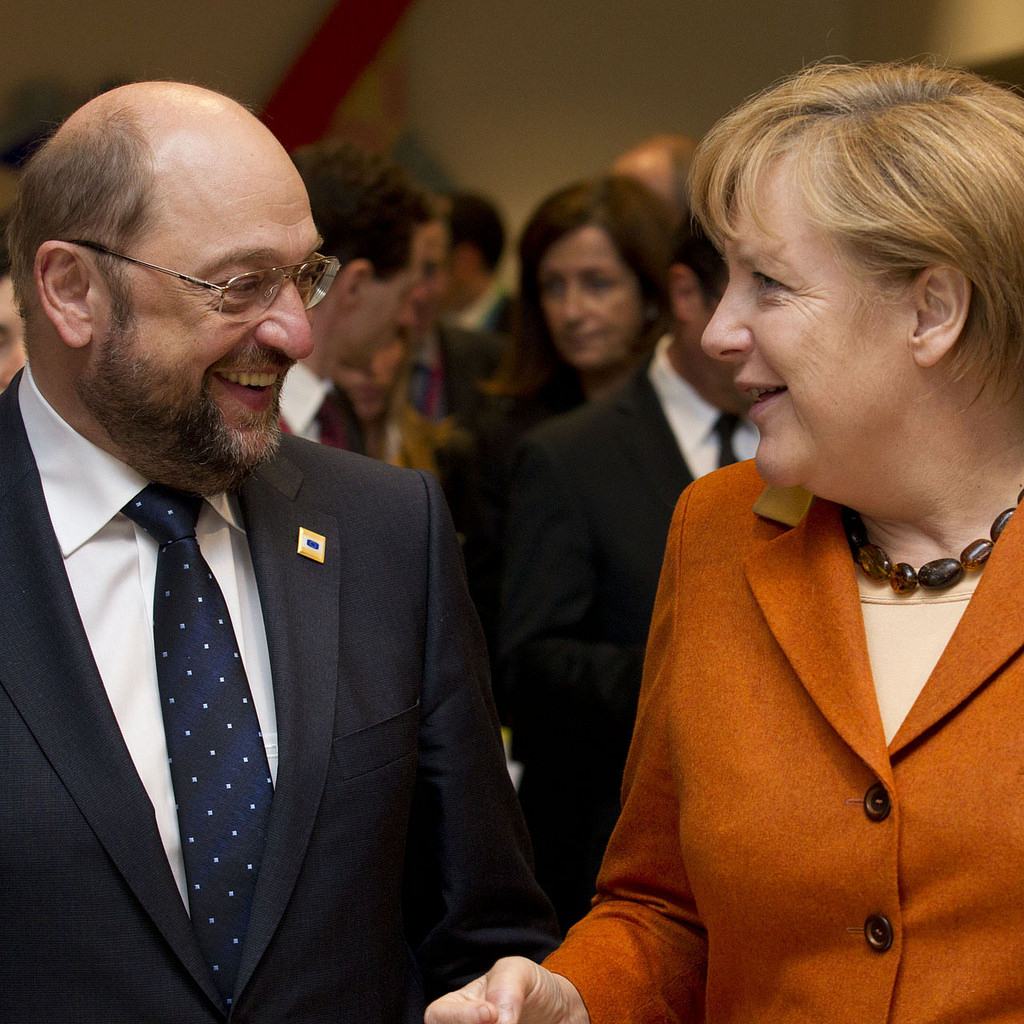
German Chancellor Angela Merkel (right)
and her main election opponent, Martin Schulz (left), whose policy positions
on key issues are virtually identical. (Image source: European
Parliament/Flickr)


Merkel and Schulz are ardent Europhiles and both are committed to
more European federalism. During an August 12 campaign speech in Dortmund, for
example, Merkel described the
European Union as the "greatest peace project" in history and vowed
that she would never turn her back on this "wonderful project."

Previously, Merkel said:

"We need more Europe, we need not only a monetary union, but
we also need a so-called fiscal union, in other words more joint budget policy.
And we need most of all a political union — that means we need to gradually
give competencies to Europe and give Europe control."

Merkel has also endorsed the idea
of a European Monetary Fund to deal with sovereign defaults by eurozone
countries:

"It could make us even more stable and allow us to show the
world that we have all the mechanisms in our own portfolio of the euro zone to
be able to react well to unexpected situations."

Schulz has argued that the EU
must be preserved at any cost:

"We are at a historical juncture: A growing number of people
are declaring what has been achieved over the past decades in Europe to be
wrong. They want to return to the nation-state. Sometimes there is even a blood
and soil rhetoric that for me is starkly reminiscent of the interwar years of
the past century, whose demons we are still all too familiar with. We brought
these demons under control through European structures, but if we destroy those
structures, the demons will return. We cannot allow this to happen."

Schulz has opposed the idea of
holding national referendums on leaving the EU:

"Referendums have always posed a threat when it comes to EU
policy, because EU policy is complicated. They are an opportunity for those
from all political camps who like to oversimplify things."

Schulz has also voiced optimism that
the British decision to leave the European Union would facilitate the creation
of a European Army:

"In the fields of security and defense policy, although the
EU loses a key member state, paradoxically such a separation could give the
necessary impulse for a closer integration of the remaining member
states."

During the September 3 debate, Schulz declared that he
would end Turkey's accession talks to join the European Union because of
Turkish President Recep Tayyip Erdogan's authoritarianism. Merkel initially
said she opposed such a move but then suddenly changed her mind. Unexpectedly,
Merkel said: "The fact is clear that Turkey should not become an EU
member."

On the issue of migration, Schulz and Merkel differ on procedure,
not principle. During the debate, for example, Schulz accused Merkel of failing
to involve the European Union in her 2015 decision to open German borders to
more than a million migrants from Africa, Asia and the Middle East. Merkel said
that although some mistakes had been made, she would take the same decision
again.

In fact, Merkel and Schulz both agree that there should be no
upper limit on the number of migrants entering Germany: "On the issue of
an upper limit, my position is clear," Merkel toldARD television.
"I won't accept one."

Schulz has said:
"A numerical cap is not a response to the refugee issue, even
if it is agreed upon in a European context. What do we do with the first
refugee who comes to the European frontier and has no quota available? Do we
send him back to perhaps a sure death? As long as this question is not
resolved, such a discussion makes no sense."

Schulz believes the
European Union should have a greater role in migration policymaking:

"What we need is a European right of immigration and asylum.
The refugee crisis shows us clearly that we cannot give a national response to
a global phenomenon such as the refugee movements. This is only possible in a
European context."

Merkel has criticized Hungary
for failing to show "solidarity" in aiding refugees. She has also
vowed to punish Poland for
its refusal to take in more migrants from the Muslim world:

"As much as I wish for good relations with Poland — they are
our neighbor and I will always strive for this given the importance of our ties
— we can't simply keep our mouth shut in order to keep the peace. This goes to
the very foundations of our cooperation within the European Union."

Schulz vowed that, if
elected chancellor, he would push for the EU to cut subsidies to countries that
do not take in refugees: "With me as chancellor, we won't accept that
solidarity as a principle is questioned."

Meanwhile, Merkel's grand coalition backed a law that
would penalize social media giants, including Facebook, Google and Twitter,
with fines of €50 million ($60 million) if they fail to remove offending
content from their platforms within 24 hours. Observers say the law is aimed at
silencing critics of Merkel's open-door migration policy.

Like Merkel, Schulz has reserved his worst vitriol for the
anti-immigration AfD, whose leaders he has described as
"rat catchers" (Rattenfänger) who are "trying to profit
from the plight of refugees." He has also called them "shameful and
repulsive."

In an August 22 interview with Bild, Merkel answered critics of
her desire to continue in power by saying that the
longer she rules, the better she gets: "I've decided to run for another
four years and believe that the mix of experience and curiosity and joy that I
have could make the next four years good ones."


Soeren Kern is a Senior Fellow at
the New York-based
 Gatestone Institute.

© 2017 Gatestone Institute. All rights reserved. The
articles printed here do not necessarily reflect the views of the Editors or of
Gatestone Institute. No part of the Gatestone website or any of its contents
may be reproduced, copied or modified, without the prior written consent of
Gatestone Institute.