Monday, October 3, 2016

Ex-ruling classes, Marathas, Muslims, still want OBC tag - By Manoj R Nair, Hindustan Times, Mumbai | Updated: Oct 02, 2016


HINDUSTAN TIMES

Ex-ruling classes, Marathas, Muslims, still want OBC tag


  • Manoj R Nair, Hindustan Times, Mumbai
  •  |  
Marathas carry out a silent rally from Kharghar to Konkan Bhavan in Navi Mumbai on September 21. (Bachchan Kumar/HT)

Two major groups in Maharashtra are agitating for quota in government jobs and educational institutions. The Marathas constitute a third – in the absence of a caste census the numbers are an estimate – of the state’s population while the Muslims are about a ninth.
There are several similarities in the two groups. Muslim and Maratha dynasties had, between them, ruled over the territory that is now Maharashtra for more than seven centuries. These communities are not homogenous: among Muslims there are sects and groups identified by their occupation, language and origins. Marathas also have various sub-castes and some groups in these communities already access reservations as Other Backward Classes (OBC). While both groups are demanding reservation of some kind, their demands have not been clearly laid out.
Though they want a quota in both government jobs and education, Muslim groups are currently pursuing a demand for 5% reservation in educational institutions that the Bombay high court has allowed. The court had rejected a demand for a quota in jobs. “We are only asking for what the courts have approved. The government of Maharashtra should allow Muslim students to get reserved seats,” said Dr Moinuddin Raut of the Muslim Kranti Andolan which has been holding meetings to raise public support for the demand. “We cannot expect the government in power, which has ignored the court’s approval for reservation in educational institutions, to even discuss job quota.”
The Marathas, who have been holding large ‘silent rallies’ across the state, are also demanding changes in the Scheduled Caste and Tribes (Prevention of Atrocities) Act 1989 – a legislation created as part of the affirmative action programme – to prevent its misuse. They have said the legislation is used as a tool to harass upper castes with false cases, though newspaper reports have said there has been no increase in the number of criminal cases filed under the law.
One of the principles that guide the national policy of reserving jobs in public services, public representative bodies and educational institutions is social discrimination and the lack of political power. The country’s affirmative action programme covers groups now classified as scheduled castes, scheduled tribes, OBC, nomadic tribes and several other categories. Can these two groups, which enjoyed historical advantages, claim that they were socially and politically disadvantaged?
The Maratha Kranti Morcha – the group leading the protests – agrees that the caste has a stronghold in the state. A majority of the state’s chief ministers were from the caste and the main agricultural community in the state – the Kunbis – is part of the community. While they agree that they have enjoyed political power and economic success, in the form of sugar and finance co-operatives, they have said the majority needs government jobs and educational reservations to prosper. The Maratha Kranti Morcha agrees that since the caste has enjoyed historical benefits, it will not be possible for them to claim a “backward’ tag. Inclusion of the entire group in the OBC category would anger the Kunbis subgroup that already has access to some reservation. The quota will also eat in the share of the other OBCs. Creation of another category of quota will be difficult as it will require a constitutional amendment.
While Maratha kings ruled the state between the 17th and 19th centuries, Muslim kings from the north came to the Deccan in 14th century, displacing Yadav rulers. They were supplanted by local sultanates and later by Maratha kings who held power till the 19th century. Can they claim to be politically disadvantaged historically? Muslims have an argument that is similar to the Marathas’.
“It was Muslim dynasties that ruled the state. Their rule did not help every Muslim,” said Raut. “Three different committees – the Rajinder Sachar, Mehmood-ur-Rehman and Ranganath Mishra – have said that the community is backward and needs help. Muslims are now economically and educationally backward than OBCs who have benefited from decades of quotas. We want a similar opportunity.”
---
My comments:

Singular credit should be given to Hindustan Times, for picking up Muslims and projecting them as old ruling class, together with Marathas. To pick up Shivaji and Mughals as old ruling dynasties and spread the misinformation that both these communities had prospered anytime in the past centuries, especially under British rule, to be now ineligible for any positive and affirmative reservations in jobs and education, is a travesty of fact, as the report itself mentions about several commissions, especially relating to Muslim conditions being even worse than that of the present status of Dalit. Besides, Muslims are not as organised as Marathas led by political groups like Maratha leader Sharad Pawar and their cause for reservation is orchestrated by those that never bothered about them when they were in power. They are therefore never consider by the Muslim masses as sincere and their well-wishers. New organisation are formed by vested interests to fool Muslims, or they would not have limited Muslim reservation demand for only in education and not in jobs. Crores in State Budget is spend on governance but Muslims are deliberately kept out of Government jobs. There are no organised Muslim leadership that could take up the matter through judiciary, rather than street demonstrations, that can further alienate Muslims from other contenders for reservation.

Ghulam Muhammed,
Mumbai

Tuesday, September 27, 2016

Muslim Ulema and India’s freedom struggle

Muslim Ulema and India’s freedom struggle: By Aazeen Kirmani The freedom which we attained on 15th August 1947 was result of a long struggle which involved contributions and sacrifices of men and women of all classes and communities of Indi...

Sunday, September 25, 2016

Why Bijnor communal villainy did not spread - By Saeed Naqvi

Why Bijnor communal villainy did not spread

thumb
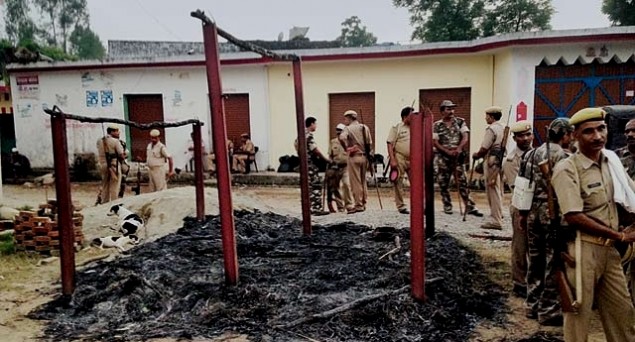
Heavy police deployment at Peda village in Bijnor after the communal tension (Photo credit – DNA – Manit)
By Saeed Naqvi,
I had the Muzaffarnagar riots of February 2013 at the back of my mind when I drove towards Pedda village on the Bijnor-Najibabad Road where three Muslims had been shot dead by Jats who fired with guns and pistols from the terraces of their homes.
Trouble began when two Muslim girls were harassed at the bus stop. When their men folk protested, the economically stronger Jats decided to teach them a lesson.
Muslims in Pedda have for generations been “dhobis” or washermen. In Sir Saiyyad Ahamd Khan’s framework, these are “arzals” or “menials”. Above them in the caste/class hierarchy are “Ajlafs”, weavers, and “Ashraf”, the genteel lot, the ones for whom the Aligarh Muslim University was initially opened.
That Yasmeen and Farheen are college-going girls is not a negligible detail: it is a glimmer of hope in a picture of unrelieved gloom which envelopes the community. Jats are prosperous farmers but socially static on issues like gender and are still bound by Khaps. The man-woman population ratio is eerily adversarial to women. In the Muslim hovel, there is economic want, not social regression.
Arrogance of economic power bristles at the sight of the lowest strata crawling upwards. This explains some of the accelerated violence against Dalits and Muslims. Caste and communal prejudice converge in such instances.
The gram pradhan or village head of Pedda, Anis Ahmad, is a short, dark man with a well trimmed beard and a mandatory skull cap, headgear which defines all Muslims from Madrasas. He has gone through the drill at the Deoband seminary, a stint as a tailor in Kuwait and now a dress designer (believe it or not) for “fashion shows”. He is not free of the usual Mullah hypocrisy: “I don’t touch female bodies; I tailor clothes for mannequins.”
With the advent of washing machines, Muslim washermen in villages like Pedda have diversified as tailors, barbers, fruit and vegetable sellers, automobile mechanics, handy men of all sorts.
The Pradhan takes me into the house where three men were shot dead on the terrace of their home. Below, in a dark verandah, women wail.
Outside, across the lane, is the fortified house of Pedda’s most powerful Jat, Sansar Singh. He hid in another village five kilometres away, but has since been arrested along with eight others involved in organising the violence.
A dozen or so policemen are snoozing outside Sansar Singh’s house, their weapons on their laps. This is the scene outside every Jat house in the lane up to the highway where a large number of policemen keep vigil.
“Look,” Anis Ahmad points his finger, “they are protecting only Jat houses.”
At Bijnor’s police headquarters, Superintendent of Police (Rural) Dharam Veer Singh thumps his table gently. “Yes, we are protecting Jat houses. If police were not posted as a deterrent, angry Muslims may retaliate against Jat women and children.”
Theoretically, Singh has a point but do Muslims in their current state of demoralisation ever retaliate? The two local journalists, Naresh Sharma of Swatantra Awaz and Jalil Ahmad of a local TV channel, India Voice, are crouching on Singh’s table, symbols of watchfulness.
Singh smiles: “Please give the police some credit for having prevented riots from spreading.”
Why did these riots not spread?
He cites geography as a roadblock to communalism. “The Ganga flows between Meerut, Muzaffarnagar and Bijnor — the communal wave that overwhelmed areas the other side of the Ganga some years ago weakens crossing the river.” There are other reasons for weakened communalism in Bijnor.
BJP President Amit Shah’s very determined presence in Muzaffarnagar and Shamli three years ago made the difference. Trumped-up stories of “love jihad”; fake video from Pakistan’s northwest circulated as Jats being lynched by Muslims; Maha Panchayats of weapon-wielding mobs and Amit Shah’s famous refrain, “Yeh badley ka election hai” (We go into this election to seek revenge) — all augmented the incendiary atmosphere. Today, there is saffron in the air, true, but not murderous saffronisation.
In Bijnor, Muslims as well as the administration (even some Jats) have praised the local MLA, Ruchi Veera of the Samajwadi party, who was present in the village round-the-clock for the duration of tension. In fact, she was able to extract Rs 20 lakh from the government in Lucknow by way of relief within days of the violence. Assessments of damage are being made for more.
District Magistrate Jagat Raj is flanked by City Superintendent of Police M.M. Baig and Senior Superintendent of Police Umesh Kumar Srivastava to address about 60 print and TV journalists around a giant oblong table. Seldom have I heard media being so lavishly thanked for having exercised restraint.
On my return, when I cross the barrage on the Ganga, I remember SP Dharam Veer Singh’s words: rivers block communal waves. Before reaching Meerut, I see road signs to Muzaffarangar. I have horrible memories of that pogrom. Past Meerut is Maliana, the site of the notorious 1987 massacre. The police had separated 42 Muslim young men, lined them up by the nearby canal and shot them.
P. Chidambaram was Rajiv Gandhi’s Minister of State for Home. He knows that incident like the back of his hand. He is now a columnist. May be some day he will give us the inside story on why the case drags on into its 29th year? Approaching Ghaziabad, I see signs to Dadri where in September 2015 Mohammad Akhlaq was lynched by cow protection vigilantes. His family is still implicated in unproved charges.
As lights of Delhi shimmer, the villainy of Pedda recedes. Nastier memories surface.
(A senior commentator on political and diplomatic affairs, Saeed Naqvi can be reached on saeednaqvi@hotmail.com. The views expressed are personal.)—IANS


Saturday, September 24, 2016

Why Indian public is delusional on Pakistan - By M K Bhadrakumar - Rediff.com

http://blogs.rediff.com/mkbhadrakumar/2016/09/21/why-indian-public-is-delusional-on-pakistan/

Indian Punchline
Reflections on foreign affairs

Why Indian public is delusional on Pakistan


 (Former diplomat and noted analyst of international politics)

While watching various Delhi TV channels tonight on issues surrounding Sunday’s attack on Uri base, one gets the depressing feeling that we are being delusional. What is entirely lacking is the ethical standard that the media should not incite public opinion by feeding it with such patent falsehoods.

We are living in a fool’s paradise, being led up the garden path by a bombastic leadership and led to believe falsely that the international community is rooting for India, that the country’s prestige is soaring sky-high, etc. and, therefore, Pakistan stands ‘isolated’.

In reality, though, the readout of the US State Department on the meeting between Secretary of State John Kerry and Pakistan Prime Minister Nawaz Sharif in New York on September 20 should come as an eye-opener. The readout is reproduced below:

  • Secretary Kerry met Monday with Pakistani Prime Minister Sharif to discuss our strong, long-term bilateral partnership and to build upon the U.S.-Pakistan Strategic Dialogue. The Secretary commended the Prime Minister for restoring macroeconomic stability to Pakistan over the last three years and expressed appreciation for Pakistan’s cooperation on climate change priorities.

  • The Secretary reiterated the need for Pakistan to prevent all terrorists from using Pakistani territory as safe havens, while commending recent efforts by Pakistani security forces to counter extremist violence. They also spoke about regional issues, including recent developments with regard to Afghanistan. The Prime Minister and Secretary Kerry expressed strong concern with recent violence in Kashmir — particularly the army base attack — and the need for all sides to reduce tensions.

  • Secretary Kerry also stressed the need for restraint in nuclear weapons programs. The Secretary praised Pakistan for hosting Afghan refugees for over 40 years and highlighted the importance of continued respect for humanitarian principles.

This is a carefully worded document, drafted by career diplomats with the full knowledge of the intelligence inputs available with the US State Department regarding the attack that took place on Uri base over 36 hours previously on Sunday. Nonetheless, such manifestly effusive sentiments and fulsome praise for Pakistan have been attributed to Kerry.

See the expressions that have been used in the document with great deliberation – “strong, long-term bilateral partnership”; “commended the Prime Minister”; “expressed appreciation for Pakistan’s cooperation”; “commending recent efforts by Pakistani security forces to counter extremist violence”; “praised Pakistan for hosting Afghan refugees for over 40 years”, et al.

Most significantly, the reference to J&K and Uri attack is framed as the shared opinion of Sharif and Kerry – “The Prime Minister and Secretary Kerry expressed strong concern with recent violence in Kashmir — particularly the army base attack — and the need for all sides to reduce tensions.” What does this single stunning sentence imply in plain language, shorn of diplomatic idiom?

  • One, US is not willing to censure Pakistan;

  • Two, US shares Pakistan’s “strong concern over recent violence in Kashmir”;

  • Three, the Uri base attack is to be seen squarely in the context of the 2-month old upheaval in Kashmir Valley; and,

  • Four, US agrees with Pakistan on the need to reduce tensions (read on the imperative need of India-Pakistan talks).

The point that really makes one shudder is that Kerry does not think this is an act of cross-border terrorism. The Americans seem to have arrived at some conclusions of their own regarding what happened in Uri, which do not tally with our account.

Now, unless we shake ourselves free of the myopic vision regarding ourselves that has been systematically created by our ruling elites through the past 2-year period, ably assisted by the unscrupulous TV channels in Delhi day in and day out, we will come to grief. This is all nothing but Goebbelsian lies that we are being fed with by our TV channels.

The unfortunate part is that almost two-thirds Indians are today clamoring for military action against Pakistan. The ruling elites would know they are riding a tiger and if they dismount at this juncture, the public opinion will devour them for not living up to the myths the people have been led to believe all this while. The Indian public does not know that the realities of the security environment surrounding India today are pretty grim and we desperately need an exit strategy.

Equally, our strategic choices are virtually nil today, thanks to the nuclear stalemate and Pakistan’s stockpile of tactical weapons that can neutralize our forces (while on their territory) without even giving cause to provoke (or justify) a nuclear counter-strike by us. These are theatre weapons which have focused usage in a specific limited area, but will annihilate the enemy in real time. Our public should realize that any provocation by us could draw forth a Pakistani retaliation the scale of which will be simply prohibitive in cost in human lives and destruction.

Read an insightful perspective on Uri attack by the well-known US pundit George Perkovich on the strategic dilemma India faces today vis-à-vis Pakistan – Perkovich candidly says India has run out of options and is left with no sensible way of addressing the challenge posed by terrorism on an enduring basis except by engaging the people of the Kashmir Valley in political dialogue, and the alternative will be a seamless asymmetric war. (here)