Monday, July 18, 2016

Uniform Civil Code -- It isn't about women - By Nivedita Menon - The Hindu

http://www.thehindu.com/opinion/lead/nivedita-menon-on-uniform-civil-code-it-isnt-about-women/article8850353.ece?homepage=true

Inline image 1

OPINION » LEAD

July 15, 2016
Updated: July 15, 2016 01:11 IST

It isn’t about women

COMMENT (177)   ·   PRINT   ·   T  T  
1

The talk of a Uniform Civil Code has nothing to do with gender justice. It has entirely to do with a Hindu nationalist agenda to ‘discipline’ Muslims

For nearly eight decades, the women’s movement has discussed and debated the desirability and feasibility of a Uniform Civil Code, and has ended up posing a simple question — what is the value of uniformity? Is it for the “integrity of the nation” that uniformity in laws is required, as some judicial pronouncements have suggested? If so, who exactly is the beneficiary? Which sections of people benefit from “integrity of the nation”, that abstract entity which is not exactly at the top of your mind as your husband throws you out on the street?
Or are uniform laws meant to ensure justice for women in marriage and inheritance? In that case, a Uniform Civil Code would simply put together the best gender-just practices from all Personal Laws. So yes, polygamy and arbitrary divorce would be outlawed (a feature derived from Hindu Personal Law). But conversely, as feminist legal activist Flavia Agnes has often pointed out, a Uniform Civil Code would require the abolition of the Hindu Undivided Family, a legal institution that gives tax benefits only to Hindus, and all citizens of India would have to be governed by the largely gender-just Indian Succession Act, 1925, currently applicable only to Christians and Parsis.
A stick to beat Muslims with

Muslim Personal Law is already modern in this sense, since it has since the 1930s enshrined individual rights to property, unlike Hindu law, in which the family’s natural condition is assumed to be “joint”. In the decades of the 1930s and 1940s, contrary to later discourses about Muslim law being backward, it was Hindu laws that were considered “backward” and needing to be brought into the modern world of individual property rights.
Again, since the Muslim marriage as contract protects women better in case of divorce than the Hindu marriage as sacrament, all marriages would have to be civil contracts. Mehr, in Muslim Personal Law, paid by the husband’s family to the wife upon marriage, is the exclusive property of the wife and it is hers upon divorce, offering her a protection Hindu women do not have. So, the Uniform Civil Code would make the practice of mehr compulsory for all while abolishing dowry.
The patent absurdity of these suggestions arises not from the ideas themselves, but from the fact, recognised by everybody, that the talk of a “Uniform Civil Code” has nothing to do at all with gender justice. It has entirely to do with a Hindu nationalist agenda, and is right up there with the beef ban and the temple in Ayodhya. A Uniform Civil Code is meant to discipline Muslims, teach them (if they didn’t know it already) that they are second-class citizens, and that they live at the mercy of “the national race” (the Hindus), as M.S. Golwalkar decreed.
The real issue of gender justice

So let us pose the question differently — who suffers in the absence of a Uniform Civil Code? Is it Muslim women, victims of polygamy and triple talaq, as Hindutvavadi wisdom has it? But for decades, feminist legal practice has successfully used both the Protection of Women from Domestic Violence Act, 2005 — that is available to all Indian citizens regardless of religious identity — as well as the Muslim Women (Protection of Rights on Divorce) Act, 1986, to deal with polygamy and triple talaq, and to obtain maintenance, child custody and rights to matrimonial home for countless Muslim women. In addition, feminist legal activists have used the landmark Shamim Ara v. State of U.P. (2002) ruling to buttress their claim that arbitrary triple talaq is invalid.
Moreover, polygamy is not exclusive to Muslims. Hindu men are polygamous too, except that because polygamy is legally banned in Hindu law, subsequent wives have no legal standing and no protection under the law. Under Sharia law, on the contrary, subsequent wives have rights and husbands have obligations towards them. If gender justice is the value we espouse, rather than monogamy per se, we would be thinking about how to protect “wives” in the patriarchal institution of marriage. “Wives” are produced through the institution of compulsory heterosexual marriage, the basis of which is the sexual division of labour. This institution is sustained by the productive and reproductive labour of women, and almost all women are exclusively trained to be wives alone.
Thus, when a marriage fails to fulfil its patriarchal promise of security in return for that labour, all that most women are left with is the capacity for unskilled labour. Or they remain trapped in marriage with children to provide for, while men marry again, legally or otherwise, producing still more dependent, exploited wives and children for whom they take no responsibility. If gender justice is the point of legal reforms, the centrality and power of the compulsory heterosexual, patriarchal marriage, and the damage it can do to women, is what must be mitigated. This would mean recognising the reality of multiple “wives” as a common practice across communities, and the protection of the rights of all women in such relationships.
In this sense, recent Supreme Court rulings that have granted rights to second wives in Hindu marriages dilute the legal standing of monogamy for Hindus but empower women.
A survey conducted by the Bharatiya Muslim Mahila Andolan, a significant voice in the debate, found that more than 90 per cent of Muslim women in India want a ban on “triple talaq” and polygamy in Muslim Personal Law. That is, the demand is made within the framework of codifying Muslim Personal Law, not in favour of a Uniform Civil Code, partly because there is no clarity on what a uniform code would look like, but also because the demand comes from clearly Hindutvavadi quarters which have shown that both women and minorities are expendable for them.
Lessons from the Goa experience

The only example of a uniform code in India is the Portuguese Civil Procedure Code (1939) of Goa, which is neither ‘uniform’ nor gender-just. Marriage laws differ for Catholics and people of other faiths, and if a marriage is solemnised in church, then Church law applies, permitting, for example, arbitrary annulment at the behest of one of the parties. The “customs and usages” of the Hindus of Goa are recognised, including “limited” polygamy for Hindus.
The positive aspect of Goa’s Civil Code is the Community Property Law, which guarantees each spouse 50 per cent of all assets owned and due to be inherited at the time of marriage. However, this provision can be sidestepped in practice, given the power relations in a marriage, and studies show that it has not made any impact on the incidence of domestic violence.
Clearly, if gender justice is not prioritised, both uniformity as well as its dilution can reinforce patriarchy and majoritarianism.
The woman at the centre of this recent round of debate on the Uniform Civil Code is Shayara Bano, who received talaq by post. Her lawyer, instead of using any of the three recourses available discussed above — the Protection of Women from Domestic Violence Act, 2005, the Muslim Women (Protection of Rights on Divorce) Act, 1986, or the citation of the Shamim Ara v. State of U.P. (2002) judgment — decided to file a Public Interest Litigation in the Supreme Court challenging triple talaq on the grounds of violation of Fundamental Rights. Ms. Bano is now in the media spotlight, spiritedly criticising patriarchy in the Muslim community.
Revealingly, a recent interview with her in a national newspaper concluded with a startling question — “What about the ‘Bharat Mata ki Jai’ slogan controversy?” Ms. Bano replies, “I feel all Muslims should say Bharat Maa ki Jai.”
Does the question seem irrelevant in the context of Ms. Bano’s fight for personal justice? What does compulsory chanting of “Bharat Mata ki Jai” have to do with a woman fighting patriarchy?
But the question does not seem irrelevant at all; it seems to be at the heart of the interview. This alone should alert us to what the demand for a Uniform Civil Code is actually about.
Nivedita Menon, a feminist scholar, is a professor at Jawaharlal Nehru University, New Delhi.
---
177 comments
  • AAmardeep  
    The problem with the opponents of UCC has always been an inability to accept a discussion on the merits of UCC. More than 65 years after it was put onto our constitution, not by Hindutava proponents, but by people who hated Hindu majoritism to their core, we are still not ready to discuss it. It is almost as if certain sections do not want to see themselves as Indians under the law but as various religious identities, Hindu, Muslim, Christians, etc under the law. It is not a question of questioning their patriotism but is a question of what is seen more effective, a law drafted by Manu in ancient India or in Arabia centuries ago or a law drafted in Europe in the dark ages or a law drafted in contemporary India for our contemporary problems irrespective of the religious faith of the person on whom it is applicable? I would choose the later. Moreover having different civil laws violates the principle of secularism of our constitution as it brings religion into public space.
    155
    about 22 hours ago
     (0) ·  (0)
     
    • AAmardeep  
      The author says this,
      "Mehr, in Muslim Personal Law, paid by the husband’s family to the wife upon marriage, is the exclusive property of the wife and it is hers upon divorce, offering her a protection Hindu women do not have. So, the Uniform Civil Code would make the practice of mehr compulsory for all while abolishing dowry."

      Why would Meher be made a part of the UCC? Just as triple talaq would be abolished the failure of payment of maintenance would also be abolished. Moreover does the author want regressive practices like Meher to be followed? Yes unlike Hindu Dowry it is paid to the bride family, but it is not a ridiculous amount of Rs 25. So whether it is better than dowry or more is moot. That is the problem with the various civil code of India. They are not fair. But just because one existing civil code is not good in one aspect does not make UCC should not be discussed or implemented. UCC can overcome most of the drawbacks of various civil codes of India.
      155
      about 22 hours ago
       (0) ·  (0)
       
      • OIOpinionated Indian  
        The tone of this article is shocking. A Uniform Civil Code is just that, a Uniform Civil Code, not a Hindu Civil Code applied to all communities. I am ashamed that my country has different rules for different people. Believe it or not, there are many people like me with no Hindutva agenda who think like this.Ms. Menon seems to suggest that it doesn't matter that Shayaro Bano was humiliated. It is the soft bigotry of lowered expectations to think that there are no people within the community who also want the removal of triple Talaq."Feminists" who put ideology and Regressive Leftism above all else, and throw women under the bus because they are inconvenient to their narrative are not feminists at all.
        2 days ago
         (3) ·  (1)
         
        Annoyed · Ashish · Govind Up Voted
        kinky Down Voted
        • SSunil  
          The writer seems to have ridiculous arguments and laughable opinions. UCC is much needed to give more rights and for protection of women. All are citizens of this country and have equal rights and duties. Parallel laws and government is not acceptable. The people support the present government with absolute majority, thanks to such non-sense opinions. Pls ask the writer not to misguide the nation in the name of liberalism..
          2 days ago
           (0) ·  (1)
           
          kinky Down Voted
          • SPSajeev P  
            Ms Menon's opinion is one sided. It is loaded with the stigma usually associated with the social science department of the JNU. UCC is not a question of Hindus or Muslims. Our country is a democratic republic. so, as we adhere to common criminal procedure coded, it is customary to follow civil laws. Personal laws hasn't any relevance. what if the citizen of India behave as his own, according to certain personal laws of his choice?
            so that is not the case. We should adhere to our constitution. Women are discriminated under various personal laws. the most obvious case is Muslim personal law. Through Hindu code bill Hindu personal laws are codified. Undivided Hindu family is another case. whenever the case of UCC arises, it is divided on Hindu-Muslim lines. It is pertaining to all religion. Indian citizens should follow once set of rules in matters of marriage, inheritance, maintenance and other similar issues. The archaic laws of the middle ages haven't any say in the modern times.
            2 days ago
             (0) ·  (1)
             
            kinky Down Voted
            • VVenkatamv  
              Selective interpretation of rights and equality is the norm of some. No wonder these so-called activists and liberals write so...Uniform civil code is needed and it has nothing to do with a Hindu and Muslim. Of Course, it can and has to debated before implementation. When in a democracy everyone has equal rights., why not this?
              2 days ago
               (0) ·  (1)
               
              kinky Down Voted
              • AMAshish Mattoo  
                i would like to make it clear to Miss Nivedita Menon that the Uniform civil code is not the invention of BJP but honorable Supreme court of India in October 2015 said there was total confusion due to various Personal Laws and sought to know if the government was willing to implement a Uniform Civil Code. It observed: “What happened to it? Why don’t you (the government) frame and implement it?” However, the apex court later declined to direct Parliament to bring in a Uniform Civil Code while allowing a PIL filed in this regard to be withdrawn.
                Supreme court of India has, on number of occasions directed the central govt. to implement uniform civil code and adhere to Article 44 of our constitution.
                So referring this decision, as communal doesnt make sense.
                2 days ago
                 (0) ·  (0)
                 
                • Rrohin  
                  what about shahbano case ?? do you think muslim personal law acted with a liberal approach . please for god sake use your pen for fighting for right issues .
                  2 days ago
                   (0) ·  (1)
                   
                  kinky Down Voted
                  • Ssam  
                    Author seems quite biased here... Indeed hindutava forces have been demanding it for UCC for a while. But it is not for appeasing the hindu brigade. this code would be the betterment of muslim community. laws,written 1400 years ago, do not fit in to modern world. Author like menon gives rise to hindutava forces. They usually forget people of this nation have become smarter than before and i see people commenting here , mostly disagree with the views of author. We dont need a pseudo intellectual who could speak on the behalf of Indian youth. today we have social media sites and comment sections on every news paper site on which we express our views and the views of intellectual common people are always against the pseudo intellectuals like menon. So u just keep ur views confined to urself .. Youth of india has been risen from the ashes. it is the first step in the advancement of the nation. Knowledge of all kind has been divided among the youth and this trend is on rise. We dont need u
                    2 days ago
                     (0) ·  (1)
                     
                    kinky Down Voted
                    • Suchindranath Aiyer Protean, polyglot, polymath, healer, global human, Brahmin. 
                      True to PANGOLIN* type:

                      *Note: PANGOLIN: An enemy of India who believes in inequality under law, exceptions to the rule of law and persecution of some for the benefit of others. At present, the sole purpose of the Indian Republic, Constitutional or otherwise, is to pamper and provide for certain constitutionally preferred sections of society who the British found useful to hold and exploit India at the cost of those who the British hated and persecuted. The Pangolin is a creature that is unique to India and feeds on ants that are known in nature to be industrious and hard working if not quite as fruitful as bees who flee to better climes. (PANGOLIN is an acronym for the Periyar-Ambedkar-Nehru-Gandhi-Other (alien) Religions-Communist Consensus that usurped the British Mantle and has worn it with elan to loot, plunder, and rape India since 1921 and re write History and laws to their exclusive benefit since 1947)
                      265
                      2 days ago
                       (0) ·  (1)
                       
                      kinky Down Voted
                      • VVaibhav  
                        people talk about gender equality , independent women etc,. and there are people who talk about obtaining their share of property after divorce...hypocricy all over..
                        And about polygamy today with the rising divorce cases specially in the so called educated class represents that none of the gender is ready to accept the imperfections in the other. so its really about understanding the sanctity of marriage and not just playing with by just making laws then and now. polygamy should not be apart of any law. you can be attached to a single woman emotionally not plenty in todays times its challenging to save the institution of marriage... UCC should be debated to its fullest before coming in shape by all religious scholars (scholars and not frauds please.)
                        And please dont take the issue of feminism and women empowerment in wrong direction.. like deepika s my choice etc....
                        2 days ago
                         (3) ·  (1)
                         
                        Rahul · TSK · Anirudh Up Voted
                        kinky Down Voted
                        • SSundar  
                          That's like saying 'the issue must be discussed to the fullest, but please don't say what I don't want to listen to.'
                          1330
                          2 days ago
                           (0) ·  (0)
                           
                        • RLRoshan Lal  
                          There couldn't be more atrocious or ridiculous statement than what M/S Menon , Professor of JNU made that BJP is using Common Civil Code as stick to beat Muslims ! All,of us swear by Our Costitution & our Secularism day &! day out hence it passes over my head as why so far Common Civil Code was not implemented! To my mind not having Common Civil Code is against basic tenets of ou Constitution Human Rights ! In the name of personal civil code , untold cruelty has been & is still inflicted by Muslims on women that one shiver at the thought of it ! Besides making numerous other follies by Mr.Nehru & congress not having Common Civil Code for our country too is one of them ! There can't be any compromise on not having Common Civil Code at the earliest ! Further no compromises should be allowed to come in the way to adopt modern & humane Civil Code keeping in view our basic tenets of Secularism as enriched in our country's constitution!
                          105
                          2 days ago
                           (6) ·  (2)
                           
                          kuldeep · HARESH · Subrahmanyam · CSampath · TSK · prakash Up Voted
                          Kamill · kinky Down Voted

                        Saturday, July 16, 2016

                        The construct of Islamic terror - Written by Maidul Islam - The Indian Express, Mumbai

                        http://indianexpress.com/article/opinion/columns/nice-france-carnage-islamist-extremists-ramzan-terror-attacks-muslim-dhaka-baghdad-medina-the-construct-of-islamic-terror-2916579/


                        The Indian Express

                        The construct of Islamic terror

                        Though we do not have firm evidence of the hand of Islamists in the July 14 attack in Nice in France, Islam might still be blamed for the carnage.

                        Written by Maidul Islam | Updated: July 16, 2016 12:03 am

                        Inline image 2


                        Inline image 1
                        A woman places a candle during a vigil to honor victims of the Bastille Day tragedy in Nice, France, in Sydney, Australia, Friday, July 15, 2016. World leaders are expressing dismay, sadness and solidarity with France over the attack carried out by a man who drove truck into crowds of people celebrating France’s national day in Nice. (AP Photo/Rob Griffith)

                        Recent terror attacks in the month of Ramzan in Dhaka, Baghdad and Medina by Islamist extremists have again brought to light the question of vilification of the entire Muslim community in social media and in a section of mainstream media. Though we do not have firm evidence of the hand of Islamists in the July 14 attack in Nice in France, Islam might still be blamed for the carnage. There is an increasing trend to blame Islam for producing “jihadi” terrorists. However, the Muslim ulema’s critique of terrorism as antithetical to Islam (which, like many religions, spreads the message of peace) is rarely highlighted by the media. Is this a new trend of Islamophobia in the media?
                        The global phenomenon of Islamophobia is a product of hundreds of years of Orientalist discourses constructed by the Western colonial education system. The dominance of many parts of the medieval world by Islamic cultures is described as “dark ages” in such discourses. In one of his celebrated essays, ‘The Campaign Against ‘Islamic Terror,’ Edward Said has shown how the depiction of Islam as a threat to the West is largely a discourse that was produced by mainstream American academia and journalism in search of a new “manufactured enemy” in the post-Soviet world order. Said, in his book Covering Islam, has also argued how the western media and academic experts in the West have often produced biased, stereotypical and mythical representations of Islam.
                        SHARE THIS ARTICLE
                        Share
                        Such discourses produced the phenomenon of “Islamophobia” that was reproduced in media caricatures and stereotyped political cartoons. Peter Gottschalk and Gabriel Greenberg’s, Islamophobia: Making Muslims the Enemy shows thatmedia caricatures and political cartoons showing Muslims as “terrorists”, “irrational”, “violent”, “evil”, “oppressive” and “fanatics” date even further back. Political caricatures of Muslims and Islam in the Western media are as old as the Suez Canal crisis of 1956-1958.
                        They made an appearance during the 1974 oil crisis, the revolution, the hostage crisis of 1979-1980 and Gulf war of 1990. The 9/11 incident followed by the Afghanistan war in 2001 and the invasion and occupation of Iraq in 2003 saw such imagery acquire a sharper edge. The prejudicial view of Islam and Muslims as backward and fanatical and not compatible with modernity slots Muslims — and Islam — into a homogenous, essentialist and unitary category without acknowledging the multiplicity of Islamic groups and the heterogeneity of the Muslim world.
                        Popular cinema in Hollywood and, to an extent, Bollywood, have also contributed in reinforcing stereotypical images of Muslims as terrorists. Many Bollywood films make a direct connection between Muslims and terrorism, and stir up sentiments against Islam and Muslims. The community is rarely shown as a victim of terrorism, which threatens lives of both Muslims and non-Muslims. The profile of the victims of terrorist attacks in Dhaka, Baghdad and Medina shows that terrorism makes no distinction between Muslims and non-Muslims.
                        It is well-known that numerous terrorist groups have organisational bases among non-Muslims. According to the Forbes’ latest list of the world’s top ten richest terrorist organisations, two are non-Islamic outfits — the Revolutionary Armed Forces of Colombia (FARC) and the Real Irish Republican Army. The Aum Shinrikyo in Japan and Democratic Karen Buddhist Army in Myanmar claim to be inspired by Buddhism. The Maronites in Lebanon and Syria, Orange Volunteers, Loyalist Volunteer Force and Red Hand Defenders in Northern Ireland, the anti-abortion Army of God in the United States, the Lord’s Resistance Army in Uganda and various neo-Nazi groups in Europe claim to follow Christianity.
                        In 2011, Anders Behring Brieivik, a neo-Nazi, carried out the horrendous attacks that killed 77 and injured 319 in Oslo in Norway. Not many decades ago, Zionist groups like Jewish Underground, Brit Hakanaim and Kingdom of Israel, as well as certain anti-communist outfits, took part in terrorist activities. Some left-wing groups, including the Maoists in India, have been designated as terrorist outfits. Hindutva activists are alleged to have organised the Malegaon, Nanded, and Hyderabad’s Mecca Masjid blasts.
                        However, it is noteworthy that there is an increasing trend of Arabisation and Wahabisation among South Asian Muslims. Changing dress codes and changing mannerisms reflect the growing Arabisation of Muslims. This tendency
                        is detrimental to the otherwise plural character of South Asian Muslims. Islamic theology needs to address the core
                        problems of the religion; these pertain to gender inequality, unequal property rights for women, discrimination against women after divorce and the right to use contraception. This is only possible through democratic movements in the Muslim community: Moderate Muslims should take charge and not become passive spectators and victims of Islamist extremism.
                        ---

                        Tuesday, July 12, 2016

                        Kashmir Protests coverage by The Indian Express. Mumbai, India

                        http://indianexpress.com/article/opinion/editorials/afspa-manipur-kin-judicial-killing-army-supreme-court-petition-2907898/


                        The Indian Express

                        Editorial

                        Calling to account

                        Supreme Court makes it clear: AFSPA does not provide blanket immunity to army personnel.


                        By: Editorial | Published:July 12, 2016 12:00 am
                        The Supreme Court ruling on the petition filed by the Extra Judicial Execution Victims Families Association, a representative platform of people in Manipur whose kin have allegedly been summarily killed by security forces, is a strong critique of the manner of deployment of the Armed Forces Special Powers’ Act (AFSPA). The petition had alleged that there have been over 1,500 extra-judicial killings in the state and pleaded for the court’s intervention to deliver justice.
                        The state and its agencies, under the cover of AFSPA, had sought immunity from legal scrutiny. The SC order has refused to be imprisoned by the state’s security-centric framework and the resultant curtailing of the citizen’s fundamental rights.
                        The validity of the AFSPA, first introduced in 1958, has periodically come under scrutiny. A constitutional bench had upheld the act in the Naga People’s Movement of Human Rights , the Justice B.P. Jeevan Reddy committee advised the government to repeal it. Last week’s order does well to outline three crucial principles: One, the “order situation in Manipur is, at best, an internal disturbance. There is no threat to the security of the country or a part thereof either by war or an external aggression or an armed rebellion”; two, “for tackling the internal disturbance, the armed forces of the Union can be deployed in aid of the civil power. The armed forces do not supplant the civil administration but only supplement it”; three, “the deployment of the armed forces is intended to restore normalcy and it would be extremely odd if normalcy were not restored within some reasonable period, certainly not an indefinite period or an indeterminate period”. The court has refused to accept the state’s plea that the extra-judicial killings, which took place in “a war-like situation”, need not be investigated. The pointed reference to “restoring normalcy within some reasonable period” has particular resonance in Manipur, a state where the AFSPA has been in force for nearly six decades.
                        The AFSPA provides the framework for the armed forces but the law clearly lays down the operational procedure which is more often violated than followed. The court has made it clear that the state is bound by the direction of the Constitution bench that “every death caused by the armed forces” should be thoroughly inquired into if there is a complaint or allegation of abuse or misuse of power. In so doing, it disabuses the state of the notion that the AFSPA provides a blanket immunity to army personnel in anti-insurgency operations. To argue that the absence of such immunity could demoralise the forces, the court says, “unsettling and demoralising, particularly in a constitutional democracy like ours h. Commendably, the court has laid the ground for a framework of accountability that the state needs to adopt in its responses to insurgency.

                        Face the disillusion

                        In its new phase, the ‘azadi’ struggle in Kashmir is leaderless, and has a strong death wish.

                        Written by Nirupama Subramanian | Updated: July 12, 2016 7:50 pm
                         Burhan Wani, Hizbul Mujahideen, wani killing, burhan wani killing, kashmir protest, kashmir violence, burhan wani violence, J&K, jammu and kashmir, Hizbul Mujahideen commander, kahmir militants, militants in kashmir, burhab wani militant, indian express columnThe security establishment may well conclude that there were faceless entities orchestrating the arrival of the tens of thousands of mourners from across the state over WhatsApp and other social media, that there were over ground workers in the crowd provoking the acts of violence. (Express Photo by Shuaib Masoodi)
                        Back in April, when Hizbul Mujahideen commander Burhan Wani was still alive, young boys in his home town of Tral declared they were readying for a long struggle in which there would be no leaders. My colleague Basharat Masood and I were in Tral to report on the new militancy centred in South Kashmir, and that remark came when we observed that Burhan and the other militants with him were likely to be captured soon as the police had already eliminated many of them and were said to be closing in on him.
                        “New militants will come. We are safe now because we have already transferred the struggle to the next generation. The cause is bigger than the individual. Even if [Hurriyat leader Syed Ali Shah] Geelani or [Hizbul Mujahideen leader Syed] Salahuddin side with India, our struggle will not end.” The Centre would try and engage with Kashmir, they said, “but they will find no one to engage with, because there will be no leaders, no one subscribes to any leaders any more”.

                        Leaders made compromises, they said. Even though many of these boys were not born or were infants at the time, in their minds was inscribed the notion that the previous generation of militants took up the gun because they wanted to become high officials in Kashmir, liberated or not. “Some of them thought, here comes azadi, now I can become a minister, may be even prime minister”. Burhan, on the other hand, was seen to be “pure”, because he had no such “greed”, no political ambition.
                        There were no leaders at Burhan’s funeral on Saturday. The security establishment may well conclude that there were faceless entities orchestrating the arrival of the tens of thousands of mourners from across the state over WhatsApp and other social media, that there were over ground workers in the crowd provoking the acts of violence.
                        kashmir-protest-759(Express Photo by Shuaib Masoodi)
                        That may or may not be true. But the mourners who streamed into Tral from all parts of the state did not believe that they were acting on anyone’s instructions. As they took over the roads leading to Tral, burning tyres and pelting stones, policing the massive influx of people, in their minds they were reacting in spontaneous anger.
                        As Kashmir boils over at the killing, it is this leaderlessness, and the new ideal of the “azadi” struggle as one that ends in death and a hero’s funeral that should worry the security and political establishment. Even a call for calm by Geelani has not helped defuse the situation. Young Kashmiris continue to revere him as the only leader who has “not compromised” but even he was not spared, as protestors jeered at his appeal.
                        This is not a situation that developed overnight. Since 2008, when the Mumbai attacks put talks with Pakistan in the freezer and all attempts at a restart tripped up repeatedly, the disillusionment of a new generation of Kashmiri youth has grown, with the continuing presence of the military, Centre’s insistence on keeping AFSPA, and continuing human rights violations, all erupting in the stone pelting agitation of 2010. Then, anger over the 112 deaths of young boys in that episode segued into popular discontent over the 2014 alliance between the PDP and BJP in the last two years, bringing the Valley closer to the bruising debates in the national arena over what to eat and who to marry.
                        Meanwhile, for a full decade now, since the round table exercise by the previous government under then Prime Minister Manmohan Singh, there has been no political initiative by the Centre in the Valley except the doomed three-member interlocutors panel set up to find out views on the ground and suggest ways to address the issue. Its report has lain in cold storage since 2011. It is the same with the recommendations of the round table committees. That has left the moderate factions of the Hurriyat, which participated in the round table process, in the cold. They had nothing to show for their compromise, and it diminished them in the eyes of a new generation of Kashmiris.
                        The NDA government has made it clear that it wants nothing to do with either the moderates or hardliners in the Hurriyat, nothwithstanding a cursory line in the BJP-PDP “agenda for alliance” that “the state government will facilitate and help initiate a sustained and meaningful dialogue with all internal stakeholders which includes political groups irrespective of their ideological views and predilections”. If the Centre is firm that it will deal only with the elected representatives in Kashmir and mainstream political parties, the NDA government has hardly been proactive in facilitating even the implementation of the doable political promises in the coalition’s common programme, despite entreaties by the PDP and Chief Minister Mehbooba Mufti.
                        With infiltration down and fewer incidents of terror strikes in Kashmir, the smugness in the political and security establishment has been apparent. Only a few thousand Kashmiris protesting on the streets, only a handful of militants, we can do encounters, we can do crowd control, it is all very manageable, has been the confident refrain.
                        kashmir-protest-759-1(Express Photo by Shuaib Masoodi)
                        But the problem with this is that it is almost entirely security driven. It has meant firing into crowds of youngsters with lethal weapons, resulting in deaths or life-impairing injuries — many boys hit by pellets are landing up at eye hospitals in Amritsar for treatment with their parents fearing their sons might be picked up by police if they went to local hospitals. It has meant taking out militants, which did not seem to matter so long as they were from across the border, but has taken on an entirely different meaning after Kashmiri boys began following Burhan’s example. The fierce resistance put up by local communities, from under 10-year-olds to senior citizens, at encounter sites, and the mass displays of anger more than grief at their funerals, is now all too well known. The police say that the death in encounter of a local militant is a sad event, yet security forces repeat such encounters and are each time taken by surprise at the public reaction.
                        What this approach has done is to bring out kids as young as 8 or 12-years old, to whom defiance of the Indian state is now as natural as playing cricket. Each death, of a militant or protestor, has become a celebration of this defiance, triggering more protests, adding more grievances, increasing the alienation. In death, Burhan has caused more turmoil in two days than in his six years as a militant. In April, Burhan’s father, Muzaffar Ahmad Wani, a school teacher, had told The Indian Express: “Kashmir is on fire. If India wants to douse it, they need to use water, not oil”. That, really, is the lesson from Kashmir’s weekend of fury.
                        ---

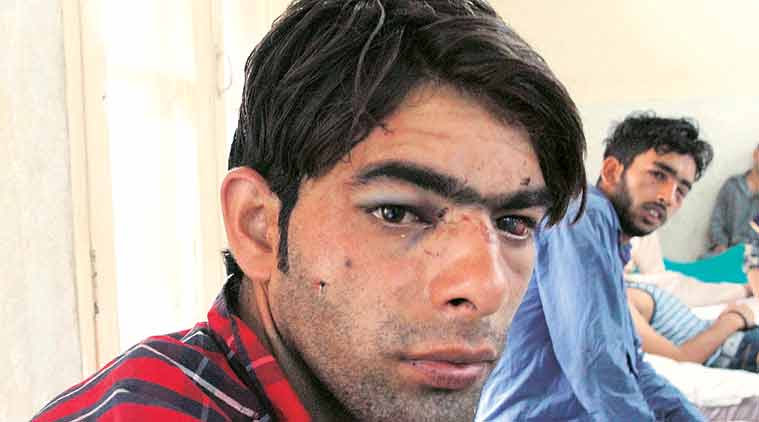
                        Kashmir protests: Pellets take a toll, 92 eye surgeries and counting


                        Pellet guns have been regularly used to quell protests in Kashmir since 2010, when the state police introduced them as “non-lethal weapon”, their use has increased over the years.


                        Written by Muzamil Jaleel | Srinagar | Updated: July 12, 2016 7:45 pm
                        kashmir, kashmir violence, rajnath singh, burhan wani death, kashmir violence, kashmir hospital, jammu kashmir violence, kashmir grenade attack, kashmir clash, burhan wani killing, hizbul mujahideen, hizbul mujahideen commander burhan wani, kashmir curfew, news, india news, latest updates kashmir, india newsAll 72 beds in the ophthalmology ward of Srinagar’s SMHS hospital, where Yasin is recovering, are occupied — some by two patients. (Express Photo: Shuaib Masoodi)
                        Eighteen-year-old Mohammad Yasin lies on a hospital bed, his vision smeared with a white haze. He is not sure if he will ever see properly again.
                        All 72 beds in the ophthalmology ward of Srinagar’s SMHS hospital, where Yasin is recovering, are occupied — some by two patients. The patients are mostly young, many of them minors, including a 12-year-old girl. The hospital administration had to vacate half of the adjoining medicine ward to accommodate the rush of youths with injuries to their eyes, sustained in protests in the wake of Burhan Wani’s killing.
                        “We have already operated on 92 patients. Every hour, more young men arrive with pellet injuries to the eyes. We are overburdened,” said Dr Sajjad Khanday, an ophthalmologist.

                        He said the injuries are so severe that the damage is almost always permanent. “In most cases, the first people to speak to patients are policemen in plainclothes. They record their antecedents even before we can examine them,” he said. “We had to shut our operation theatre in the trauma unit because it was getting difficult to stop people from entering.”
                        Though pellet guns have been regularly used to quell protests in Kashmir since 2010, when the state police introduced them as “non-lethal weapon”, their use has increased over the years. The use of pellet guns in the current clashes, doctors said, is “unprecedented”.
                        The pellets, sources said, come in grades ranging from 5 to 12, depending on damage, range and speed; 5 being the most damaging. Sources said number 9 is preferred to control crowds but police often use the stronger number 6 or number 7 in villages.
                        “These pellets don’t kill you, which means there isn’t any body count, so police are fine with it. But once a young man loses one or both of his eyes, it is worse than death,” Khanday said. “Not just his life, his entire family is destroyed. We have seen families take their children to places like Chennai in the hope that vision can be restored. It takes years for a family to accept the fate. There are very few cases where intervention helps after a pellet has pierced the eye.”
                        Inside Ward 8, Yasin, a resident of Chursoo village, said he had gone to Tral on Saturday to participate in Burhan’s funeral. He was returning home when policemen fired pellets at a group of about 20 boys. “I was the only one hit. I remember something burning entering my eye. I felt an excruciating pain,” he said. “I walked many miles to reach Awantipora hospital. The doctors there told me they cannot help.”
                        He said he saw an ambulance van heading to Pampore and boarded it. Then he hopped into another ambulance which took him to Srinagar. “I have two pellets in my right eye. My family doesn’t know what has happened to me. I haven’t been able to reach them on the phone.”
                        An older boy, recovering on the same bed, was hit by a pellet on the left eye. Distributing biscuits to others in the ward, he said, “I can’t see a thing from my left eye. We were protesting. We were shouting slogans. They (the police) came and fired pellets.”
                        He then unbuttoned his shirt and said, “Look at the injury marks on my chest.”
                        Doctors said even patients who can see right now sometimes complain of vision loss after a few weeks. “These pellets are devastating for the eyes. They make a hole and destroy the tissue. We can do nothing to help. There are 10 such cases today,” Khanday said.
                        One patient, hit by a pellet on the right eye during a protest in Parimpora on Monday, said his only consolation is that “I can still see with one eye”. “I am very angry. They want us blinded for life. Is this the way to treat people who are seeking their rights?” he said.
                        Khanday said a lot of cases go unreported. “It took one patient two days to come from Achabal (south Kashmir) to the hospital. There are many who are not able to make it here,” he said. “One young man lost an eye to a pellet earlier. The healthy eye was hit by a pellet today.”
                        Another senior doctor at SMHS hospital who did not wish to be named said, “We have never seen anything of this magnitude. Everyone who came here has pellet wounds above the chest.”
                        A senior police officer said that while they are aware of devastating effects of such eye injuries, they don’t have an option. “The use of pellet guns to control protests is preferred to the use of live ammunition. Deaths attract a lot of attention. Plus there is a view that when a protester is hit with a pellet in the eye, it becomes a deterrent. I don’t agree with this, but that is what is happening,” the officer said.