Saturday, April 11, 2015

What India Can Teach Us About Islam and Assimilation - By Shikha Dalmia - TIME Newsmagazine

http://time.com/3817133/india-muslim-assimilation-islam-us/

TIME NEWSMAGAZINE


IDEAS RELIGION

What India Can Teach Us About Islam and Assimilation

April 10, 2015

Shikha Dalmia is a senior policy analyst at Reason Foundation.

What Ayaan Hirsi Ali gets wrong about Muslim immigration

Ayaan Hirsi Ali, a Somali, Muslim-born émigré who is one of Islam’s fiercest critics in the West, warned in TIME that Americans should stop thinking of Charlie Hebdo-style massacres as something that “couldn’t happen here.” Sure, America doesn’t have Islamists calling for the “United States of Sharia,” as in Europe. But the Muslim population in America is on track to grow at over twice the rate of that in France over the next 15 years, she maintains. And this is a problem given that even moderate Muslims might be resistant to the American melting pot because they’ll want ultimately to live in a society governed by sharia. Therefore, they may instinctively “turn a blind eye to the use of violence and intimidation tactics…against apostates and dissidents.” And Americans need to wake up from their torpor and confront the threat.
The suggestion that Americans, who have spent trillions on multiple wars and an intrusive “homeland security” apparatus post 9/11, are insufficiently alarmed about Muslim extremism is more than a little bizarre. But setting that aside, how accurate is Hirsi Ali’s suggestion that Muslims are inherently incapable of assimilating in non-Muslim societies?


Not very, if the experience of India, the world’s most populous democracy, is any indication. Muslims make up almost 15% of India’s population, compared to 0.8% in America. And they couldn’t be any more dissimilar to the portrait drawn by Hirsi Ali.
If Hirsi Ali were right about the perennial allure of radicalism for Muslims, India, a country where I grew up and lived before moving to the United States and making Michigan my home, should be Ground Zero for Islamic militancy. Instead, Indian Muslims participate fully and enthusiastically in their nation’s civic and cultural life, including, remarkably, its majoritarian Hindu religious traditions, without experiencing too much cognitive dissonance. As of last year, four of them were known to have joined ISIS — while the total number who may have gone is unknowable, it appears to be far fewer than the numbers in Europe and America that Hirsi Ali plays up. Those known cases may be four too many. However, as I’ve pointed out elsewhere, there are always some malcontents in liberal societies who are attracted to illiberal ideologies. Some Americans left for the Soviet Union during the heyday of communism.
Muslims have lived in India for a millennium, first arriving in small pockets as traders and then in large numbers as invaders. They established the Mughal dynasty that ruled the country for 300 years till the Hindu majority took over and established a secular democracy after colonial rule ended in 1947. If Hirsi Ali were correct, the ignominy of being deposed from power and subjected to infidel rule would bring out their worst extremist tendencies.
Instead, India’s Muslims are no more prone to violence than anyone else. Muslim insurgency has broken out in some parts of India like Kashmir. But that’s at least partly a response to an abusive and obtuse central government that has ignored local needs, much like the Sikh separatist Khalistan movement in the 1980s. That’s why George W. Bush famously introduced Manmohan Singh to Laura Bush as “the prime minister of India, a democracy which does not have a single al-Qaida member in a population of 150 million Muslims.”
Rampant prejudice in housing and elsewhere — along with occasional outburst of Hindu nationalist violence — has hindered Muslim progress, relegating Muslims to the lowest socio-economic rungs. Yet, Indian Muslims have avoided the sword and eagerly seized the opportunities afforded to them by their country’s (imperfect) democracy.
Consider: Four Muslims have served as India’s president — a ceremonial but high office reserved for civilians of major accomplishment. One of them, A.P.J. Abdul Kalam, played a leading role in developing India’s ballistic missile and nuclear weapons program with no apparent qualms that he was boosting the military of a nation of infidels. The founder of Wipro, a software giant that is India’s pride and joy, is Prem Azmji, a Muslim man. Muslims are among India’s most prominent cricketers, a sport that means even more to India’s national pride than a moon landing may someday.
Muslims are an integral part of every facet of Bollywood, India’s 125-year-old film industry whose open veneration of romantic love is deeply subversive of puritanical Islamic strictures. Indeed, Bollywood’s three top male stars right now are Muslims (all with the last name of Khan) — and Muslim women have always been among Bollywood’s top actresses. Also, some of these stars are among India’s most vocal progressives fighting for the rights of gays,women, and minorities — not to mention sexual liberation.
But nothing speaks more to the depth of Muslims’ cultural assimilation in India than the fact that Muslims have written, composed and sung some of the most popular bhajans or Hindu devotional songs. The late Mohammad Rafi, a Muslim singer who is a household name in India, sang bhajans so poignant and soul stirring that they bring tears to the eyes even of a Hindu-turned-atheist like me. Iqbal, a Muslim poet, wrote the lyrics of arguably the most patriotic song in India that celebrates “Hindustan” as the best nation in the world. More recently, A.R. Rahman, an observant Muslim composer who won an Oscar for his score in Slumdog Millionaire, has recorded the most goose-bump-inducing rendition of Vande Mataram — an ode to the Hindu Motherland. (Conversely, Hindu musicians have created many moving Islamic Qawwalis or Sufi songs dedicated to allah.)
Indian Muslims are proud of their tradition of tolerance and moderation and guard it zealously from Wahhabi influence. They’ve even refused to bury the bodies of Muslim suicide bombers, including the Mumbai attackers, the ultimate punishment because it forever deprives the bombers of a spot in heaven. Indeed, in recent years many Indian Muslims have been fighting tooth-and-nail against Saudi-funded Wahhabis who are trying to take over India’s madrassas and Muslim shrines. Some even submitted a memorandum to Indian authorities demanding that madrassas be reformed to include modern education alongside traditional religious instruction.
In other words, the moral high ground among Indian Muslims is decisively on the side of moderates, not extremists — in complete contradiction to Hirsi Ali’s predictions for America.
Furthermore, notes William Dalrymple, a celebrated British writer who has written extensively about the Islamic world, Indian Muslims are not all that unique. Even in countries where they are the majority, Muslims are often doctrinally flexible, allowing a great deal of give-and-take with other religions and sharing their festivals and sacred spaces (Saudi Arabia and other countries where Islam is the sole religion are a different story). For example, he notes, the Coptic festivals in Egypt attract thousands of Muslims as do many Christian shrines in Syria, such as the pilgrimage church of Our Lady of Seidnaya outside Damascus, which attracts many Muslim couples seeking children. He is a friend of Hirsi Ali, and admires her spirit, yet regards her fears that Islam is inherently — and ineluctably — prone to extremism as “entirely wrong-headed.” Her reading of Islam is colored by her own tragic experience growing up in Somalia (where she endured genital mutilation), he argues, not from a wide-ranging familiarity with Islamic practices. “She has now spent much more of her life in Europe and the Beltway than in the Muslim world,” he says.
All of this suggests that if 150-million-plus Muslims have managed to “melt” in the “pot” of India’s young and fragile democracy without boiling over into violence, they’ll be able to do so in America even more easily, especially given that its democracy is stronger and more established, and their numbers are much smaller. What won’t help, however, is anti-Muslim fear mongering based on a narrative knit from gaudy acts of extremism that fails to take full measure of the broader Muslim reality.

Thursday, April 9, 2015

Cattle market gone, farmers vow to leave the infirm in Maha cities - Written by Parthasarathi Biswas - The Indian Express, Mumbai

"The ban is a result of pressure from sethjis* in the cities, so let them look after the animals."


* Sethji here may refer to the role of Jain, Marwari moneybags who now rule India with their backseat driving. This will be the first mass public reaction to such power management of Indian governance by the money class.


http://indianexpress.com/article/india/india-others/cattle-market-gone-farmers-vow-to-leave-the-infirm-in-maha-cities/

The Indian Express

Cattle market gone, farmers vow to leave the infirm in Maha cities

maharashtra beef ban, beef ban, cattle traders
Tupkar said farmers cannot afford the upkeep of the old cattle, which would cost them Rs 5,000 to Rs 6,000 every month.
Written by Parthasarathi Biswas | Pune | Updated: April 10, 2015 2:02 am
Farmers in Maharashtra have threatened to abandon their cattle in cities, a fallout of the ban on beef. Maharashtra’s new law has led to the closure of most cattle markets — 80 per cent as estimated by farmers as well as Department of Animal Husbandry officials — and the unsold stock is more than the already packed shelters can accommodate.
The cattle that farmers want to dump on the streets are the old, infirm ones, said Swambhimani Shetkari Sanghatana youth president Ravikant Tupkar. Farmers would otherwise have sold these off so that they could invest in new cattle. Such transactions mostly happen during April-May, allowing farmers to buy the new cattle ahead of June-July sowing season, Tupkar said.
Tupkar said farmers cannot afford the upkeep of the old cattle, which would cost them Rs 5,000 to Rs 6,000 every month. The normal life span of a cow or a bull is 20 years and it remains active for 10 to 12 years.  Farmers would soon transport these infirm animals to urban centres, Tupkar said.
“The ban is a result of pressure from sethjis in the cities, so let them look after the animals. With repeated droughts and a complete breakdown of the agrarian economy, the farmer will not be able to look after them,” Tupkar  said.
Until the ban, trade in Maharashtra’s cattle markets reached an average 3 to 4 lakh stock every year. Prices have dropped by half since the ban. “There are more than 100 cattle markets in the state where such trading happens. The biggest of such markets is near Ahmednagar, but since the ban has come into force, most of the markets have closed down.” Tupkar said.
Tupkar said the organisation is in the process of finalising a massive agitation. “If the government does not provide a financial package to help farmers look after such cattle, we will transport the animals to the sethjis who brought about the ban,” he said.
The question of dealing with such animals has been discussed by the animal husbandry department too. Its commissioner, A T Kumbhar, said since the government has banned the slaughter of animals of the cow progeny, they are implementing the ban. Asked what the government plans to do with the lakhs of such animals, Kumbhar conceded he has no answers. “We are waiting for government directions on this,” he said.
Senior officers too admitted that their office is not clear about how they should deal with the old and infirm animals whose numbers will keep swelling year after year. “The state has 140 cow shelters but all of them are run by private parties. The government should now clarify where we can accommodate these animals,” said a senior officer.
First Published on: April 10, 20151:49 am

Akbaruddin Owaisi mocks Thackerays in bastion, Shiv Sena fumes - ummid.com


Akbaruddin Owaisi mocks Thackerays in bastion, Shiv Sena fumes


Thursday April 9, 2015 11:38 AM, ummid.com & Agencies

Mumbai: Mounting a stringent attack on the Shiv Sena in the run-up to the April 11 by polls in Bandra (East), All India Majlis-e-Ittehadul Muslimeen (MIM) senior leader Akbaruddin Owaisi mocked Uddhav Thackeray and his party symbol, and also challenged him to visit Hyderabad if he is a real ‘tiger’.

"If you (Uddhav) are the Tiger, then why isn't the tiger stepping out? What type of tiger is this who roams only in his home, Mumbai and Maharashtra," Owaisi said amid the chants of ‘Sher Aaya, sher aaya, Hyderabad se sher aaya’.

"Look at us, we move around all over India. If you have the guts, you should come to Hyderabad," Akbaruddin Owaisi said while addressing an election rally on Monday in Bandra - home to Thackeray family and considered as Shiv Sena stronghold.

“Uddhav Thackeray calls us 'Hyderabad wale'. You are naive. Your entire life has been spent in the shadow of your father," he added.

“We came from Hyderabad to Nanded and then to Aurangabad and Byculla," he said.

On AIMIM leader Akbaruddin Owaisi's statement daring him to visit Hyderabad, Uddhav said if the former has courage, he should ensure better livelihood for Muslims. 

"The Owaisi brothers should understand that we treat our parents like God," he said Wednesday in a reference to Akbaruddin's remarks that Uddhav had always been under his father Bal Thackeray's shadow.

Uddhav also alleged, without elaborating, that Congress has offered crores to Owaisi. 

"We showed culture by not fielding candidate against the widow of RR Patil (NCP leader) in Tasgaon seat after the appeal made by Sharad Pawar, but NCP did not reciprocate and backed Congress in Bandra," added Uddhav.

Shiv Sena leader Sanjay Saut however criticised Akbaruddin Owaisi for his tirade against Thackeray.

"Who are these Owaisis? Is Hyderabad in Pakistan? Owaisis had earlier challenged Modiji. World saw he addressed a successful rally in Hyderabad. We will also go to Hyderabad", he said.

Meanwhile, with only two days left in polling, the election battle in Bandra (East) bypoll has intensified. In the constituency, while Sena is trying hard to retain the seat, Congress candidate Narayan Rane, who had lost the 2014 state election, too is in fray for an entry into the state assembly.

The elecion however has turned into a tri-lateral battle with the entry of the MIM. The MIM candidate, Siraj Rehbar Khan, who had bagged over 23,000 in the last election, is predicted to be front runner in the high profile bypoll.


Tuesday, April 7, 2015

The Lemmings of Hashimpura

The Lemmings of Hashimpura

March 26, 2015

Press Release


The largest incident of custodial killing, where officers of the notorious Provincial Armed Constabulary (PAC) shot dead 42 persons from the Muslim community and sought to destroy the evidence has resulted in acquittal because of the deliberately lackadaisical and shoddy investigation says Vibhuti Narain Rai, retired officer of the Indian Police Force (IPS) in an exclusive interview to Communalism Combat-Newsclick and Hillele.org. . Worse still, successive governments since 1987, over 20 years, belonging to different political parties, were never interested in punishing the guilty. .


and also at

“The sight that met my eyes the night of May 22, 1987 is something forever embedded in my psyche,” says Rai, adding, that “language is a very poor substitute for thought. Bodies lying half dead, fully dead, on the banks, flowing in the canal...every step I took I was scared I would step on someone’s head or limb. One lone survivor, Babuddin recounted the horror to us in an eye-witness account.”

Rai who’s seminal work on the Communal Bias in the Police machinery was first publicly written about in Communalism Combat (February 1995) later published the subject matter of his research in a book when the government that had granted him permission while in service to conduct it, disowned the work. He is the first officer to have squarely confronted the existence of this communal bias. Shahr Mein Curfew, (1988) his experiences of heading the police in Allahabad has also sold many copies.

In this exclusive interview conducted in collaboration between Communalism Combat, News click and Hillele TV, we discuss the Hashimpura massacre with the policeman who filed the first FIR in the case, retired IPS officer VN Rai. Given that 42 people did not just fall down and die, how can this judgment be explained?  Mr. Rai. tells us about what he saw on the night of 22nd May 1987 and the prevailing communal bias in police services. He explains how he believes that CID failed to adequately investigate and prosecute the matter. Mr Rai also addresses the issue of how steps can be taken to prevent any further incidents of this nature.

Hashimpura was the largest incident of custodial killing, where the senior leadership of the PAC and also the political leadership needed to be investigated but this ghastly massacre has never been acknowledged or treated as such by the state apparatus be it the National Police Academy, Hyderabad or State Police Academies. Representation of different sections of Indians, Minorities, Dalits, Adivasis and Women within the law and Order machinery is a policy measure that needs to be implemented to ensure a forces that reflects India’s diversity.

From the start, the Crime Investigation department (CID) ensured that the masterminds were not investigated and punished, says Rai in this interview. The decision to abduct and kill in cold blood 42 young Muslims has had to have been taken at the highest level and yet no attempt was ever made to investigate who gave the instructions for this horrific custodial killing. Massacres of this kind are a huge challenge before the Indian state and we have simply not faced up to the challenge.

Rai had not only recorded his statement before the CID but also deposed before the Court. His forthcoming book on the massacre he says is a repayment of a debt that has weighed heavily on his conscience since the dark night of May 22, 1987.

A 28 year battle for justice has ended at least for now, in abject failure, with a UP session’s court acquitting all the 16 accused in the infamous Hashimpura massacre case. Despite firsthand accounts from survivors of the incident, in which about 42 people of the Muslim community were allegedly picked up and brutally murdered by armed constabulary, the Sessions court held that the prosecution has failed to establish its its case beyond reasonable doubt, leading to serious questions about the investigating authorities competence and will to deal effectively with the case. The judgment raises critical and serious questions about the efficacy of our state institutions in dealing with cases involving minorities. 

Ends

'Reclaiming Australia' from Islam is really about reclaiming whiteness - By Yassir Morsi - The Guardian, UK

http://www.theguardian.com/commentisfree/2015/apr/07/reclaiming-australia-from-islam-is-really-about-reclaiming-whiteness


the guardian UK


'Reclaiming Australia' from Islam is really about reclaiming whiteness


Reclaim Australia’s rallies weren’t a reaction to a real ‘threat’ from Islam. On the contrary, Islamism gives racists a convenient vocabulary for their grievances
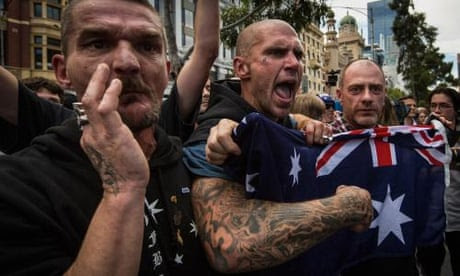
‘Muslims, as 2% of the population, possess little by way of political power, have no significant representation, and own no capacity to impose their will.’ ‘Muslims, as 2% of the population, possess little by way of political power, have no significant representation, and own no capacity to impose their will.’ Photograph: Richard Ashen/Demotix/Corbis
There are no Islamic courts, no practice of its jurisprudence, no laws from the Quran, and yet on Saturday we saw Reclaim Australia rally violently, their placards demanding the country say “No to Sharia!”
Seeing barricades, lines of mounted officers, rivals groups brawling over the truth of the “Islamification” of Australia, is a little overblown when we consider that Muslims, as 2% of the population, possess little by way of political power, have no significant representation, and own no capacity to impose their will.
The Muslim-Australian is hardly a political threat to the nation, and Muslims themselves continue to struggle with the scrutiny applied to them as part of the continued war on terror.
So while we could dismiss the Reclaim movement as paranoid and ignorant, I refuse to see racism as a natural response, like an immune system, to presence of a “real” threat. We need to recognise the powerful feeling of “owning the nation” that comes with white Australia saying “no” to foreigners.
Reclaim’s sentiments come from a social imaginary of Australia under attack, which is inundated with images of a violent Islam. But it’s not that racism is the result of the “presence” of Islamism. It is that Islamism gives racism its convenient vocabulary.
Ordinary people can imagine the erosion of their social surroundings in everyday terms of stories and images that are fed to them in an exaggerated form, of an existential fight between us and them over who owns even the minutiae of life: where we live, the languages we speak and, in the case of the halal certification “debate”, what we eat.
The beleaguered “community” increasingly becomes formed by these fantasies, fears, symbols, caricatures, stereotypes and nightmares. Racism then defaults to a kind of commonsense language, a no-bullshit bypass of political correctness. The community is provoked by a threatening Muslim, a foreigner whose presence is drenched in images of the inhuman violence we see circulated every day, and who is presumed to have an Asiatic capacity for cruelty and violation.
The Muslim as society’s folk devil is no mere illusion or fantasy. It represents deep-seated anxieties about control, displaced on to an Islam that has come to represent symbolically a sense of traditional loss and struggle in a changing global and multicultural world.
Any contest over what is “obvious” about Islam or “real” about Islamism, or whether Muslims need “fixing”, however, misses the point. The Reclaim Australia rallies were never about Islam in the first place, but were a clash of different ideas about being Australian.
Racism is rarely about the reality of the other. 
Racism is rarely about the reality of the other; the Reclaim protestors, without irony or self-reflection, were able to appropriate the Indigenous flag in their cry to reclaim Australia.
With the presence of swastika tattoos, and the general demography of the rally’s participants, it is obvious that race still remains central to our political culture in a constitutive sense; being “white” continues to play a formative role in how we construct what it means to be authentically Aussie.
For some, Aussie still simply means “white”, a sentiment that itself obscures the mostly forgotten English bigotry against the Irish, Australia’s first other.
These days the un-Australian is commonly a figure of colour, who is easily transmittable from one ethnic identity to another. The foreigner as a “form” always remains a thing to respond to, even as we openly acknowledge that, in Australia’s history, its content has always been interchangeable: Asian, African, Arab, Muslim – and yet, always Indigenous.
The foreigner is a piñata doll, the thing you beat so you can still feel you own a stick. It’s a thing to say “no” to, a thing whose integration is to be always measured against “our” standard and in doing so making that standard feel more real than it is.
In these cacophonies of “no” to foreignness, the foreigner is contradictory, fragmentary by its nature. Its truth is secondary to its function as a crude shorthand for the negating of difference and change.


No sensible adult could think Australia is becoming Islamic, and Reclaim Australia has little to do with halal, sharia, jihad or terrorism. These words are like traumas, a backdrop against which the repressed frustration of losing privilege plays out.
Yet despite official denunciation and celebration of diversity, racism as a concept in this country endures, adapting and readapting, chameleon-like to the changing social and political times. It does so because its aim, in part, is to address the sensitive needs of the dominant white nation’s sense of self.
---

Sunday, April 5, 2015

BEEF NAMA

BEEF NAMA


India is a democratic country. India is a secular country. The majority rules. The religions keep distance from State. Still a 3% Brahmin minority aided and abetted by a minuscule Jain minority, has been able to impose its religio-cultural diktats on the entire country, and that too for centuries --- in some form or other. BJP's rule in Maharashtra had brought in a very critical moment, when the ban of cow slaughter had turned into high criminal demonology. People are to be jailed for number of years, just for possession of beef. A situation much worse than the prohibition of liquor or drugs. However, the reaction to the new ban is now being realised by the rest of the majority in different lights. It is be realised that it is a draconian measures and imposes on personal constitutional rights of freedom of Indian citizens. Even though the measure has pointedly aimed as hitting at Muslims, the impact of the ban is developing into an gross anti-people measure. A gradual consensus is appearing to take hold of the liberals who are not communal and/or religious in strictest sense of the words and are ever vigilant to counter all fascist moves by the Saffron fanatics for their self-promotion as the very epitome of uber-nationals to finally grab India for their hundred year old ambition to change India into a exclusive preserve of their existentially disintegrating ideological experimentation.

Indian Express has come out with 3 important articles, that highlights how beef is ingrained into the lives of those that are not Brahmins or call themselves up-castes. And they are the discriminated majority that are bound to react and ask: where is the beef.

Ghulam Muhammed, Mumbai

---

Memories of Meals Past: For the Dalits in Maharashtra, the ban snaps their link to cheap protein


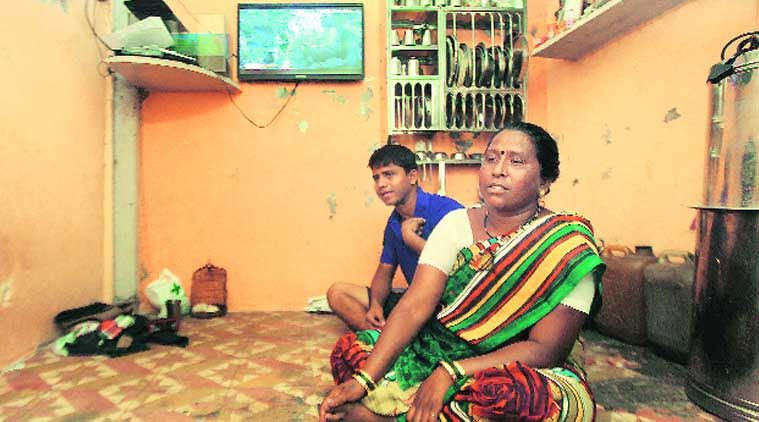
Lalita and son Sagar at their home (Source: Express photo by Prashant Nadkar)
New Delhi | Published on:April 5, 2015 1:00 am
By Anjali Lukose and Alifiya Khan 
Tiny prawns have replaced the succulent beef, but a craving for the mouth-watering “kaali dal aani beef curry” or black lentils with beef curry refuses to go away.
It’s been a month since the Ingles, who work at the fishing dock at Bhaucha Dhakka or ferry wharf in South Mumbai’s Carnac Bunder, tasted their mother’s signature dish. The ban on slaughter of bulls and bullocks in the state and the self-imposed ban on slaughter of water buffaloes by beef dealers meant that the Ingles could find no beef anywhere. This, despite living across one of Asia’s largest abattoirs in Deonar, central Mumbai.
A beef recipe that Lalita Ingle picked up from her grandmother is the family’s favourite. “Thodi kalimari, kuch garam masala. Uska correct mix mein hi beef ka mast taste aata hai (Some pepper, some garam masala. The correct mix is the secret to the yum beef curry),” says Lalita, who is in her mid-40s. “Marinate the meat properly and cook it well but not in excess oil and then mix it with dal and it tastes almost as good as when my aaji (grandmother) used to make it,” she says. Lalita, her husband and three children, all working at the docks, live in the Bhim Sevak Sangh Mohala, Deonar.
For 12 hours a day, seven days a week, 60-year-old Pune resident Suman Ratikar, a ragpicker by profession, goes house to house picking wet waste from dry waste with her bare hands, cleaning verandahs for an extra five rupees and often ends up having to lift soiled diapers. Two days a week, she keeps a fast, which she breaks with chapati and a dry gravy made of beef innards.
Both the Ingles and Ratikars are a part of a food culture that is as old as any other in India. In 2009, a team of researchers from the University of Pune embarked on a project to unearth the food memories of Dalits. “Yes, beef-eating is an intrinsic part of Dalit culture and has been a major source of protein for the community for ages. But it’s important to understand whether this was a choice or food economics that forced the community to eat beef. The basic idea was to untangle the caste, class and gender dynamics of the food we eat,” says Sangita Thosar, a teaching associate at the Tata Institute of Social Sciences, Mumbai, and a Dalit. She was a part of the editorial team of Isn’t This Plate Indian? Dalit Histories and Memories of Food, the result of the project which was led by the late sociologist Sharmila Rege.
The aim of the project was not just to show how deprivation determined Dalit food habits, but also to explore the cuisine’s creativity, its ability to make the most of its frugality. For example, chunchuni is dried and salted beef which is stored sometimes for an entire year, and consumed when families have no money to buy vegetables. Kandawani is a dish made with only onions, with a similar philosophy: to be made when nothing else is available. “Rakti might sound gross to you but is quite nutritious. It is made of coagulated chunks of cattle blood. No part of the animal was wasted,” says Thosar, whose family is from Rohkal village in Osmanabad district’s Paranda Taluka, and who belongs to the Mahar community. Dalits possess their own distinct culinary traditions, she says, but they never figure in any cookbooks, “which only mention upper-caste recipes”.
The book acknowledges that food was central to the concept of untouchability as the Brahminical order first decided who would eat what, and later made it a mark of pure and impure status.
The probable history of why Dalits took to beef lies in the upper-caste Hindu’s aversion to meat as he began to afford a range of vegetables and dairy products. For Dalits, who couldn’t buy richer meats like chicken or mutton, beef remained a staple. “Often it would be the dried meat of dead and decaying cattle. One cooked liver or innards which came at one-third the price. These are fatty portions and require less oil to cook too. For a woman like Ratikar, who gets Rs 50 a day can only spend Rs 40 once in a week to buy beef innards, any other meat is unthinkable,” says Thosar.
The Ingles live in a mixed colony. Here, the mostly fisherfolk Dalit community cohabit with the Qureshi butchers and meat handlers working at the abattoir across the street. The Ingles would buy beef twice a week, mostly at a discounted rate, from their neighbours. While the market rates were Rs 140 a kg, the Ingles would get fresh beef from the abattoir at Rs 100 a kg.
“We bought beef, because it is tastier and relatively cheaper,” says Lalita, who sells fish at the docks. “Now, we bring home more prawns and Bombay Duck to compensate,” she says. More than the dish, the Ingles say, the grim mood at their neighbours’ makes them wish the ban would be repealed. “Chalo, in desperation, we can manage with dal-chawal also. But for our friends, it is a question of their livelihood,” says Sagar Ingle, Lalita’s 22-year-old son.
Thosar believes the ban on beef (except meat from water buffaloes) in Maharashtra will spell disaster for the community. “Imagine the chief protein source vanishes from your diet. Soon prices of water buffalo will go up too. Will they be able to afford it?” she says.
But April 1 was a special day for the Ingles. Their neighbours and close friends were back on duty at the abattoir. “It’s twice the excitement today. Our neighbours have got their jobs back and we will get beef tonight,” says Sagar, referring to the Qureshi community returning to their jobs, this time culling only water buffaloes. “Just yesterday, my father who cannot live without beef, planned to go to Mumbra. He heard they were selling beef there. Legal or illegal, my father did not care. That’s how much he misses it,” he says.
For one night, at least, the smell of beef curry would waft through this lane.
---

How not to waste your beef

beef-2-main
In many places in the Northeast, beef is a lesser meat, but widely consumed
Written by Adam Halliday | New Delhi | Updated: April 5, 2015 7:15 pm
Looking at the north-south expanse of Aizawl, the capital of Mizoram, from a nearby ridge, Liansanga, 34, a community leader, pointed towards a hill-side meadow surrounded by trees and said, “When we were kids, that’s where we used to tether Christmas cows.” It is a custom in these parts for every congregation to save money through the year to buy at least a pig and a cow for the Christmas feast.
“A bunch of us would walk down from the neighbourhood every morning and feed it. It was always the responsibility of the kids to make sure the cow was fattened,” he remembered.
Pigs, on the other hand, are never given such treatment. They are simply bought from its owner and slaughtered near the sty it has always lived in.
It never has and may perhaps never equal the pride of place its wilder cousin, the bison, has in stature as meat, but beef is now more commonly consumed across the tribal, non-Hindu regions of the North-East because it is cheaper and more widely available.
For some tribes in Arunachal Pradesh, it is a lesser meat because while the bison is the meat of choice during celebratory festivals or marriages, beef is rather like chicken and mutton. For some Nagas, it is either a meat for the less wealthy (those who cannot afford to slaughter a pig for a festive family occasion offer guests beef) or sometimes a side-dish accompanying bison meat (when a bison is slaughtered for community feasts, a cow usually follows).
An old Naga saying goes that when male relatives travel to a distant village to look for and find a bison to slaughter for a girl’s wedding feast, the bison will travel on its own to where the wedding will take place. No such mythical intelligence is afforded to the cow, however, a pointer to where it stands on the pantheon of meats.
But nonetheless, beef is widely consumed, and no part of the cow’s body is wasted. Lean meat, tongue, brain, innards, legs, bone, marrow, and no, not even the tail.
The Mizos relish the lean meat when it is simply boiled in some amount of water with seasonings and salt. Most, by the way, swear by the soup’s Viagra-like properties. Sometimes, it is cut into strips and smoked. The Khasis add a larger range of vegetables such as potatoes, cabbage and onions to make stew of it, or mince it to turn out cutlets. Most Nagas like lean meat smoked in thin strips and shredded to accompany chutneys of fermented soya-bean and local herbs.
“We don’t fry our food. Beef has it’s own juice, we add ginger, garlic, chilli powder or fresh green chilli, according to our preference, put it on medium heat and let it cook,” said Aketoli Zhimomi, proprietor of Dimapur’s Ethnic Table restaurant and one of Nagaland’s most famous chefs.
Arunachal Pradesh’s Tani group of tribes smoke it over the hearth fire in large chunks or stuff them into bamboo placed near the flame, bringing it to slow tenderness. “We eat everything from the stomach to the brain to the tongue. Usually they are all cooked inside bamboo, where we place ginger, garlic and some native leafy begetable and we roast it near the fire in the hearth. We call the leaf we use to line the inside of the bamboo akum. We add a little bit of water, and then we slow cook it. So it’s roasting and steaming at the same time,” says Moyir Riba, of the Gallo tribe, one among the Tani group of tribes.
Among the tribes that inhabit the central hills of Arunachal Pradesh, beef innards freshly extracted from their bamboo ovens offer conviviality, for it is more often than not an accompaniment to apong, local beer made from rice or maize, a mildly sweet drink that slowly but surely affects the head.
The head, of course, offers yet another delicacy. The head of a cow, that is. Particularly the brain.
Nagas mostly make incisions all over this organ so a paste of ginger-garlic, chilli and salt seeps into its inner sanctums. The whole is then wrapped in a plantain leaf and stuffed under the warm ashes of a hearth. On top, a wood fire is built. After this, it is dry fried in bits on a pan, then add bamboo-shoot and Raja Mircha (considered the world’s hottest chilli), serving it as a sort of chutney.
Surely some part of the animal must not be consumed, like the bone? “The bone?” asks Zhimomi, bewildered for a moment before recovering with a giggle, “Oh, we love to chew our bones. And the marrow is what we really fight over at home.”
---
Medium, Not Rare
At the Beef King restaurant in Kolkata (Source: Express photo by Partha Paul)
Written by Premankur Biswas | New Delhi | Published on:April 5, 2015 1:00 am
In Rayaz Beef King restaurant, chunks of beef sizzle in a silken red gravy, gargantuan pots of beef biryani are emptied in a matter of hours and moist beef rolls are expertly assembled by the dozens. Sheikh Rayaz, the proprietor of the 40-year-old establishment, insists that business has been “always good”. Even on a sleepy weekday afternoon, the two-storied establishment at the mouth of Prince Anwar Shah Road in South Kolkata is buzzing with customers. Rabi Nandi, 54, a government bus driver, is finishing his meal of beef curry and rice when he decides to join our conversation. “I am a Hindu and I have been a regular customer here for more than 20 years. No one in my family likes having beef but I love the taste. Who is the government to dictate my eating habits?” asks Nandi.
Mumbai might be a city without beef but Kolkata certainly celebrates the flavourful meat. Or does it? Most Muslim-owned biriyani joints in the city sport the “No-beef” tag to “draw in more customers”. Even at the celebrated Nizams, the signature beef roll is no longer on the menu. “We have customers from all communities visiting us, we have to cater to their needs as well. That’s why we did away with beef items from our menu. Even a lot of Muslims don’t like having beef outside their homes,” says Anwar Hussain, a waiter at Nizams.
Most of the places that serve beef actually serve buffalo meat because it’s cheaper and cow slaughter is still frowned upon by most people. “There are a few places where you can get cow meat but they tend to be low-end eateries,” says Poorna Banerjee, a food blogger.
Rayaz Beef King is one such place. Here, plywood tables and wooden benches are the seating arrangement, most of the restaurant spills over to the pavement and none of the items on the menu cross the Rs 50 mark. But that doesn’t deter the customers. “We even have foreigners visiting our restaurant. In fact, one British gentleman was so impressed that he suggested that we name the restaurant Beef King after the famous chain in England. That’s how the restaurant got its name,” says Rayaz.
Even though the search for beef in Kolkata does not drag you into the entrails of a black market, a whiff of disapproval clings to it. “Of course, there is the religious issue but there is also a class thing. Even a number of rich Muslims don’t have beef because it’s considered a poor man’s meat,” says Banerjee.
It’s in the outskirts of the city, in places like Baruipur and Sonarpur, where you will find beef in abundance. “There, people would rather pay Rs 70 for a plate of beef biryani than Rs 100 for a plate of chicken biryani,” says Banerjee. At Asma Hotel, a 35-year-old institution adjacent to the bustling Baruipur station, the pricing is the USP. The flavourful beef biryani has customers making two-hour-long drives for a meal. “Most of our customers are daily labourers. We try to serve them good food for a reasonable price. You would be surprised to find that 80 per cent of our customers are Hindu,” says Masood Ali.
At Park Street and its surrounds, beef items are widely available. The beef steak at Olypub, one of the most popular watering holes of the city, runs on its reputation rather than anything else. “I find it rather chewy but I order it nonetheless. There is an element of glamour in ordering beef steak at Olypub,” says Arkadeep Sarkar, a music teacher with Ashok Hall High School. Sarkar, a Hindu Bengali, knows his parents don’t approve but they have never really stopped him. “As long as I don’t cook it at home. It’s like me consuming alcohol, they pretend that it never happens,” says Sarkar.