Sunday, April 5, 2015

BEEF NAMA

BEEF NAMA


India is a democratic country. India is a secular country. The majority rules. The religions keep distance from State. Still a 3% Brahmin minority aided and abetted by a minuscule Jain minority, has been able to impose its religio-cultural diktats on the entire country, and that too for centuries --- in some form or other. BJP's rule in Maharashtra had brought in a very critical moment, when the ban of cow slaughter had turned into high criminal demonology. People are to be jailed for number of years, just for possession of beef. A situation much worse than the prohibition of liquor or drugs. However, the reaction to the new ban is now being realised by the rest of the majority in different lights. It is be realised that it is a draconian measures and imposes on personal constitutional rights of freedom of Indian citizens. Even though the measure has pointedly aimed as hitting at Muslims, the impact of the ban is developing into an gross anti-people measure. A gradual consensus is appearing to take hold of the liberals who are not communal and/or religious in strictest sense of the words and are ever vigilant to counter all fascist moves by the Saffron fanatics for their self-promotion as the very epitome of uber-nationals to finally grab India for their hundred year old ambition to change India into a exclusive preserve of their existentially disintegrating ideological experimentation.

Indian Express has come out with 3 important articles, that highlights how beef is ingrained into the lives of those that are not Brahmins or call themselves up-castes. And they are the discriminated majority that are bound to react and ask: where is the beef.

Ghulam Muhammed, Mumbai

---

Memories of Meals Past: For the Dalits in Maharashtra, the ban snaps their link to cheap protein
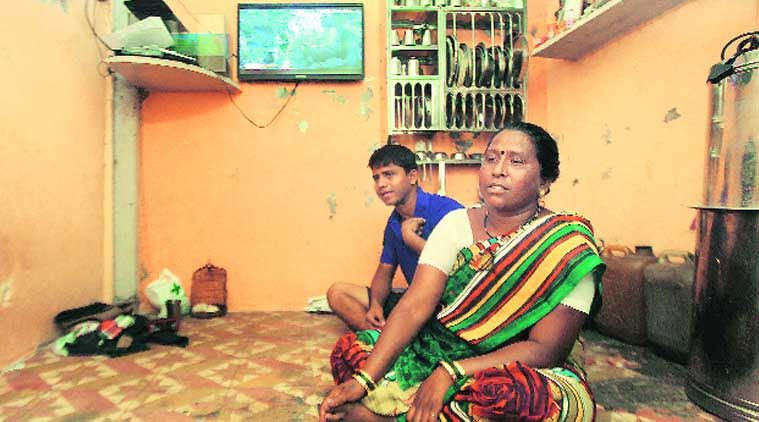


Lalita and son Sagar at their home (Source: Express photo by Prashant Nadkar)
New Delhi | Published on:April 5, 2015 1:00 am
By Anjali Lukose and Alifiya Khan 
Tiny prawns have replaced the succulent beef, but a craving for the mouth-watering “kaali dal aani beef curry” or black lentils with beef curry refuses to go away.
It’s been a month since the Ingles, who work at the fishing dock at Bhaucha Dhakka or ferry wharf in South Mumbai’s Carnac Bunder, tasted their mother’s signature dish. The ban on slaughter of bulls and bullocks in the state and the self-imposed ban on slaughter of water buffaloes by beef dealers meant that the Ingles could find no beef anywhere. This, despite living across one of Asia’s largest abattoirs in Deonar, central Mumbai.
A beef recipe that Lalita Ingle picked up from her grandmother is the family’s favourite. “Thodi kalimari, kuch garam masala. Uska correct mix mein hi beef ka mast taste aata hai (Some pepper, some garam masala. The correct mix is the secret to the yum beef curry),” says Lalita, who is in her mid-40s. “Marinate the meat properly and cook it well but not in excess oil and then mix it with dal and it tastes almost as good as when my aaji (grandmother) used to make it,” she says. Lalita, her husband and three children, all working at the docks, live in the Bhim Sevak Sangh Mohala, Deonar.
For 12 hours a day, seven days a week, 60-year-old Pune resident Suman Ratikar, a ragpicker by profession, goes house to house picking wet waste from dry waste with her bare hands, cleaning verandahs for an extra five rupees and often ends up having to lift soiled diapers. Two days a week, she keeps a fast, which she breaks with chapati and a dry gravy made of beef innards.
Both the Ingles and Ratikars are a part of a food culture that is as old as any other in India. In 2009, a team of researchers from the University of Pune embarked on a project to unearth the food memories of Dalits. “Yes, beef-eating is an intrinsic part of Dalit culture and has been a major source of protein for the community for ages. But it’s important to understand whether this was a choice or food economics that forced the community to eat beef. The basic idea was to untangle the caste, class and gender dynamics of the food we eat,” says Sangita Thosar, a teaching associate at the Tata Institute of Social Sciences, Mumbai, and a Dalit. She was a part of the editorial team of Isn’t This Plate Indian? Dalit Histories and Memories of Food, the result of the project which was led by the late sociologist Sharmila Rege.
The aim of the project was not just to show how deprivation determined Dalit food habits, but also to explore the cuisine’s creativity, its ability to make the most of its frugality. For example, chunchuni is dried and salted beef which is stored sometimes for an entire year, and consumed when families have no money to buy vegetables. Kandawani is a dish made with only onions, with a similar philosophy: to be made when nothing else is available. “Rakti might sound gross to you but is quite nutritious. It is made of coagulated chunks of cattle blood. No part of the animal was wasted,” says Thosar, whose family is from Rohkal village in Osmanabad district’s Paranda Taluka, and who belongs to the Mahar community. Dalits possess their own distinct culinary traditions, she says, but they never figure in any cookbooks, “which only mention upper-caste recipes”.
The book acknowledges that food was central to the concept of untouchability as the Brahminical order first decided who would eat what, and later made it a mark of pure and impure status.
The probable history of why Dalits took to beef lies in the upper-caste Hindu’s aversion to meat as he began to afford a range of vegetables and dairy products. For Dalits, who couldn’t buy richer meats like chicken or mutton, beef remained a staple. “Often it would be the dried meat of dead and decaying cattle. One cooked liver or innards which came at one-third the price. These are fatty portions and require less oil to cook too. For a woman like Ratikar, who gets Rs 50 a day can only spend Rs 40 once in a week to buy beef innards, any other meat is unthinkable,” says Thosar.
The Ingles live in a mixed colony. Here, the mostly fisherfolk Dalit community cohabit with the Qureshi butchers and meat handlers working at the abattoir across the street. The Ingles would buy beef twice a week, mostly at a discounted rate, from their neighbours. While the market rates were Rs 140 a kg, the Ingles would get fresh beef from the abattoir at Rs 100 a kg.
“We bought beef, because it is tastier and relatively cheaper,” says Lalita, who sells fish at the docks. “Now, we bring home more prawns and Bombay Duck to compensate,” she says. More than the dish, the Ingles say, the grim mood at their neighbours’ makes them wish the ban would be repealed. “Chalo, in desperation, we can manage with dal-chawal also. But for our friends, it is a question of their livelihood,” says Sagar Ingle, Lalita’s 22-year-old son.
Thosar believes the ban on beef (except meat from water buffaloes) in Maharashtra will spell disaster for the community. “Imagine the chief protein source vanishes from your diet. Soon prices of water buffalo will go up too. Will they be able to afford it?” she says.
But April 1 was a special day for the Ingles. Their neighbours and close friends were back on duty at the abattoir. “It’s twice the excitement today. Our neighbours have got their jobs back and we will get beef tonight,” says Sagar, referring to the Qureshi community returning to their jobs, this time culling only water buffaloes. “Just yesterday, my father who cannot live without beef, planned to go to Mumbra. He heard they were selling beef there. Legal or illegal, my father did not care. That’s how much he misses it,” he says.
For one night, at least, the smell of beef curry would waft through this lane.
---

How not to waste your beef
beef-2-main
In many places in the Northeast, beef is a lesser meat, but widely consumed
Written by Adam Halliday | New Delhi | Updated: April 5, 2015 7:15 pm
Looking at the north-south expanse of Aizawl, the capital of Mizoram, from a nearby ridge, Liansanga, 34, a community leader, pointed towards a hill-side meadow surrounded by trees and said, “When we were kids, that’s where we used to tether Christmas cows.” It is a custom in these parts for every congregation to save money through the year to buy at least a pig and a cow for the Christmas feast.
“A bunch of us would walk down from the neighbourhood every morning and feed it. It was always the responsibility of the kids to make sure the cow was fattened,” he remembered.
Pigs, on the other hand, are never given such treatment. They are simply bought from its owner and slaughtered near the sty it has always lived in.
It never has and may perhaps never equal the pride of place its wilder cousin, the bison, has in stature as meat, but beef is now more commonly consumed across the tribal, non-Hindu regions of the North-East because it is cheaper and more widely available.
For some tribes in Arunachal Pradesh, it is a lesser meat because while the bison is the meat of choice during celebratory festivals or marriages, beef is rather like chicken and mutton. For some Nagas, it is either a meat for the less wealthy (those who cannot afford to slaughter a pig for a festive family occasion offer guests beef) or sometimes a side-dish accompanying bison meat (when a bison is slaughtered for community feasts, a cow usually follows).
An old Naga saying goes that when male relatives travel to a distant village to look for and find a bison to slaughter for a girl’s wedding feast, the bison will travel on its own to where the wedding will take place. No such mythical intelligence is afforded to the cow, however, a pointer to where it stands on the pantheon of meats.
But nonetheless, beef is widely consumed, and no part of the cow’s body is wasted. Lean meat, tongue, brain, innards, legs, bone, marrow, and no, not even the tail.
The Mizos relish the lean meat when it is simply boiled in some amount of water with seasonings and salt. Most, by the way, swear by the soup’s Viagra-like properties. Sometimes, it is cut into strips and smoked. The Khasis add a larger range of vegetables such as potatoes, cabbage and onions to make stew of it, or mince it to turn out cutlets. Most Nagas like lean meat smoked in thin strips and shredded to accompany chutneys of fermented soya-bean and local herbs.
“We don’t fry our food. Beef has it’s own juice, we add ginger, garlic, chilli powder or fresh green chilli, according to our preference, put it on medium heat and let it cook,” said Aketoli Zhimomi, proprietor of Dimapur’s Ethnic Table restaurant and one of Nagaland’s most famous chefs.
Arunachal Pradesh’s Tani group of tribes smoke it over the hearth fire in large chunks or stuff them into bamboo placed near the flame, bringing it to slow tenderness. “We eat everything from the stomach to the brain to the tongue. Usually they are all cooked inside bamboo, where we place ginger, garlic and some native leafy begetable and we roast it near the fire in the hearth. We call the leaf we use to line the inside of the bamboo akum. We add a little bit of water, and then we slow cook it. So it’s roasting and steaming at the same time,” says Moyir Riba, of the Gallo tribe, one among the Tani group of tribes.
Among the tribes that inhabit the central hills of Arunachal Pradesh, beef innards freshly extracted from their bamboo ovens offer conviviality, for it is more often than not an accompaniment to apong, local beer made from rice or maize, a mildly sweet drink that slowly but surely affects the head.
The head, of course, offers yet another delicacy. The head of a cow, that is. Particularly the brain.
Nagas mostly make incisions all over this organ so a paste of ginger-garlic, chilli and salt seeps into its inner sanctums. The whole is then wrapped in a plantain leaf and stuffed under the warm ashes of a hearth. On top, a wood fire is built. After this, it is dry fried in bits on a pan, then add bamboo-shoot and Raja Mircha (considered the world’s hottest chilli), serving it as a sort of chutney.
Surely some part of the animal must not be consumed, like the bone? “The bone?” asks Zhimomi, bewildered for a moment before recovering with a giggle, “Oh, we love to chew our bones. And the marrow is what we really fight over at home.”
---
Medium, Not Rare
At the Beef King restaurant in Kolkata (Source: Express photo by Partha Paul)
Written by Premankur Biswas | New Delhi | Published on:April 5, 2015 1:00 am
In Rayaz Beef King restaurant, chunks of beef sizzle in a silken red gravy, gargantuan pots of beef biryani are emptied in a matter of hours and moist beef rolls are expertly assembled by the dozens. Sheikh Rayaz, the proprietor of the 40-year-old establishment, insists that business has been “always good”. Even on a sleepy weekday afternoon, the two-storied establishment at the mouth of Prince Anwar Shah Road in South Kolkata is buzzing with customers. Rabi Nandi, 54, a government bus driver, is finishing his meal of beef curry and rice when he decides to join our conversation. “I am a Hindu and I have been a regular customer here for more than 20 years. No one in my family likes having beef but I love the taste. Who is the government to dictate my eating habits?” asks Nandi.
Mumbai might be a city without beef but Kolkata certainly celebrates the flavourful meat. Or does it? Most Muslim-owned biriyani joints in the city sport the “No-beef” tag to “draw in more customers”. Even at the celebrated Nizams, the signature beef roll is no longer on the menu. “We have customers from all communities visiting us, we have to cater to their needs as well. That’s why we did away with beef items from our menu. Even a lot of Muslims don’t like having beef outside their homes,” says Anwar Hussain, a waiter at Nizams.
Most of the places that serve beef actually serve buffalo meat because it’s cheaper and cow slaughter is still frowned upon by most people. “There are a few places where you can get cow meat but they tend to be low-end eateries,” says Poorna Banerjee, a food blogger.
Rayaz Beef King is one such place. Here, plywood tables and wooden benches are the seating arrangement, most of the restaurant spills over to the pavement and none of the items on the menu cross the Rs 50 mark. But that doesn’t deter the customers. “We even have foreigners visiting our restaurant. In fact, one British gentleman was so impressed that he suggested that we name the restaurant Beef King after the famous chain in England. That’s how the restaurant got its name,” says Rayaz.
Even though the search for beef in Kolkata does not drag you into the entrails of a black market, a whiff of disapproval clings to it. “Of course, there is the religious issue but there is also a class thing. Even a number of rich Muslims don’t have beef because it’s considered a poor man’s meat,” says Banerjee.
It’s in the outskirts of the city, in places like Baruipur and Sonarpur, where you will find beef in abundance. “There, people would rather pay Rs 70 for a plate of beef biryani than Rs 100 for a plate of chicken biryani,” says Banerjee. At Asma Hotel, a 35-year-old institution adjacent to the bustling Baruipur station, the pricing is the USP. The flavourful beef biryani has customers making two-hour-long drives for a meal. “Most of our customers are daily labourers. We try to serve them good food for a reasonable price. You would be surprised to find that 80 per cent of our customers are Hindu,” says Masood Ali.
At Park Street and its surrounds, beef items are widely available. The beef steak at Olypub, one of the most popular watering holes of the city, runs on its reputation rather than anything else. “I find it rather chewy but I order it nonetheless. There is an element of glamour in ordering beef steak at Olypub,” says Arkadeep Sarkar, a music teacher with Ashok Hall High School. Sarkar, a Hindu Bengali, knows his parents don’t approve but they have never really stopped him. “As long as I don’t cook it at home. It’s like me consuming alcohol, they pretend that it never happens,” says Sarkar.

Friday, April 3, 2015

THE FUTURE OF WORLD RELIGIONS: POPULATION GROWTH PROJECTIONS, 2010-2050 - PEW Research Center

http://www.pewforum.org/2015/04/02/muslims/#change-in-countries-with-largest-muslim-populations


Pew Research Center

Religion & Public Life

APRIL 2, 2015

THE FUTURE OF WORLD RELIGIONS: POPULATION 

GROWTH PROJECTIONS, 2010-2050

Muslims


Projected Global Muslim Population, 2010-2050The number of Muslims around the world is projected to increase rapidly in the decades ahead, growing from about 1.6 billion in 2010 to nearly 2.8 billion in 2050.40 Muslims are expected to grow twice as fast as the overall global population. Consequently, Muslims are projected to rise from 23% of the world’s population in 2010 to 30% in 2050.41
Projected Compound Annual Growth Rates for Muslims Between Five-Year PeriodsThis significant projected growth is largely due to the young age and high fertility rate of Muslims relative to other religious groups.
The annual growth rate of Muslims is expected to be considerably higher than the rate for the world as a whole. In 2010-2015, the expected Muslim growth rate is 1.8% while the rate for the world’s population is 1.1%. Both rates are expected to decline over time. In 2045-2050, for example, the annual growth rate of Muslims is projected to be about 1% while it will be 0.4% for the world.

Regional Change

Change in Regional Distribution of Muslims, 2010 vs. 2050Looking to the future, the Asia-Pacific region is expected to remain the home of a majority of the world’s Muslims. However, the share of the global Muslim population living in several Asian countries with large Muslim populations (such as Indonesia, Pakistan and Bangladesh) is anticipated to decline between 2010 and 2050. While 62% of the world’s Muslims lived in Asia and the Pacific in 2010, 53% are projected to live in the region in 2050.
The Middle East-North Africa region is predominantly Muslim, but as of 2010, only one-in-five Muslims lived in that part of the world. By 2050, about the same share of the global Muslim population is expected to live in the Middle East and North Africa (20%).
Sub-Saharan Africa is projected to have a significantly larger share of the world’s Muslims in 2050 compared with 2010. About 24% of the world’s Muslims are expected to live in sub-Saharan Africa in 2050, up from nearly 16% in 2010.
Muslim populations are expected to grow in absolute number in all regions of the world between 2010 and 2050. In the Asia-Pacific region, for instance, the Muslim population is expected to reach nearly 1.5 billion by 2050, up from roughly 1 billion in 2010. The number of Muslims in the Middle East-North Africa region is expected to increase from about 300 million in 2010 to more than 550 million in 2050. The Muslim population in sub-Saharan Africa is forecast to more than double, growing from about 250 million in 2010 to nearly 670 million in 2050. The absolute number of Muslims also is projected to increase in regions with smaller Muslim populations, including Europe and North America.
World Muslim Population by Region, 2010 and 2050Although a smaller share of the world’s Muslims are projected to live in the Asia-Pacific region in 2050 compared with 2010, the share of the region’s population that is Muslim is expected to grow from 24% in 2010 to nearly 30% in 2050. In fact, Muslims are projected to surpass Hindus and become the largest religious group in the Asia-Pacific region by 2050.
The share of the population in sub-Saharan Africa that is Muslim also is expected to grow in the coming decades, from about 30% in 2010 to 35% in 2050. Meanwhile, the overwhelming majority of the population in the Middle East and North Africa is projected to remain Muslim – increasing from about 93% of the region’s population in 2010 to 94% in 2050.
Muslim Population Growth Compared With Overall Growth in Each Region, 2010 to 2050As a share of Europe’s population, Muslims are expected to nearly double, growing from about 6% in 2010 to about 10% in 2050. In North America, the share of the population identifying with Islam is expected to grow from 1% to 2% in the coming decades.
Between 2010 and 2050, the most rapid Muslim population growth in percentage terms is projected to occur in North America (197%) — more than seven times the expected increase in the region’s overall population (26%). The Muslim population in sub-Saharan Africa also is anticipated to grow more than in the region as a whole (170% vs. 131%).
With the bulk of the Middle East-North Africa region’s population being Muslim, the overall growth for Muslims there (74%) is expected to be about the same as the region overall (73%).
The Muslim population in Europe is expected to grow by 63% between 2010 and 2050, while Europe’s overall population is expected to decrease in size (minus 6%). During this period, the Muslim population in the Asia-Pacific region is expected to increase by 48% while the region’s population as a whole increases by 22%.
The relatively small population of Muslims in Latin America and the Caribbean is anticipated to increase by 13% between 2010 and 2050, while the region’s overall population is expected to grow 27%.

Change in Countries With Largest Muslim Populations

Collectively, the 10 countries with the largest Muslim populations in 2010 are expected to account for roughly the same share of the world’s total population in coming decades (35% in 2050, compared with about 32% in 2010). In most cases, little change is expected in each country’s share of the global population. The one exception is Nigeria, where about 4% of the world’s population is expected to reside in 2050 (up from about 2% in 2010).
Projected Population Change in Countries With Largest Muslim Populations in 2010In eight of the 10 countries, the share of the population that is Muslim is expected to remain about the same. However, the Muslim share of the population is expected to increase in India and Nigeria. Muslims made up 14% of India’s population in 2010; they are expected to rise to 18% in 2050. Less than half of Nigeria’s population (49%) was Muslim in 2010, but Muslims are expected to make up a majority of the population (59%) in 2050.
As of 2010, Indonesia had the largest number of Muslims (about 209 million Muslims, or about 13% of the world’s Muslims), followed by India (176 million, or about 11%), Pakistan (167 million, 10%) and Bangladesh (134 million, 8%). Nigeria, Egypt, Iran and Turkey each also had more than 70 million Muslims in 2010.
With the exception of India, where Muslims are a minority religious group, and Nigeria, where Muslims made up nearly half the population, the other eight countries on the list each had a large Muslim majority in 2010.
India is projected to have the world’s largest Muslim population in 2050 (311 million), while Pakistan is expected to have the second-most Muslims (273 million). Indonesia – the country with the largest number of Muslims in 2010 – is expected to fall to third place by 2050, with 257 million Muslims. Nigeria is forecast to rank fourth, with about 231 million Muslims at mid-century.
By 2050, Iraq and Afghanistan are expected to join the list of countries with the 10 largest Muslim populations. All told, more than six-in-ten of the world’s Muslims (62%) are projected to live in the 10 countries with the most Muslims in 2050, slightly smaller than the share of the world’s Muslims that lived in the top 10 countries in 2010 (66%).
10 Countries With the Largest Muslim Populations, 2010 and 2050

Demographic Characteristics of Muslims That Will Shape Their Future

Fertility

Total Fertility Rates of Muslims by Region, 2010-2015With a Total Fertility Rate (TFR) of 3.1 children per woman, Muslims have higher fertility levels than the world’s overall population between 2010 and 2015 (2.5). High fertility is a major driver of projected Muslim population growth around the world and in particular regions. In every region for which data were available, the TFR for Muslims is at or above the replacement level of 2.1 children per woman (the number needed to maintain a stable population, all else being equal).
In every region except the Middle East and North Africa, Muslim fertility is higher than the rate for the region as a whole. Muslim women in sub-Saharan Africa, for example, have nearly one more child on average than women in the region overall between 2010 and 2015.
The countries with the highest Muslim fertility in the 2010-2015 period are concentrated in sub-Saharan Africa, including Niger (6.9), Nigeria (6.5), Somalia (6.3), Mali (6.1), Rwanda (6.0) and Malawi (6.0). The Muslim fertility rate in India (3.2) is around the same as the global rate for Muslims (3.1); in part because Muslims in Indonesia are having fewer children (2.0), India is expected to pass Indonesia and become the country with the world’s largest Muslim population by 2050. While Muslim fertility is well above replacement level in many countries, it is below replacement level in Iran (1.6) and in much of Eastern Europe, including Romania (1.5) and Russia (1.6).
Total Fertility Rates of Muslims, by Country

Age Structure

Age Distribution, 2010Globally, Muslims were younger (median age of 23) than the overall population (median age of 28) as of 2010. Indeed, of all the religious groups included in this study, Muslims had the youngest median age as of 2010. The percentage of the population younger than 15 is another indication of the relative youth of a population. In 2010, 34% of the global Muslim population was under age 15, compared with 27% of the overall world population.
Age Distribution of Muslims by Region, 2010In the Asia-Pacific region, where about six-in-ten of the world’s Muslims live, the median age of Muslims (24) was five years younger than the median age of the region as a whole (29). Mostly owing to a high number of young immigrants and their children, Muslims in Europe (median age of 32) and North America (median age of 26) also were considerably younger than the general populations in these regions as of 2010.
Muslims in sub-Saharan Africa and the Middle East-North Africa region were similar in age to those regions’ general populations in 2010.

Religious Switching

Projected Scenarios for Muslims With and Without Religious Switching, 2050In the Asia-Pacific region, the Middle East and North Africa and Latin America and the Caribbean, the projected Muslim share of the population in 2050 is about the same whether or not religious switching is taken into account in the population projections.
Religious switching only marginally changes the projected Muslim share of the population in North America, where the Muslim population is expected to be 0.2% smaller when religious switching is included in the projection scenario. This means that a small net loss of Muslims is occurring in North America through religious switching.
Meanwhile, net gains of Muslims through religious switching appear to be happening in sub-Saharan Africa and Europe. But again, they are not anticipated to significantly change the projected Muslim populations in these regions.

Migration

Projected Scenarios for Muslims With and Without Migration, 2050About 3.6 million Muslims are expected to move to a new region between 2010 and 2015, mostly coming from majority-Muslim countries in the Asia-Pacific and Middle East-North Africa regions. More than 1 million are forecast to move to Europe, including 600,000 from Asia and the Pacific and an additional 470,000 from the Middle East and North Africa.
At the same time, about 170,000 Muslims from the Asia-Pacific region and 120,000 from the Middle East-North Africa region are forecast to move to North America between 2010 and 2015. And more than 1 million Muslim migrants are expected to move from the Asia-Pacific region to the Middle East-North Africa region during this time period. These migration patterns are projected to continue in the decades ahead. (See the Methodology for more information on how migration flows were estimated.)
As Muslim migrants leave the Asia-Pacific and Middle East-North Africa regions, their movements are projected to decrease slightly the shares of those regions that are Muslim while increasing the Muslim shares of Europe and North America.
When migration is factored into the projection models, Muslims are expected to make up 10% of Europe’s population in 2050; without migration, the figure would be about 8%. For North America, when migration is considered in the projection models, the expected share of the region’s 2050 population that is Muslim is about one percentage point higher than it would be without migration (2% vs. 1%).
Muslim Migration, 2010-2015

  1. For more information about Islam and its major branches (Sunni and Shia), see “Defining the Religious Groups.” ↩
  2. Some projections for Muslims included in this report may differ from those in the Pew Research Center’s January 2011 report “The Future of the Global Muslim Population.” http://www.pewforum.org/2011/01/27/the-future-of-the-global-muslim-population/. This report uses more recent demographic information than the earlier report on the global Muslim population. ↩

Monday, March 30, 2015

NYT Publishes Call to Bomb Iran - By Robert Parry -

http://www.commondreams.org/views/2015/03/29/nyt-publishes-call-bomb-iran

Published on
Sunday, March 29, 2015
by

NYT Publishes Call to Bomb Iran

An Iranian man holding a photo of Supreme Leader Ali Khamenei. (Iranian government photo)
If two major newspapers in, say, Russia published major articles openly advocating the unprovoked bombing of a country, say, Israel, the U.S. government and news media would be aflame with denunciations about “aggression,” “criminality,” “madness,” and “behavior not fitting the Twenty-first Century.”

But when the newspapers are American – the New York Times and the Washington Post – and the target country is Iran, no one in the U.S. government and media bats an eye. These inflammatory articles – these incitements to murder and violation of international law – are considered just normal discussion in the Land of Exceptionalism.

On Thursday, the New York Times printed an op-ed that urged the bombing of Iran as an alternative to reaching a diplomatic agreement that would sharply curtail Iran’s nuclear program and ensure that it was used only for peaceful purposes. The Post published a similar “we-must-bomb-Iran” op-ed two weeks ago.

The Times’ article by John Bolton, a neocon scholar from the American Enterprise Institute, was entitled “To Stop Iran’s Bomb, Bomb Iran.” It followed the Post’s op-ed by Joshua Muravchik, formerly at AEI and now a fellow at the neocon-dominated School of Advanced International Studies at Johns Hopkins. [For more on that piece, see Consortiumnews.com’s “Neocon Admits Plan to Bomb Iran.”]

Both articles called on the United States to mount a sustained bombing campaign against Iran to destroy its nuclear facilities and to promote “regime change” in Tehran. Ironically, these “scholars” rationalized their calls for unprovoked aggression against Iran under the theory that Iran is an aggressive state, although Iran has not invaded another country for centuries.

Bolton, who served as President George W. Bush’s ambassador to the United Nations, based his call for war on the possibility that if Iran did develop a nuclear bomb – which Iran denies seeking and which the U.S. intelligence community agrees Iran is not building – such a hypothetical event could touch off an arms race in the Middle East.

Curiously, Bolton acknowledged that Israel already has developed an undeclared nuclear weapons arsenal outside international controls, but he didn’t call for bombing Israel. He wrote blithely that “Ironically perhaps, Israel’s nuclear weapons have not triggered an arms race. Other states in the region understood — even if they couldn’t admit it publicly — that Israel’s nukes were intended as a deterrent, not as an offensive measure.”

How Bolton manages to read the minds of Israel’s neighbors who have been at the receiving end of Israeli invasions and other cross-border attacks is not explained. Nor does he address the possibility that Israel’s possession of some 200 nuclear bombs might be at the back of the minds of Iran’s leaders if they do press ahead for a nuclear weapon.

Nor does Bolton explain his assumption that if Iran were to build one or two bombs that it would use them aggressively, rather than hold them as a deterrent. He simply asserts: “Iran is a different story. Extensive progress in uranium enrichment and plutonium reprocessing reveal its ambitions.”

Pulling Back on Refinement

But is that correct? In its refinement of uranium, Iran has not progressed toward the level required for a nuclear weapon since its 2013 interim agreement with the global powers known as “the p-5 plus one” – for the permanent members of the UN Security Council plus Germany. Instead, Iran has dialed back the level of refinement to below 5 percent (what’s needed for generating electricity) from its earlier level of 20 percent (needed for medical research) — compared with the 90-plus percent purity to build a nuclear weapon.

In other words, rather than challenging the “red line” of uranium refinement that Israeli Prime Minister Benjamin Netanyahu drew during a United Nations speech in 2012, the Iranians have gone in the opposite direction – and they have agreed to continue those constraints if a permanent agreement is reached with the p-5-plus-1.

However, instead of supporting such an agreement, American neocons – echoing Israeli hardliners – are demanding war, followed by U.S. subversion of Iran’s government through the financing of an internal opposition for a coup or a “colored revolution.”

Bolton wrote: “An attack need not destroy all of Iran’s nuclear infrastructure, but by breaking key links in the nuclear-fuel cycle, it could set back its program by three to five years. The United States could do a thorough job of destruction, but Israel alone can do what’s necessary. Such action should be combined with vigorous American support for Iran’s opposition, aimed at regime change in Tehran.”

But one should remember that neocon schemes – drawn up at their think tanks and laid out on op-ed pages – don’t always unfold as planned. Since the 1990s, the neocons have maintained a list of countries considered troublesome for Israel and thus targeted for “regime change,” including Iraq, Syria and Iran. In 2003, the neocons got their chance to invade Iraq, but the easy victory that they predicted didn’t exactly pan out.

Still, the neocons never revise their hit list. They just keep coming up with more plans that, in total, have thrown much of the Middle East, northern Africa and now Ukraine into bloodshed and chaos. In effect, the neocons have joined Israel in its de facto alliance with Saudi Arabia for a Sunni sectarian conflict against the Shiites and their allies. Much like the Saudis, Israeli officials rant against the so-called “Shiite crescent” from Tehran through Baghdad and Damascus to Beirut. [See Consortiumnews.com’s “Congress Cheers Netanyahu’s Hatred of Iran.”]

Since Iran is considered the most powerful Shiite nation and is allied with Syria, which is governed by Alawites, an offshoot of Shiite Islam, both countries have remained in the neocons’ crosshairs. But the neocons don’t actually pull the trigger themselves. Their main role is to provide the emotional and political arguments to get the American people to hand over their tax money and their children to fight these wars.

The neocons are so confident in their skills at manipulating the U.S. decision-making process that some have gone so far as to suggest Americans should side with al-Qaeda’s Nusra Front in Syria or the even more brutal Islamic State, because those groups love killing Shiites and thus are considered the most effective fighters against Iran’s allies. [See Consortiumnews.com’s “The Secret Saudi Ties to Terrorism.”]

Friedman’s Madness

The New York Times’ star neocon columnist Thomas L. Friedman ventured to the edge of madness as he floated the idea of the U.S. arming the head-chopping Islamic State, writing this month: “Now I despise ISIS as much as anyone, but let me just toss out a different question: Should we be arming ISIS?”

I realize the New York Times and Washington Post are protected by the First Amendment and can theoretically publish whatever they want. But the truth is that the newspapers are extremely restrictive in what they print. Their op-ed pages are not just free-for-alls for all sorts of opinions.

For instance, neither newspaper would publish a story that urged the United States to launch a bombing campaign to destroy Israel’s actual nuclear arsenal as a step toward creating a nuclear-free Middle East. That would be considered outside responsible thought and reasonable debate.

However, when it comes to advocating a bombing campaign against Iran’s peaceful nuclear program, the two newspapers are quite happy to publish such advocacy. The Times doesn’t even blush when one of its most celebrated columnists mulls over the idea of sending weapons to the terrorists in ISIS – all presumably because Israel has identified “the Shiite crescent” as its current chief enemy and the Islamic State is on the other side.

But beyond the hypocrisy and, arguably, the criminality of these propaganda pieces, there is also the neocon record of miscalculation. Remember how the invasion of Iraq was supposed to end with Iraqis tossing rose petals at the American soldiers instead of planting “improvised explosive devices” – and how the new Iraq was to become a model pluralistic democracy?

Well, why does one assume that the same geniuses who were so wrong about Iraq will end up being right about Iran? What if the bombing and the subversion don’t lead to nirvana in Iran? Isn’t it just as likely, if not more so, that Iran would react to this aggression by deciding that it needed nuclear bombs to deter further aggression and to protect its sovereignty and its people?

In other words, might the scheming by Bolton and Muravchik — as published by the New York Times and the Washington Post — produce exactly the result that they say they want to prevent? But don’t worry. If the neocons’ new schemes don’t pan out, they’ll just come up with more.
© 2014 Consortium News
Robert Parry broke many of the Iran-Contra stories in the 1980s for the Associated Press and Newsweek. His latest book, Neck Deep: The Disastrous Presidency of George W. Bush, was written with two of his sons, Sam and Nat. His two previous books are Secrecy & Privilege: The Rise of the Bush Dynasty from Watergate to Iraq and Lost History: Contras, Cocaine, the Press & 'Project Truth'.