http://www.nytimes.com/2014/

In Tunnel War, Israeli Playbook Offers Few Ideas
By ISABEL KERSHNER
AUG. 1, 2014
AUG. 1, 2014
Photo
 Israeli soldiers near the
Kerem Shalom crossing into Gaza on Friday. A retired Israeli general
said Hamas had “changed its doctrine” in attacking from tunnels.
Credit
Amir Cohen/Reuters
Israeli soldiers near the
Kerem Shalom crossing into Gaza on Friday. A retired Israeli general
said Hamas had “changed its doctrine” in attacking from tunnels.
Credit
Amir Cohen/Reuters
Related Coverage:
JERUSALEM — Israel entered its latest conflict with Hamas armed with a high-tech arsenal, real-time battlefield intelligence and strong domestic support for dealing a heavy blow to Hamas.
But again on Friday, Israeli forces were taken by surprise, this time with two soldiers killed and one taken prisoner when militants once again attacked from a tunnel in Gaza.
As frustration grows in Israel over the military’s limited success so far in trying to neutralize Hamas, the militant Islamic group that governs Gaza, some military experts say it is increasingly evident that the Israel Defense Forces have been operating from an old playbook and are not fully prepared for a more sophisticated, battle-ready adversary. The issue is not specifically the tunnels — which Israel knew about — but the way Hamas fighters trained to use them to create what experts in Israel are calling a “360-degree front.”
“Hamas has changed its doctrine and is using the tunnels as a main method of operation,” said Israel Ziv, a retired general who headed the military’s Gaza division and its operations directorate. “This is something we learned amid the fighting.”
Video

[Please click the original source: http://www.nytimes.com/2014/
Of the 32 fortified tunnels that the Israeli military has exposed so far, at least 11 run deep beneath the border into Israeli territory. Others are part of an underground labyrinth inside Gaza connecting buildings, weapons stores and concealed rocket launchers.
Israeli troops in Gaza described Hamas gunmen who vanished from one house, like magicians, and suddenly popped up to fire at them from another. And while Hamas fighters are able to use the tunnels to surprise the forces from behind and to attack those in the rear, Israeli soldiers find themselves having to improvise.
In the Gaza war that began in late 2008, 10 Israeli soldiers were killed, four of them from friendly fire. This time, 63 soldiers have been killed, mostly in combat, and one is now a prisoner.
“The military has been playing it by ear,” said Amos Harel, a military affairs analyst for the newspaper Haaretz, who added that despite the Israeli military’s knowledge of the tunnels, its planners did not draft a new doctrine for prosecuting a land invasion. “But it is pretty good at doing that, and has done it many times.”
In this latest asymmetrical war with Hamas, the third in five years, Israel thought it was prepared. It had built up an integrated communications systems able to transfer intelligence in real time to air and ground forces, an advancement that military officials called a “force multiplier.”
Precision-guided missiles have destroyed up to a third of Hamas’s rocket stocks, according to Israeli officials, as well as hundreds of houses or apartments that the military described as militant command-and-control centers and many other weapons production sites and stores. In 24 days of intense bombing, 4,300 targets have been hit.
Photo
 Israeli soldiers prepare to enter Gaza.
Credit
Uriel Sinai for The New York Times
Israeli soldiers prepare to enter Gaza.
Credit
Uriel Sinai for The New York Times
Hamas still has up to 4,000 rockets, beyond the more than 3,000 that it has fired into Israel. More than 1,600 Palestinians have been killed, many of them civilians, according to Gaza officials, stirring international outrage and raising demands for a cease-fire.
And while Israel says it has killed hundreds of militants and arrested scores more, Hamas’s senior military command and political leadership remain intact.
“The leadership hides underground, like under Shifa Hospital,” said Eado Hecht, a military analyst who teaches at the Israeli military’s Command and General Staff College and at Bar-Ilan and Haifa Universities.
What Israel was apparently less ready for was Hamas fighters who are willing to engage and are trained to use tunnels, a tool of war whose roots go back to antiquity. During Israel’s last ground incursion in the winter of 2008-9, Hamas fighters largely avoided clashes, melting into the crowded urban landscape. This time, they were prepared for combat.
“What surprised me was the operational plans they built,” said Atai Shelach, a former commander of the military’s combat engineering unit.
The tunnels themselves, while well known, have also presented a challenge. After years of research there is still no technological solution for detecting and destroying them from afar, officials said.
The shafts leading to Hamas’s labyrinth are “inside houses, so we won’t see them from the air,” said Mr. Hecht, the military analyst.
“You have to go house to house and check,” he added.
On Thursday, the military distributed video footage of two tunnel shafts discovered under a prayer room in a mosque.
As Israel’s forces have slowly advanced, they have pummeled neighborhoods with heavy artillery, which analysts said was militarily necessary to safeguard soldiers. Those tactics have also drawn international condemnation for devastating civilian homes and infrastructure, and taking so many lives. “In a dense urban environment, you need to use aggressive force to save soldiers’ lives,” Mr. Harel, the military affairs analyst, said.
Special forces are equipped with portable Israeli-made Spike antitank guided missiles with ranges of 1.5 to 15 miles. Yiftah Shapir, a weapons expert at the Institute for National Security Studies at Tel Aviv University, said they could be used for almost anything, and were so accurate that they could pinpoint a window on a building.
Hamas has also upgraded its weaponry. Aside from its rockets, some of which can reach almost to the northern Israeli port city of Haifa, its arsenal includes antiaircraft and antitank missiles.
The number of Palestinian casualties in Gaza is comparable to that in the 2008-9 conflict, when about 1,400 were killed, according to Palestinian figures. Israel put the figure at closer to 1,120.
Photo
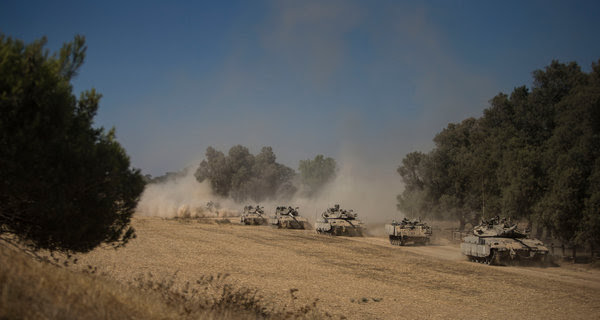 Tanks near the border.
Frustration is growing in Israel over the military’s limited success so
far in trying to neutralize Hamas.
Credit
Uriel Sinai for The New York Times
Tanks near the border.
Frustration is growing in Israel over the military’s limited success so
far in trying to neutralize Hamas.
Credit
Uriel Sinai for The New York Times
Still, a decisive Israeli victory over Hamas remains elusive.
“The question is not military; the question is what does Israel want,” said Yaakov Amidror, a retired general who served as Israel’s national security adviser until November. To bring complete quiet to Gaza would require a takeover and occupation of the territory for six months to a year, he said. Israel, which unilaterally withdrew its forces and settlements from the Gaza Strip in 2005, has little appetite to return.
What is left, military officials say, is to create deterrence. In recent years, Israeli strategists have spoken of the “Dahiya doctrine,” referring to Israel’s flattening of the Dahiya district in Beirut, a Shiite neighborhood that housed the command-and-control headquarters of Hezbollah, during its 34-day war in Lebanon in the summer of 2006. The idea was to inflict such damage that the other side would decide confrontation was not worthwhile.
While many Israelis deemed that war a failure, it has restored quiet to Israel’s northern border for the last eight years.
But experts say the Dahiya doctrine does not apply to Gaza. The Hamas command is not concentrated in one area, and the leader of the movement, Khaled Meshal, lives in exile, “in a five-star hotel in Qatar,” as Mr. Amidror put it, where the impact of the destruction is less immediate.
Gabi Siboni, who runs the military and strategic affairs program at the Institute for National Security Studies, said another reason was that Hamas “is not accountable, not to the world and not to its citizens.” By embedding its forces and fighting from within the population centers, he said, Hamas has raised its willingness “to sacrifice” its civilians “to an art form.”
Hamas has said it is fighting to lift the economic blockade from Gaza and wants an opening of the passages controlled by Israel and Egypt, among other things — demands that would be addressed if substantive cease-fire talks were to take place in Cairo. Israel wants blocks on Hamas’s ability to rearm and, eventually, to see Gaza demilitarized.
----- ----- ----- ----- -----
.
-
Gaza Fighting Intensifies as Cease-Fire Falls ApartAUG. 1, 2014
-
Obama Casts Doubt on Chances of Gaza Cease-FireAUG. 1, 2014
-
Quest for Demilitarization of Gaza Is Seen Getting Netanyahu Only So FarJULY 30, 2014
-
Peering Into Darkness Beneath the Israel-Gaza BorderJULY 25, 2014
-
From Gaza, an Array of Makeshift Rockets Packs a CounterpunchJULY 17, 2014
-
Birthright Trips to Israel Continue Despite Mideast ConflictAUG. 1, 2014


JERUSALEM — Israel entered its latest conflict with Hamas armed with a high-tech arsenal, real-time battlefield intelligence and strong domestic support for dealing a heavy blow to Hamas.
But again on Friday, Israeli forces were taken by surprise, this time with two soldiers killed and one taken prisoner when militants once again attacked from a tunnel in Gaza.
As frustration grows in Israel over the military’s limited success so far in trying to neutralize Hamas, the militant Islamic group that governs Gaza, some military experts say it is increasingly evident that the Israel Defense Forces have been operating from an old playbook and are not fully prepared for a more sophisticated, battle-ready adversary. The issue is not specifically the tunnels — which Israel knew about — but the way Hamas fighters trained to use them to create what experts in Israel are calling a “360-degree front.”
“Hamas has changed its doctrine and is using the tunnels as a main method of operation,” said Israel Ziv, a retired general who headed the military’s Gaza division and its operations directorate. “This is something we learned amid the fighting.”
Video
Play Video|2:20
[Please click the original source: http://www.nytimes.com/2014/
Hamas’s Tunnels to Israel
An underground look at Hamas’s tunnels into Israel.
Video Credit By Carrie Halperin and Sofia Perpetua on
Publish Date July 22, 2014.
Image CreditJim Hollander/European Pressphoto Agency
----- -----
----- -----
Of the 32 fortified tunnels that the Israeli military has exposed so far, at least 11 run deep beneath the border into Israeli territory. Others are part of an underground labyrinth inside Gaza connecting buildings, weapons stores and concealed rocket launchers.
Israeli troops in Gaza described Hamas gunmen who vanished from one house, like magicians, and suddenly popped up to fire at them from another. And while Hamas fighters are able to use the tunnels to surprise the forces from behind and to attack those in the rear, Israeli soldiers find themselves having to improvise.
In the Gaza war that began in late 2008, 10 Israeli soldiers were killed, four of them from friendly fire. This time, 63 soldiers have been killed, mostly in combat, and one is now a prisoner.
“The military has been playing it by ear,” said Amos Harel, a military affairs analyst for the newspaper Haaretz, who added that despite the Israeli military’s knowledge of the tunnels, its planners did not draft a new doctrine for prosecuting a land invasion. “But it is pretty good at doing that, and has done it many times.”
In this latest asymmetrical war with Hamas, the third in five years, Israel thought it was prepared. It had built up an integrated communications systems able to transfer intelligence in real time to air and ground forces, an advancement that military officials called a “force multiplier.”
Precision-guided missiles have destroyed up to a third of Hamas’s rocket stocks, according to Israeli officials, as well as hundreds of houses or apartments that the military described as militant command-and-control centers and many other weapons production sites and stores. In 24 days of intense bombing, 4,300 targets have been hit.
Photo
Hamas still has up to 4,000 rockets, beyond the more than 3,000 that it has fired into Israel. More than 1,600 Palestinians have been killed, many of them civilians, according to Gaza officials, stirring international outrage and raising demands for a cease-fire.
And while Israel says it has killed hundreds of militants and arrested scores more, Hamas’s senior military command and political leadership remain intact.
“The leadership hides underground, like under Shifa Hospital,” said Eado Hecht, a military analyst who teaches at the Israeli military’s Command and General Staff College and at Bar-Ilan and Haifa Universities.
What Israel was apparently less ready for was Hamas fighters who are willing to engage and are trained to use tunnels, a tool of war whose roots go back to antiquity. During Israel’s last ground incursion in the winter of 2008-9, Hamas fighters largely avoided clashes, melting into the crowded urban landscape. This time, they were prepared for combat.
“What surprised me was the operational plans they built,” said Atai Shelach, a former commander of the military’s combat engineering unit.
The tunnels themselves, while well known, have also presented a challenge. After years of research there is still no technological solution for detecting and destroying them from afar, officials said.
The shafts leading to Hamas’s labyrinth are “inside houses, so we won’t see them from the air,” said Mr. Hecht, the military analyst.
“You have to go house to house and check,” he added.
On Thursday, the military distributed video footage of two tunnel shafts discovered under a prayer room in a mosque.
As Israel’s forces have slowly advanced, they have pummeled neighborhoods with heavy artillery, which analysts said was militarily necessary to safeguard soldiers. Those tactics have also drawn international condemnation for devastating civilian homes and infrastructure, and taking so many lives. “In a dense urban environment, you need to use aggressive force to save soldiers’ lives,” Mr. Harel, the military affairs analyst, said.
Special forces are equipped with portable Israeli-made Spike antitank guided missiles with ranges of 1.5 to 15 miles. Yiftah Shapir, a weapons expert at the Institute for National Security Studies at Tel Aviv University, said they could be used for almost anything, and were so accurate that they could pinpoint a window on a building.
Hamas has also upgraded its weaponry. Aside from its rockets, some of which can reach almost to the northern Israeli port city of Haifa, its arsenal includes antiaircraft and antitank missiles.
The number of Palestinian casualties in Gaza is comparable to that in the 2008-9 conflict, when about 1,400 were killed, according to Palestinian figures. Israel put the figure at closer to 1,120.
Photo
Still, a decisive Israeli victory over Hamas remains elusive.
“The question is not military; the question is what does Israel want,” said Yaakov Amidror, a retired general who served as Israel’s national security adviser until November. To bring complete quiet to Gaza would require a takeover and occupation of the territory for six months to a year, he said. Israel, which unilaterally withdrew its forces and settlements from the Gaza Strip in 2005, has little appetite to return.
What is left, military officials say, is to create deterrence. In recent years, Israeli strategists have spoken of the “Dahiya doctrine,” referring to Israel’s flattening of the Dahiya district in Beirut, a Shiite neighborhood that housed the command-and-control headquarters of Hezbollah, during its 34-day war in Lebanon in the summer of 2006. The idea was to inflict such damage that the other side would decide confrontation was not worthwhile.
While many Israelis deemed that war a failure, it has restored quiet to Israel’s northern border for the last eight years.
But experts say the Dahiya doctrine does not apply to Gaza. The Hamas command is not concentrated in one area, and the leader of the movement, Khaled Meshal, lives in exile, “in a five-star hotel in Qatar,” as Mr. Amidror put it, where the impact of the destruction is less immediate.
Gabi Siboni, who runs the military and strategic affairs program at the Institute for National Security Studies, said another reason was that Hamas “is not accountable, not to the world and not to its citizens.” By embedding its forces and fighting from within the population centers, he said, Hamas has raised its willingness “to sacrifice” its civilians “to an art form.”
Hamas has said it is fighting to lift the economic blockade from Gaza and wants an opening of the passages controlled by Israel and Egypt, among other things — demands that would be addressed if substantive cease-fire talks were to take place in Cairo. Israel wants blocks on Hamas’s ability to rearm and, eventually, to see Gaza demilitarized.
----- ----- ----- ----- -----
.